Research
Topology-independent quantum advantage in communication networks
Overview Research area: Quantum information science, specifically quantum communication complexity and semi-device-independent certification in multiparty quantum networks. Technical level: Advanced.
- arXiv
- 2610.04734
- Published
- 2026-10-03
- Authors
- Ankush Pandit, V. N. S. Meghanath Ashtakala, Leon George Padayatty, Debashis Saha
AI summary
Overview
Research area: Quantum information science, specifically quantum communication complexity and semi-device-independent certification in multiparty quantum networks.
Technical level: Advanced. The paper uses convex polytope geometry, facet enumeration, and semidefinite-programming (SDP) hierarchies, though its opening example is simple enough for a non-specialist to follow.
Scope: The paper introduces and analyzes "topology-independent quantum advantage" — a quantum advantage that holds against every classical protocol using the same total communication, no matter how that communication is routed among the parties.
What This Paper Is About
Almost every quantum communication advantage is proven relative to a fixed network layout: the parties agree in advance on who sends messages to whom. This paper asks what happens when that layout is left completely free, so that a classical competitor may split its limited communication budget across any links, in any causal order, even randomizing over layouts using unlimited shared classical randomness.
The goal is to find quantum protocols that beat every such classical strategy at once, and then to characterize the full set of classical correlations achievable under this relaxed constraint.
Key Contributions
-
A new notion of advantage. The authors define topology-independent quantum advantage: a quantum protocol outperforming all classical protocols subject to the same total communication-dimension constraint, regardless of how that dimension is distributed over links, and even with unlimited shared classical randomness.
-
A minimal working example. A three-party "equality" task — two senders with ternary inputs, one input-free receiver, two bits of total communication — exhibits the phenomenon: every classical protocol is capped at a success rate of 7/9, while a two-qubit protocol reaches 5/6.
-
A general framework and an exact solution in the minimal case. Admissible communication structures are represented as weighted sink-rooted directed acyclic graphs, with edge weights giving message dimensions. The classical correlation set is the convex hull over all graphs, edge weights, party assignments, and causal orderings. For the scenario denoted [(3,3),2,4], the authors fully characterize this polytope, reducing 330 facet inequalities to 11 inequivalent classes.
-
Certification applications. One facet inequality (ℐ₈) certifies a nonunitary quantum channel semi-device-independently; another (ℐ₅) certifies that a quantum network is necessarily sequential, with no prior assumption about its configuration. The framework is extended to a four-party scenario, [(3,3,3),2,6], where 18 distinct topologies suffice and a quantum-violating inequality is identified.
Main Findings
-
Classical limit of the equality task: With two communicated bits arranged in any topology, any classical strategy answers correctly on at most seven of the nine input pairs, giving ℐ ≤ 7/9.
-
Quantum value of the equality task: The explicit two-qubit protocol (Alice encodes x₁ into one of three qubit states; Bob applies an input-dependent channel built from two Kraus operators; Charlie measures in a fixed basis) achieves ℐ = 5/6, which the paper describes as the algebraic maximum. Its conditional probabilities are p(0|x₁,x₂) = 1 whenever x₁ = x₂ and p(1|x₁,x₂) = 3/4 whenever x₁ ≠ x₂.
-
Smallest scenario with an advantage: The scenario [(3,3),2,4] is identified as the simplest admitting a topology-independent quantum advantage. For total dimension d < 4, or for the scenarios [(2,2), n_z, 4] and [(2,3), n_z, 4], the Frenkel–Wehner theorem rules out any advantage.
-
Topology reduction: Theorem 1 shows the parallel topology A→C, B→C can be reproduced in the sequential topology A→B→C using dimensions d_A and n_z. Theorem 2 reduces the analysis of [(3,3),2,4] to four topologies (the paper's convex mixture in Eq. (8) lists four terms, while the text later refers to five topologies including A→C←B). The direct topologies each generate 1024 deterministic strategies; the sequential ones each generate 2048.
-
Eleven inequivalent facets, all violable: After quotienting by input relabelings, sender exchange, and output flip, 11 inequivalent facet inequalities remain. Seesaw SDP optimization yields quantum lower bounds above the classical bound for each, for example ℐ₁ ≤ 1 with quantum value 1.5, ℐ₅ ≤ 2 with 2.5981, and ℐ₈ ≤ 4 with 4.414. The paper notes that seesaw optimization over the parallel topology A→C←B produces no violation of any listed inequality.
-
Noise robustness: Under a white-noise model where the communicated qubit is replaced by (1−v)ρ + v·I/2 at both communication stages, the maximum tolerable noise fraction v* ranges from 0 (ℐ₂) to 0.123 (ℐ₅); equivalently, the minimum required visibility 1−v* ranges from 1 down to 0.877.
-
Certifying nonunitarity: For ℐ₈, the bound when the intermediate party is restricted to unitary channels is 4.0981. Observing a value above this certifies, semi-device-independently and using only assumed communication dimensions, that the intermediate operation is a nonunitary quantum channel. The authors describe this as among the simplest such certifications in terms of numbers of preparations and measurement settings.
-
Certifying sequential topology: For ℐ₅ ≤ 2, Theorem 3 shows the quantum value stays at or below 2 for the parallel topology A→C←B and for the direct topologies A→C and B→C with a four-dimensional message. A violation therefore rules out those layouts, leaving a sequential quantum network — without characterizing states, operations, or measurements.
-
Four-party extension: In [(3,3,3),2,6], with three ternary-input senders, a binary receiver output, and total dimension 6, Theorem 4 shows two classes of weighted sink-rooted DAGs suffice, generating 18 distinct topologies across party permutations. The classical correlation set is written as a convex mixture of four structural families, and a communication inequality with quantum violations is identified.
-
Scope of the evidence: All reported quantum values in Table 1 are lower bounds from see-saw optimization, not proven optima; the paper does not report an experimental demonstration.
Methodology in Plain English
The authors first construct a small, concrete counterexample to the idea that fixing the network is harmless: they design a specific quantum protocol and prove a classical ceiling for it. To prove the ceiling, they reason about how two bits can be spread over any arrangement of three parties.
They then generalize. Any communication layout is drawn as a directed graph with no cycles, ending at the receiver, with each arrow labeled by how large a message travels along it. A classical strategy is fully deterministic once shared randomness is fixed, so the full set of classically achievable behaviors is the convex hull of all deterministic strategies across all layouts, weight assignments, party labelings, and causal orderings.
Two simplification theorems cut down the number of layouts that need explicit handling. The authors then enumerate deterministic strategies, remove duplicate points, and compute the facets of the resulting polytope with SageMath/PANDA. They group equivalent facets using the problem's symmetries, and for each remaining class they search for quantum violations with a seesaw procedure: alternately optimizing Alice's states, Bob's channels (in Choi–Jamiołkowski form, so each step is an SDP), and Charlie's measurement. To bound what unitary-only channels could achieve, they note such strategies reduce to dimension-bounded prepare-and-measure scenarios and bound those with the Navascués–Vértesi SDP hierarchy.
Why This Matters
Impact on research: The communication topology has generally been treated as part of the problem specification. Removing that assumption makes quantum advantages more robust: they no longer depend on the classical competitor being forced into a particular architecture. The result also turns a communication-complexity inequality into a certification tool, connecting two normally separate literatures — dimension-bounded quantum advantages and semi-device-independent network certification.
Potential applications (not demonstrated in the paper, but motivated by its results):
- Certifying that a quantum device performs a genuinely nonunitary operation, without trusting its internal implementation.
- Verifying that an untrusted quantum network really has a sequential relay structure rather than parallel links.
- Benchmarking quantum communication hardware where the physical wiring is unknown or untrusted.
- Designing communication tasks whose quantum advantage survives reconfiguration of the underlying network.
Industry relevance: Quantum network testbeds, quantum key distribution infrastructure, and delegated quantum computation all involve parties who do not fully know or trust the intervening hardware. Inequalities that certify channel character or network structure from observed input-output statistics alone are directly relevant to such trust assumptions.
Future Directions
-
Rigorous parallel bounds for the other facets. Numerical seesaw optimization over parallel qubit strategies returns, for each of the 11 inequivalent inequalities, a maximum equal to the topology-independent classical bound within numerical precision. The authors flag proving this rigorously as future work, which would yield further topology witnesses.
-
Closing the gap between bounds and optima. Reported quantum values are lower bounds from see-saw optimization, and the unitary-channel bounds come from an SDP hierarchy; exact quantum maxima for the facet inequalities remain open.
-
Scaling the framework. Enumerating topologies grows rapidly with the number of parties. The four-party case required structural reductions to reach 18 topologies; whether further reductions exist for larger networks is unresolved.
-
Input at the receiver. The framework assumes an input-free receiver, and the authors note it can be extended to include a receiver input, though no advantage presented requires it.
Target Audience
Quantum information researchers working on communication complexity, dimension-bounded and semi-device-independent protocols, and quantum networks will get the most from this paper. It is also valuable for mathematically inclined readers interested in correlation polytopes and convex geometry, and for experimentalists building or testing multiparty quantum communication hardware who need certification tools that assume as little as possible about the network. Readers without a background in quantum communication will find the opening three-party example accessible, but the later sections require comfort with SDPs and polytope facet analysis.
Authors’ abstract
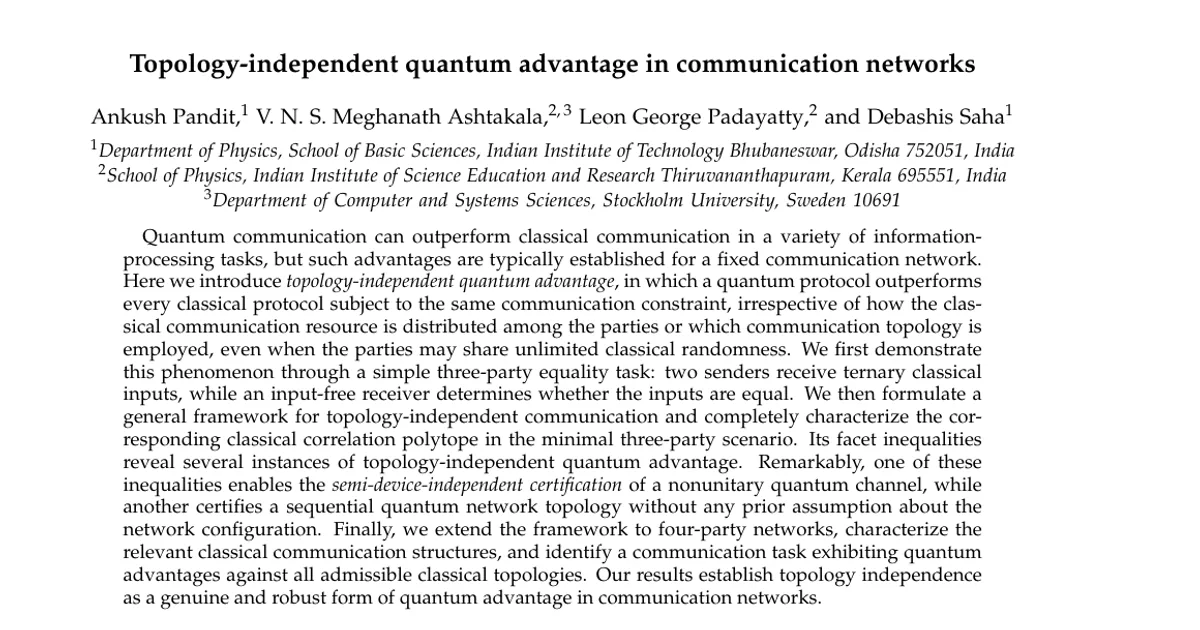
Quantum communication can outperform classical communication in a variety of information-processing tasks, but such advantages are typically established for a fixed communication network. Here we introduce topology-independent quantum advantage, in which a quantum protocol outperforms every classical protocol subject to the same communication constraint, irrespective of how the classical communication resource is distributed among the parties or which communication topology is employed, even when the parties may share unlimited classical randomness. We first demonstrate this phenomenon through a simple three-party equality task: two senders receive ternary classical inputs, while an input-free receiver determines whether the inputs are equal. We then formulate a general framework for topology-independent communication and completely characterize the corresponding classical correlation polytope in the minimal three-party scenario. Its facet inequalities reveal several instances of topology-independent quantum advantage. Remarkably, one of these inequalities enables the semi-device-independent certification of a nonunitary quantum channel, while another certifies a sequential quantum network topology without any prior assumption about the network configuration. Finally, we extend the framework to four-party networks, characterize the relevant classical communication structures, and identify a communication task exhibiting quantum advantages against all admissible classical topologies. Our results establish topology independence as a genuine and robust form of quantum advantage in communication networks.