Research
Topologically Protected Learning from Exceptional Point Braiding: Toward Braid Programming
Overview Research area: Non-Hermitian quantum physics and topological quantum machine learning — specifically, using exceptional points (EPs) in a non-Hermitian Bogoliubov–de Gennes (BdG) Hamiltonian
- arXiv
- 2608.15829
- Published
- 2026-08-16
- Authors
- M. N. Jipdi, C. Avomo Mba, A. B. Moubissi, L. C. Fai, M. E. Ateuafack
AI summary
Overview
Research area: Non-Hermitian quantum physics and topological quantum machine learning — specifically, using exceptional points (EPs) in a non-Hermitian Bogoliubov–de Gennes (BdG) Hamiltonian as a computational primitive.
Technical level: Advanced. The paper assumes familiarity with non-Hermitian Hamiltonians, Jordan–Wigner and Bogoliubov–de Gennes techniques, winding numbers and symmetry classes, non-Abelian holonomy, and braid-group reasoning. The conceptual message is accessible, but the derivations are not.
Scope (one sentence): The paper builds a complete framework in which the adiabatic braiding of exceptional points in a non-Hermitian spin chain supplies a universal set of discrete quantum gates, and learning is reformulated as a combinatorial search over braid words rather than gradient descent on continuous weights.
What This Paper Is About
Modern machine learning, classical and quantum, rests on gradient descent over continuous parameters — an approach the authors argue is intrinsically fragile, prone to catastrophic forgetting, vulnerable to adversarial perturbation, and (in quantum circuits) limited by barren plateaus. The paper asks whether computation and learning can instead be encoded in discrete, topological quantities: the non-Abelian holonomy picked up when an exceptional point is encircled in parameter space. Its goal is to construct, for one concrete non-Hermitian spin-chain Hamiltonian, the full chain from exact diagonalisation through EP conditions, topological invariants, braid gates, and finally a learning algorithm defined as search over the braid group.
Key Contributions
-
Exact diagonalisation strategy. The 1D spin-1/2 chain with XYZ-type exchange (isotropic $J_1$, anisotropic $J_2$) and a site-dependent complex field $g_j = a + i\gamma e^{i\pi j}$ is mapped via Jordan–Wigner transformation, Fourier transform, and Bogoliubov–de Gennes block diagonalisation onto a $4\times4$ matrix. Because the mapping is exact, diagonalising a matrix of size $O(N)$ replaces brute-force diagonalisation of a $2^N \times 2^N$ matrix.
-
Closed EP super-surface equation and exact EP counting. A closed algebraic equation for the EP condition is derived, and momentum quantisation in finite systems ($k = 2\pi n/N$) is used to predict the exact number and real-space parameter positions of all EPs independently of system size. A complete topological map is given: all EPs lie in $R_{\rm Topo} = {(\gamma, J_1, a) \mid \gamma^2 < J_1^2 \lor a = 0}$.
-
Two quantised EP invariants and a band-topology classification. EP topology is characterised by the state-swap fidelity $T_{\rm swap} = 0, \pm 1$ and the normalised Berry phase $\Gamma_{\rm Berry} = 0, \pm\pi/2$ (equivalently $T_{\rm Berry} = 0, \pm 1$), which cannot both be zero for a topological EP. Separately, the BdG Hamiltonian is assigned to symmetry class D with a $\mathbb{Z}_2$ invariant, yielding three winding-number regimes.
-
Braid programming as a learning paradigm. A universal set of braid gates is obtained from adiabatic encirclements (Pauli-$X$, Pauli-$Y$, Pauli-$Z$, a Hadamard-like gate, the $T$-gate, and SWAP, with $a=0$ supplying additional phase gates). Learning is then reformulated as a discrete search over the braid group, implemented as a proof-of-concept genetic search.
Main Findings
-
EPs exist on the real momentum axis only when $|\gamma_0| \le |J_1|$. The bound follows from requiring $0 \le \cos^2 k \le 1$ in $\cos^2 k = \gamma_0^2(J_2^2 + a^2)/(J_1^2 a^2 + \gamma_0^2 J_2^2)$. The equality $|\gamma_0| = |J_1|$, or $a = 0$, places the EP at $k = 0$ (or $k = \pi$); for $|\gamma_0| > |J_1|$ with $a \neq 0$, no real $k$ satisfies coalescence and EPs move into the complex $k$-plane.
-
EP proliferation coincides with the gap-closing condition. The EP region $\gamma^2 \le J_1^2$ or $a = 0$ is reported to coincide with the closed-gap limit, so EPs appear exactly where non-trivial band topology is possible. For $a = 0$, particle and hole energies are degenerate, giving a unified band with parameter-independent eigenvectors and no coalescence of particle and hole states — described as a Majorana-like degeneracy.
-
Three winding-number regimes. Evaluating the winding number via the residue theorem gives $\upsilon = \frac{1}{2}n - 1$, where $n$ is the number of zeros of $F(z) = -\alpha^2 z^4 + (a^2 + \gamma^2 - 2\alpha\beta)z^2 - \beta^2$ inside the unit circle, with $\alpha = (J_1+J_2)/2$ and $\beta = (J_1-J_2)/2$. Regime I: $\upsilon = +1$ for $a^2 + \gamma^2 < J_1^2 - J_2^2$. Regime II: $\upsilon = -1$ for $J_1^2 - J_2^2 < a^2 + \gamma^2 < J_1^2$. Regime III: $\upsilon = 0$ for $a^2 + \gamma^2 > J_1^2$. In the limit $J_1 = J_2$ the first regime disappears and the Kitaev-chain result is recovered: $0 < a^2 + \gamma^2 < J_1^2 \Rightarrow \upsilon = -1$.
-
The band-topological region is fully contained in the EP region. The phase diagram in the $(a,\gamma)$ plane shows the topological region bounded by $a^2 + \gamma^2 = J_1^2$, with $\gamma = \pm J_1$ marking where EPs occur at $k = 0, \pi$, and the circle $a^2 + \gamma^2 = J_1^2 - J_2^2$ separating the two opposite-winding topological regimes.
-
Eigenvector coalescence is necessary but not sufficient for braidable EP topology. The paper requires additionally that the discriminant $\Delta = (\lambda_+ - \lambda_-)^2$ winds around the origin under encirclement, so that the Riemann-surface branch structure forces quantised phase accumulation.
-
Quantised diagnostics of EP topology. The swap indicator $T_{\rm swap}$ is defined from overlaps $|\langle v_-(2\pi)|v_+(0)\rangle|^2$ and $|\langle v_+(2\pi)|v_-(0)\rangle|^2$ (ideal EP2 encirclement: $O_{nn} = 0$, $O_{nm} = 1$). The Berry invariant is $T_{\rm Berry} = \frac{2}{\pi}\Gamma_{\rm Berry}$, quantised as $T_{\rm Berry} = 0, \pm 1 \Leftrightarrow \Gamma_{\rm Berry} = 0, \pm\pi/2$. Fractional values indicate a path that does not fully enclose the branch point.
-
Holonomy matrix equals the braid gate. The path-ordered product of consecutive overlap matrices $M^{(i)}_{mn} = |\tilde{v}m(\theta_i)\rangle\langle v_n(\theta{i+1})|$ gives $U = \prod_i M^{(i)}$; its eigenvector arguments are the geometric phases, and its structure (permutation, phase gate, or coherent superposition) is fixed by the homotopy class of the path and the EP order.
-
Genetic search finds short braid words. A proof-of-concept genetic search discovers braid words reproducing the standard Hadamard gate and the $H\cdot Z$ gate with perfect fidelity (the paper states perfect fidelity; no numerical fidelity value is reported).
-
Claimed advantages of braid programming. Inherent noise immunity, prevention of catastrophic forgetting through compositional concatenation, and generalisation guaranteed by mathematical construction — all argued from the discreteness, robustness, non-commutativity, and geometric character of the EP holonomy.
Methodology in Plain English
The authors start with a model that is deliberately "neural-network-like": a one-dimensional chain of quantum spins whose interactions can frustrate and whose magnetic field is complex, with an imaginary part that alternates sign from site to site. A complex field means probability is not conserved — the system is non-Hermitian, the natural setting for exceptional points, where two eigenvalues and their eigenvectors merge into one.
Because such a chain naively requires handling a matrix of dimension $2^N \times 2^N$, they use three exact, standard transformations in sequence. First, a Jordan–Wigner transformation turns spins into spinless fermions. Second, because the alternating complex field creates two sublattices (even and odd sites), they split the chain and Fourier transform, which sends the problem to momentum space. Third, the resulting Hamiltonian is assembled into a $4\times4$ Bogoliubov–de Gennes matrix acting on a Nambu spinor — small enough to diagonalise by hand and exponentially cheaper than brute force, while giving exactly the same answer.
With the spectrum in hand, they solve algebraically for where the two bands touch and the eigenvectors align, obtaining a single closed equation. Imposing the finite-size quantisation of momentum tells them how many such points exist and where, for a chain of any length. They then compute a winding number for the complex energy bands to classify which parameter regions are topological, and draw a phase diagram.
The computational step is geometric: they define a closed loop in the $(\gamma, k)$ parameter plane that wraps one EP, transport the eigenvectors adiabatically around it, and record how the states permute and what phase they accumulate. Tracking overlaps step by step yields a holonomy matrix, which is the quantum gate. Finally, since the gate set is generated by different braid sequences, they replace "train the weights" with "search the braid group", and run a genetic algorithm to find short braid words for target gates.
Why This Matters
The paper's argument is that information stored in the homotopy class of a path — a discrete label — cannot be eroded continuously the way a floating-point weight can. If correct, this reframes robustness, forgetting, and generalisation not as engineering tricks to be patched onto gradient descent but as consequences of geometry. It also offers a concrete bridge between two fields that have mostly developed in parallel: exceptional-point physics (well established theoretically and experimentally in microwave cavities, coupled optical waveguides, and superconducting circuits) and neuromorphic/topological computing.
Potential real-world applications (as motivated by the paper and the experimental platforms it cites):
- Noise-immune classical or hybrid hardware in which computation is programmed by choosing sequences of parameter loops rather than by tuning millions of continuous weights.
- Photonic topological processors, building on demonstrated non-Abelian braiding of light in coupled optical waveguides.
- Superconducting-circuit quantum gates, building on measured non-Abelian Berry phases from EP encirclement in superconducting circuits.
- Continual-learning systems where new tasks are appended as braid words, so earlier knowledge is preserved by construction rather than by rehearsal or regularisation.
- Interpretable models, since a trained model is a short, readable braid word rather than an opaque weight tensor.
Industry relevance: the natural near-term fits are quantum-hardware vendors working with non-Hermitian and dissipative control, photonic computing companies, and edge-AI settings where resistance to perturbation and to forgetting matters more than raw parameter count. The paper's own framing — hybrid computing architectures, discussed in its Section 5 — points in this direction, though no hardware demonstration is presented here.
Future Directions
- Physical realisation. The framework is theoretical; mapping the braid gates onto an actual microwave-cavity, waveguide, or superconducting platform — and quantifying how adiabaticity requirements trade against gate speed — is the obvious next step.
- Scaling the braid search. The genetic search is described as a proof-of-concept finding short braid words for Hadamard and $H\cdot Z$. Whether combinatorial search over the braid group remains tractable for larger gate sets and deeper compositions is unresolved.
- Noise and non-adiabaticity. The claimed noise immunity follows from topology in the ideal adiabatic limit; the paper does not report a quantitative robustness study against parameter drift, finite encirclement speed, or path deformation.
- Completeness of the gate set and its consequences. The paper asserts a universal set (Pauli-$X$, $Y$, $Z$, Hadamard-like, $T$, SWAP, plus phase gates at $a=0$); establishing formal universality and working out how multi-gate algorithms compose as braid words remain open.
- The topological selectivity question. Section 5 is announced to discuss EP topological selectivity, Riemann surfaces, and hybrid architectures, but the supplied text is truncated within Section IV.2, so those results and the Section 6 conclusions cannot be assessed here — as is the case for any explicit numerical fidelity values or benchmark comparisons, which are not reported in the available content.
Target Audience
Graduate students and researchers in non-Hermitian quantum physics, topological quantum computation, and quantum machine learning who want a worked, end-to-end construction rather than a single result. It is also useful for machine-learning researchers curious about what a genuinely non-gradient learning paradigm would look like, and for experimentalists in photonics or superconducting circuits looking for a concrete Hamiltonian and gate proposal to implement. Readers without a background in BdG diagonalisation or holonomy will find the derivations demanding, though the motivating argument in the introduction is accessible to a wider audience.
Authors’ abstract
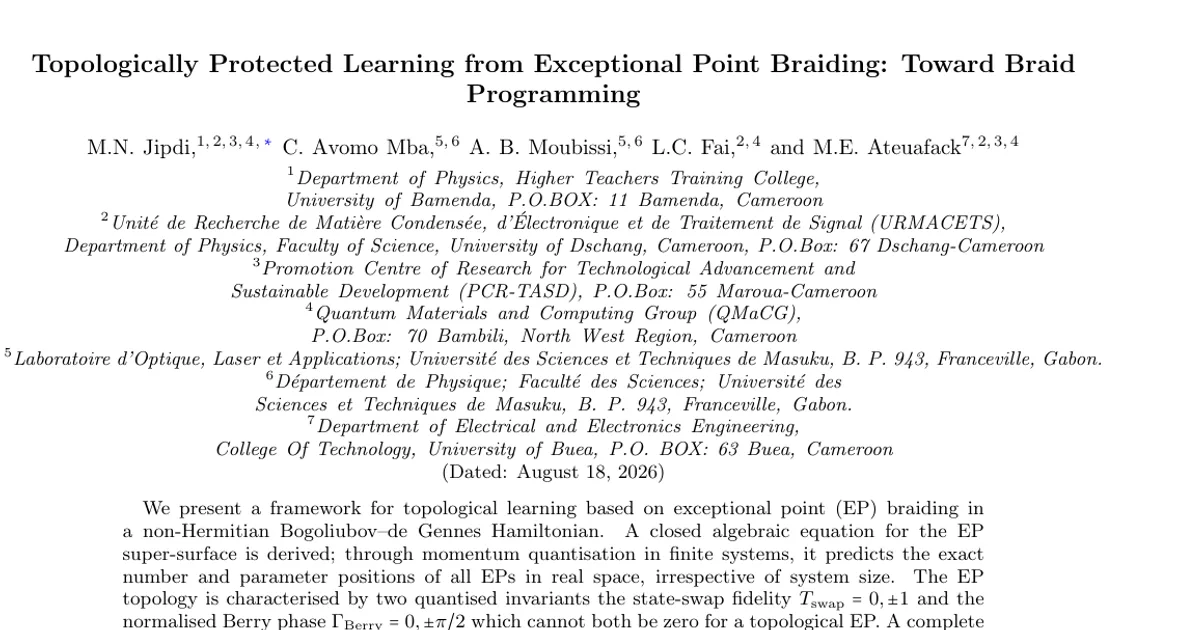
We present a framework for topological learning based on exceptional point (EP) braiding in a non-Hermitian Bogoliubov-de Gennes Hamiltonian. A closed algebraic equation for the EP super-surface is derived; through momentum quantisation in finite systems, it predicts the exact number and parameter positions of all EPs in real space, irrespective of system size. The EP topology is characterised by two quantised invariants the state-swap fidelity and the normalised Berry phase which cannot both be zero for a topological EP. A complete topological map shows that all EPs lie within a specefic region. Adiabatic encirclements confirm robust state swapping and yield a universal set of braid gates, including Pauli-X, Pauli-Y, Pauli-Z, a Hadamard-like gate, the T-gate, and a SWAP operation, with the special case where a is 0, providing additional phase gates. Building on these generators, we reformulate learning as braid programming a discrete search over the braid group that replaces gradient descent on continuous weights with combinatorial optimisation. A proof-of-concept genetic search successfully discovers short braid words that reproduce the standard Hadamard gate and the H.Z gate with perfect fidelity. This paradigm offers inherent noise immunity, catastrophic-forgetting prevention through compositional concatenation, and guaranteed generalisation by mathematical construction, establishing EP braiding as a promising substrate for robust, interpretable, and topologically protected neuromorphic computation.