Research
The Utility of Sparse Error Detection in Quantum Simulations
The Utility of Sparse Error Detection in Quantum Simulations Overview Research area: Quantum simulation of lattice gauge theories combined with quantum error detection — specifically, embedding the la
- arXiv
- 2608.02944
- Published
- 2026-08-03
- Authors
- Henry Froland, Dorota M. Grabowska, Sebastian Grieninger, Jeremy Hartse, Anne L. Lashbrook, Zhiyao Li, Ziyuan Li, Sarah J. M. Powell, Martin J. Savage, Xiaojun Yao, Nikita A. Zemlevskiy
AI summary
The Utility of Sparse Error Detection in Quantum SimulationsOverview
Research area: Quantum simulation of lattice gauge theories combined with quantum error detection — specifically, embedding the lattice Schwinger model into small distance-two error-detecting codes (Iceberg and Hypercube families) and quantifying whether sparse stabilizer checks plus physics-aware postselection improve observable estimation under near-term noise.
Technical level: Intermediate to Advanced. The paper assumes familiarity with stabilizer codes, Trotterized time evolution, and Hamiltonian lattice gauge theory, though its central question — "does a little error detection actually help?" — is accessible to a motivated reader.
Scope: A classical, noisy simulation study (using Qiskit's AerSimulator) of the Schwinger model on 2, 4, 6 and up to 13 spatial sites, comparing unencoded circuits against several Iceberg and Hypercube code embeddings at two-qubit depolarizing error rates of p₂ = 0.001 and 0.003.
What This Paper Is About
Near-term quantum computers have noisy qubits, and full fault-tolerant error correction costs far more qubits and gates than are currently available. The authors ask a narrower, practical question: if you only add sparse error detection — a few stabilizer check layers plus the physics constraint that total charge must be conserved — how much does the accuracy of simulated observables actually improve, and at what cost in discarded shots? They test this on the lattice Schwinger model in axial gauge, a standard benchmark for lattice gauge theory simulation.
Key Contributions
-
A systematic comparison of code-block partitions for the same lattice. For four spatial sites (
L = 4), the authors compare a single monolithic[[10,8,2]]block against the partitions[[8,6,2]]⊗[[4,2,2]],[[6,4,2]]^⊗2,[[6,4,2]]⊗[[4,2,2]]^⊗2, and[[4,2,2]]^⊗4, quantifying the trade-off between shot rejection and systematic error reduction. -
Quantification of how sparse error detection drives systematic error toward a code floor. Additional rounds of error detection are shown to systematically reduce errors in observables up to a saturation point, with longer time intervals requiring more layers before saturation.
-
A "failure time" scaling analysis for monolithic Iceberg codes. For codes of the form
[[2L+2, 2L, 2]], the time at which error detection fails decreases with system size, dropping to roughly one Trotter step forL = 13atp₂ = 0.003with10⁴shots, and the numerical results are fit and extrapolated to a[[102,100,2]]example. -
A direct comparison of Iceberg versus Hypercube code families. Because the authors use Trotterized time evolution, Iceberg codes are found to carry more benefit than Hypercube codes; the
N = 3Hypercube block[[8,3,2]]is explored in detail forL = 2, 4, 6and found to underperform in fixed-resource scenarios.
Main Findings
-
Large code blocks win when connectivity is unconstrained. Embedding the whole lattice into a single large code block is advantageous in the absence of connectivity constraints; for two sites, the
[[6,4,2]]encoding consistently outperforms[[4,2,2]]^⊗2for the studied observables, and its stabilizers areZ⁶andX⁶. -
Physics-aware postselection is nearly free and removes leading order errors. Postselecting on the charge sector removes all
O(p₂)charge-violating errors and correspondingO(p₂ⁿ)errors, and when measuring observables that commute with electric charge this postselection costs nothing. -
Postselection and stabilizer checks target different error orders. Postselection into the Gauss's-law-preserving charge sector eliminates
O(p₂)bit-flip errors in both encoded and unencoded simulations, while mid-circuit measurement or postselection on stabilizer results suppressesO(p₂²)errors. Embedding into a larger Hilbert space matters because severalO(p₂)errors can conspire to return the system to the codespace, creating an undetectable logical error. -
Saturation, not monotonic improvement, with more detection layers. At fixed resources (
10⁴shots), a small number of error-detection rounds substantially reduces systematic error over a long time interval, but beyond a small number, increasing detection density does not continue to reduce systematic error. The longer the time interval, the more layers are needed before saturation, implying an optimal density that must be found by pre-production tuning. -
Error detection extends the useful time window, but not indefinitely. Monolithic Iceberg encoding improves partially fault-tolerant simulations over some interval but becomes impractical beyond it, because the surviving ensemble shrinks roughly as
exp(-p₂ × #gates)and exponentially more shots are needed to extend the interval by an order-one time. -
The best code depends on the shot budget. For
L = 4at fixed error rates, the best-performing code evolves from[[10,8,2]]at small shot numbers to[[6,4,2]]^⊗2at large shot numbers, with the performance difference largest at small shot numbers. -
Larger systems reject parametrically more shots. For the same error rates, shot rejection in
L = 4is parametrically larger than inL = 2, and some observations required more than10⁶shots to clearly identify. -
Ancillas can be lower fidelity. Given the limited number of operations performed on error-detection ancilla qubits, they can have lower fidelity without noticeably impacting the quality of computed observables.
-
Hypercube acceptance is lower. Acceptance probabilities for
L = 2, 4, 6in[[8,3,2]]Hypercube blocks are significantly lower than for comparable Iceberg embeddings.
Methodology in Plain English
The authors take a small, well-understood model of quantum electrodynamics on a 1D lattice — the Schwinger model — and map it onto qubits in the axial gauge, where each spatial site costs two qubits under Jordan-Wigner mapping. A single site therefore fits exactly into the [[4,2,2]] code, which stores two logical qubits in four physical qubits and can detect (but not correct) any single-qubit error. Larger lattices are packed into single larger Iceberg blocks ([[6,4,2]], [[10,8,2]], or [[2L+2,2L,2]]) or split across several smaller blocks.
They then simulate the quench dynamics starting from the strong-coupling Néel vacuum, classically, using Qiskit's AerSimulator with a NoiseModel() applying isotropic depolarizing noise: two-qubit gate error p₂ = 0.001 or 0.003, with single-qubit error set to one-tenth of p₂, and rz gates assigned zero error since they are typically implemented in software. The transpiled basis is ['h','x','rz','sx','cx']. Measurement errors are not included, and no post-processing error mitigation (Decoherence Renormalization, Operator Decoherence Renormalization, or Zero-Noise Extrapolation) is applied, so that the effect of error detection is isolated.
Between Trotter steps they insert sparse layers of stabilizer checks (S_z = ZZZZ and S_x = XXXX for the [[4,2,2]] block) using a small number of ancillas, producing four classical flags per block per round. Any shot that flags an error anywhere in the system is discarded globally — no use is made of the spacetime location of errors relative to a local observable, so the reported ensemble sizes are lower-bound estimates. At the end, shots are additionally postselected into the charge sector allowed by Gauss's law. They then compare measured observables — the energy in the electric field, the chiral condensate Σ, and the number of e⁺e⁻ pairs — against exact unitary evolution, noiseless Trotterized evolution, noisy evolution without postselection, and noisy evolution with postselection.
For L = 2 they use m = 0.1, g = 0.3, evolve from t = 0 to T = 30 with Trotter step ΔT = 0.5, and fix the shot budget at 10⁴. For L = 4 they simulate out to T = 45 using up to 90 Trotter steps at p₂ = 0.001; larger lattices use more than 10⁵ shots.
Why This Matters
Full fault tolerance is not available yet, but partial protection might be. This paper provides quantitative guidance on whether lightweight error detection is worth its overhead today, and gives a methodology — sparse checks plus charge-sector postselection plus shot-budget-aware code selection — that can be reused for other lattice theories. It also serves as a reality check on the cost side: the ensemble shrinks exponentially, so there is a hard limit on how far in time a fixed-resource run can go.
Real-world applications:
- Nuclear and particle physics simulations: providing a practical route to real-time dynamics of strongly interacting matter, relevant to high-multiplicity collisions, matter–antimatter asymmetry, and new phases of matter, which are named in the paper as target simulations.
- Near-term hardware planning: the saturation behavior and shot-acceptance scaling let experimental teams decide how many detection layers to insert and how many shots to allocate before a production run.
- Hardware requirements for ancillas: the finding that detection ancillas can be lower fidelity informs device design and calibration priorities.
- Benchmarking code families: the Iceberg-versus-Hypercube comparison, and the code-partition comparison at
L = 4, gives code designers application-relevant performance data rather than abstract threshold numbers.
Industry relevance spans quantum hardware vendors developing error-detecting code families (Iceberg/C₄ codes, Hypercube codes, LDPC and surface codes), cloud quantum computing providers whose users run fixed-shot workloads, and national-laboratory and university groups building quantum simulation stacks for fundamental physics.
Future Directions
- Interplay with error mitigation. The authors explicitly did not apply Decoherence Renormalization, Operator Decoherence Renormalization, or Zero-Noise Extrapolation, and flag quantifying the interplay between error detection and these mitigation techniques — plus extrapolation in the number of detection layers — as a study for the near future.
- Pre-production tuning of detection density. Since there is an optimal density of error-detection layers for a given evolution operator and error rate, a practical protocol for identifying that density in situ, alongside other run parameters, remains to be developed.
- Beyond global shot rejection. The current analysis rejects a shot if an error is detected anywhere; exploiting spacetime localization (backward light-cones for local operators) and noise that commutes with observables could raise the surviving ensemble above the lower bounds reported here.
- Extending to larger and more complex theories. The results are demonstrated on the Schwinger model in axial gauge; carrying the approach to higher-dimensional gauge theories, larger spatial volumes, and full fault-tolerant constructions (magic-state injection or code switching, which the paper notes would be needed for genuinely fault-tolerant logical rotations) is the natural next step.
Target Audience
Quantum information researchers working on error-detecting codes and near-term algorithms; lattice gauge theory and nuclear/particle physicists planning quantum simulations; quantum hardware and compiler teams who need application-level justification for code and ancilla design choices; and graduate students or advanced readers seeking a concrete, quantitative case study of how partial fault tolerance behaves in a realistic fixed-shot, fixed-qubit workflow. Readers without background in stabilizer formalism or Trotterization will find the middle sections dense.
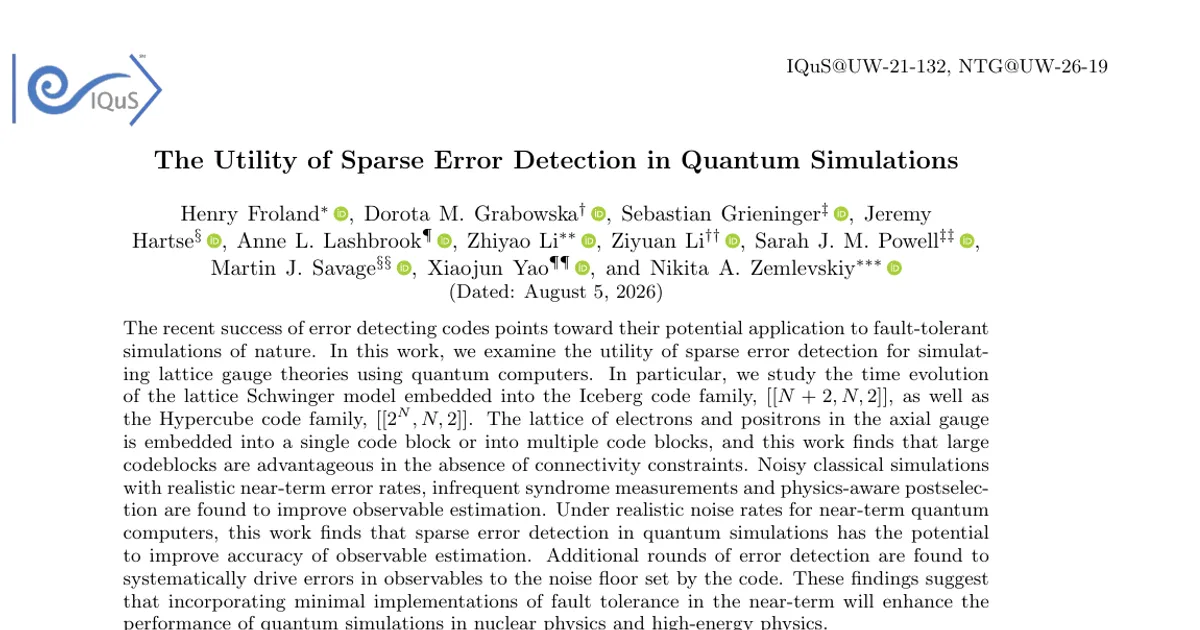
Authors’ abstract
The recent success of error detecting codes points toward their potential application to fault-tolerant simulations of nature. In this work, we examine the utility of sparse error detection for simulating lattice gauge theories using quantum computers. In particular, we study the time evolution of the lattice Schwinger model embedded into the Iceberg code family, $[[N+2, N, 2]]$, as well as the Hypercube code family, $[[2^N, N, 2]]$. The lattice of electrons and positrons in the axial gauge is embedded into a single code block or into multiple code blocks, and this work finds that large codeblocks are advantageous in the absence of connectivity constraints. Noisy classical simulations with realistic near-term error rates, infrequent syndrome measurements and physics-aware postselection are found to improve observable estimation. Under realistic noise rates for near-term quantum computers, this work finds that sparse error detection in quantum simulations has the potential to improve accuracy of observable estimation. Additional rounds of error detection are found to systematically drive errors in observables to the noise floor set by the code. These findings suggest that incorporating minimal implementations of fault tolerance in the near-term will enhance the performance of quantum simulations in nuclear physics and high-energy physics.