Research
The I3322 quantum value is attained spatially but not in finite dimension
Overview Research area: Quantum information theory and operator algebras, specifically the structure of quantum correlation sets for Bell scenarios (the $I_{3322}$ Bell functional, the sets $C_q$ and
- arXiv
- 2609.05555
- Published
- 2026-09-03
- Authors
- Seth Douglas
AI summary
Overview
Research area: Quantum information theory and operator algebras, specifically the structure of quantum correlation sets for Bell scenarios (the $I_{3322}$ Bell functional, the sets $C_q$ and $C_{qs}$, and dimension requirements for quantum strategies).
Technical level: Advanced. The paper combines Bell-inequality analysis, Jacobi (tridiagonal) spectral theory, Bellman-type variational arguments, and measure-theoretic disintegration in operator algebras, with Lean 4 and exact-arithmetic verification of selected facts.
Scope (one sentence): The paper proves that the $I_{3322}$ quantum supremum $S$ is not attained by any finite-dimensional quantum strategy, is attained by a spatial strategy on $\ell^{2}(\mathbb{Z}) \otimes \ell^{2}(\mathbb{Z})$, and that the local dimension needed to approach $S$ within $\varepsilon$ grows as $\Theta(\log(1/\varepsilon))$.
What This Paper Is About
The $I_{3322}$ inequality is a three-measurements-per-party, two-outcome Bell functional that is a facet of the local polytope inequivalent to CHSH. In 2010 Pál and Vértesi computed its quantum value numerically and conjectured, in their own words, that "no finite dimension suffices to achieve the true quantum maximum," challenging the community to supply an analytical proof. This paper supplies that proof, together with a proof that the value is attained when infinite-dimensional (spatial) strategies are allowed, and it quantifies how quickly local dimension must grow to approximate the value.
Key Contributions
-
Nonattainment in finite dimension (Theorem 1). For the common tensor-product and commuting supremum $S$, certified to lie in $(0.2508753845015185, 0.250875388108398]$, no finite-dimensional strategy attains $S$. The statement covers all finite-dimensional Hilbert spaces $\mathcal{H}_A, \mathcal{H}_B$, every state $\rho$ on $\mathcal{H}_A \otimes \mathcal{H}_B$, and every triple of binary measurements per party, projective or POVM, acting as $F \otimes I$ and $I \otimes G$.
-
Spatial attainment (Theorem 2). There are projections $a_1,a_2,a_3$ and $b_1,b_2,b_3$ in $\mathcal{L}(\ell^{2}(\mathbb{Z}))$ and a unit vector $\psi_S \in \ell^{2}(\mathbb{Z}) \otimes \ell^{2}(\mathbb{Z})$ such that $\langle \psi_S, \mathcal{B},\psi_S\rangle = S$, so the resulting behavior lies in $C_{qs}(3,3;2,2)$.
-
Non-closure of the finite-dimensional correlation set (Corollary 3). $C_q(3,3;2,2)$ is not closed, and $C_{qs}(3,3;2,2) \setminus C_q(3,3;2,2)$ is nonempty. Among two-outcome bipartite scenarios, $(3,3;2,2)$ is the smallest by input count in which non-closure is known.
-
Dimension complexity (Theorem 6). With $D(\varepsilon) = \min{d : S - S_d \le \varepsilon}$, the paper proves $D(\varepsilon) = \Theta(\log(1/\varepsilon))$. The constructive upper bound is $D(\varepsilon) \le 23.9010650 \log(1/\varepsilon)$ for all sufficiently small $\varepsilon$, with natural logarithms; the lower constants are existential.
Main Findings
- The certified value window: $S = \omega_{\mathrm{tensor}}(I_{3322}) = \omega_{\mathrm{commuting}}(I_{3322})$ is certified to lie in $(0.2508753845015185, 0.250875388108398]$. The paper explicitly does not identify $S$ with a historical numerical decimal and does not prove the limiting value of a prescribed numerical parameter sequence; the window is a certified input, not a contribution.
- Strict gap above the qubit ceiling: The lower certificate (LB) is an exact $255$-dimensional strategy certifying $S > 0.2508753845015185 > 1/4$, with rational square-root floors independently reconstructed in $160$-digit interval arithmetic. The two-qubit maximum is exactly $1/4$, and the local (classical deterministic) bound is $0$.
- Endpoint exclusion with exact margins: Using interior detour radius $r = 1/10$ in two-edge histories, the endpoint predecessor lines exceed the storage by at least $m_+ = \frac{23686917837403}{3008753881083980} > 0.00787$ and $m_- = \frac{274562305945801}{4008753881083980} > 0.0684$; only positivity is used. Consequently any state of value at least $q - \varepsilon$ carries endpoint mass at most $\varepsilon/m$ with $m = \tfrac{1}{2}\min(m_+, m_-)$, so an exact maximizer carries none.
- The mechanism of nonattainment: A hypothetical finite-dimensional maximizer must occupy a zero set that is the graph of a single strictly increasing injection $P$. Two order-reversing maps act on the occupied labels, $\sigma(u) = -u$ and $a = P^{-1}\circ(-P)$. A finite totally ordered set admits exactly one order-reversing bijection, so $a = \sigma$, forcing every occupied label to be paired with its own reflection. Eliminating amplitude ratios on such a reflected pair caps the value at $1/4$, contradicting $S > 1/4$.
- The mechanism of spatial attainment: In the commuting model a maximizer exists by weak-$*$ compactness. The composition $\tau = a \circ \sigma$ is increasing and fixed-point-free off a null set, so its orbits are order-isomorphic to $\mathbb{Z}$. Disintegrating the maximizer's scalar spectral measure over the orbits of the group generated by $a$ and $\sigma$, and fixing one orbit, yields weights whose square roots are the amplitudes of an $\ell^{2}(\mathbb{Z})$ eigenvector of the Jacobi matrix at eigenvalue $S$. Normalizability is inherited, not imposed: $1 \le \sum_j \tilde{\lambda}_j^{2} \le 2$ because the weights come from a probability measure.
- Explicit spatial strategy: The bipartite vector is $\psi_S = \sum_j \lambda_j, e_j \otimes e_j$ in the standard basis of $\ell^{2}(\mathbb{Z}) \otimes \ell^{2}(\mathbb{Z})$, with each party's measurements an orthogonal direct sum of rank-one projections over one of the two perfect matchings of $\mathbb{Z}$.
- Logarithmic dimension cost: The upper half truncates the attaining carrier to a window of length $O(\log(1/\varepsilon))$, with $\kappa_{\mathrm{eff}} = (1/\kappa_- + 1/\kappa_+)^{-1}$. The lower half uses an approximate balance of spectral marginals on at most $4d$ labels, a Lipschitz monotone predictor separating cyclic components, and a signed potential forcing $\varepsilon \ge c,e^{-Cd}$.
- Scenario minimality context: If either party has only two binary measurements, $C_q(2,n;2,2)$ is closed for every $n$, and the case $(2,2;2,2)$ recovers the stronger statement that every functional there attains its maximum on two qubits. Previously the smallest two-outcome non-closure witness was Beigi's $(4,4;2,2)$; the first two-outcome non-closure witness was the $(5,5;2,2)$ synchronous construction of Dykema–Paulsen–Prakash, with a simplified proof by Musat–Rørdam. Outside the two-outcome class the known witnesses are larger, including Beigi's $(4,4;3,3)$, the $(4,5;3,3)$ correlation of Coladangelo and Stark, and a linear-system game with input sets of sizes $184$ and $235$ and output sets of sizes $8$ and $2$.
- A recorded correction history: An earlier release (3 August 2026, v1.0.0–v1.2.0) claimed the principal results via a bi-infinite chain construction whose load-bearing amplitude datum was refuted by the authors' own post-release exact audit (an exactly certified nonzero mismatch, reproduced by two independent interval engines); the claims were publicly decertified the following day (4 August, v2.0.0). The present results were rebuilt on independent routes; the present revision also replaces the earlier lower-bound argument with a finite weighted-flow proof that controls all retained cell weights and accommodates spectral multiplicity without identifying state vectors in different cells. The headline rate is unchanged.
- Concurrent independent work: Pauwels proved finite-dimensional nonattainment and non-closure by a different route (spectral-weight matrices and a Jacobi-recurrence argument), and Coladangelo independently established both finite-dimensional nonattainment and spatial attainment. The paper describes the three works as concurrent and credits prior numerical certification, including Mghirbi's proof-carrying exact certificates with enclosure width below $10^{-9}$ published in July 2026.
- Verification status: Lean 4 checks the exact endpoint margins of step (N2), the finite-closure lemma of (N5) — the single point where finite dimensionality enters Theorem 1 — and the amplitude-elimination chain and quarter ceiling. Exact-arithmetic scripts guard algebraic identities of (N1) and (N4) and name explicitly the analytic steps they do not cover. None of Section 4 is formalized; the complete analytic proof is not formalized.
Methodology in Plain English
The paper replaces each party's first two binary measurements by the pair combinations $X = A_1 + A_2 - I$, $Y = A_2 - A_1$ and $U = B_1 + B_2 - I$, $V = B_2 - B_1$, which for binary projections satisfy $X^2 + Y^2 = I$ and $XY + YX = 0$ (and likewise for $U, V$). In these coordinates the Bell operator has the third measurements entering only through two off-diagonal blocks.
Each spectral label $t \in [-1,1]$ names a real symmetric tridiagonal (Jacobi) matrix $J_{\mathbf{c}}$ with diagonal $\delta(x,u) = xu + (x-u)/2 - 1$ and off-diagonal $b(t) = \sqrt{1-t^{2}}/2$. The Pál–Vértesi block-to-Jacobi identity turns Rayleigh quotients of these matrices into Bell values of finite strategies, giving $S = \sup_{\mathbf{c}} \lambda_{\max}(J_{\mathbf{c}})$.
Dualizing that supremum via an LDL/Schur-pivot computation converts the word supremum into a one-site problem: a positive continuous "storage" function $g$ is Bellman-feasible at level $q$ when $\frac{b(x)^2}{g(x)} + g(u) \le q - \delta(x,u)$ for all labels $x,u$, and the infimum of admissible levels equals $S$. Taking $q \downarrow S$ produces a critical storage $g$ (continuous, nonnegative, concave, positive on the open interval) together with a zero set $Z$ — the label pairs a strategy of value exactly $S$ may occupy.
For nonattainment, the argument shows $Z$ is the graph of a strictly increasing injection, so two order-reversing maps act on the occupied labels. Finite dimensionality enters only at the final closure step: a finite totally ordered set has exactly one order-reversing bijection, which forces reflection pairing and caps the value at $1/4$.
For spatial attainment, the same zero-set geometry applies without finite dimension. The response transports are realized by exact operator blocks $W = Y(B_3 - \tfrac{1}{2}I)$ and $W_B = (A_3 - \tfrac{1}{2}I)V$ satisfying $W^2 = b(X)^2$ and $WX = -XW$, yielding Radon–Nikodym transport laws for the maximizer's scalar spectral measure. Disintegrating that measure over the orbits of the generated group (infinite dihedral, with a constructed Borel transversal) gives, on a single orbit, square-summable amplitudes that satisfy $J\lambda = S\lambda$ exactly. The Pál–Vértesi block identity then installs the eigenvector as a spatial strategy; every Bell term is a sum over disjoint two-site blocks and no operator topology is invoked.
For the dimension rate, truncating the carrier to a window costs only a two-bond boundary flux at geometric rates $\kappa_-$ and $\kappa_+$, giving the constructive upper bound; the lower bound uses the actual response operators, an approximate balance of spectral marginals on at most $4d$ labels, a Lipschitz monotone predictor, and a signed potential controlling every branch at once.
Why This Matters
The paper settles a conjecture posed explicitly by Pál and Vértesi in 2010 and a question raised by Dykema, Paulsen, and Prakash, and it identifies $(3,3;2,2)$ as the smallest two-outcome bipartite scenario by input count with known non-closure. It also upgrades a qualitative separation into a quantitative law: approaching the unattainable value costs local dimension logarithmic in the inverse error, with an explicit constructive constant.
Real-world applications: the paper itself does not report applications, and the following are areas of potential relevance rather than results stated in the paper.
- Device-independent quantum cryptography, where protocols rely on the structure of the quantum correlation set and on whether optimal correlations are physically realizable at finite dimension.
- Self-testing and hardware certification, where knowing how much local dimension is needed to reach a target value within $\varepsilon$ informs what can be certified on finite devices.
- Benchmarking near-term quantum hardware, since the dimension-complexity rate gives a quantitative expectation for how measured Bell violations approach the ideal value.
- Theory of quantum correlation sets, relevant to complexity-theoretic characterizations of quantum games and to distinguishing operator-algebraic models of bipartite correlations.
Industry relevance: The results matter most to groups building certification and benchmarking standards for quantum devices, and to those tracking the mathematical limits of device-independent protocols. The paper's explicit correction history and its partial Lean 4 formalization also make it a case study in how computer-assisted mathematical claims can be audited and, when necessary, decertified.
Future Directions
- Formalizing the analytic proof. Lean 4 checks specified numerical, scalar, and finite accounting facts, but the complete analytic proof is not formalized; none of Section 4's measure-theoretic and operator-algebraic chains are in Lean 4.
- Sharpening the constants. The upper constant $23.9010650$ is explicit and constructive, but the lower constants are existential; tighter two-sided constants for $D(\varepsilon)$ are not reported.
- Extending beyond the present scenario. The paper does not claim minimality over scenarios with larger output alphabets, leaving open where the first non-closure witness lies for other output-set sizes and whether analogous nonattainment arguments apply to other Bell functionals beyond the CHSH family.
- Reconciling the concurrent routes. The relationship between this paper's scalar-measure disintegration, Pauwels' spectral-weight-matrix and Jacobi-recurrence argument, and Coladangelo's independent attainment proof is described as concurrent and independent; consolidating them into a single framework, and connecting to Mghirbi's critical Bellman–Jacobi dynamics for broader reversible classes, are natural next steps.
Target Audience
This paper is for advanced researchers in quantum information theory, mathematical physics, and operator algebras who work on Bell inequalities, correlation sets, and dimension requirements for quantum strategies. It will also interest mathematicians studying Jacobi matrices and spectral theory, and verification researchers interested in partially formalized, computer-assisted proofs and
Authors’ abstract
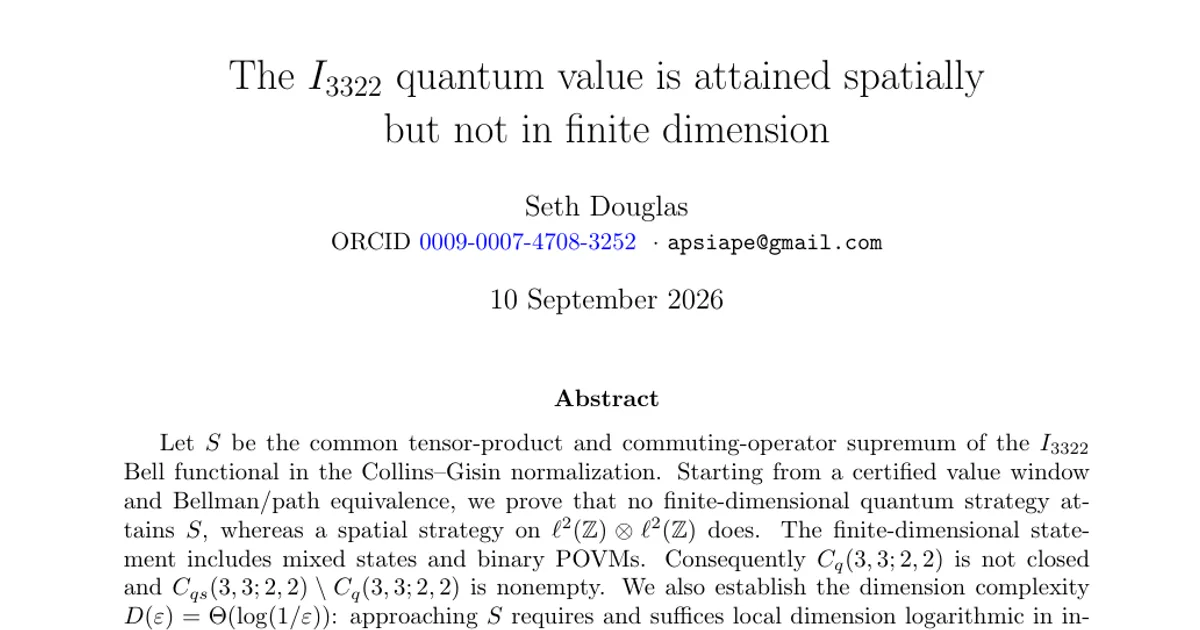
Let $S$ be the common tensor-product and commuting-operator supremum of the $I_{3322}$ Bell functional in the Collins-Gisin normalization. Starting from a certified value window and Bellman/path equivalence, we prove that no finite-dimensional quantum strategy attains $S$, whereas a spatial strategy on $\ell^2(\mathbb{Z})\otimes\ell^2(\mathbb{Z})$ does. The finite-dimensional statement includes mixed states and binary POVMs. Consequently $C_q(3,3;2,2)$ is not closed and $C_{qs}(3,3;2,2)\setminus C_q(3,3;2,2)$ is nonempty. We also establish the dimension complexity $D(ε)=Θ(\log(1/ε))$: approaching $S$ requires and suffices local dimension logarithmic in inverse error. The constructive upper bound is $D(ε)\le 23.9010650\log(1/ε)$ for all sufficiently small $ε$, with natural logarithms; the lower constants are existential. The proofs use critical Bellman storage, spectral transport and normalizable orbit measures. A finite weighted-flow argument supplies the unrestricted quantitative lower bound without identifying distinct joint spectral components. This revision replaces an unsupported step in the earlier lower argument and records additional proof corrections. Prior numerical certification and independent concurrent attainment results are credited. Exact arithmetic and Lean 4 check specified numerical, scalar and finite accounting facts; the complete analytic proof is not formalized.