Research
Stochastic Liouville-transport theory of light-atom interaction noise in thermal atomic vapors
Overview Research area: Quantum metrology and atomic physics — specifically the theory of light–atom interaction noise in thermal (room-temperature, unlaser-cooled) atomic vapors used as quantum senso
- arXiv
- 2608.15130
- Published
- 2026-08-15
- Authors
- Shaoxin Yuan, Bin Wu, Mingyong Jing, Chaoyang Hu, Yan Peng, Tingting Li, Xingya Li, Wenguang Yang, Junyao Xie, Zongkai Liu, Hao Zhang, Linjie Zhang, Liantuan Xiao, Suotang Jia
AI summary
Overview
- Research area: Quantum metrology and atomic physics — specifically the theory of light–atom interaction noise in thermal (room-temperature, unlaser-cooled) atomic vapors used as quantum sensors.
- Technical level: Advanced. The paper builds an operator-valued phase-space transport formalism coupled to multilevel open-system (Lindblad) dynamics, and the reader needs familiarity with density operators, hyperfine–Zeeman structure, Wigner 3j symbols, and noise power spectral densities.
- Scope (one sentence): The paper develops a general stochastic Liouville–transport theory that treats multilevel internal dynamics, Doppler-resolved ballistic motion, finite-mode transit, quantum jumps, and stochastic atomic renewal jointly, and tests it against polarization-resolved resonant noise spectra of the Cs D₂ line.
What This Paper Is About
Thermal atomic vapors are the sensing medium in compact clocks, magnetometers, and Rydberg electrometers, but noise from the way light interacts with moving atoms can limit how sensitive those devices become. Existing theories each capture only part of the problem — either the internal atomic states, or the finite-beam atomic motion, or the random replacement of atoms at the edges of the interaction region — so their coupled contributions to a measured noise spectrum are not clearly separated. This paper builds one unified microscopic framework that keeps all of these processes together and uses it to explain measured polarization-resolved noise in a cesium vapor cell.
Key Contributions
-
A general stochastic Liouville–transport formalism. The authors introduce an operator-valued atomic phase-space density ϱ̂(r⊥, v, t) that resolves the internal quantum state as a function of transverse position and velocity, governed by a single transport equation (Eq. 1) with three parts: ballistic drift, a multilevel internal Liouvillian, and operator-valued injection/removal source terms Σ̂_in and Σ̂_out. The formulation is stated to be independent of atomic species and optical readout configuration.
-
Explicit treatment of open boundary renewal with proper kinetic statistics. Instead of an ad hoc reservoir, atoms enter a circular renewal region of radius R_eff through a boundary whose injection statistics follow a flux-weighted Maxwell–Boltzmann distribution, with a derived distribution for the inward normal speed, and leave when they cross outward. Injected atoms carry an independently sampled internal density operator ρ̂_in, which is what turns renewal into a genuine noise source rather than just a loss channel.
-
A trajectory-level numerical scheme linking microscopic dynamics to measurable spectra. Each trajectory combines sampled injection position, velocity, and initial pure state with a Monte Carlo wave-function unraveling of the Lindblad master equation along the ballistic path; the mode-weighted responses of all atoms in the region are summed into a readout trace, and the one-sided PSD is defined from the finite-time Fourier transform of the trace fluctuation (Eq. 17).
-
A full 48-state Cs D₂ implementation benchmarked against experiment. The model is specialized to the complete Cs D₂ hyperfine–Zeeman manifold — 7 F=3 plus 9 F=4 ground Zeeman states and 32 excited states, giving a 48-dimensional internal space — with dipole couplings from Wigner 3j symbols, hyperfine and Zeeman constants, a positively polarized probe producing only q = ±1 coupling, and spontaneous emission represented by a set of Lindblad jump operators derived from a Lorentzian frequency-overlap matrix (Eq. 20).
Main Findings
- Transit-dominated noise below roughly 100 kHz: Joint experiment–theory analysis identifies atom–light interaction noise below approximately 100 kHz as transit-dominated.
- Common-mode origin of ballistic noise: Ballistic motion through the finite Gaussian mode modulates both the coupling-weighted effective atom number and the trajectory-dependent Rabi coupling, and this produces predominantly common-mode noise — i.e., noise shared by the two circular polarization channels.
- Differential noise from boundary renewal: Boundary renewal introduces atoms whose ground-state sublevels are independently sampled, generating differential population fluctuations that act with opposite sign on the σ⁺ and σ⁻ channels — a distinctly different noise character from the transit contribution.
- Quantitative spectral agreement with a single free parameter: With one common scale factor, the calculated polarization-resolved PSDs reproduce the measured low-frequency spectral dependence and the separation between the single-arm and balanced-difference spectra.
- Qualitative field-dependence agreement: Under an applied longitudinal magnetic field, experiment and theory show the same qualitative nonmonotonic change in common-mode suppression, supporting a picture of Zeeman redistribution of the channel responses.
- Note on the supplied text: The content provided here ends within Section III.3, so the Results section, figure-by-figure comparisons, tabulated noise-floor values, and the specific magnetic-field values scanned are not available to verify. Figures 1 and 2 are captioned but their quantitative content is not reported in the supplied text.
Methodology in Plain English
The authors essentially track a large ensemble of individual atoms as they fly through a laser beam, while simultaneously tracking the quantum state of each atom's internal electrons and nucleus.
- Motion: Atoms travel in straight lines (ballistic, no collisions, no recoil) through a two-dimensional Gaussian beam profile, so the light intensity each atom sees changes along its path. This turns the beam's spatial shape into a time-varying coupling strength.
- Internal quantum state: Each atom's 48-level Cs D₂ structure — ground hyperfine levels F=3 and F=4, excited levels F′=2 through 5, all split by an applied magnetic field — evolves under a master equation with laser drive, Doppler shift (detuning depends on velocity), spontaneous emission, and dephasing.
- Boundary bookkeeping: The vapor outside a circular region of radius R_eff continuously feeds atoms in. The incoming atoms' velocities are drawn from a flux-weighted Maxwell–Boltzmann distribution (faster atoms cross the boundary more often, so they are over-represented), and each incoming atom starts in a freshly sampled internal state — this "renewal" is the physical origin of the differential noise.
- Numerical simulation: Each atom's trajectory is simulated with a Monte Carlo wave-function method: smooth non-Hermitian evolution punctuated by random quantum jumps. The experimenters' actual observable — the transmitted power in each circular polarization — is reconstructed by summing the responses of all atoms currently in the beam, normalized to the 10 µW detector power, and either taken single-arm or subtracted to form the balanced signal S₃ = S₊ − S₋.
- Experiment: A vertically polarized, cavity-stabilized 852.347 nm probe at about 580 µW with a 0.75 mm 1/e² radius is tuned to the Cs F=4 → F′=5 resonance and passed through an 8 cm vapor path inside a cell with 0.2 cm windows. A quarter-wave plate and Wollaston prism separate σ⁺ and σ⁻ with roughly 10⁶:1 extinction. Spectra are recorded at 200 Hz resolution bandwidth, near zero field (residual below 2 nT) and at several longitudinal fields in Faraday geometry, alongside far-detuned references and a separately measured photodetector noise floor, all low-frequency corrected according to Appendix A.
Why This Matters
The work supplies a single, physically complete accounting of where noise in a thermal-vapor measurement comes from, which matters because these devices are pushed toward ever better sensitivity and the noise budget is often the limiting factor. Being able to attribute noise to a specific microscopic mechanism — finite-mode transit versus atomic replacement versus Zeeman-driven channel mixing — tells experimentalists which knob to turn (beam size, cell geometry, bias field, detection scheme) rather than guessing.
Real-world applications:
- Vapor-cell atomic clocks — reducing interrogation noise improves frequency stability in compact, laser-cooling-free timekeeping.
- Optically pumped magnetometers — the introduction cites subfemtotesla operation; lower atom–light noise translates into better field sensitivity for biomagnetic and geophysical sensing.
- Rydberg-atom electric-field sensors — the framework is designed to be extended to optical–Rydberg manifolds with microwave coupling, enabling microscopic noise-source attribution in Rydberg electrometers used for SI-traceable, vector, and multichannel wideband radio-frequency field measurement.
- Balanced detection design — the explicit prediction that transit noise is largely common-mode while renewal noise is differential gives a concrete rationale for choosing single-arm versus balanced readout in a given regime.
Industry relevance: thermal-vapor sensors are attractive commercially precisely because they need no cryogenics and no laser cooling, permitting compact, continuous, field-deployable instruments. A validated noise model supports engineering trade-offs in clock, magnetometer, and RF-receiver products, and gives manufacturers a simulation tool for geometry and optics design before building hardware.
Future Directions
- Extending to Rydberg manifolds. Adding Rydberg states and microwave coupling would let the same formalism attribute noise in Rydberg-atom electric-field measurements, which the authors explicitly propose.
- Turning qualitative agreement into quantitative agreement under bias fields. The longitudinal-field comparison is described as qualitative only; a quantitative match across field values would test the proposed Zeeman redistribution of channel responses more stringently.
- Applying the species-independent framework to other vapors and observables. Because the Liouville–transport formulation is stated to be independent of species and readout configuration, it invites application to other alkali vapors, other level schemes, and other measured quantities such as spin observables or absorption.
- Using the noise decomposition as a design tool. With transit and renewal contributions separable in the model, the natural next step is systematic optimization of beam size, mode shape, cell geometry, and detection balance against a specified noise target.
Target Audience
Experimental and theoretical researchers in atomic physics, quantum metrology, and precision measurement — particularly groups building vapor-cell clocks, optically pumped magnetometers, and Rydberg-based field sensors — as well as graduate students and postdocs who need a rigorous, unified model of noise in thermal-vapor measurements. The paper assumes comfort with open quantum systems and atomic structure, so it is best suited to readers with an advanced background in AMO physics rather than beginners.
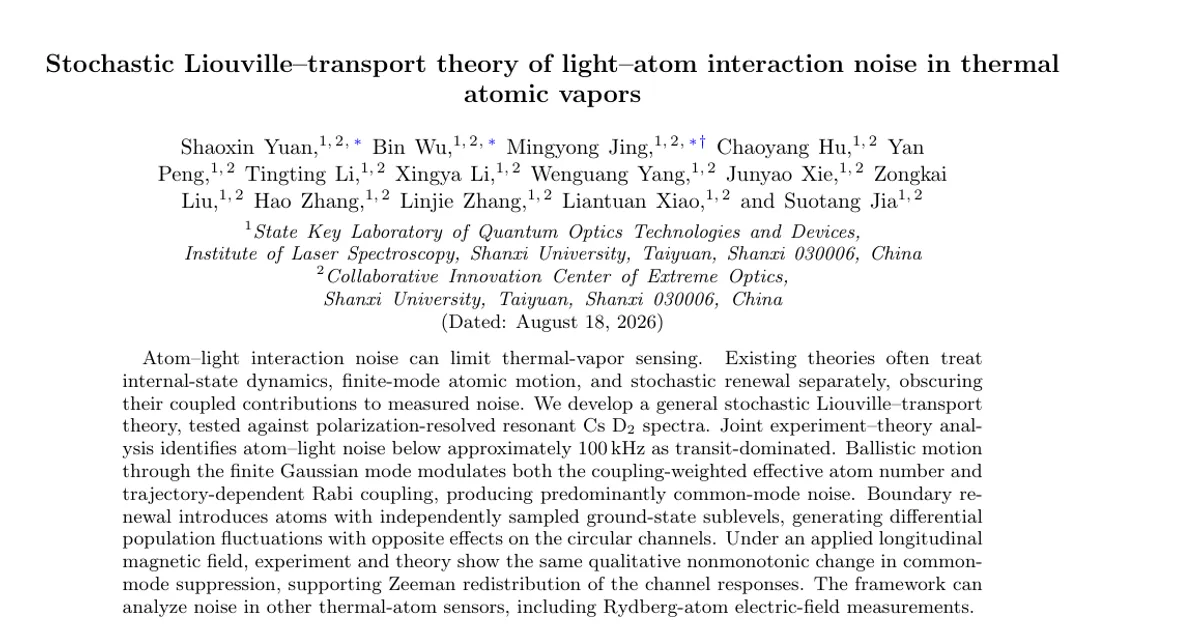
Authors’ abstract
Atom-light interaction noise can limit thermal-vapor sensing. Existing theories often treat internal-state dynamics, finite-mode atomic motion, and stochastic renewal separately, obscuring their coupled contributions to measured noise. We develop a general stochastic Liouville-transport theory, tested against polarization-resolved resonant Cs D$_2$ spectra. Joint experiment-theory analysis identifies atom-light noise below approximately 100 kHz as transit-dominated. Ballistic motion through the finite Gaussian mode modulates both the coupling-weighted effective atom number and trajectory-dependent Rabi coupling, producing predominantly common-mode noise. Boundary renewal introduces atoms with independently sampled ground-state sublevels, generating differential population fluctuations with opposite effects on the circular channels. Under an applied longitudinal magnetic field, experiment and theory show the same qualitative nonmonotonic change in common-mode suppression, supporting Zeeman redistribution of the channel responses. The framework can analyze noise in other thermal-atom sensors, including Rydberg-atom electric-field measurements.