Research
Secure Quantum Handshakes: Quantum Network Verification Via Simon's Algorithm
Overview Research area: Quantum networking, quantum cryptography, and quantum computational verification — specifically, how a quantum network can confirm that a joining device is genuinely quantum-ca
- arXiv
- 2610.12209
- Published
- 2026-10-08
- Authors
- Reece Robertson, Sejal Patil, Sebastian Deffner
AI summary
Overview
Research area: Quantum networking, quantum cryptography, and quantum computational verification — specifically, how a quantum network can confirm that a joining device is genuinely quantum-capable.
Technical level: Intermediate. The paper assumes familiarity with qubits, unitary oracles, and standard noise channels (erasure, bit-flip/dephasing, depolarizing), but its core argument is presented through an extended analogy involving Arthurian characters.
Scope: The paper proposes and numerically simulates a client-admission ("handshake") protocol in which a quantum server challenges a candidate node to solve a Simon's-algorithm oracle, admitting only devices that demonstrate fault-tolerant quantum capability over a sufficiently high-fidelity channel.
What This Paper Is About
Quantum networks need every participating node to be a genuine quantum device connected by a reliable quantum channel, but no reliable method currently exists to check this when an unknown client requests admission. A classical machine can present credentials or follow protocol, but it cannot reproduce the statistical behavior of a fault-tolerant quantum computer. The authors propose a handshake in which the network gives a candidate node a Simon's-problem oracle to query over a quantum channel, and admits the node only if it recovers the hidden secret string within a query budget that no classical machine could meet.
Key Contributions
-
A proof-of-quantum-capability admission protocol. A verified quantum server instantiates an oracle for an oracular quantum algorithm, lets the client query it remotely, and admits the client only if the hidden information is recovered. The protocol is designed to reject classical spoofers, noisy quantum devices, and genuine devices connected over noisy or insecure channels.
-
A networked implementation of Simon's algorithm that resolves an apparent paradox. Simon's algorithm requires the oracle to be simultaneously unknown to the client and physically implementable. The authors localize the oracle computation on the server and transmit quantum states across the channel (their Figure 3), which is logically equivalent to the standard single-processor circuit (their Figure 2) while keeping the oracle hidden from the client.
-
A three-way threat analysis using named characters. Guinevere is the quantum server; Nimue is a genuine fault-tolerant quantum client; Merlin is a classical client spoofing quantum capability; Morgan le Fay is a noisy quantum client. Each interaction is analyzed separately, including the explicit state Merlin sends and receives.
-
Numerical validation under three noise models, plus a tunable security threshold. Simulations under erasure, dephasing (bit-flip), and depolarizing noise show that the server can set an oracle size n to exclude devices whose noise parameter p exceeds a chosen level. The paper also analyzes requiring multiple oracle challenges and sketches a classical-channel-only variant in Appendix A.
Main Findings
-
Classical spoofing yields no information. Because Merlin can only send a computational-basis state |z⟩, the server computes U_f(|z⟩|0⟩) = |z⟩|f(z)⟩ and returns |z⟩ unchanged after measuring the second register. Merlin's best strategy is a random guess. At n = 20 there are 2^20 − 1 = 1,048,575 candidate bitstrings, giving a success probability of less than one in a million.
-
Genuine quantum clients succeed with near-certainty. With n + 20 shots of a fault-tolerant implementation, the probability of failing to obtain the n − 1 nontrivial independent samples needed to reconstruct s is less than one in a million, regardless of n (citing Mermin). The classical post-processing of the linear system scales at worst cubically in n.
-
Errors accumulate in both noise strength and problem size. For every noise model, the simulated probability of recovering s is certain at p = 0 and decays as both p and n increase. Simulations swept p over [0, 0.1] and n over [2, 15], instantiating 100 oracle problems per combination and drawing n + 20 samples each.
-
Erasure noise is the most forgiving. Success probabilities under the erasure model are on average higher than under the other two models, likely because the locations of errors are known, enabling more efficient decoding.
-
Depolarizing noise is the harshest. Success falls very quickly as a function of p, attributed at least partly to error correlations that the classical noise models cannot produce. This simulation was a density-matrix simulation with one- and two-qubit depolarizing channels applied after every one- and two-qubit gate, including those implementing the oracle, with a noiseless communication channel.
-
Dephasing sits between the two. Modeling bit flips in the computational basis (dephasing in the Bell basis) with unknown error locations produces a general decrease in success probability relative to the erasure case.
-
Thresholds are selectable via n. For the depolarizing model at n = 12, clients with p > 0.03 will very likely be rejected and clients with p < 0.01 will likely be accepted; clients with p in [0.01, 0.03] have an appreciable chance of admission, so p = 0.03 is described as the effective threshold for that oracle size.
-
Multiple oracle challenges tighten security without increasing n. In a worked example at n = 15: with one required success, Nimue succeeds with probability greater than 99.9999%, Merlin less than 0.0031%, and a Morgan with 67% per-oracle success succeeds 67% of the time. Requiring 18 successes drops Morgan below 1%, makes Merlin fail with certainty, and keeps Nimue above 99.9982% — but a Morgan at 90% per-oracle success still has a 15% admission probability, and one at 99% has over 83%.
-
The classical-channel-only variant is not secure. In Appendix A, the server sends the oracle itself to the client and enforces a time limit m instead of counting queries. Because the oracle implementation is revealed, a classical client could in principle reverse engineer it without querying, so the authors describe this variant as a pedagogical tool rather than a verification mechanism.
Methodology in Plain English
Start with a trusted quantum server. A candidate node asks to join. The server picks a problem size n and builds a Simon's-problem oracle — a two-to-one function with a hidden secret string s — and keeps the implementation to itself. The client prepares an n-qubit uniform superposition and sends it over the quantum channel; the server applies the oracle, measures the second register (collapsing the first into a superposition of two strings differing by s), and sends the result back. The client measures and repeats this n + 20 times, then solves a binary linear system to recover s and returns it.
A classical client cannot prepare the superposition, so the server's measurement leaves its input untouched and it learns nothing. A noisy quantum client can prepare only an approximate state, so its samples sometimes fall outside the valid set and its reconstruction fails.
To test this, the authors simulated the noisy client under three noise sources. The first two are classical, applied to the sampled bitstrings: an erasure model where each bit is dropped and later filled with a random 0 or 1, and a bit-flip model where each bit is flipped independently. The third is genuinely quantum: a density-matrix simulation of Simon's algorithm with depolarizing channels after every gate. For each combination of n and p, they drew n + 20 noisy samples, repeatedly subsampled n − 1 equations, attempted an exact solve, and counted a failure if 50 independent subsamples produced no nontrivial solution. No real-network implementation was performed, which the authors attribute to the resources available in the current public quantum landscape. Code and data are posted at the project's GitHub repository, and an implementation for IBM devices and simulators accompanies the Appendix A variant.
Why This Matters
The paper targets a gap the authors identify in the quantum networking literature: existing work reasons about quantum networks, certifies their topology, or verifies shared entanglement, but does not address verifying the quantum capability of nodes before they are admitted. Because admission confers the trust and privileges of a verified member, wrongly admitting a faulty node threatens the whole network. This protocol makes admission conditional on a physical demonstration rather than a credential.
-
Access control for quantum networks and quantum cloud services, where a provider must confirm that a remote client is a genuine quantum device rather than a classical emulator.
-
Free-space photonic quantum links, where atmospheric turbulence is described as the dominant error source — the motivation for the erasure model, which the authors call the most relevant of the three.
-
Distributed quantum computing, where large algorithms such as Shor's factoring algorithm could be split across a collection of small fault-tolerant devices that must trust one another.
-
Secure decentralized and long-term quantum internet proposals, including blockchain-adjacent protocols and quantum repeater links, all of which presuppose trustworthy nodes.
Industry relevance: the protocol offers a practical admission test for quantum networking hardware vendors, quantum cloud providers, and operators of metropolitan or free-space quantum links. Its threshold tuning means operators can trade oracle size against the quality of devices they are willing to accept.
Future Directions
-
Deployment on a real quantum network. The authors explicitly call for this to certify efficacy beyond idealized noise models and to test implicit assumptions, such as ready access to secure quantum communication channels.
-
More physically inspired noise models, for example photon-loss models that capture correlations in losses of neighboring bits due to prolonged turbulence, and models accounting for turbulence on both incoming and outgoing quantum messages.
-
Multi-server and topology-aware admission. The paper sketches a version in which every node acts as a server for each candidate, or in which candidates need only pass challenges with the nodes closest to them, and leaves systematic exploration of such variants open.
-
Further protocol variants inspired by classical secure networking. The authors suggest exploring additional modifications of the basic server-client model, with emphasis on directions motivated by state-of-the-art classical secure network communications.
Target Audience
Researchers and graduate students in quantum networking, quantum cryptography, and quantum computational complexity who need a concrete, noise-aware admission mechanism for multi-node quantum systems. It is also useful for security engineers and network architects evaluating how quantum network access control might work in practice, and for readers interested in how the "unknown yet implementable oracle" tension in Simon's algorithm can be resolved by splitting computation across a client and a server.
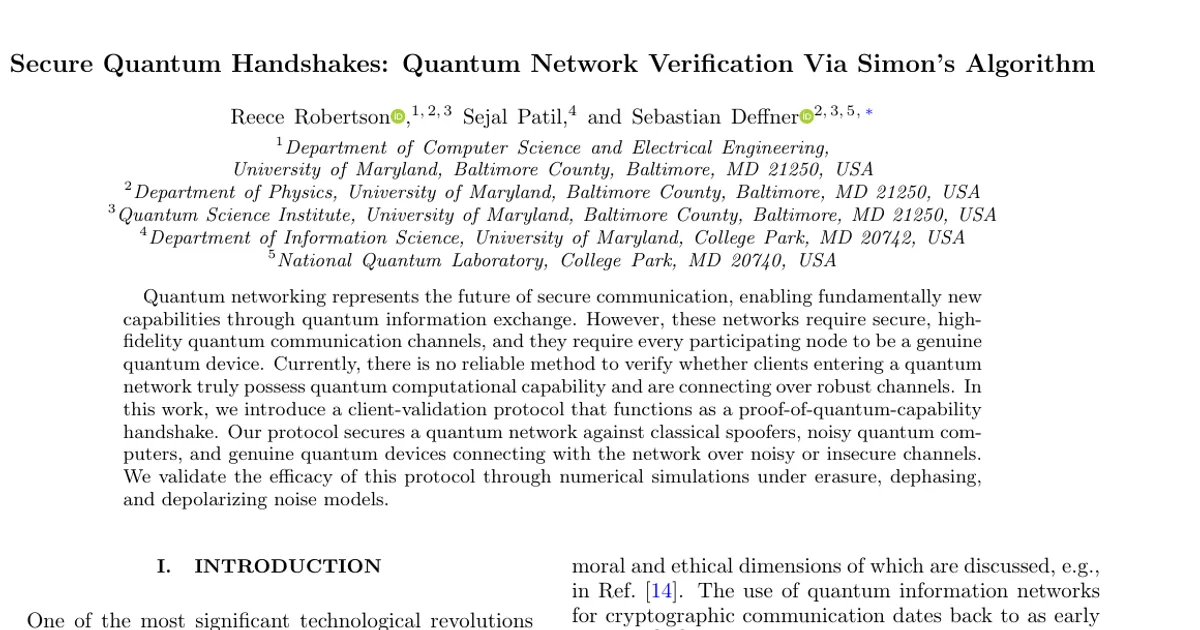
Authors’ abstract
Quantum networking represents the future of secure communication, enabling fundamentally new capabilities through quantum information exchange. However, these networks require secure, high-fidelity quantum communication channels, and they require every participating node to be a genuine quantum device. Currently, there is no reliable method to verify whether clients entering a quantum network truly possess quantum computational capability and are connecting over robust channels. In this work, we introduce a client-validation protocol that functions as a proof-of-quantum-capability handshake. Our protocol secures a quantum network against classical spoofers, noisy quantum computers, and genuine quantum devices connecting with the network over noisy or insecure channels. We validate the efficacy of this protocol through numerical simulations under erasure, dephasing, and depolarizing noise models.