Research
Rewire and reset are all you need: Minimal resources for manipulating non-Abelions
Overview Research area: Topological quantum computation, anyon manipulation in quantum double models, and quantum error correction. Technical level: Advanced. The paper assumes familiarity with topolo
- arXiv
- 2610.06845
- Published
- 2026-10-05
- Authors
- Chiu Fan Bowen Lo, Rohith Sajith, Anasuya Lyons, Ashvin Vishwanath, Ruben Verresen
AI summary
Overview
Research area: Topological quantum computation, anyon manipulation in quantum double models, and quantum error correction. Technical level: Advanced. The paper assumes familiarity with topological order, non-Abelian anyons, stabilizer codes, quantum doubles, and circuit-level quantum information. Scope: The paper determines the minimal circuit resources needed to braid and fuse non-Abelian anyons in quantum doubles (D(G)) of finite groups, introducing a diagrammatic “graph rewiring” calculus and showing that unitary rewiring plus qudit reset suffices, with measurement or ancillas needed only for read-out.
What This Paper Is About
Topological quantum computation relies on braiding and fusing non-Abelian anyons, but existing circuit protocols typically use ancillas and measurements to carry out these operations. This paper asks what the minimal resources actually are. It shows that sequential unitary circuits alone can braid anyons, proves that unitary circuits alone cannot fuse anyons of unknown type without leaving a remnant, and demonstrates that adding a single-qudit reset enables input-agnostic fusion.
Key Contributions
- Graph rewiring calculus. The authors introduce a diagrammatic framework in which individual two-qudit gates are assigned a geometric interpretation as deformations of the underlying lattice graph, while tracking their action on the stabilizers of the quantum double state.
- Ancilla-free braiding circuits. They construct sequential unitary circuits that exchange charges or fluxes in a general quantum double (D(G)), contradicting the folklore expectation that an ancilla is needed to track a non-Abelion’s internal degree of freedom during movement.
- No-go theorem for unitary fusion. They prove that no unitary circuit, even one assisted by a catalytic ancilla, can fuse anyons of unknown type while guaranteeing that no remnant anyon is left behind.
- Reset-based fusion protocol and resource hierarchy. They show that resetting a single edge, combined with graph rewiring, is sufficient to fuse charges and fluxes without prior knowledge of their state, and they separate braiding, fusion, and fusion read-out into distinct circuit-resource complexity classes.
Main Findings
- A single (CX) gate is a geometric rewiring move. In the toric code, a (CX) gate between two consecutive edges detaches the target edge’s end at vertex (v) and rewires it to vertex (u). The two adjacent plaquettes (p_1) and (p_2) become a pentagon and a triangle, and vertices (v) and (u) become trivalent and pentavalent, respectively, matching the modified stabilizers.
- The rewiring picture generalizes to arbitrary finite groups. For quantum doubles (D(G)), the (CX) gate is replaced by controlled group multiplication: the target edge’s group label is multiplied by the control’s, with left or right multiplication and inverses determined by edge orientations. The geometric action remains an elementary graph rewiring.
- Ribbon operators decompose into two primitives. The ribbon operator used to create non-Abelions can be expressed using only local pair creation and graph rewiring.
- Braiding requires only sequential unitary circuits. The paper provides ancilla-free circuits for exchanging charges or fluxes in general quantum doubles.
- Unitary input-agnostic fusion is impossible. The no-go theorem rules out unitary or isometric protocols, including those using a catalytic ancilla, for fusing unknown anyon types without a remnant. The obstruction is a counting argument: fusion coalesces microscopically distinct input states into the same output, which is incompatible with the orthogonality-preserving nature of a unitary or isometric operator.
- Entangled ancillas allow unitary fusion but do not scale. If an ancilla is allowed to remain entangled at the end, unitary fusion is possible, but each fusion event requires an additional ancilla, producing growing spatial overhead as fusion continues.
- A single reset enables input-agnostic fusion. Dissipatively resetting one edge to a fixed state, combined with graph rewiring, fuses charges and fluxes without knowledge of the input anyon type. The paper provides protocols for both charges and fluxes.
- Measurement or ancillas are needed only for read-out. Braiding, the act of fusion, and syndrome extraction fall into separate resource classes: braiding needs unitary rewiring; fusion needs rewiring plus reset; fusion read-out needs measurement or an ancilla.
- Reset is an underutilized error-correction primitive. Because reset is relatively cheap compared with measurement, the fusion protocol avoids the spacetime overhead associated with ancillas and measurements, with implications for surface-code architectures on superconducting qubits.
- No numerical benchmarks are reported. The paper’s results are analytic and protocol-level; it reports no dataset sizes, benchmark scores, or model performance metrics.
Methodology in Plain English
The authors develop a diagrammatic bookkeeping tool called graph rewiring. Instead of analyzing a complicated circuit algebraically, they track how each two-qudit gate reshapes the graph on which the quantum double state is defined. A gate between neighboring edges is interpreted as detaching one edge endpoint and reattaching it elsewhere, which changes the stabilizers in a controlled way. They first explain this in the toric code, then generalize it to quantum doubles of arbitrary finite groups by replacing (CX) with controlled group multiplication.
Using this tool, they build explicit sequential circuits that move anyons around without ancillas. They then analyze whether unitary circuits can also fuse anyons. A counting argument shows that fusion maps many distinct microscopic inputs to the same output, which a unitary cannot do while preserving orthogonality. Finally, they add a reset operation, reinitializing one edge in a fixed state, and show that this non-unitary primitive, together with rewiring, implements fusion without knowing the input anyon type.
Why This Matters
The paper challenges the prevailing assumption that ancillas are necessary for manipulating non-Abelian anyons. It reduces the resource requirements for braiding and fusion to sequential unitary circuits plus reset, and it clarifies exactly where measurement or ancillas remain necessary: in reading out fusion outcomes. This is relevant to experimental efforts because reset is generally cheaper and simpler than measurement, and avoiding ancillas removes spatial overhead from repeated fusion events.
Potential applications include:
- Topological quantum computing: braiding and fusing non-Abelions with fewer hardware primitives, potentially simplifying compiled logical operations in quantum double architectures.
- Superconducting surface-code hardware: using reset-based protocols for fusion and error correction where reset is cheaper than measurement.
- Defect-based quantum computation: manipulating twist defects and non-Abelian defects in stabilizer codes with graph-based circuit moves.
- Syndrome extraction and error correction: exploiting reset as a low-overhead primitive for fusion-type operations without the spacetime cost of ancilla-assisted measurement.
Industry relevance: The work is directly relevant to groups building superconducting qubit processors and topological or stabilizer-based error-corrected architectures, where reducing ancilla count and measurement overhead is a practical design goal. The paper cites recent experimental demonstrations of non-Abelian defects and non-Abelian topological order, including a universal gate set in (D(S_3)), indicating that the resource questions it addresses are experimentally timely.
Future Directions
- Experimental demonstration of reset-based fusion. Testing the proposed reset-plus-rewiring fusion protocol on programmable quantum processors that have already realized non-Abelian anyons or defects.
- Extension beyond finite-group quantum doubles. The paper focuses on (D(G)) for finite (G); extending graph rewiring and the reset-fusion protocol to string-net models such as Fibonacci anyons, which are not finite-group quantum doubles, remains open.
- Reducing read-out overhead. Since measurement or ancillas are still required to read out fusion outcomes, finding lower-overhead read-out schemes or determining whether reset can partially replace measurement in decoding is a natural next step.
- Fault-tolerance and scalability analysis. Quantifying the error thresholds and spacetime costs of reset-based fusion protocols in realistic error models, including comparison with ancilla-based schemes.
- Broader primitive search. Investigating whether other non-unitary primitives besides reset can enable input-agnostic fusion or other anyon operations at similarly low cost.
Target Audience
This paper is best suited for researchers in topological quantum computation, quantum error correction, and condensed matter theory, particularly those working on quantum double models, non-Abelian anyons, stabilizer codes, and circuit-level protocols. It will also benefit experimentalists building topological or stabilizer-based quantum processors who are interested in reducing ancilla and measurement overhead. Graduate students with a background in quantum information and topological order will find the graph-rewiring calculus conceptually useful, though the paper is not beginner-friendly.
Authors’ abstract
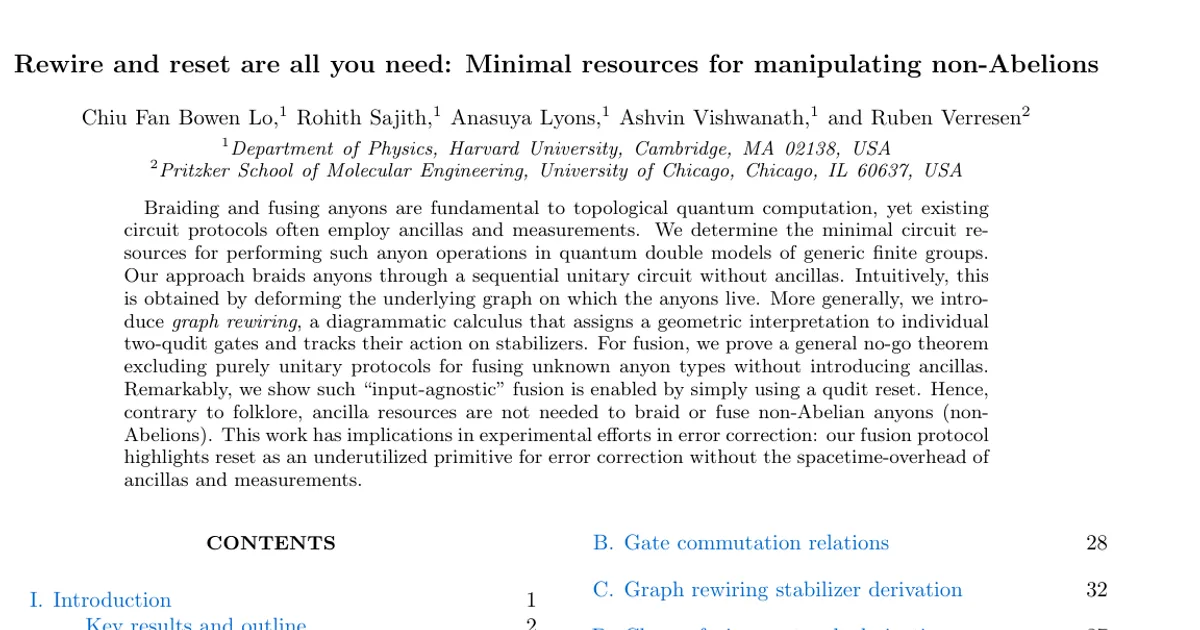
Braiding and fusing anyons are fundamental to topological quantum computation, yet existing circuit protocols often employ ancillas and measurements. We determine the minimal circuit resources for performing such anyon operations in quantum double models of generic finite groups. Our approach braids anyons through a sequential unitary circuit without ancillas. Intuitively, this is obtained by deforming the underlying graph on which the anyons live. More generally, we introduce graph rewiring, a diagrammatic calculus that assigns a geometric interpretation to individual two-qudit gates and tracks their action on stabilizers. For fusion, we prove a general no-go theorem excluding purely unitary protocols for fusing unknown anyon types without introducing ancillas. Remarkably, we show such "input-agnostic" fusion is enabled by simply using a qudit reset. Hence, contrary to folklore, ancilla resources are not needed to braid or fuse non-Abelian anyons (non-Abelions). This work has implications in experimental efforts in error correction: our fusion protocol highlights reset as an underutilized primitive for error correction without the spacetime-overhead of ancillas and measurements.