Research
Real-Time Correlation of Relaxation, Dephasing, and Two-level System Dynamics in Transmon Qubits
Overview Research area: Superconducting quantum computing — specifically noise and stability in transmon qubits fabricated with tantalum on high-purity silicon (Ta-on-Si). Technical level: Advanced. T
- arXiv
- 2610.34485
- Published
- 2026-10-25
- Authors
- Ambrose Yang, Alexander M. Young, Paal H. Prestegaard, Atharv Joshi, Matthew S. Ai, Q. Rumman Rahman, Faranak Bahrami, Matthew P. Bland, Jui-Lin Niu, Ourania-Maria Glezakou-Elbert, Ray D. Chang, Jocelyn Liu, Zhengyi Lu, Robert J. Cava, Nathalie P. de Leon, Andrew A. Houck
AI summary
Overview
Research area: Superconducting quantum computing — specifically noise and stability in transmon qubits fabricated with tantalum on high-purity silicon (Ta-on-Si).
Technical level: Advanced. The paper assumes familiarity with transmon qubits, T₁/T₂ coherence measurements, Hahn echo, CPMG dynamical decoupling, noise spectral density, and two-level system (TLS) defects.
Scope (one sentence): The paper uses a single interleaved measurement protocol combining lifetime, coherence, CPMG noise spectroscopy, and AC-Stark TLS spectroscopy to show that minutes-to-hours drops in transmon T₁ and T₂E are caused by individual strongly-coupled TLS defects spectrally diffusing into resonance with the qubit.
What This Paper Is About
State-of-the-art Ta-on-Si transmons reach millisecond-scale T₁ and T₂E, but their performance fluctuates over time, which limits gate fidelities. The authors call the hours-long periods of reduced T₁ and T₂E "T₁ and T₂ excursions" and set out to identify the physical noise source behind them. Their goal is to correlate relaxation, dephasing, environmental noise spectra, and TLS spectra in real time on the same qubit, rather than inferring the cause from separate experiments.
Key Contributions
- A shot-to-shot interleaved measurement protocol that alternates T₁ and T₂E pulse sequences (and optionally Ramsey, CPMG, and AC Stark sequences) with delay times ordered as (τ₁, θ₁, τ₂, θ₂, …, τₙ, θₙ), so that T₁ and T₂E are measured nearly simultaneously. The authors state this gives four orders of magnitude improvement in simultaneity compared with sequential T₁ and T₂E measurements.
- Demonstration of correlated relaxation and dephasing during excursions on state-of-the-art Ta-on-Si qubits, quantified with a Spearman correlation coefficient of 0.51 and a linear slope Γφ/Γ1 = 0.89 ± 0.02, plus a piecewise linear fit identifying a change in behavior at Γ₁ = 1.47 kHz (T₁ = 683 μs).
- Real-time noise spectroscopy inside and outside an excursion, showing that excess noise in the kHz range appears during excursions and fits a Lorentzian with a roll-off at 365 ± 18 kHz, and that the excess noise does not show 1/f scaling.
- Direct TLS spectroscopy correlated with T₁, showing that T₁ excursions coincide with a single TLS spectrally diffusing onto the qubit frequency, and a quantitative model (Eq. 4) separating TLS, broadband, and background loss contributions, with Lin's Concordance Correlation Coefficient r_c = 0.831 between modeled and measured Γ₁.
Main Findings
- Excursions are common and long-lived. Repeated measurements over multiple days show hours-long periods of reduced T₁ (and T₂E) bookended by sudden jumps. Figure 1(a) shows dataset 3 measured over 72 hours, with a gray-shaded excursion lasting 7 hours; Table 1 lists dataset 3 as 74 hours.
- Excursions threaten gate fidelity targets. Assuming a 20 ns π/2-pulse and T₁ relaxation as the dominant gate error source, temporal T₁ fluctuations prevent single-qubit gate fidelities from reaching the 99.999% milestone 45.5% of the time; the threshold corresponds to T₁ = 667 μs.
- T₁ and T₂E drop together. In a 54-hour interleaved dataset (dataset 1; listed as 53 hours in Table 1), T₁ and T₂E decrease during the same excursions, and the derived Γφ = 1/T₂E − 1/(2T₁) increases at the same times. The integrated autocorrelation time of the T₁ data is 34 minutes.
- The Γφ–Γ₁ relation is piecewise linear. A ReLU-based piecewise fit selected with the Bayes Information Criterion gives zero slope for Γ₁ < 1.47 kHz (T₁ > 683 μs) and a slope of 1.12 for Γ₁ > 1.47 kHz (T₁ < 683 μs), implying a common noise source for correlated relaxation and dephasing in the low-T₁ regime.
- Noise rises in the kHz range during excursions. Outside an excursion, the noise spectrum is flat with a roll-off matching the readout resonator bandwidth, consistent with thermal photons in the readout resonator. Inside an excursion, noise amplitude in the kHz range increases, with a 365 ± 18 kHz roll-off; other excursions show different roll-off frequencies, indicating a source with variable correlation times.
- The spectra are non-Gaussian and not 1/f. The added noise is not consistent with 1/f scaling expected from a TLS bath, charge noise, or critical current noise; the authors also argue against quasiparticle bursts (millisecond timescale, versus minutes-to-hours excursions) and photon shot noise (which causes dephasing but not relaxation).
- T₁ distributions are non-Gaussian. Shapiro-Wilk and D'Agostino-Pearson tests at significance level α = 0.01 classify nearly all T₁ and T₂E distributions as non-Gaussian, with stated exceptions: dataset 6 for T₂E under both tests, and dataset 5 for T₁ under D'Agostino-Pearson.
- Single TLSs drive the excursions. TLS spectroscopy over a 15 MHz bandwidth shows TLS resonances drifting and jumping; a T₁ excursion at hour 27 in dataset 7 coincides with a TLS spectrally diffusing onto the qubit frequency (white dashed line in Fig. 4(b)).
- TLS term dominates the fluctuations. Measured Γ₁ correlates with the fitted TLS term with Pearson coefficient 0.902 but is uncorrelated with the broadband term (−0.056), and the variance of the TLS term is 10.8 times larger than that of the broadband term.
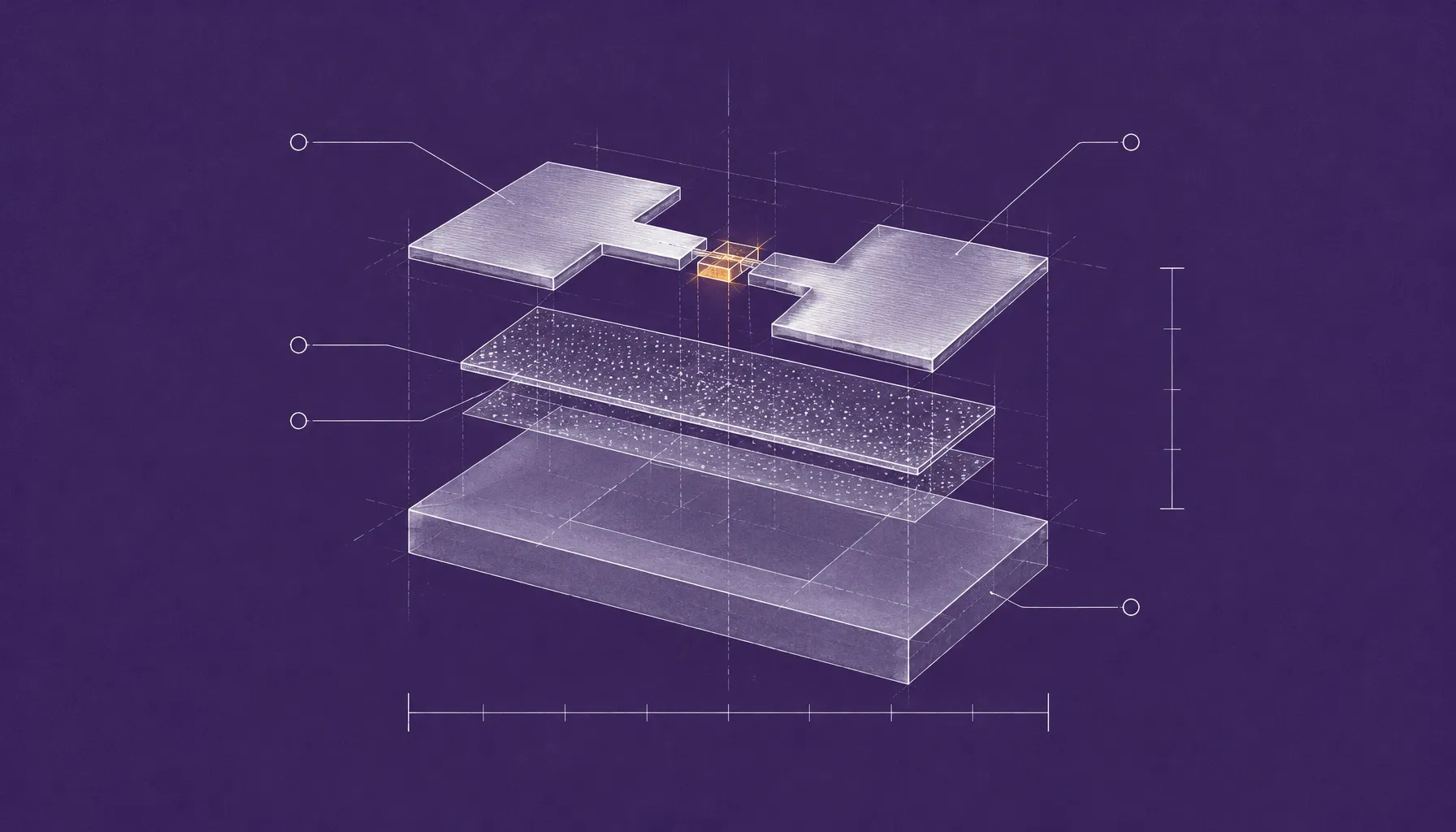
- A spatial model for loss. Because TLS-qubit coupling scales with p·E and fields are strongest near the Josephson junction, the authors propose that TLSs in the capacitor pads and bulk substrate set the average T₁, while strongly-coupled TLSs near the junction set T₁ stability.
Methodology in Plain English
The team repeatedly measured how long a fixed-frequency transmon stays excited (T₁) and how long it keeps a definite phase relationship (T₂E), thousands of times over 10 to 91 hours per dataset, across 9 datasets on 5 qubits. Instead of running a full T₁ experiment and then a full T₂E experiment, they interleaved single shots of both sequences: each round takes one shot at each delay time for T₁ and one for T₂E, and 500 (or, for some datasets, 300) rounds are averaged to extract each decay. This makes the two quantities effectively simultaneous, since the per-shot wall-clock time is dominated by the ~1 ms delay time.
They added an active reset protocol, implemented in FPGA logic on a Quantum Machines Operator X, that measures the qubit, applies a π pulse if it is excited, and waits 10/κ for the resonator to depopulate, so each measurement starts from the ground state. Readout was recalibrated with single-shot calibration every 30 minutes using 1000 shots per state.
To see which noise frequencies were responsible, they inserted CPMG sequences with varying numbers of π-pulses N and total free evolution times τ; each such sequence acts as a narrow filter centered at N/(2τ), letting them reconstruct the noise spectral density from kHz to MHz. To see the TLSs directly, they applied an off-resonant microwave tone to Stark-shift the qubit frequency and recorded the excited-state population at τ = 100 μs across a 15 MHz band, producing a map of TLS resonances versus frequency and time. These measurements were all interleaved in one protocol so that noise spectra and TLS maps could be compared against T₁ inside and outside an excursion.
Why This Matters
The paper establishes a causal, real-time link between a specific microscopic defect class and the temporal instability of state-of-the-art qubits, rather than attributing fluctuations to a generic "TLS bath." It converts an empirical nuisance into a measurable, modelable loss channel: excursions are dominated by a few individually resolvable, strongly-coupled TLSs, and the fit reproduces the measured Γ₁ well (r_c = 0.831).
Real-world applications:
- Quantum error correction: fluctuating error rates, including the 45.5% of the time that the 99.999% fidelity milestone is out of reach under a 20 ns π/2-pulse, require error-correction protocols that tolerate time-varying noise.
- Processor calibration and scheduling: recognizing excursions lets a processor avoid or reschedule gates during known bad periods, and motivates continuous in-line noise monitoring.
- Junction and materials engineering: identifying the near-junction region as the stability-limiting location points fabrication efforts toward alternative junction materials and oxide control.
- Benchmarking standards: interleaved T₁/T₂E plus noise and TLS spectroscopy provides a stability metric for comparing material stacks (tantalum, niobium, aluminum).
Industry relevance: The work is directly relevant to superconducting processor developers, since gate fidelity and error-correction overhead are set by the worst periods of qubit performance, not the average. The study was supported by Google Quantum AI and AFOSR/LPS, and the authors disclose relevant financial conflicts of interest with Google Quantum AI and Quantum Circuits Incorporated (QCI)/DWave.
Future Directions
- Extend the probed spectral range. AC Stark TLS spectroscopy covers only about 10–20 MHz; the authors propose flux-tunable qubits to probe TLS dynamics over approximately GHz of range.
- Replace junction materials. Because the strongly-coupled TLSs likely reside in amorphous oxides along the Josephson junction leads or surfaces near the junction, comparative studies of TLS coupling strengths, linewidths, and spectral diffusion across junction materials are proposed to select better junctions.
- Understand TLS spectral diffusion dynamics itself. The physical mechanism behind the diffusive drifts and abrupt jumps observed in TLS resonance frequencies remains an open target.
- Mitigate or predict excursions. A model that separates TLS, broadband, and background contributions (Eq. 4) raises the question of whether excursions can be anticipated from continuously monitored spectroscopy and avoided in processor operation.
Target Audience
Graduate students and researchers in superconducting quantum computing and quantum device noise, especially those working on coherence, materials, and junction fabrication. It is also useful for quantum error-correction researchers who need realistic, time-varying error models, and for industry engineers responsible for processor calibration and stability benchmarking. Readers without background in qubit coherence measurements and dynamical decoupling will find the methods sections demanding.
Authors’ abstract
Materials improvements in transmon qubits have yielded remarkable advances in qubit lifetimes (T1)and coherence times (T2). However, state-of-the-art superconducting qubits experience temporal fluctuations in their performance, which limit gate fidelities and quantum processor performance. We observe correlated increases in qubit relaxation and dephasing rates that last for minutes to hours, which we call T1 and T2 excursions. Using interleaved lifetime and coherence time measurements, noise spectroscopy, and two-level-system (TLS) spectroscopy, we find that these excursions are caused by single or few strongly-coupled TLS defects that spectrally diffuse into resonance with the qubit frequency. Our measurement protocol provides a powerful tool for understanding the noise sources that cause temporal fluctuations in superconducting qubit performance.