Research
Quantum Secure Time Transfer for Satellites
Overview Research area: Quantum communications — entanglement-based quantum key distribution (QKD) combined with quantum clock synchronization for a Quantum-Secure Time Transfer (QSTT) protocol over a
- arXiv
- 2608.24092
- Published
- 2026-08-25
- Authors
- Ravi Singh Adhikari, Anju Rani, Aman Gupta, Xiaoyu Ai, Robert Malaney
AI summary
Overview
Research area: Quantum communications — entanglement-based quantum key distribution (QKD) combined with quantum clock synchronization for a Quantum-Secure Time Transfer (QSTT) protocol over an emulated low Earth orbit (LEO) satellite-to-ground channel.
Technical level: Advanced (experimental quantum optics, finite-key QKD security analysis, and applied cryptography), though the summary below is written to be accessible.
Scope in one sentence: The paper reports an experimental, tabletop demonstration of a satellite-style QSTT system built around a custom high-rate type-0 PPKTP Sagnac entangled-photon source, achieving GPS-free sub-nanosecond clock synchronization and a finite QKD key rate roughly 30 times higher than the Micius entanglement-based benchmark.
What This Paper Is About
Precise time synchronization between remote clocks underpins positioning, telecommunications, and quantum networks, but classical methods such as GPS, White Rabbit, and the Network Time Protocol are limited in precision and vulnerable to jamming, spoofing, and delay attacks. Quantum approaches using energy-time or polarization entanglement can detect eavesdropping and reach very fine timing precision, yet the security of the classical time-tag data and the very low key rates of satellite entanglement-based QKD have remained obstacles. The authors build and test an entanglement-based QSTT system with a high-generation-rate type-0 source to raise the finite key rate, remove dependence on GPS for synchronization, and add post-quantum and pre-shared-key protections, all at a channel loss matched to the Micius satellite link.
Key Contributions
-
A custom high-rate entangled-photon source. A degenerate, non-collinear, polarization-entangled source using a type-0 PPKTP crystal in a Sagnac interferometer, chosen because the type-0 nonlinear coefficient in KTP is about 4.7 times larger than type-II, giving more than a 22-fold increase in photon-pair generation rate, with an additional enhancement factor of up to four from the large SPDC bandwidth, for roughly a two-orders-of-magnitude overall gain.
-
A complete QSTT architecture combining QKD, pre-shared keys, and post-quantum cryptography. Time-tag data are protected by selective QKD one-time-pad encryption (first timestamp, a shuffled permuted partition of diff-time-tags, and a random subset of diff-time-tags), an obfuscated cascade of AES-256 (seeded with QKD keys) and Ascon (keyed via post-quantum key encapsulation), a pre-shared-key encrypted instruction sequence, and an information-theoretic Wegman-Carter message authentication code.
-
GPS-free clock synchronization driven by the same entangled photons. A coarse-scan plus fine-alignment algorithm estimates clock offset and drift rate from cross-correlation histograms of detection time tags, delivering sub-nanosecond precision without external timing infrastructure and without extra synchronization hardware.
-
A benchmarking comparison against Micius at 63 dB channel loss, reporting asymptotic and finite key rates, clock-synchronization precision, and system features side by side.
Main Findings
-
Entanglement quality: Average polarization-correlation visibility of 88% (V = 0.88), giving an estimated Bell parameter S = 2√2 V = 2.48, confirming nonclassical correlations. Photon bandwidth Δλ = 1.5 nm, implying a temporal correlation width σ_int = 1.5 ps.
-
Source brightness: At 0.5 mW pump power and a 1 ns coincidence window, brightness exceeds 10^6 pairs s^-1 mW^-1; heralding efficiency is reported as a function of pump power.
-
Emulated link: Operation at 14 mW pump power over a 1.2 m free-space channel with 63 dB total loss (32.5 dB Alice, 30.5 dB Bob), verified as equivalent to the Micius link over two channels. Measured S1 = 2.5 × 10^5 counts s^-1, S2 = 3.8 × 10^5 counts s^-1, coincidence rate Rc = 216 counts s^-1, giving a generation rate G ≈ 4.4 × 10^8 pairs s^-1 and a combined average loss of 63.1 dB, with fluctuations of order 0.75 dB.
-
Clock synchronization: Over 6 minutes of continuous operation, the system timing jitter is σ_ex = 467 ± 56 ps from the cross-correlation width, versus a predicted 434 ps from the component budget (σ_int = 1.5 ps, σ_det = 250 ps, σ_tt = 18 ps, σ_drift = 250 ps). Without the protocol, σ_ex = 8 ns. Clock-offset precision is Δ ≈ 63 ps, and the algorithm continuously tracks and compensates the drift rate.
-
QKD rate: Over 5 sessions, average QBER of 7.1%, asymptotic key rate 13.13 bits s^-1, finite key rate 3.29 bits s^-1 using Serfling's bound (parameters f_e = 1.19, n̂ = k = 10^4, ε_sec = ε_cor = 10^-10), and a Clopper-Pearson-based finite rate of 4.93 bits s^-1. The abstract describes this as approximately 3 bits s^-1 at a 10^-10 security parameter.
-
Benchmark against Micius: Compared with the Micius entanglement-based system (type-II source, 5.9 × 10^6 generation rate at 30 mW, average coincidence rate 2.2, asymptotic rate 0.43 bits s^-1, finite rate 0.12 bits s^-1), the reported increases are 27-fold in finite key rate and 30-fold in asymptotic key rate. The Clopper-Pearson value is not reported in the Micius work, so no direct comparison is possible there. Since the system runs at half the Micius pump power, raising the pump to 30 mW may increase the finite key rate by 60-fold.
-
Loss dependence: As satellite channel loss decreases, precision improves and QBER falls, raising the asymptotic secret key rate. At 66 dB loss, the synchronization algorithms mostly fail to estimate the true clock offset and drift rate because of insufficient coincidence counts.
-
Acknowledged limitation: The QKD key generation rate is lower than the time-tag creation rate, so QKD one-time-pad encryption of the entire timing data — and therefore full information-theoretic security for all timing data from self-generated keys — is not achieved. AES contributes only computational security, and encrypting and authenticating the large time-tag array adds a processing delay of a few seconds.
Methodology in Plain English
A continuous-wave 405.5 nm laser is spatially filtered through a pinhole and focused into a 1 × 2 × 30 mm type-0 PPKTP crystal (grating period 3.425 µm) held at 22 °C inside a Sagnac loop formed by a dual half-wave plate, a dual polarizing beam splitter, and high-reflection mirrors. Photon pairs are emitted at the degenerate 811 nm wavelength into a ring, and diametrically opposite points of that ring are selected by apertures and coupled into multimode fibers feeding single-photon counting modules, creating signal and idler paths. A visibility measurement stage of a polarizing beam splitter and half-wave plate is used to characterize the correlations; the Bell state targeted is Φ+ = (|HH⟩ + |VV⟩)/√2.
For the QSTT demonstration, variable attenuators set the two channel losses that emulate the satellite link. Alice and Bob each record photon detection time tags against a global reference. Alice converts her tags into inter-arrival (diff-time) tags, encrypts the first tag and the permutation with QKD one-time-pad keys, encrypts a random subset of diff-time tags similarly, and protects the rest with a chain of AES-256 and Ascon operations chosen from one of four instruction sequences, with that sequence itself encrypted by a pre-shared key; a Wegman-Carter MAC authenticates the whole package. Bob decrypts, reconstructs Alice's tags, and runs a synchronization algorithm that builds a coarse cross-correlation, then partitions coincidence events into P = 5 segments, histograms the differences with bin width w (350 ps at the main operating point) and a 400 ps coincidence window, and fits the peak to extract the clock offset, drift rate, and cumulative corrections. The same coincidence events feed the BBM92 protocol (measurements in the H/V and D/A bases), followed by sifting, error estimation, error correction, and privacy amplification; finite-key lengths are computed with a reduced expression adapted from the Micius analysis, plus an independent Clopper-Pearson bound calculation.
Why This Matters
The work pushes entanglement-based QSTT from a proof of concept toward a deployable satellite capability, showing that an improved source alone can raise finite key rates by an order of magnitude while simultaneously improving synchronization precision and shrinking synchronization hardware overhead. It also highlights that securing the quantum signal is not enough — time-tag data traveling on the classical channel must be protected too, and the paper offers a concrete hybrid architecture (QKD, pre-shared keys, post-quantum algorithms, obfuscation) for doing so.
Real-world applications:
- Secure timing for telecommunications and network infrastructure, where tamper-resistant synchronization underpins financial timestamping, industrial control, and data-center coordination.
- GNSS-independent navigation and defense systems, replacing or backing up GPS with a channel whose eavesdropping is detectable.
- Satellite quantum networks, where synchronized clocks are needed for entanglement distribution, quantum teleportation, and trusted-node key relays.
- Distributed quantum computing and distributed quantum sensing, which the introduction identifies as requiring precisely synchronized remote clocks.
Industry relevance spans satellite operators and payload developers, quantum communications hardware vendors, and defense and government agencies — the work is co-funded by Northrop Grumman Australia and the Defense Trailblazer Program, a partnership between the University of Adelaide and the University of New South Wales co-funded by the Australian Government Department of Education.
Future Directions
- Raising the source rate further. The authors project that moving from 14 mW to 30 mW pump power could improve the finite key rate by 60-fold over the Micius benchmark; larger gains would also help close the gap between time-tag creation rate and key rate so that full one-time-pad encryption of timing data becomes feasible.
- Reducing post-processing latency. The few-second delay from encrypting and authenticating the time-tag array is attributed to current computing, and the authors suggest high-performance computers could reduce it.
- Space qualification and real links. The type-0 Sagnac architecture has a large physical footprint, and the paper notes that satellite sources must survive size, weight, power, temperature, vibration, and radiation constraints; testing beyond the emulated 63 dB link, especially near the 66 dB point where synchronization fails, is a clear next step.
- Improving the jitter budget. Detector timing jitter (250 ps) and residual clock drift (250 ps) dominate σ_ex, so faster detectors and better drift tracking would directly improve both precision and QBER.
Target Audience
Quantum communication and QKD researchers, satellite payload and free-space optical link engineers, time and frequency metrology specialists, and security architects interested in post-quantum and hybrid cryptographic protection of timing infrastructure. Readers wanting a benchmark comparison between entanglement-based satellite QKD approaches will find the Micius comparison table directly useful, while those new to the field will need background in SPDC sources and finite-key QKD to follow the analysis.
Authors’ abstract
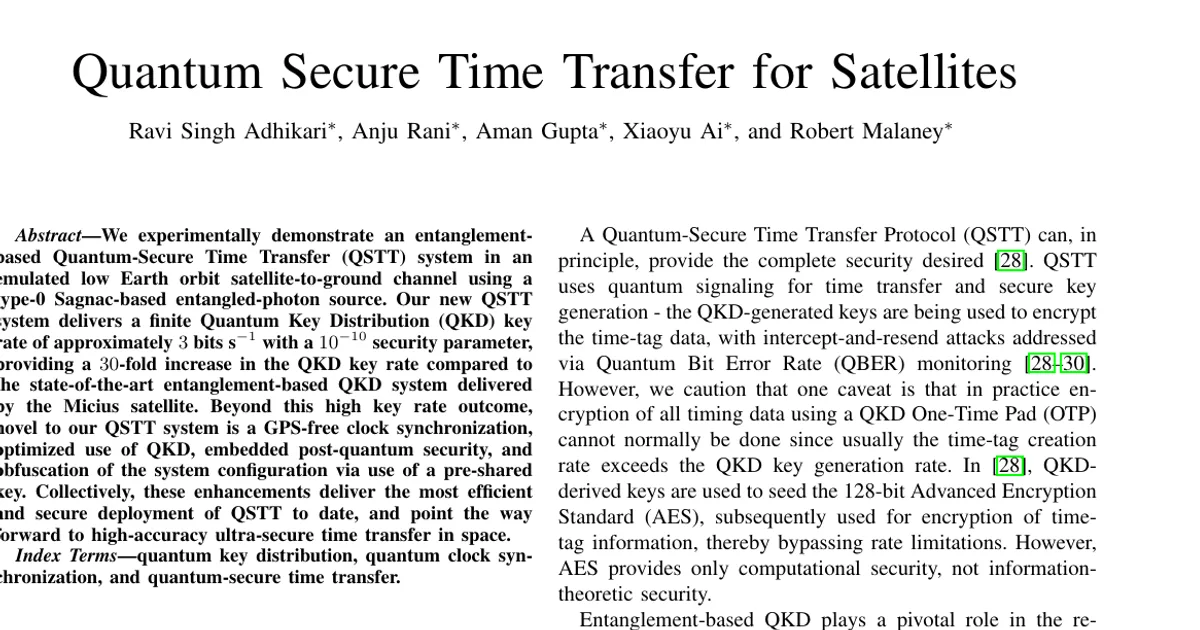
We experimentally demonstrate an entanglement-based Quantum-Secure Time Transfer (QSTT) system in an emulated low Earth orbit satellite-to-ground channel using a type-0 Sagnac-based entangled-photon source. Our new QSTT system delivers a finite Quantum Key Distribution (QKD) key rate of approximately $3~$bits$~\text{s}^{-1}$ with a $10^{-10}$ security parameter, providing a $30$-fold increase in the QKD key rate compared to the state-of-the-art entanglement-based QKD system delivered by the Micius satellite. Beyond this high key rate outcome, novel to our QSTT system is a GPS-free clock synchronization, optimized use of QKD, embedded post-quantum security, and obfuscation of the system configuration via use of a pre-shared key. Collectively, these enhancements deliver the most efficient and secure deployment of QSTT to date, and point the way forward to high-accuracy ultra-secure time transfer in space.