Research
Quantum random number generation using spatial quantum noise of light
Overview Research area: Quantum photonics / quantum random number generation (QRNG) — specifically, harvesting entropy from the spatial (transverse, two-dimensional) quantum noise of coherent states o
- arXiv
- 2607.26486
- Published
- 2026-07-29
- Authors
- Mohamed Armoon Shaliq, Ashok Kumar
AI summary
Overview
Research area: Quantum photonics / quantum random number generation (QRNG) — specifically, harvesting entropy from the spatial (transverse, two-dimensional) quantum noise of coherent states of light rather than from time-domain measurements.
Technical level: Intermediate. Readers should be comfortable with basic quantum optics concepts (coherent states, Poissonian photon statistics, shot noise) and with standard randomness-testing terminology, but the experimental logic is explained step by step.
Scope (one sentence): The paper demonstrates an extractor-free quantum random number generator that images the spatial shot noise of two balanced coherent-state pulses on an EMCCD camera and converts pixel fluctuations directly into bitstreams, reporting an instantaneous rate of 5.92 Gbps, a sustained throughput of 7.5 Mbps, and successful passage of the NIST SP 800-22 and Marsaglia Diehard suites.
What This Paper Is About
Most optical quantum random number generators measure fluctuations in time — counting photons or sampling field quadratures at successive instants — which makes them vulnerable to timing jitter and often forces the use of cryptographic randomness extractors that discard entropy and slow the generator down. This paper asks whether randomness can instead be read out in space: every pixel across the beam profile becomes its own independent noise channel. The goal is a simple, highly parallel, extractor-free generator built around a single electron-multiplying charge-coupled device (EMCCD) camera operating in high-speed kinetic mode, with the quantum origin of the noise verified experimentally rather than assumed.
Key Contributions
-
A spatial, extractor-free QRNG architecture. Randomness is extracted directly from the spatial intensity fluctuations of coherent-state pulses imaged on an EMCCD, with no algorithmic randomness extraction applied to the raw bitstream.
-
Experimental verification of the quantum origin of the noise. The authors combine spatial cross-correlation between two balanced beams, spatial auto-correlation within a single beam, a binning-dependent noise-ratio analysis, and a shot-noise-versus-background-noise decomposition to show the fluctuations are shot-noise dominated and statistically independent.
-
A combinatorial frame-subtraction scheme for high bit yield. From a single six-frame kinetic acquisition containing two spatially separated beams, all frame pairs are processed to produce 30 unique spatial quantum fluctuation images, from which three least-significant bits per pixel are retained.
-
Full statistical validation of the raw output. The unprocessed bitstream is benchmarked against all of NIST SP 800-22 and the original Marsaglia Diehard suite, with min-entropy tracked across 2,400 acquisitions.
Main Findings
-
Instantaneous generation rate of 5.92 Gbps without algorithmic randomness extraction. A 150 × 150 pixel region across 30 combinatorial fluctuation images yielded 2.025 × 10⁶ random bits from a single six-frame acquisition lasting 342 μs; the measured min-entropy was 0.9966 per bit.
-
Projected scaling to approximately 11.45 Gbps if illumination is extended to the full active 170 × 512 pixel region of the EMCCD.
-
Sustained throughput limited to approximately 7.5 Mbps by the readout electronics, not the entropy source. The horizontal amplifier reads pixels serially at a 1 MHz low-noise setting, giving a digitization period of about 270 ms per acquisition cycle. The authors stress this is an electronic bottleneck, since the vertical shift registers move charge at 300 ns per row.
-
Shot-noise-limited operation. The measured shot-noise-to-background-noise SNR is approximately 29 dB, confirming that quantum shot noise dominates detector and residual classical noise.
-
Noise ratio stays near unity across bin sizes. The noise ratio NR ≈ 1 regardless of super-pixel binning up to 20 × 20, consistent with Poissonian statistics and indicating no residual electronic or technical correlations.
-
No measurable spatial correlations. The cross-correlation map between the left and right beam fluctuations shows no correlation peak, and the auto-correlation across 100 pixels of spatial scans stays randomly distributed near zero — supporting the treatment of each pixel as an independent entropy source.
-
Min-entropy remains high over long runs. Across 2,400 acquisitions totaling 4.86 × 10⁹ bits, min-entropy was 0.998890. Min-entropy stays near-ideal for about six bit-extraction depths before declining slowly; the authors chose three least-significant bits per pixel as the operating point.
-
Negligible temporal correlations. Autocorrelation coefficients for the first 100 lags, computed on a sample of 10⁸ bits, are randomly distributed around zero with magnitudes on the order of 10⁻⁴.
-
All statistical tests passed on raw data. For NIST SP 800-22, 400 independent sequences of 10⁶ bits each were used; individual sequences passed at p ≥ 0.01, the passing proportion met the 0.9750 threshold, and the global p-values for all 22 tests fell above 0.0001. The Diehard suite was passed with results in the 0.01 ≤ p ≤ 0.99 range.
Methodology in Plain English
The team starts with a Titanium-Sapphire laser at 795 nm, chopped by an acousto-optic modulator into 1 μs pulses. A half-wave plate and polarizing beam splitter divide each pulse into two beams of equal power, so both carry identical mean photon flux — the balanced condition needed for the noise comparison. Both beams land side by side on a single EMCCD camera.
The camera is run in kinetic mode: the 512 × 512 active sensor plus a 512 × 512 buffer region is divided into six frames of 170 × 512 pixels. Only the top frame is exposed at a time, and charge is shifted vertically at 300 ns per row, giving a 51 μs transfer window per frame and a total separation of 57 μs between consecutive frames. The 1 μs laser pulse is synchronized to fall inside the camera's 10 μs exposure window, triggered 6 μs after the exposure begins.
To isolate quantum noise, the researchers subtract one frame from the next. This cancels the static classical intensity profile and leaves the spatial fluctuation pattern. A background frame taken without the laser pulse is also subtracted to remove electronic noise.
They then check that what remains is genuinely quantum. Cross-correlating the left and right beam fluctuations (a 150 × 150 pixel region of interest on the left, a 100 × 100 region on the right, scanned to build a correlation map) shows no peak, meaning the two beams are independent. Auto-correlating a single beam shows no structure either. Grouping pixels into larger and larger super-pixels leaves the noise ratio unchanged at about 1, which is what pure Poissonian shot noise should do.
For bit generation, all frame pairs within one six-frame acquisition are combined, producing 30 fluctuation images. Pixel magnitudes are converted to 16-bit unsigned integers, and the three least-significant bits of each pixel are kept — the rationale being that when the quantum-limited spread is much larger than the digitization step, the low-order bits are intrinsically equiprobable and uncorrelated. The resulting bits are tested directly, with no randomness extractor in the chain.
Why This Matters
Impact on research. The work shows that the transverse spatial degree of freedom — largely unexploited in practical QRNGs — can serve as a massively parallel entropy resource, with thousands of pixels acting as independent, simultaneously read channels. It also offers a simple, experimentally undemanding alternative to source-independent continuous-variable QRNG protocols, which prioritize security certification under weaker trust assumptions; this scheme prioritizes simplicity and parallel acquisition instead. Verifying the quantum origin of the noise with correlations and shot-noise analysis, rather than assuming it, strengthens confidence in extractor-free designs.
Real-world applications:
- Cryptographic key generation for secure communications.
- Quantum key distribution, where the generator must integrate with existing fiber-optic infrastructure.
- Large-scale stochastic simulations that consume very large volumes of high-quality random numbers.
- Banking and financial security systems that depend on unpredictable keys.
Industry relevance. The reported 7.5 Mbps sustained rate is modest, but the paper is explicit that this is set by the serial readout electronics rather than the quantum source, and that the camera supports digitization up to 20 MHz in EM mode. That framing points industry toward a clear engineering target: faster readout, not a better entropy source. The approach needs only a pulsed laser, a beam splitter, and a cooled camera, with no cryptographic post-processing.
Future Directions
-
Combining the spatial approach with a source-independent security framework, which the authors explicitly name as an interesting direction for future investigation.
-
Removing the readout bottleneck. The paper notes that the EMCCD supports digitization up to 20 MHz in EM mode, which could in principle push rates into the hundreds of Mbps; realizing this without sacrificing entropy fidelity to electronic read noise is the open engineering problem.
-
Scaling illumination to the full sensor. The 11.45 Gbps figure for the full active 170 × 512 region is a projection, not a demonstration, and remains to be measured.
-
Addressing the practical constraints the authors list: EMCCD readout speed, the requirement for thermoelectric cooling, and the need for careful detector-noise characterization — plus characterizing the breakdown regime under increasing classical noise and reduced shot-noise contribution as the region of interest is expanded.
Target Audience
Experimental quantum optics and quantum photonics researchers; engineers developing QRNG hardware and quantum key distribution systems; and security or cryptography practitioners who need to understand what "quantum" randomness certification involves and where a raw, extractor-free bitstream must be validated. Graduate students looking for a clearly described example of building randomness characterization from correlation analysis, noise-ratio scaling, and standard test suites will also benefit.
Authors’ abstract
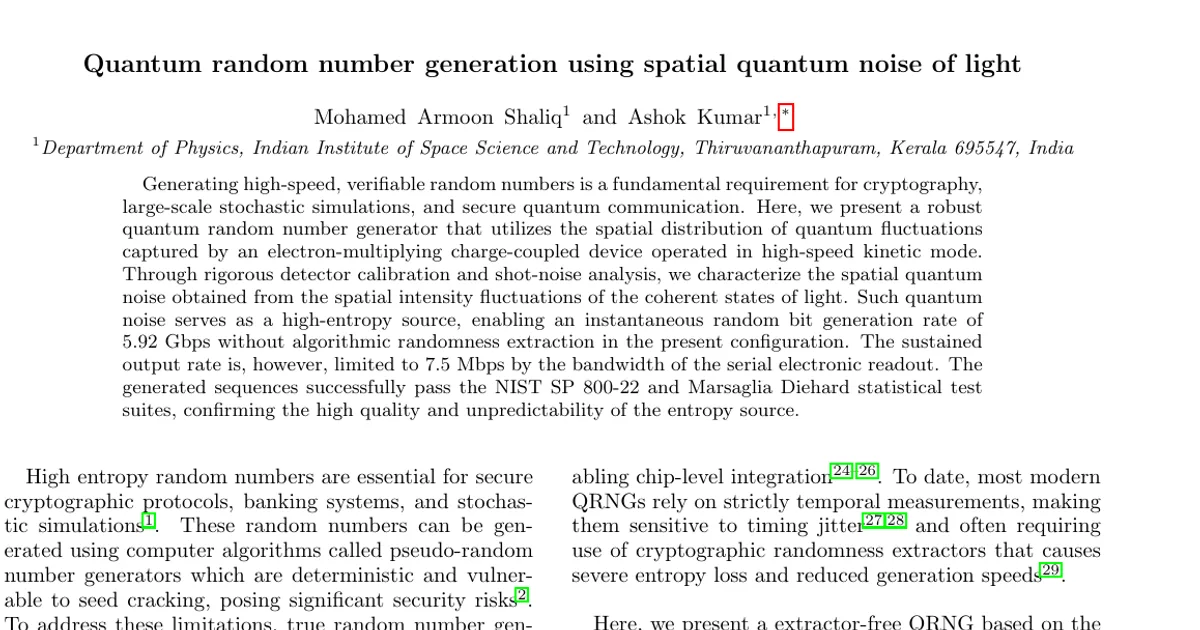
Generating high-speed, verifiable random numbers is a fundamental requirement for cryptography, large-scale stochastic simulations, and secure quantum communication. Here, we present a robust quantum random number generator that utilizes the spatial distribution of quantum fluctuations captured by an electron-multiplying charge-coupled device operated in high-speed kinetic mode. Through rigorous detector calibration and shot-noise analysis, we characterize the spatial quantum noise obtained from the spatial intensity fluctuations of the coherent states of light. Such quantum noise serves as a high-entropy source, enabling an instantaneous random bit generation rate of 5.92 Gbps without algorithmic randomness extraction in the present configuration. The sustained output rate is, however, limited to 7.5 Mbps by the bandwidth of the serial electronic readout. The generated sequences successfully pass the NIST SP 800-22 and Marsaglia Diehard statistical test suites, confirming the high quality and unpredictability of the entropy source.