Research
Quantum circuit simulation with high-order optical tensor processing
Overview Research area: Classical simulation of quantum circuits using photonic (optical) hardware and tensor-network methods. Technical level: Advanced — the paper assumes familiarity with quantum ci
- arXiv
- 2610.36172
- Published
- 2026-10-26
- Authors
- Yufeng Zhang, Xuhan Guo, Zixuan Ning, Zhiliang Yuan, Yikai Su, Kaizhi Wang, Sergei Turitsyn, Zhipei Sun
AI summary
Overview
Research area: Classical simulation of quantum circuits using photonic (optical) hardware and tensor-network methods.
Technical level: Advanced — the paper assumes familiarity with quantum circuit simulation, tensor networks, and optical signal processing (spatial and wavelength multiplexing).
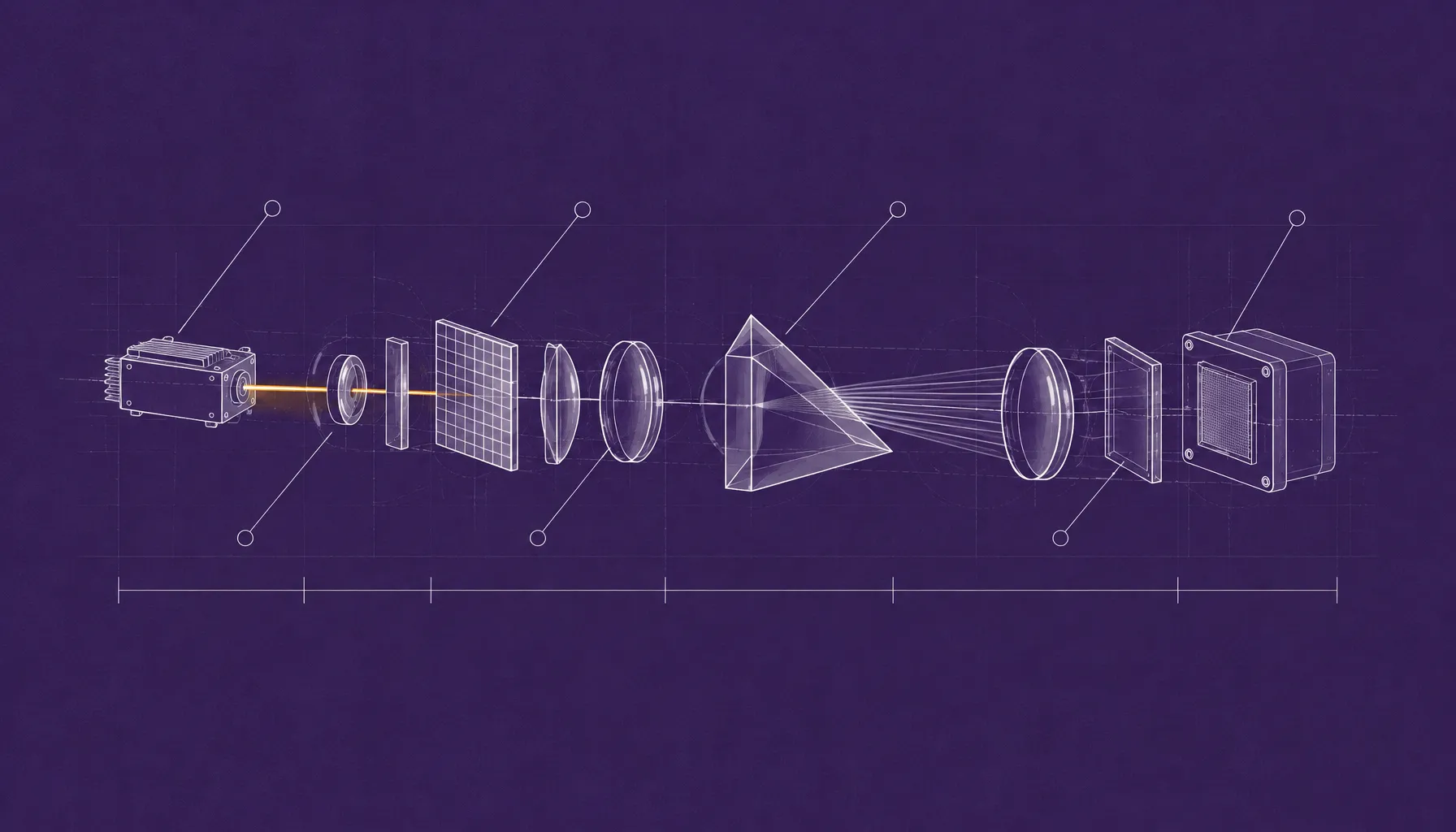
Scope (one sentence): The paper proposes and experimentally demonstrates an optical architecture that performs high-order tensor–matrix multiplication in a single light propagation, and uses it as a unified platform for both batched gate simulation and tensor-network contraction.
What This Paper Is About
Simulating quantum circuits on ordinary digital computers is hard because the state space grows exponentially with the number of qubits, so each additional qubit roughly doubles the work. The authors ask whether optics can relieve this bottleneck by exploiting concurrency that electronics cannot easily match. Their answer is an architecture in which a quantum gate and a whole batch of input states are treated as separate dimensions of one tensor, so that many simulation instances — or an eligible tensor-network contraction — are computed by a single pass of light through the processor.
Key Contributions
- A reframing of the simulation problem as a tensor problem. Gates and batches of input states are treated as independent tensor dimensions instead of separate, repeated simulation runs, which turns many simulation instances into one multi-dimensional operation.
- A unified architecture for two distinct workloads. Eligible tensor-network contractions are mapped onto the same optical processor used for gate–state batch simulation, so the two task families share one framework rather than requiring separate machines.
- A co-designed encode/readout scheme across two optical degrees of freedom. Multidimensional encoding and readout across spatial and wavelength dimensions enable high-order tensor–matrix multiplication, which the authors realize experimentally in a single propagation, processing all computational-basis inputs for each 4-qubit gate.
- A numerical evaluation of algorithmic workloads. Using a physics-based model of optical propagation, the authors assess the architecture on the Deutsch algorithm and on the tensor network of all 128 target instances of a 7-qubit Grover algorithm.
Main Findings
-
Single-pass high-order tensor–matrix multiplication: The authors report experimental realization of high-order tensor–matrix multiplication in one propagation of light, achieved through co-designed multidimensional encoding and readout across spatial and wavelength degrees of freedom.
-
Full input batching per gate: For each 4-qubit gate, all computational-basis inputs are processed together, rather than simulated one at a time.
-
One framework, two task types: The same architecture addresses both batched gate–state simulation and eligible tensor-network contractions, which the abstract presents as the paper's unifying result.
-
Algorithm-level numerical assessment: A physics-based optical propagation model is used to evaluate the architecture numerically for the Deutsch algorithm and for the 7-qubit Grover tensor network spanning 128 target instances. The abstract does not report the quantitative outcomes of these evaluations — no fidelities, error levels, circuit depths, or wall-clock comparisons are given — so the specific performance claims cannot be assessed from the abstract alone.
-
Concurrency as the core resource: The stated conclusion is that optical concurrency can be exploited across different kinds of quantum simulation tasks, providing a route toward a shared optical simulation framework.
Methodology in Plain English
The team maps the mathematics of quantum circuit simulation onto the physics of light. A quantum gate applied to a set of qubits is a tensor, and instead of running that tensor against inputs one by one, they assign different parts of the problem to different physical properties of the light itself — where the light travels (spatial paths) and what color it is (wavelength). Because these properties are independent, many multiplications happen simultaneously as the light passes through the processor once. A matching readout design then separates the mixed output back into individual results.
They demonstrate the multiplication operation on real optical hardware for 4-qubit gates, covering all computational-basis inputs at once. Because building out full algorithms on hardware is costly, they then model the optical propagation numerically and use that model to estimate how the architecture would handle two well-known algorithms, Deutsch and Grover, including all 128 target instances of the 7-qubit Grover search.
Why This Matters
Research impact: Quantum algorithm development and hardware debugging depend on classical simulation, and that dependence becomes painful as qubit counts rise. Demonstrating that a physical optical processor can carry many simulation instances simultaneously, and can also absorb tensor-network contractions, suggests an alternative hardware path for a task currently dominated by GPUs and supercomputers. It also links two communities — photonic computing and tensor-network simulation — that usually work separately.
Potential applications:
- Verifying and debugging quantum processor designs and compiled circuits before running them on scarce quantum hardware.
- Rapid prototyping and testing of quantum algorithms such as search (Grover) and oracle-based interference (Deutsch).
- Accelerating tensor-network calculations, a mathematical tool used well beyond quantum computing in physics and machine learning.
- Informing the design of optical or photonic co-processors for structured linear-algebra workloads.
Industry relevance: Relevant to quantum computing companies needing simulation and verification tooling, to photonic computing and optical interconnect firms, and to high-performance computing operators looking at non-electronic accelerators for specific numerical kernels.
Future Directions
- Scaling beyond small gate widths and instance counts. The demonstrated experiments cover 4-qubit gates, while the 7-qubit Grover case is evaluated only numerically; extending hardware demonstrations to larger registers and larger tensor batches is the obvious next step.
- Broadening the class of supported contractions. The abstract refers to "eligible" tensor-network contractions, implying that some contractions do not map cleanly onto the hardware; characterizing and widening that eligible class is an open problem.
- Quantifying accuracy and noise in practice. The gap between a physics-based numerical propagation model and a real experimental run at algorithm scale needs closing, with error sources in encoding and readout characterized and mitigated.
- Moving from ideal algorithms to realistic circuits. Systematic validation against established digital simulators, including non-unitary operations such as measurement and noise channels, would clarify where optical simulation is genuinely advantageous.
Target Audience
Researchers and engineers working on quantum circuit simulation, tensor-network methods, and photonic or optical computing. It is also useful for quantum algorithm developers who rely on simulators, and for hardware architects evaluating non-electronic accelerators for structured linear-algebra workloads. Readers without a background in tensor networks or optical multiplexing will find the framing intuitive but the technical content demanding.
Authors’ abstract
Classical simulation is essential for developing and testing quantum circuits, but the exponential growth of Hilbert space challenges conventional digital processors. Here, we introduce a classical optical quantum simulation architecture that treats gates and batches of input states as independent tensor dimensions rather than separate simulation instances, while mapping eligible tensor network contractions onto the same processor. Using co-designed multidimensional encoding and readout across spatial and wavelength degrees of freedom, we experimentally realize high-order tensor-matrix multiplication in a single propagation and process all computational-basis inputs for each 4-qubit gate. Using a physics-based optical propagation model, we further numerically evaluate the architecture for the Deutsch algorithm and for the tensor network of all 128 target instances of a 7-qubit Grover algorithm. These results establish a unified framework for gate-state batch and tensor network simulation, providing a route to exploit optical concurrency across quantum simulation tasks.