Research
Quantum Černý complexity of binary words
Overview Research area: Quantum information theory intersecting with automata theory and algorithmic complexity — specifically a quantum analogue of Černý's synchronization problem for deterministic f
- arXiv
- 2609.40154
- Published
- 2026-09-30
- Authors
- Pui Hang Lee, Pui-Yee Lee, Bjørn Kjos-Hanssen
AI summary
Overview
Research area: Quantum information theory intersecting with automata theory and algorithmic complexity — specifically a quantum analogue of Černý's synchronization problem for deterministic finite automata, framed as a description-size measure for binary words.
Technical level: Advanced. The paper assumes familiarity with density matrices, completely positive trace-preserving (CPTP) maps, Kraus operators, the Bloch sphere parametrization of qubits, and classical synchronization theory.
Scope (one sentence): The paper defines and analyzes the quantum Černý complexity qc(w) of a binary word w — the least dimension of a quantum channel instance for which w is the unique shortest synchronizing word — establishing general bounds, proving constant words are extremal, constructing a qubit "counter" that makes patterned words cost nothing, and separating a pure-target variant.
What This Paper Is About
In classical automata theory, one can ask how many states a deterministic automaton needs for a given binary word w to be its unique shortest synchronizing (reset) word — this is the reset complexity rc(w), a machine-based description size in the spirit of automatic complexity. This paper introduces the quantum version: states become density matrices, letters become quantum channels, and "synchronizing" means the channel of w maps the entire reachable set of states to a single state (the target). The goal is to determine how many dimensions a quantum system must have to make a given word the unique shortest such word, and to compare this to the classical analogue.
Key Contributions
-
A new complexity measure. The paper defines
qc(w)— the least dimensiondsuch that some instance(d, A₀, A₁, ρ₀)of quantum channels ond×ddensity matrices haswas its unique shortest synchronizing word — together with a pure-target variantqc_pure(w)in which the reset state must be pure. -
General bounds with a quadratic quantum saving. It proves
2 ≤ qc(w) ≤ ⌈√(|w|+1)⌉for every nonempty word, and shows the constant word0^mattains the upper bound exactly:qc(0^m) = ⌈√(m+1)⌉. The saving over the classical automaton picture is quadratic, because coherences make available a difference space of dimensiond²−1rather thand−1. -
A qubit counter and the collapse of the Černý function. It shows
qc(01ⁿ0) = 2for everyn ≥ 1, realized by a single qubit whose rotation angle acts as a continuous counter. Consequently no quantum analogue of the Černý function exists: for each fixedd ≥ 2there are instances of dimensiondwhose unique shortest synchronizing words have unbounded length. -
A purity separation via an explicit qutrit. It proves no dimension-
2instance has a unique shortest synchronizing word of length at least2with pure target, then exhibits a qutrit instance achievingqc_pure(01ⁿ0) = 3, with target the basis state|e₂⟩⟨e₂|and synchronization holding universally over all3×3density matrices — so purity of the reset state costs exactly one dimension on this family.
Main Findings
-
Constant words are extremal. For every
m ≥ 1,qc(0^m) = ⌈√(m+1)⌉, matching the general upper bound of Theorem 2.4. Among words of its length, the "simplest" word is the most complex; the authors describeqcas strongly anti-correlated with intuitive notions of descriptive complexity. -
Patterned words are free.
qc(01ⁿ0) = 2for everyn ≥ 1. The construction usesA₀with Kraus operators projecting to the diagonal, andA₁a rotation withθ = π/(4n); after01ⁿ0any density matrix becomes½ I, the maximally mixed state. The angle is a continuous parameter used as a counter, verifying "exactlynones in a row" through a single orthogonality coincidence at zero dimensional cost. -
No quantum Černý function. Corollary 4.2: for each fixed
d ≥ 2, instances of dimensiondexist whose unique shortest synchronizing words have unbounded length. The classical counting argument that makes random words expensive fails over the continuous machine class, since there are only finitely many small classical automata but infinitely many continuous ones. -
Linearization and computability. Every synchronization question reduces to a matrix-mortality question: for traceless Hermitian matrices, the space
V = span_ℝ(R − R)is invariant under the real-linear actionsL₀, L₁, andusynchronizes iffL_uvanishes onV. MoreoverVis spanned by differences of states reachable by words of length at mostd²−1. Because of this,qc(andqc_pure) is computable via the first-order theory of the reals and Tarski's decision procedure — in contrast with the undecidability of general matrix mortality over the integers. -
The quadratic mechanism. Upper bounds come from a "depolarizing perturbation" lemma: any real-linear map
Lon the traceless Hermitian space can be embedded into a genuine quantum channel for sufficiently smallε, by perturbing the completely depolarizing channel. Encoding the Knuth–Morris–Pratt automaton ofwinto such maps on a space of dimensiond²−1 ≥ |w|yields the⌈√(|w|+1)⌉bound. -
No pure targets on a qubit. Theorem 5.1: no dimension-
2instance has a unique shortest synchronizing word of length at least2with pure target, so{w : qc_pure(w) = 2} = {0,1}. The proof uses a rigidity phenomenon: in dimension2every mixed state has full rank, and each Kraus operator is forced to be of the form|φ⟩⟨χᵢ|, making the last letter alone synchronize — a contradiction with minimality. -
Qutrit escape hatch. Theorem 5.2:
qc_pure(01ⁿ0) = 3for everyn ≥ 1, via a channelA₀that funnels populations1→2,2→3,3→2(constant, equal to|e₂⟩⟨e₂|, on the face supported onspan(e₁,e₃)) combined with a rotationUin the(e₁,e₂)-plane withθ = π/(2n). A dimension-3state space admits proper faces; a qubit's does not. -
Purity costs exactly one dimension on this family. Corollary 5.3:
qc(01ⁿ0) = 2 < 3 = qc_pure(01ⁿ0) ≤ ⌈√(n+3)⌉forn ≥ 7. The pure-target variant also admits no Černý function, since fixed dimension3supports unique shortest synchronizing words of unbounded length with basis-state targets. -
Non-monotonicity.
qc(0⁸) = 3whileqc(01⁸0) = 2, soqcis wildly non-monotone in length and under taking factors. -
Fragility. Both counter constructions live on codimension-one coincidences (an inner product vanishing; a cosine vanishing). Under generic perturbation of parameters, no word synchronizes exactly — the authors flag an
ε-approximate theory as deserving separate study. In the qutrit instance the face-collapse mechanism is robust; only the steering stepUⁿis a measure-zero coincidence. -
Classical comparison. Realizing the same automaton classically with deterministic channels on
ℂ^(n+1)givesqc_pure(w) ≤ |w| + 1with a pure target, so both quantities are finite and the quantum saving in Theorem 2.4 is genuinely quadratic. The classical counting argument givesrc(w) ≳ m/(2 log m)for most words of lengthm. -
The qutrit instance is irreducibly quantum. The classical shadow of
A₀on diagonal states is the map1→2,2→3,3→2, which can never synchronize alone since states2, 3cycle; the coherent rotation transferring population back to level1before the funnel closes is what makes it work.
Methodology in Plain English
The authors start from a striking observation: quantum channels act affinely on density matrices, which means the condition "the word's channel sends all reachable states to one state" can be rewritten as a purely linear-algebraic condition — a product of real-linear maps must vanish on a certain invariant subspace of the (d²−1)-dimensional space of traceless Hermitian matrices. This turns the synchronization question into a matrix-mortality question over a concrete finite-dimensional real vector space, and also shows the relevant subspace is determined by finitely many words (of length at most d²−1).
For upper bounds, the authors use a perturbation trick: take the completely depolarizing channel and add a small multiple ε of an arbitrary real-linear map. Since the depolarizing channel's Choi matrix is the full-rank identity, complete positivity survives for small ε, so any linear map can be realized as part of a genuine quantum channel. This lets them simulate a classical pattern-matching automaton (the Knuth–Morris–Pratt automaton of w) inside quantum channels on a space whose dimension grows like the square root of the word length — the source of the quadratic saving.
For lower bounds, they argue about nilpotency: if 0^m is the unique shortest synchronizing word, the operator L₀ restricted to the invariant subspace must be nilpotent of index exactly m, which forces m ≤ dim V ≤ d²−1.
For the qubit construction, they write channels in the Bloch ball picture (x ↦ Bx + c) and design a measurement-like channel that kills off-diagonal entries plus a rotation by θ = π/(4n) that turns exactly n ones into a quarter turn.
For the pure-target separation, they first prove a rigidity theorem for qubits (analyzing Kraus operators via positivity of each summand in Σ Kᵢ σ Kᵢ†), then construct an explicit qutrit with a funnel channel and a rotation, and verify minimality and uniqueness by tracking a single scalar parameter y through the word and showing the induced affine maps are injective unless a run length is congruent to n modulo 2n.
Why This Matters
Impact on research. The paper opens a quantum counterpart to reset complexity and the Černý conjecture, and delivers a largely negative but structurally informative answer: because continuous parameters can encode integers at zero dimensional cost, the quantum measure does not behave like a Kolmogorov-style description length. What remains expensive is exact nilpotency depth — the one resource continuous parameters cannot shortcut. The computability result (via real quantifier elimination) contrasts sharply with undecidability of general matrix mortality over the integers, and the paper provides a Lean 4 formalization of its results. The qutrit construction is a concrete demonstration of a task that is genuinely quantum rather than a disguised automaton.
Real-world applications (speculative, as the paper does not claim these):
- Quantum control and reset protocols: understanding the minimal Hilbert-space dimension needed to force a quantum system into a designated state bears on initialization and reset primitives in quantum hardware.
- Synchronizing codes and stream alignment: classical synchronizing words underlie resynchronization of data streams and error-recovery; quantum analogues could inform alignment procedures for quantum data.
- Verification of finite-dimensional quantum protocols: the linearization technique converts state-equality conditions on channels into finite matrix conditions, a template for certifying that a sequence of operations erases history.
- Distinguishing quantum from classical resources: the qutrit instance gives a certified example where coherence, not classical state count, does the work — useful for benchmarking where quantum advantage can originate.
Industry relevance. The results are foundational rather than immediately deployable. They are most relevant to quantum-software and quantum-control teams interested in minimal-resource compilation of reset and initialization sequences, and to groups building formally verified quantum reasoning tools (the paper ships a Lean 4 formalization).
Future Directions
-
Characterize the dimension-2 class. The authors conjecture
qc(01101001) = 2(the Thue–Morse prefix), withqc(01101001) ≤ 3following from the general bound. More broadly, characterizing{w : qc(w) = 2}is open; a Bloch-picture dimension count suggests the class is large, but it is unknown whether, for example, all words with at least one alternation and no long constant power belong to it. -
Complexity of computing
qc. The computability proof via real quantifier elimination is far from efficient. Open: isqc(w)computable in time polynomial in|w|? Is{(w,k) : qc(w) ≤ k}in NP, or in the existential theory of the reals? -
Typical and extremal words. What is
qc(w)for a uniformly random word of lengthm? The classical counting argument givesrc(w) ≳ m/(2 log m), but it is consistent with these results thatqc(w) = 2for almost allw. Separately, is0^m(with its reversal and complementations) the unique maximizer ofqcamong words of lengthm, for all largem? -
Pure-target savings and robust complexity. Does a general quadratic-type saving
qc_pure(w) ≤ O(√|w|)hold, i.e. a pure-target analogue of the main upper bound? The proof of Theorem 2.4 places the target at the maximally mixed state and does not adapt. Also open: develop theε-approximate theory and determine which words remain expensive when eigenvalue-decay mechanisms are available, and whether a robust analogue of the no-Černý-function corollary exists.
Target Audience
Researchers in quantum information theory, automata theory, and algorithmic complexity who work on synchronization, reset words, and description-size measures; graduate students with a background in CPTP maps and finite automata looking for an accessible entry point into quantum generalizations of classical automata notions; and formal-verification practitioners interested in the machine-checked Lean 4 development accompanying the paper.
Authors’ abstract
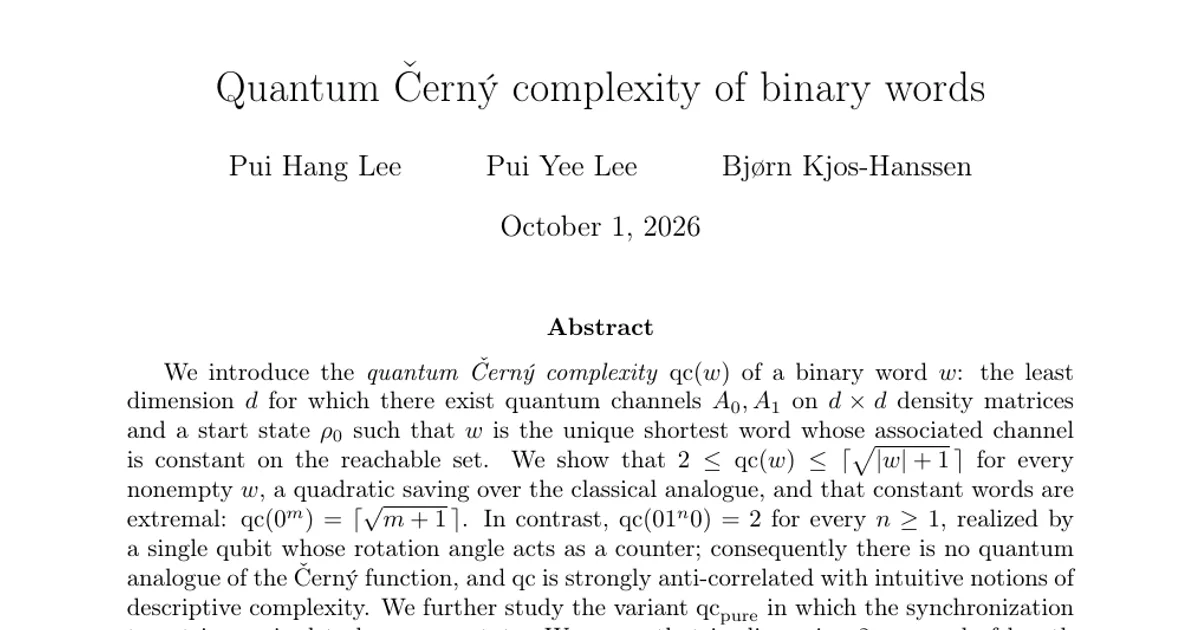
We introduce the quantum Černý complexity $\mathrm{qc}(w)$ of a binary word $w$: the least dimension $d$ for which there exist quantum channels $A_0,A_1$ on $d\times d$ density matrices and a start state $ρ_0$ such that $w$ is the unique shortest word whose associated channel is constant on the reachable set. We show that $2\le\mathrm{qc}(w)\le\lceil\sqrt{|w|+1}\,\rceil$ for every nonempty $w$, a quadratic saving over the classical analogue, and that constant words are extremal: $\mathrm{qc}(0^m)=\lceil\sqrt{m+1}\,\rceil$. In contrast, $\mathrm{qc}(01^n0)=2$ for every $n\ge 1$, realized by a single qubit whose rotation angle acts as a counter; consequently there is no quantum analogue of the Černý function, and $\mathrm{qc}$ is strongly anti-correlated with intuitive notions of descriptive complexity. We further study the variant $\mathrm{qcp}$ in which the synchronization target is required to be a pure state. We prove that in dimension $2$ no word of length at least $2$ can be a unique shortest synchronizing word with pure target, and we exhibit an explicit qutrit instance, combining a coherent rotation with a measure-and-funnel channel, achieving $\mathrm{qcp}(01^n0)=3$ with target a computational basis state and with synchronization holding universally over all input states. Thus purity of the reset state costs exactly one dimension on this family. We also observe that $\mathrm{qc}$ is computable, by reduction to the first-order theory of the reals.