Research
Quantifying the fidelity of a quantum memory
Overview Research area: Quantum information science, specifically the certification and benchmarking of quantum memories (devices that store quantum states, typically photonic qubits, for later retrie
- arXiv
- 2610.08445
- Published
- 2026-10-06
- Authors
- Victor Barizien, Sophie Egelhaaf, Angelo Gelmini Rodriguez, Louis Nicolas, Théo Sanchez Mejia, Mikael Afzelius, Pavel Sekatski, Nicolas Brunner
AI summary
Overview
Research area: Quantum information science, specifically the certification and benchmarking of quantum memories (devices that store quantum states, typically photonic qubits, for later retrieval) using tools from quantum channel theory.
Technical level: Intermediate. The authors include a pedagogical introduction, but the core results rely on 2-designs, the Choi–Jamiołkowski isomorphism, semidefinite programming, and channel capacity concepts.
Scope (one sentence): This paper proposes the average channel fidelity as an operationally meaningful, experimentally accessible figure of merit for quantum memories, develops exact estimation protocols and lower-bound witnesses for it, and applies them to a solid-state time-bin qubit memory, certifying 98.6% fidelity.
What This Paper Is About
Quantum memories are essential for future quantum networks, but there is no standard, platform-independent way to quantify how well one works. Existing experiments either probe an ad hoc list of input states or test whether entanglement survives storage, and these results are hard to compare across platforms and lack a clear operational meaning. The paper's goal is to define a single figure of merit — the average channel fidelity, i.e. how closely the memory approximates the identity channel, averaged over all pure input states — and to show how it can be estimated or lower-bounded with realistic, finite experimental effort.
Key Contributions
-
An operational figure of merit with exact finite estimation. The average channel fidelity F_avg(M, id) is defined as an integral over all pure states with the Haar measure, yet it can be computed exactly from a finite set of probe states forming a 2-design. The paper presents this as a unified framework replacing ad hoc state choices and entanglement-witness tests.
-
A hierarchy of experimentally friendly witnesses. Beyond 2-designs, the authors derive lower bounds on F_avg from smaller, simpler state sets: 4-state and 2-state qubit protocols (with an SDP-computed bound for the 2-state case), a product witness for composite/multi-qubit memories, a two-MUB nonlinear witness using 2d probe states in dimension d, and a minimal d-state witness that is faithful (unit witness value implies an ideal channel).
-
Connections to other channel properties. The paper shows that a certified F_avg directly yields bounds on the worst-case fidelity, on the channel's Schmidt number/dimensionality (SN(M) ≥ ⌈d F_CJ⌉ = ⌈(d+1)F_avg − 1⌉), and on its quantum capacity. Thresholds F_avg > 2/(d+1) rule out entanglement breaking and F_avg > 1/d rule out correlation breaking.
-
Experimental certification of a solid-state memory. Applying the methods to a solid-state quantum memory storing a time-bin photonic qubit, the authors certify average channel fidelities of 98.6% and 98.5% for storage times of 10 μs and 125 μs, at efficiencies of 16.6% and 3.65% respectively.
Main Findings
-
Six Pauli states give the exact average fidelity for qubits. The set S_6 of eigenstates of σ_z, σ_x and σ_y is a 2-design, requiring only three projective measurements (a complete set of MUBs). The average channel fidelity equals the average of the six measured input–output fidelities, and this recovers a result previously obtained by direct Bloch-sphere integration. The paper notes that several earlier qubit memory experiments used these six states as an ad hoc choice without recognizing the connection to average channel fidelity.
-
Smaller state sets give valid lower bounds. Four equatorial Pauli states S_4 = {|0⟩, |1⟩, |+⟩, |−⟩} yield F_avg ≥ (4 T_{S_4} − 1)/3, and two non-orthogonal states S_2 = {|0⟩, |+⟩} give F_avg ≥ f_2(T_{S_2}), where f_2 is a convex function defined by a semidefinite program. Both underestimate the fidelity (certifying non-entanglement-breaking needs T_{S_4} > 3/4 rather than T_{S_6} > 2/3), but both can certify an ideal memory when the witness value reaches 1, making the two-state protocol minimal for that purpose.
-
A SIC POVM is the smallest qubit 2-design. The four states forming a regular tetrahedron on the Bloch sphere (d² states, the minimum cardinality for a 2-design) also work, but require four projective measurements since the states are not pairwise orthogonal.
-
Entanglement-based estimation is equivalent. Preparing a maximally entangled state and storing one half defines the Choi state and the Choi fidelity F_CJ. Since one channel is unitary, the two quantities are one-to-one related by (d+1) F_avg = d F_CJ + 1, so they are rescalings of the same property. For qubits, measuring the three correlators E_XX, E_YY, E_ZZ in the X, Y, Z bases suffices; the four-state witness in this setting becomes F_avg ≥ (E_XX + E_ZZ + 1)/3.
-
Lossy memories are handled by two separate numbers. For probabilistic memories that sometimes output vacuum (orthogonal to the input space), the paper separates the average efficiency η(M) and the conditional fidelity F̄_avg = F_avg / η, both estimable from 2-design probe sets, with a corresponding conditional Choi fidelity.
-
High dimensions have explicit 2-designs and cheaper witnesses. MUBs form 2-designs with d(d+1) states for prime-power dimensions (existence in all dimensions is conjectured not to hold); SIC POVMs give d² states, minimal but explicitly constructed only up to about d = 67; weighted 2-designs can be built from sufficiently many orthonormal bases. For n simultaneously stored qubits, product sets S_6^{⊗n} or S_4^{⊗n} give valid global bounds using 6^n or 4^n states, even though a product of subsystem 2-designs is not itself a global 2-design. A two-MUB construction from prior work uses 2d states, and a d-state witness is faithful and provably minimal, since fewer than d states cannot span the Hilbert space.
-
General statistics can be turned into a bound via SDP. For arbitrary mixed probe states and POVMs, the Choi fidelity is lower-bounded by a semidefinite program whose constraints include the observed probabilities; SDP solvers converge to the global minimum under mild regularity conditions, unlike local nonlinear optimizers.
-
Fidelity implies dimensionality and capacity. Because the Schmidt number of the channel bounds from below as ⌈(d+1)F_avg − 1⌉, any fidelity witness also certifies that the memory transmits high-dimensional quantum information; the paper further states that the fidelity relates to the channel's quantum capacity, defined as the maximal number of Bell pairs per channel use between input and output parties. The detailed capacity derivation lies in a portion of the text beyond what was available here.
-
Experimental result. A solid-state quantum memory with a time-bin photonic qubit is certified at 98.6% average channel fidelity with 16.6% efficiency at 10 μs storage, and 98.5% with 3.65% efficiency at 125 μs.
Methodology in Plain English
The researchers model the memory as a quantum channel: a black box that takes an input quantum state and returns an output state after the storage time. An ideal memory returns exactly what went in, so quality is measured by how close the channel is to the identity. Averaging the input–output overlap over every possible pure input state is the natural score, but the average is an integral over infinitely many states.
The key trick is that this particular integral is a quadratic function of the input state, so it can be evaluated exactly by averaging over a finite, carefully symmetric collection of states called a 2-design — for a qubit, the six Pauli eigenstates. In the lab, one prepares each probe state, sends it through the memory, and measures whether the output matches the input; the fraction of matching outcomes directly gives that state's fidelity, and the plain average over the set gives the channel fidelity.
For situations where preparing a full 2-design is impractical, the team derived inequalities that convert the observed average over a smaller set of states into a guaranteed lower bound on the true average fidelity, including cases with only two or four probe states. The tightest such bounds are computed by semidefinite programming, which finds the worst-case channel consistent with the observed data. They also translated everything into an entanglement-based version, where one half of a maximally entangled pair is stored, and into a version that tolerates the vacuum losses typical of photonic memories. Finally, they ran these protocols on an actual solid-state memory to produce a certified number rather than an estimate.
Why This Matters
Research impact. The work gives the quantum memory community a single, platform-independent, operationally justified benchmark. It retroactively explains why a common six-state experimental practice works, provides rigorous shortcuts for groups that cannot perform full tomography or complete MUB measurements, and links a measurable fidelity to fundamental channel properties (entanglement breaking, dimensionality, capacity). The authors note the certification methods apply equally to other quantum devices such as fibers, transducers and gates.
Real-world applications (as motivated by the paper):
- Quantum repeaters and long-distance quantum communication networks, where memories must be benchmarked comparably across platforms such as atomic ensembles and solid-state systems.
- High-dimensional quantum communication, e.g. memories storing orbital angular momentum or time-bin encodings, where the dimensionality certificate matters.
- Benchmarking photonic interconnects, fibers and transducers with the same fidelity figure of merit.
- Validating quantum gates and channels in computing hardware, since a gate is also a channel that should approximate a target unitary.
Industry relevance. Companies and labs building quantum networking hardware need standardized, defensible performance claims; a fidelity number with a proven lower bound and a known relation to capacity is far more useful for procurement, comparison and roadmapping than a collection of ad hoc state fidelities. The low-state-count witnesses are attractive for commercial devices where measurement time is expensive.
Future Directions
- Semi-device-independent certification. The abstract and introduction promise a scenario where the output measurement is treated as a black box; the details fall in the portion of the text not available here, and extending and testing such protocols remains open.
- Scaling witnesses to genuinely high dimensions. The two-MUB and d-state witnesses trade rigor for practicality; how much fidelity is lost in these bounds, and whether tighter O(d)-state witnesses exist, is a natural next question.
- Applying the framework beyond memories. The authors explicitly invite application to fibers, transducers and gates; establishing standardized protocols and reference thresholds for those devices is a logical follow-up.
- Connecting certified fidelity to quantum capacity quantitatively. The paper states the link, but turning a measured fidelity into a usable rate bound for realistic, lossy memories (including the efficiency/conditional-fidelity split) would make the framework directly actionable for network design.
Target Audience
Experimental groups working on quantum memories and quantum repeaters who need a defensible benchmark; quantum information theorists interested in channel certification and 2-design techniques; graduate students entering quantum networking who want a pedagogical, self-contained treatment connecting state tomography, entanglement tests and channel capacity; and engineers or program managers evaluating quantum hardware who need to interpret a claimed fidelity figure and know what it does and does not guarantee.
Authors’ abstract
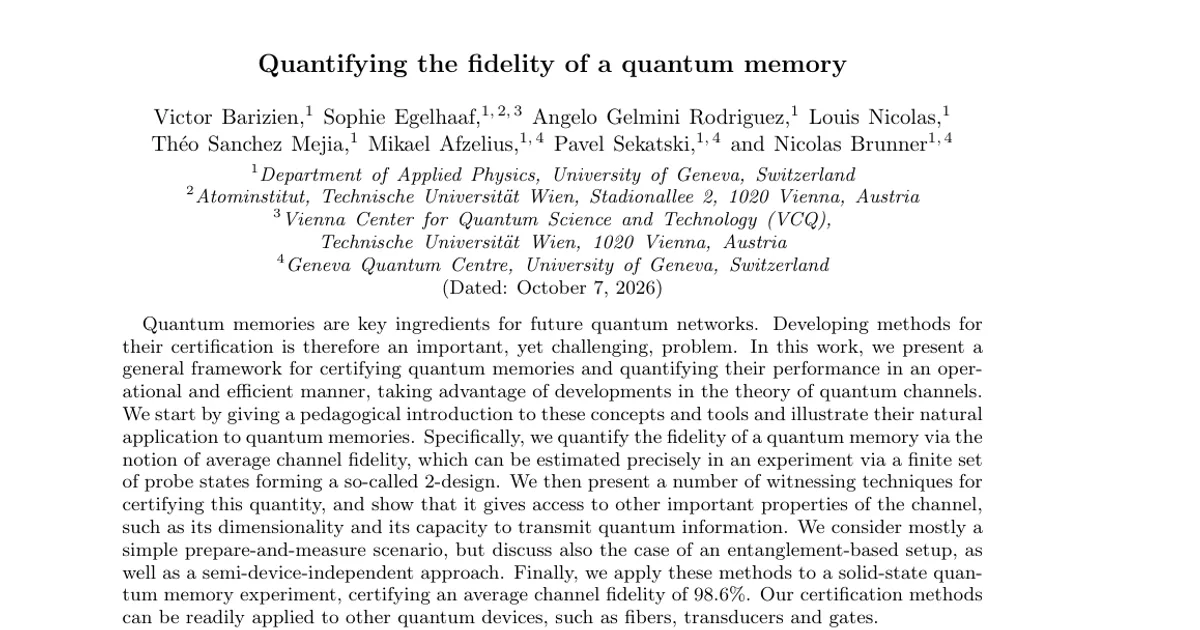
Quantum memories are key ingredients for future quantum networks. Developing methods for their certification is therefore an important, yet challenging, problem. In this work, we present a general framework for certifying quantum memories and quantifying their performance in an operational and efficient manner, taking advantage of developments in the theory of quantum channels. We start by giving a pedagogical introduction to these concepts and tools and illustrate their natural application to quantum memories. Specifically, we quantify the fidelity of a quantum memory via the notion of average channel fidelity, which can be estimated precisely in an experiment via a finite set of probe states forming a so-called $2$-design. We then present a number of witnessing techniques for certifying this quantity, and show that it gives access to other important properties of the channel, such as its dimensionality and its capacity to transmit quantum information. We consider mostly a simple prepare-and-measure scenario, but discuss also the case of an entanglement-based setup, as well as a semi-device-independent approach. Finally, we apply these methods to a solid-state quantum memory experiment, certifying an average channel fidelity of 98.6%. Our certification methods can be readily applied to other quantum devices, such as fibers, transducers and gates.