Research
Qmes: Quantum Meta-Learning for Encoding Selection in Quantum Kernel Methods
Overview Research area: Quantum machine learning, specifically quantum kernel methods (QKMs), combined with classical meta-learning and research software engineering. Technical level: Intermediate. Re
- arXiv
- 2609.04652
- Published
- 2026-09-04
- Authors
- Dao Duy Tung, Quoc Chuong Nguyen, Vu Tuan Hai, Le Bin Ho, Lan Nguyen Tran
AI summary
Overview
Research area: Quantum machine learning, specifically quantum kernel methods (QKMs), combined with classical meta-learning and research software engineering.
Technical level: Intermediate. Readers should know what a quantum feature map and a kernel matrix are, but the paper is written as a software/benchmark paper and explains its pipeline step by step.
Scope (one sentence): The paper presents Qmes, an open-source Python package that learns to predict which quantum encoding circuit will work best for a new tabular dataset, so that users can skip exhaustive quantum evaluation at inference time.
What This Paper Is About
In a quantum kernel method, the encoding circuit defines the kernel, and therefore defines what "similar" means to the downstream learner. Different circuits therefore produce different results, and the standard way to choose one is to build and score the kernel matrix for every candidate circuit on every new dataset, at a cost of O(n²) pairwise kernel evaluations per circuit per dataset. The authors' goal is to replace that per-dataset search with a trained recommender: characterize the dataset with classical complexity measures, then query a pre-trained model that returns a ranked list of circuits using only classical computation.
Key Contributions
-
A packaged meta-learning pipeline. Qmes implements a two-stage framework: an offline stage that extracts complexity meta-features and scores every circuit in a pool as a quantum kernel, and an inference stage that maps a new dataset's complexity vector to a circuit ranking. The package is released under the MIT License, requires Python ≥ 3.10 (tested on 3.10–3.12), and depends on Problexity, the Qsun simulator, NumPy, pandas, and scikit-learn.
-
Extension from classification to regression, plus a one-vs-one formulation. The authors' earlier proof-of-concept covered classification only. Qmes adds a regression path (12 regression meta-features instead of 22 classification meta-features, Kernel Ridge Regression with R² scoring instead of SVC with MCC) and replaces direct multi-class selection with a pairwise one-vs-one (OvO) scheme of binary "comparators" whose votes are tallied into a ranking.
-
Distributed pre-trained recommenders and a modular, extensible architecture. Three abstract core components (FeatureExtractor, QuantumEvaluator, Recommender) plus four utility modules (Preprocessing, CircuitRegistry, ModelSelection, InferenceRunner) let users add new meta-features, new circuits, or new evaluators without rewriting the recommender or inference path. Fitted models ship serialized in
importlib.resourcesand load with a single call. -
Benchmark validation on 105 classification and 86 regression datasets. The package is validated against 105 classification and 86 regression benchmark datasets, with an additional external case study on the HTRU2 pulsar-candidate dataset, and with software-quality evidence including 81 tests, 94% combined line-and-branch coverage, and mutation testing.
Main Findings
-
Regret reduction against a non-adaptive baseline: mean recommendation regret drops from 0.0366 (LOO Best-Avg) to 0.0165 for classification, and from 0.0626 to 0.0150 for regression — reported as a 2.2× and 4.2× reduction respectively.
-
Statistical significance: a paired Wilcoxon signed-rank test on per-dataset regret differences gives p = 5.42 × 10⁻⁵ for classification and p = 1.56 × 10⁻⁵ for regression; the abstract summarizes this as p < 10⁻⁴.
-
Same configuration wins both tasks: k-nearest neighbors with the top-10 mutual-information-selected features achieves the lowest leave-one-out mean regret in both panels (ρ̄(MCC) = 0.0165, ρ̄(R²) = 0.0150) and is set as the default for both classification and regression.
-
A small circuit pool is enough to matter: the pool contains seven encoding circuits (unit, SRx, RY, HERx, RY_CX, ZFM, HD), and the top recommendation varies meaningfully by dataset in the benchmark tables.
-
Meta-dataset filtering removes uninformative datasets: datasets are dropped as "no-signal" if max over circuits of the score is below 0.1, and as "ceiling" if the minimum score is at least 0.99, which yields the N = 105 and N = 86 sizes reported throughout.
-
External case study on HTRU2: on a stratified subsample of 600 candidates (55 pulsars), Qmes recommends HERx, RY, and unit. All three classify all 545 non-pulsars correctly (FP = 0), so they differ only in pulsar recall: HERx reaches Y(MCC) = 0.862 (42 of 55 recovered, 13 missed), RY 0.829 (39 recovered, 16 missed), and unit 0.781 (35 recovered, 20 missed).
-
Errors concentrate in the class-overlap region: the figure analysis shows every circuit recovers the well-separated pulsars, so the MCC ranking is decided entirely by pulsars lying among the non-pulsars near the decision boundary.
-
Software quality evidence: 81 tests run in continuous integration across Python 3.10–3.12; mutation testing over three modules kills 631 of 700 mutants (90.1% mutation score), with no survivors in the leave-one-out selection module and the remaining 69 survivors manually confirmed as equivalent mutants.
Methodology in Plain English
The authors treat circuit selection as an ordinary supervised learning problem where the input is a description of the dataset and the output is a set of circuit scores.
-
Describe the dataset cheaply. Each dataset is compressed into a fixed-length vector of classical complexity measures computed from the raw features and labels — 22 dimensions for classification and 12 for regression. Missing values are median-imputed, datasets above 600 samples are subsampled, and features are min-max scaled to [0, 1] as Problexity requires. Two measures per task are stochastic, so each is averaged over 10 fixed seeds (0–9) to make outputs deterministic.
-
Score the circuits once, offline. Every circuit in the pool is evaluated as a quantum kernel using 3-fold cross-validation with a precomputed kernel and a fixed random state. Features are standardized, reduced by PCA to at most 4 components to match the qubit count, and rescaled to [0, π] (or [0, 1] for unit). Classification is scored by a support vector classifier with the Matthews correlation coefficient; regression by kernel ridge regression with R². Averaging over the 3 folds gives one number per (dataset, circuit) pair, and the collected pairs form the meta-dataset.
-
Learn pairwise comparisons rather than a single best label. For every pair of circuits, a binary classifier is trained to predict which of the two scores higher on a given dataset. At inference, all pairs vote and the circuits are ranked by vote count. The authors motivate this by the small meta-dataset size (about 100 datasets per task) and by the wish to preserve full ordering information rather than collapsing it to one label.
-
Choose the recommender configuration by leave-one-out. Each meta-feature is ranked by mutual information against the best-circuit label, and subsets of the top m features are tried (m ∈ {5, 10, 15, 20, full} for classification, {5, 8, 10, full} for regression) across 14 classical machine learning models. Every configuration is scored by leave-one-out mean regret, and the best is refitted on the full meta-dataset and serialized.
-
Compare against non-adaptive baselines. The trained recommender is compared to LOO Best-Avg (pick the circuit with the best average on the other datasets), LOO Modal (pick the most frequent winner on the other datasets), and Random, on the real benchmark meta-datasets.
Why This Matters
Research impact. The paper reframes a costly hyperparameter-like decision in quantum kernel methods as a classical meta-learning problem, and it releases both the code and the fitted models. That makes circuit-choice studies reproducible and gives other groups a baseline and an extension point (new circuits, new meta-features, new evaluators) without rebuilding the quantum evaluation loop.
Real-world applications (areas where tabular classification/regression with a kernel is the natural fit):
- Pulsar candidate screening in radio surveys, demonstrated directly on HTRU2 with 17,898 labelled candidates and eight continuous features.
- Scientific tabular classification where kernel methods are already used, such as the supernova classification from spectral features cited in the introduction.
- Small-to-medium tabular regression problems where a kernel ridge model is appropriate and the target is continuous.
- Any supervised tabular workflow where several candidate quantum feature maps exist and per-dataset quantum evaluation is the bottleneck.
Industry relevance. The inference path is entirely classical: the quantum cost is paid once when the meta-dataset is constructed, and the shipped model returns recommendations without any quantum evaluation. That is the shape a practical tool needs — a cheap classical call in a deployment pipeline, with the expensive quantum work amortized offline.
Future Directions
- Enlarging the circuit pool and meta-dataset. The authors state both can be expanded without structural changes, so the natural next question is whether rankings improve as the pool grows and the meta-dataset covers more dataset families.
- A variational oracle. The evaluator interface is designed to admit circuits whose parameters are trained rather than fixed, which would extend the method beyond fixed, non-trainable feature maps.
- Noise-aware evaluation. All current scores come from noiseless state-vector simulation, so hardware errors are not reflected in the recommendations; noisy simulation or real hardware evaluation is an explicit planned extension.
- Beyond supervised learning. Extending Qmes to unsupervised tasks would require meta-features that do not depend on labelled targets, which the current complexity measures do.
Target Audience
Quantum machine learning researchers and practitioners who use quantum kernel methods on tabular data and need a principled way to pick a feature map; research software engineers who want a documented, tested, extensible package rather than a script; and reviewers or students who want a concrete, benchmarked example of how classical meta-learning can be layered on top of a quantum pipeline. Beginners will follow the architecture and results sections but will need background on kernels and quantum feature maps to follow the formalism.
Authors’ abstract
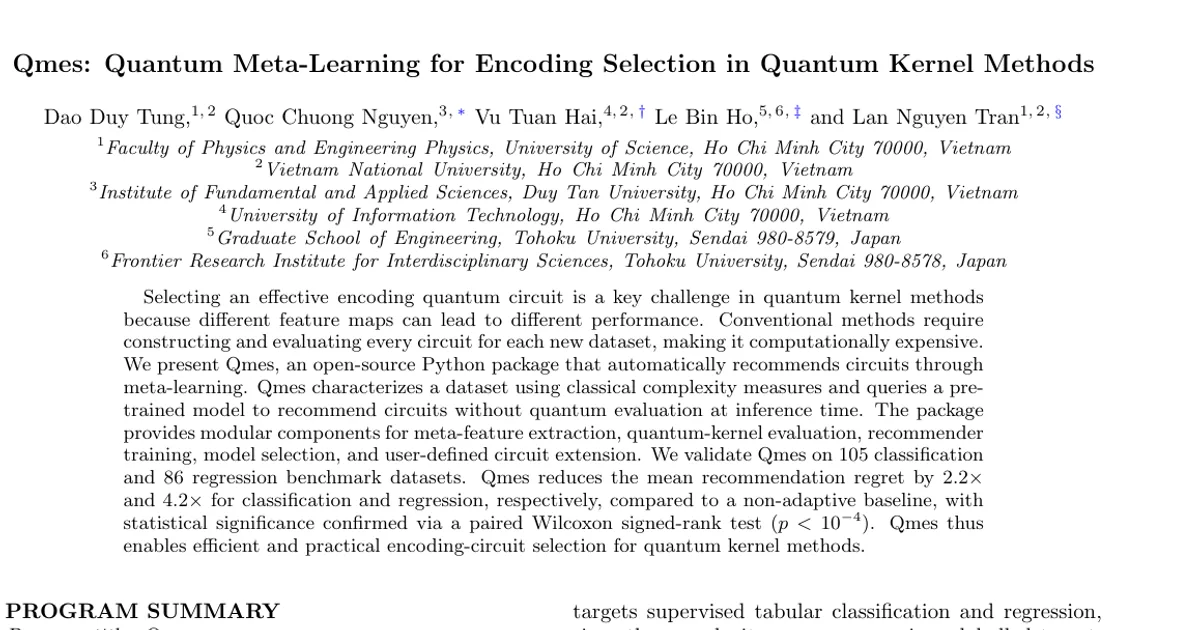
Selecting an effective encoding quantum circuit is a key challenge in quantum kernel methods because different feature maps can lead to different performance. Conventional methods require constructing and evaluating every circuit for each new dataset, making it computationally expensive. We present Qmes, an open-source Python package that automatically recommends circuits through meta-learning. Qmes characterizes a dataset using classical complexity measures and queries a pre-trained model to recommend circuits without quantum evaluation at inference time. The package provides modular components for meta-feature extraction, quantum-kernel evaluation, recommender training, model selection, and user-defined circuit extension. We validate Qmes on 105 classification and 86 regression benchmark datasets. Qmes reduces the mean recommendation regret by 2.2x and 4.2x for classification and regression, respectively, compared to a non-adaptive baseline, with statistical significance confirmed via a paired Wilcoxon signed-rank test ($p < 10^{-4}$). Qmes thus enables efficient and practical encoding-circuit selection for quantum kernel methods.