Research
Q-MERGE: Parallelising Quantum State Preparation for Large-Scale Classical Data
Overview Research area: Quantum computing — quantum state preparation and quantum data encoding (amplitude encoding of classical data). Technical level: Advanced (assumes familiarity with quantum circ
- arXiv
- 2610.04247
- Published
- 2026-10-03
- Authors
- Archie Butterworth, Jens Renders, Jingbo Wang
AI summary
Overview
Research area: Quantum computing — quantum state preparation and quantum data encoding (amplitude encoding of classical data). Technical level: Advanced (assumes familiarity with quantum circuits, amplitude encoding, block encodings and tensor-network state preparation, though the summary below is written in plain language). Scope: The paper introduces Q-MERGE, a framework that splits a large amplitude-encoded target state into independently prepared segments and then coherently merges them, and it benchmarks the method on an ultrasound dataset both in simulation and on trapped-ion hardware.
What This Paper Is About
Many quantum algorithms assume the input data already sits in the amplitudes of a quantum state, but preparing that state is often the dominant cost — in the worst case it grows exponentially with the number of qubits. The authors propose a way to break this bottleneck by cutting a large target state into M smaller, easier-to-prepare segments, preparing those segments in parallel on separate registers, and then merging them into one state on a much smaller register. The goal is to make large classical datasets encodable at high fidelity while exposing a tunable trade-off between circuit depth and qubit count.
Key Contributions
- A new state-preparation framework (Q-MERGE, "Quantum Multi-ReGister Encoding"). A target state is partitioned into M segments of n qubits each, each segment is prepared by its own circuit U_prep^(i), and the segments are combined using SELECT-SWAP operations controlled on an index register, followed by computational-basis measurement of the preparation registers. The framework is agnostic to how each segment is prepared, so existing methods can be reused on smaller subproblems.
- A second stage that restores the original segment weights. Stage 1 produces a "weighted stack" state whose weights w_i are determined by the measurement outcomes and the known input data. Stage 2 applies a block-encoded diagonal re-weighting operator (M controlled rotations on a single ancilla) to recover the exact target state, succeeding with probability 1/β² where β = max_i |α_i|.
- A classical preprocessing trick to rescue the post-selection probability. A shallow "flattening" circuit V of 10 brickwall layers of two-qubit SU(4) gates is optimised classically to minimise the inverse participation ratio (IPR) of the state, which boosts the re-weighting success probability; V† is then applied to undo the transformation.
- A qubit-efficient variant. By allowing mid-circuit measurement and reset, a fixed number of preparation registers can be reused, reducing the required ancilla/preparation qubits from O(Mn) to O(n) while preserving the O(M log³(m) + Mn) main-register depth, and enabling encoding of data generated on the fly.
Main Findings
- Large fidelity gain in simulation on real data: On a real 128 × 256 ultrasound dataset (the "R75" dataset, partitioned into M = 128 rows of length N = 256, each row prepared with Schmidt Spectrum Optimisation using 200 L-BFGS-B iterations per staircase layer and 100 layers of SU(4) gates), Q-MERGE reached an infidelity of 1.066 × 10⁻⁸, versus 3.413 × 10⁻¹ for directly encoding the full state with the same underlying method — described by the authors as a seven-order-of-magnitude improvement.
- Stage 2 needed help from preprocessing: Simulating the Stage 1 measurement gave a re-weighting success probability of only P = 0.0053 before preprocessing; the 10-layer brickwall flattening circuit raised this to P = 0.3154. The preconditioned state's infidelity was 1.478 × 10⁻⁸.
- Haar-random state analysis: Numerical analysis of Haar-random states indicates consistent success probability for up to M = 10⁷ segments, which the authors cite as evidence of scalability.
- Hardware demonstration on shallow segment circuits: On the Quantinuum System Model H2 trapped-ion computer, the authors encoded M = 4 rows of length N = 2¹⁰ = 1024 (upscaled by a factor of 4 from R75 via bicubic interpolation) on 53 qubits, with each U_prep kept to 1 SSO layer. Per-branch shadow overlap ω and inferred fidelities were: row 0, 0.795 ± 0.076 → F = 0.589 [0.339, 0.839]; row 1, 0.895 ± 0.068 → F = 0.790 [0.567, 1.000]; row 2, 0.860 ± 0.075 → F = 0.721 [0.474, 0.967]; row 3, 0.860 ± 0.071 → F = 0.720 [0.492, 0.949]. The weight-averaged fidelity using |σ_i|² = {0.210194, 0.296888, 0.249177, 0.243741} was 0.7135 ± 0.0720.
- Hardware demonstration with deeper segment circuits: On a 4 × 32 downsampled version of R75, each segment was prepared with 10 SSO layers to an infidelity of order 10⁻⁹. From the same 450-shot protocol (150 each of X, Y, Z), per-branch results were: row 0, 0.823 ± 0.064 → F = 0.658 [0.503, 0.809]; row 1, 0.738 ± 0.072 → F = 0.493 [0.247, 0.738]; row 2, 0.760 ± 0.069 → F = 0.531 [0.357, 0.699]; row 3, 0.934 ± 0.043 → F = 0.872 [0.733, 1.000], with target weights |σ_i|² = {0.092629, 0.390162, 0.282708, 0.234501}. The weight-averaged fidelity for this experiment is not reported in the provided text (the content is truncated at that point).
- Space utilisation improves only after merging: Holding all segments separately occupies a Hilbert space of dimension N^M while only NM dimensions carry data, and requires M⌈log N⌉ qubits instead of the optimal ⌈log(NM)⌉; the merge discards the preparation registers and leaves n + m qubits holding the full N·M-dimensional state.
- Linearity is preserved: The weighted stack is linear in the segment vectors |ψ_i⟩, unlike the raw tensor product |ψ_0⟩ ⊗ … ⊗ |ψ_{M−1}⟩, which the authors note matters for downstream tasks such as quantum machine learning and quantum linear algebra.
Methodology in Plain English
The authors start from the observation that preparing one enormous quantum state directly is hard — the circuit optimisation landscape is rugged, and the problem has NP-hard relatives in gate-count minimisation. So instead they cut the data into pieces that are individually easy to prepare.
Stage 1 — prepare and merge. Each piece gets its own small quantum register and its own preparation circuit, all run in parallel. A shared "storage" register and an "index" register are put into equal superposition, and a controlled-SWAP operation loads the i-th prepared piece into storage when the index register holds the value i. Crucially, this avoids the usual alternative of applying each preparation circuit under an ever-growing set of control qubits, which would multiply gate counts or may not even be exactly implementable. Measuring all the preparation registers then "compresses" everything onto the storage and index registers. The catch: the measurement randomises how much each segment is weighted. Those weights are not unknown — they are determined by the measurement outcomes and the classical input data, so they can be computed on a normal computer.
Stage 2 — fix the weights. Because the weights are classically known, the correction is a diagonal operator on the index register. It is implemented as a block encoding using one ancilla qubit and M controlled rotations, and it succeeds when the ancilla is measured in |0⟩ — with probability 1/β².
Rescuing bad cases. If some amplitudes are tiny, β becomes large and the success probability collapses. The fix exploits the observation that shallow brickwall layers of two-qubit gates can flatten a state's amplitude distribution while pushing the complex structure into the phases. The authors optimise 10 such layers (15 real parameters per gate) to minimise the inverse participation ratio, prepare the flattened state (which re-weights well), then apply the inverse circuit to recover the original state.
Testing. They benchmark with a tensor-network segment-preparation method (Schmidt Spectrum Optimisation), simulate the measurement statistics classically, and then run Stage 1 alone on real trapped-ion hardware, certifying each branch of the merged state with shadow overlap estimation plus an inverse-regression calibration curve built from randomly sampled fidelities.
Why This Matters
The paper targets what it calls a bottleneck that "dominates the end-to-end complexity" of quantum algorithms claiming advantage over classical methods — if the data cannot be loaded, the promised speedups are unreachable. Q-MERGE reframes the problem as many small, parallel, hardware-friendly preparations plus a cheap classical correction, and it shows the trade-off between depth and width can be dialled deliberately, including down to O(n) ancillas using mid-circuit measurement. Demonstrating it on a commercial trapped-ion device, rather than only in simulation, gives the approach a concrete credibility that pure proposal papers lack.
Real-world applications (as motivated in the paper and its data choice):
- Quantum-assisted medical imaging, which is the explicit motivation for using an ultrasound dataset.
- Encoding image-like or sensor-array data, where splitting into rows or columns both shrinks the problem and converts 2D structure into 1D structure that tensor networks handle well.
- Quantum machine learning and quantum linear algebra pipelines that need linear, amplitude-encoded inputs.
- Streaming or on-the-fly data encoding, where segments are generated algorithmically or by measurement, allowing data of exponential size relative to both the classical and quantum machines involved.
Industry relevance: The work speaks directly to quantum hardware vendors and quantum software/algorithm teams, since it converts a hardware constraint (limited qubits, limited coherence) into a tunable parameter and it uses mid-circuit measurement and reset — capabilities that differentiate modern trapped-ion and superconducting platforms. The use of a production device (Quantinuum System Model H2) and a standard certification protocol makes the results actionable for practitioners assessing near-term feasibility.
Future Directions
- Stage 2 on hardware: The experimental demonstrations cover Stage 1 only; the re-weighting block encoding and its post-selection were simulated classically, so an end-to-end hardware test remains open.
- Scaling the demonstration: The claim of consistent success probability up to M = 10⁷ segments rests on numerical analysis of Haar-random states, not on the 128-segment ultrasound case or on hardware — bridging that gap is an obvious next step.
- Better flattening circuits: The preconditioning circuit is a heuristic (10 brickwall layers minimising IPR), and the paper only argues IPR as a proxy for true re-weighting success; tighter optimisation or alternative flattening strategies could raise success probabilities further. The success probability of 0.3154 after preprocessing still implies substantial repetition cost.
- Choosing the partition: The paper notes the partition should be chosen so each segment has a favourable preparation circuit, but does not give a general recipe; how to partition arbitrary high-dimensional or highly entangled data (beyond row-wise 2D image splits) is left open.
Target Audience
Quantum algorithm researchers and quantum software engineers working on data loading and state preparation; quantum computing practitioners evaluating near-term hardware feasibility with mid-circuit measurement; and applied researchers in quantum machine learning, quantum linear algebra, and quantum-assisted imaging who need high-fidelity amplitude encoding of large classical datasets. Readers without a quantum computing background will find the framing accessible but will need the paper itself for the mathematics.
Authors’ abstract
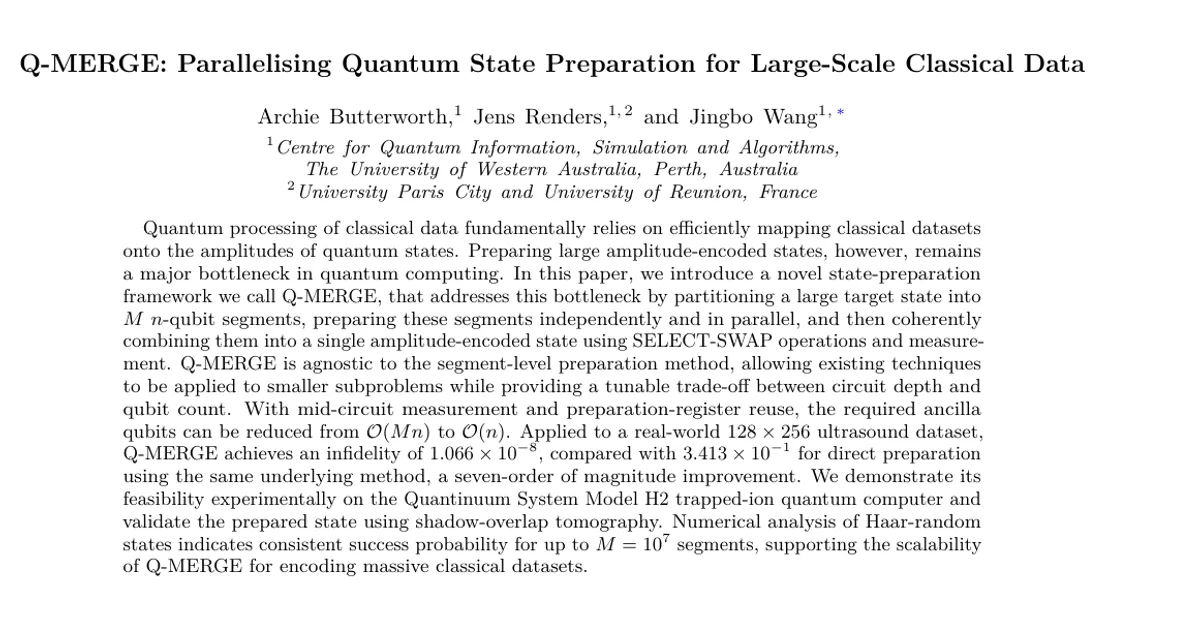
Quantum processing of classical data fundamentally relies on efficiently mapping classical datasets onto the amplitudes of quantum states. Preparing large amplitude-encoded states, however, remains a major bottleneck in quantum computing. In this paper, we introduce a novel state-preparation framework we call Q-MERGE, that addresses this bottleneck by partitioning a large target state into $M$ $n$-qubit segments, preparing these segments independently and in parallel, and then coherently combining them into a single amplitude-encoded state using SELECT-SWAP operations and measurement. Q-MERGE is agnostic to the segment-level preparation method, allowing existing techniques to be applied to smaller subproblems while providing a tunable trade-off between circuit depth and qubit count. With mid-circuit measurement and preparation-register reuse, the required ancilla qubits can be reduced from $\mathcal{O}(Mn)$ to $\mathcal{O}(n)$. Applied to a real-world \(128\times256\) ultrasound dataset, Q-MERGE achieves an infidelity of $1.066\times10^{-8}$, compared with $3.413\times10^{-1}$ for direct preparation using the same underlying method, a seven-order of magnitude improvement. We demonstrate its feasibility experimentally on the Quantinuum System Model H2 trapped-ion quantum computer and validate the prepared state using shadow-overlap tomography. Numerical analysis of Haar-random states indicates consistent success probability for up to $M=10^7$ segments, supporting the scalability of Q-MERGE for encoding massive classical datasets.