Research
Photon-stimulated decay of $χ$-matched ancillas causes unheralded bit flips in bosonic codes
Overview Research area: Quantum error correction with bosonic codes — specifically circuit-QED syndrome extraction using transmon ancillas and the fault channels that survive parity-based ("χ-matching
- arXiv
- 2610.17017
- Published
- 2026-10-12
- Authors
- Aleksandr Gulkanov
AI summary
Overview
Research area: Quantum error correction with bosonic codes — specifically circuit-QED syndrome extraction using transmon ancillas and the fault channels that survive parity-based ("χ-matching") protection.
Technical level: Intermediate. The paper assumes familiarity with transmons, dispersive shifts, cat codes and repetition codes, but its core argument is a parity selection rule that can be followed without the full formalism.
Scope (one sentence): The paper identifies, quantifies and models a first-order photon-stimulated decay channel in χ-matched (g, f) transmon ancillas, derives its rate law and per-gate cost, and propagates it through a microscopic model of the Ocelot repetition cat code to predict a bit-flip floor that grows linearly with cat size.
What This Paper Is About
Bosonic codes read out their errors using a transmon ancilla whose g and f levels have equal parity and matched dispersive shifts, so that an f → e decay is heralded and leaves the code intact while a direct f → g decay is parity-forbidden. The paper asks whether that protection survives at first order in the ancilla decay rate when the code mode actually holds photons, and finds that it does not: dressing by the code mode lets charge noise drive a photon-stimulated Raman decay |f, n⟩ → |g, n+1⟩. The goal is to derive the law and cost of this channel, place it among the other faults of syndrome extraction, and test its consequences against published data from the Ocelot repetition cat code.
Key Contributions
-
Discovery and derivation of the opened channel. The paper shows that total parity forbids f → g without a photon but permits |f, n⟩ → |g, n+1⟩ driven by charge noise at first order in the ancilla decay rate, with an element that is the environment-driven counterpart of the cavity-assisted f0–g1 Raman process.
-
A branching law and a coupling-independent cost per gate. The branching per photon relative to f → e is given by ρ ≈ |χ_ge| α / (2|Δ(Δ+α)|), equivalently (χ_ge/2g_01)², and at χ-matching by the detuning the cost is ≈ Γ_fe/α per gate and photon, independent of coupling strength and gate speed.
-
Conversion of the fault into logical errors. Using a dressed-ladder model of the Ocelot cells and a multi-class first-order Dyson expansion of the syndrome cycle, the paper shows the opened decay is unheralded and flips a cat with probability ≈ 1/2, making it the only single charge-noise fault of a χ-matched ancilla that is both likely to flip a cat and silent.
-
Predictions for repetition cat codes. In the model the gate part of the bit-flip floor grows as c₀ + c₁n̄, which caps the noise bias and gives the logical error a true minimum in photon number, with the growth from four to ten photons being a prediction beyond the published data.
Main Findings
-
The selection rule and its loophole: Charge noise is odd under total parity Π = Π_t(−1)^{a†a}, so it connects dressed states only when i − j + k is odd; the photon-free f → g is forbidden, but f → g with one photon into the mode is allowed, and in a multilevel ancilla it opens j → j−2 for every j ≥ 2. With a tunable coupler the conserved operator becomes 𝒫 = (−1)^{k+c+n}, and every forbidden charge element vanishes numerically to 10⁻³⁰.
-
The branching law: ρ ≡ Γ_fg/((n+1)Γ_fe) ≈ |χ_ge| α / (2|Δ(Δ+α)|), independent of the coupling. Against exact dressed ladders of the eight Ocelot pairs the law holds to 0.90–0.99 at n = 0, and to 1.21–1.24 for the first-order branching of the two GKP devices; at n = 10 the Ocelot ρ has fallen to 0.64–0.88 of its n = 0 value, and for n ≤ 2 the law holds within 13%.
-
Rate with a spectral factor: Γ_fg(n) = σ (n+1) ρ Γ_fe, where σ compares the charge noise at the released frequency ω_gf − ω with that at ω_ef; a smooth bath has σ = 1, while two-level defects make σ device-specific.
-
Matching points: A directly coupled transmon matches at x = Δ/α = 0.900, 0.932 and 0.949 for E_J/E_C = 50, 95 and 150; a larger detuning breaks the matching (r = 0.69 at x = 3); with the mode below the e–f resonance (x < −1) the static shifts cannot be matched (r < 0.45 for mode frequencies above 1 GHz). In Ocelot the coupler moves the matching point to x ≈ 0.80, and the model reproduces the measured r of all eight pairs to ≤ 0.011.
-
Cost per gate and photon: At exact matching by the detuning the cost is (0.85–1.1) Γ_fe/α, about 3 × 10⁻⁵ per gate and photon for α/2π = 200 MHz and T₁^fe = 25 μs, whatever the coupling or gate speed. The mismatched pair A4–S4 (r = 1.30, x = 0.37) pays 1.35 × 10⁻⁴ at its α/2π = 192 MHz. A deliberate mismatch lowers the cost 2.5 times at x = 1.5 (r = 0.85), at the price of residual rotations after f → e decays. The drive-matched ancillas of Refs. [2, 1] pay 4.2 × 10⁻⁶ and 2.5 × 10⁻⁷ per gate and photon.
-
Which ancillas are exposed: Ocelot's CX gates operate at Δ = 0.4–1.2 α and reach ρ = 1.5–9.7 × 10⁻³ per photon, so at its 1–4 photons the opened channel is 0.3–4% of the f → e decay. GKP qubits stabilized with echoed conditional displacements drive their cavity to hundreds of photons but are detuned by about seven anharmonicities, reaching only ρ ≈ 3 × 10⁻⁶ if their ancilla used f; their qubit ancilla has no one-photon charge channel at all.
-
Conversion into cat errors: A single f → e decay (1.4–2.0% per measurement at |α|² = 4) is heralded and flips a cat with probability ≲ 10⁻³. The opened decay is silent and flips with probability 0.45–0.52; the double decay f → e → g converts as often (0.49–0.58) but is second order.
-
Weights at |α|² = 4: The direct f → g makes 29–66% of the logical-relevant error of the four stabilizers, the double decay 24–62%, and the deterministic Kerr shear ≤ 7%, of a total 0.23–0.30 × 10⁻³ per measurement; heating at 50 mK would raise the total by 9–20%. At |α|² = 16 the direct f → g makes 58–85% and carries the entire photon-number-linear term, 0.010–0.024 × 10⁻³ per photon and measurement, while the double decay stays flat at 0.06–0.15 × 10⁻³.
-
Ordering against the double decay: The ratio follows the estimate (n̄+1)ρ̄/(Γ_eg T_ab) times 1.1–1.8 over the four stabilizers, three baths and |α|² = 4–16. With λ = 3, the direct channel takes over between |α|² = 4 and 8 for A1 and A4; with an ancilla three times longer-lived (λ = 1/3) it exceeds the double decay for all four stabilizers at |α|² ≥ 4.
-
A growing floor: The gate part of the bit-flip probability fits c₀ + c₁n̄ with c₁ = 0.8–3.9 × 10⁻⁵ per photon for the five cats at λ = 1 and 2.7–2.9 times more at λ = 3; this is a 1.2–1.7-fold growth between |α|² = 4 and 10, and 1.4–2.3 times a constant floor at |α|² = 16. The exponential suppression of idle bit flips meets this floor at n̄ ≲ 4–6.
-
A ceiling on the noise bias: The bias Γ_Z/Γ_X approaches κ₁T_c/c₁, which is 0.5–5.7 × 10³ for the five cats (upper values at λ = 1). It is approached slowly: c₀ dominates up to |α|² ~ c₀/c₁ ≈ 10–16 at λ = 1 (15–27 at λ = 3), and the bias reaches 235–545 at |α|² = 4 and 785–2900 at 16.
-
An optimal cat size: Because the logical bit-flip probability is d times A e^{−γn̄} + c₀ + c₁n̄, it is minimal at n̄* = γ⁻¹ ln(Aγ/c₁); in the model this is n̄ ≈ 4–5 for every distance with a storage T₁ of 1 ms and a 1-μs cycle. At d = 9–15, operating at n̄ = 16 instead costs a factor 1.36 (λ = 3) or 1.6 (λ = 1), while a flat CX part gives a plateau within 10% of its minimum from n̄ ≈ 3 to 16 at d ≥ 5.
-
Confrontation with Ocelot data: At |α|² = 2–4 the data exceed the idle-referenced model by a factor 4.6 in the median over pairs (2.2–8.1 between pairs; 4.3 over all points), and an undressed model is 8.9 times below; the level needs λ ≈ 2.7, close to the ≈ 3 relative to the idle T₁ that the experiment's own simulations need. The model singles out the χ-mismatched A4–S4 but does not reproduce the order of the other seven.
-
The F9 anomaly: An f-prepared ancilla decays directly to g with a peak near |α|² ≈ 10 while the e population stays at baseline; the smooth channel at idle-referenced strength gives only ≈ 2% of the peak (≈ 5% with T₁^fe = 12.5 μs), so a defect in the 26-MHz band through which the photons sweep the released quantum is needed. One-defect fits favour s = 5–11 times the idle-referenced strength; at s = 8 the opened family carries 27–53% and 68–76% of the modelled f excess of A4–S4 and A4–S5, with data/model 0.98 — consistency, not an independent determination.
-
Logical memory and erasure bounds: The public raw data reproduce the published logical bit flips; measured single-gate and idle rates account for them within 10% in the distance-5 code (17% in the distance-3 sections), and the model at λ = 3 lies within 0.95–1.4 of the data. Per-round erasure flags bound the on-gate f → e enhancement by λ_f ≤ 2.6–3.6 and do not depend on |α|², as χ-matching predicts.
Methodology in Plain English
The argument has three layers. First, a symmetry argument: charge noise — the dielectric loss and two-level defects that set a transmon's T₁ — is odd under total parity, which is the combined parity of the transmon and the number of photons in the mode. Writing down which transitions that rule permits yields the allowed and forbidden channels directly, without any detailed modelling of the noise.
Second, perturbation theory checked against exact numerics. The opened matrix element is computed to first order in the coupling as a sum of two interfering paths through the intermediate level, giving the familiar form of a cavity-assisted Raman process with the drive replaced by the bath. The resulting branching law is then compared against exact dressed-ladder calculations of the eight Ocelot storage–ancilla pairs and against first-order calculations for the two GKP devices.
Third, a microscopic device model used only as a test. Each Ocelot storage–ancilla interaction is treated as a cell of a storage resonator, a flux-tunable transmon coupler and a fixed-frequency transmon ancilla in the laboratory frame without the rotating-wave approximation, with circuit parameters inferred from static spectroscopy — frequencies, dispersive shifts, Kerr coefficients — and never from error rates. The ancilla charge couples to a smooth bath referenced to measured idle lifetimes and to discrete defects, evolved with the universal Lindblad equation in the dressed basis. The syndrome cycle is propagated with both ancilla branches through the two gates, each cat is re-stabilized with the asymptotic map of two-photon dissipation, and the evolution is split into fault sequences with at most one jump of each class by a multi-class first-order Dyson expansion. Each sequence is assigned a probability per stabilizer measurement, a probability of an odd number of cat flips, and a herald probability. The stabilizer tables up to |α|² = 16 are then combined with idle bit flips derived from measured data and a Stim table of the phase-flip memory.
Why This Matters
Impact on research. The paper identifies a fault channel that architecture models had treated as photon-number independent and that device simulations had not included: prior gate simulations divided measured e and f lifetimes by a fitted factor, architecture models treated the ancilla floor as independent of n̄, and the experiment itself listed direct f → g decay among the mechanisms still to be investigated. Because the channel is first order, it overtakes the second-order double decay as the ancilla improves, which reverses the usual intuition that better ancillas monotonically improve bosonic-code performance. The result also imposes a trade-off: because the bit-flip floor grows linearly while idle bit flips fall exponentially, the logical error acquires a genuine minimum in photon number, and the noise bias acquires a ceiling of order 10³.
Real-world applications (as the paper frames them):
- Superconducting quantum processors using repetition cat codes for biased-noise memories, where the choice of cat size and ancilla design directly sets the logical error rate.
- Hardware design of syndrome-extraction ancillas, where a deliberate χ-mismatch, matching by a drive, a longer T₁^fe, a larger anharmonicity, or a qubit ancilla instead of a (g, f) ancilla all lower the channel's cost.
- Benchmarking and calibration methodology for quantum hardware, since the predicted growth of the CX bit-flip contribution from four to ten photons is a discriminating measurement that published data do not yet reach.
- Error-model and simulator development for fault-tolerant architectures, where a constant floor assumption can misplace the optimal operating point.
Industry relevance. The analysis is calibrated against the published Ocelot repetition-cat-code memory from AWS, and the predictions bear on how such devices should be characterized and scaled. The released bosonoise package, three reference Stim noise models and 72 syndrome datasets give hardware and architecture teams directly usable error models.
Future Directions
-
Measure the slope c₁. The published gate data end at four photons, where c₁n̄ is still below c₀, so the growth from four to ten photons (a factor 1.2–1.7 in the model) is untested; measuring it would confirm or refute the channel's contribution.
-
Separate smooth channel from defects. The F9 anomaly is fitted equally well by a charge-coupled defect and by a junction defect that modulates E_J, and the data do not distinguish them; a defect anomaly appearing with only one storage of an ancilla would point to the opened channel, whereas an E_J-modulating defect would appear with both.
-
Determine σ for real devices. The spectral factor σ is assumed to be 1 for a smooth bath, but two-level defects make it device-specific; the on-gate T₁(f) of A4 accounts for only a factor ≈ 1.6 of the fitted s, leaving σ ≈ 3–7 near 5.00 GHz to be established.
-
Explain the remaining discrepancies. Not explained are the g-protocol floor, the excess at |α|² ≤ 1.5, the g+e protocol of A3–S4, and most of the growth of the measurement error with |α|²; the coupler parameters are priors, leaving defect band positions uncertain by tens of MHz.
Target Audience
Experimentalists and theorists working on superconducting bosonic codes and biased-noise architectures; device physicists responsible for transmon ancilla design and syndrome-extraction calibration; and architecture and error-model researchers who need photon-number-dependent fault models for fault-tolerance estimates. Readers focused on photonic or trapped-ion bosonic encodings will find the parity argument transferable but the quantitative results specific to circuit QED.
Authors’ abstract
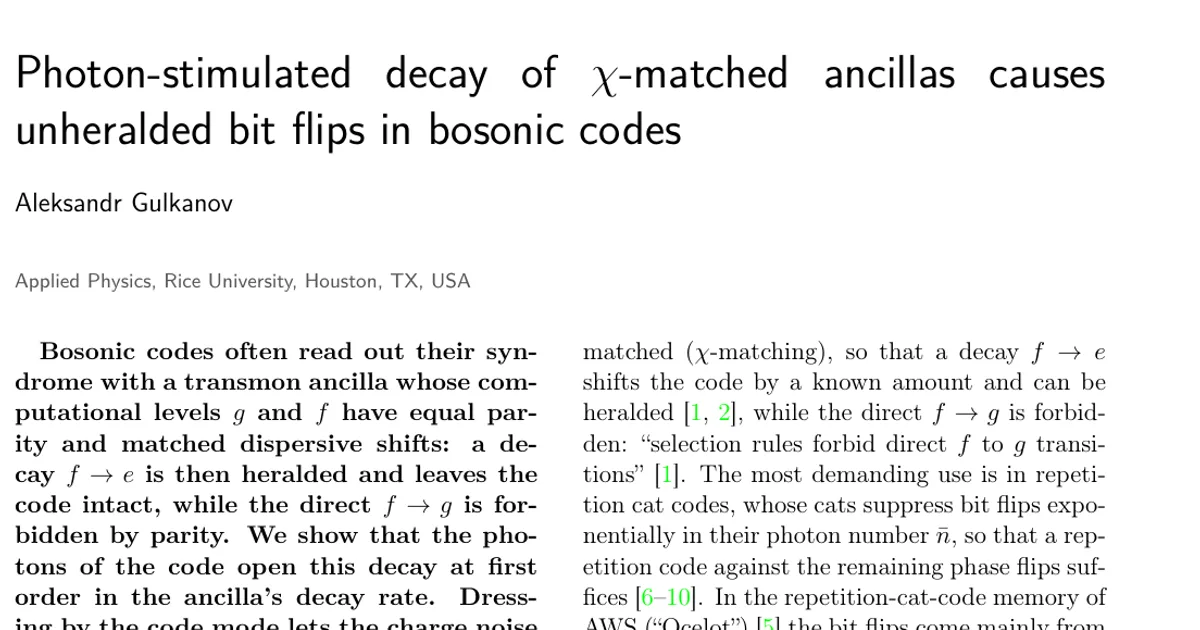
Bosonic codes often read out their syndrome with a transmon ancilla whose computational levels $g$ and $f$ have equal parity and matched dispersive shifts: a decay $f\to e$ is then heralded and leaves the code intact, while the direct $f\to g$ is forbidden by parity. We show that the photons of the code open this decay at first order in the ancilla's decay rate. Dressing by the code mode lets the charge noise that limits the ancilla's $T_1$ drive a photon-stimulated Raman decay $|f,n\rangle\to|g,n+1\rangle$, at $(n+1)(χ_{ge}/2g_{01})^2$ times the $f\to e$ rate for a smooth noise spectrum. When the matching is set by the detuning, the decay costs $\approxΓ_{fe}/α$ per gate and photon, whatever the coupling strength; a deliberate mismatch or matching by a drive lowers this cost, and a qubit ancilla has no such channel. The opened decay is unheralded and flips a cat with probability $\approx 1/2$; being first order, it overtakes the second-order double decay $f\to e\to g$ as the ancilla improves. In a microscopic model of the Ocelot repetition cat code, it makes the bit-flip floor of the gates grow linearly with the cat size, by a factor 1.2-1.7 from four to ten photons, which would limit the noise bias to $\sim 10^3$. The published gate data end at four photons and do not yet test this growth.