Research
Photon-Number Discrimination from Increasing Time-of-Arrival Separation in Wide Superconducting Microstrip Single-Photon Detectors
Overview Research area: Superconducting single-photon detectors (SNSPDs) and their use for resolving photon number in quantum optics. Technical level: Advanced. The paper combines device fabrication,
- arXiv
- 2610.32154
- Published
- 2026-10-23
- Authors
- Hsin-Yeh Wu, Shu-Xiao Liu, Boris Tuchming, Xavier-François Navick, Pu-Kai Wang, Yi-Ren Wu, Jia-Wern Chen, Marc Besançon, Jean-François Glicenstein, Pisin Chen, Yu-Jung Lu, Stathes Paganis
AI summary
Overview
Research area: Superconducting single-photon detectors (SNSPDs) and their use for resolving photon number in quantum optics.
Technical level: Advanced. The paper combines device fabrication, time-correlated single-photon counting measurements, multi-component statistical fitting, and a phenomenological vortex-based model.
Scope: The paper reports time-of-arrival (TOA) measurements on two wide, short niobium nitride (NbN) superconducting microstrip single-photon detectors (SMSPDs) and shows that adjacent photon-number timing peaks become more separable at high photon number, reaching a pairwise assignment fidelity of 99.58% between the components assigned to n = 7 and n = 8.
What This Paper Is About
Detecting light is not the same as counting how many photons arrived in a pulse, and most single-photon detectors only report "a click." In conventional narrow-wire SNSPDs, multi-photon events do shift the timing response, but the timing peaks for neighboring photon numbers crowd together at high photon number, which makes counting by timing difficult. This paper asks whether a different geometry — a wide but short microstrip — can keep those neighboring timing peaks spread apart, and it builds a simple physical model to explain why the peaks behave as observed.
Key Contributions
-
Demonstration of photon-number-resolved TOA peaks in wide SMSPDs. Two 10 µm-long NbN devices with widths of 3.2 µm (Device A) and 6.4 µm (Device B) were characterized under pulsed 515 nm excitation, with resolved exponentially modified Gaussian (EMG) timing components extending through n = 5 in the narrower device and through n = 8 in the wider device.
-
Observation of increasing relative peak separation at high photon number. The FWHM-normalized separation between adjacent components generally grows with photon number, in contrast to the compression of neighboring timing shifts reported for conventional narrow-wire SNSPDs. The largest separation is R^FWHM_(7,8) = 2.15 ± 0.03 in the wider device.
-
A quantitative discrimination metric. The authors define an equal-prior pairwise TOA-assignment fidelity from the overlap integral of adjacent fitted EMG distributions, obtaining F^pair_(7,8) = (99.58 ± 0.06)% for the n = 7 / n = 8 pair in Device B.
-
A phenomenological two-contribution timing model. The model splits the measured delay into an edge-sensitive vortex-nucleation term (mapped onto the EMG exponential tail τ_n) and a collective current-redistribution term (mapped onto the Gaussian location μ_n), reproducing the observed photon-number trends.
Main Findings
-
Wider device resolves more photon numbers: Resolved components extend through n = 5 in the 3.2 µm device and through n = 8 in the 6.4 µm device, under the same illumination, bias (approximately 0.80 I_sw), and fitting conditions.
-
Component areas follow Poisson statistics: Normalized component areas agree with the conditional Poisson description expected for coherent-state illumination, which supports assigning the timing components to photon-number classes.
-
Exponential tail shrinks strongly with photon number: For Device A, τ_1 ≈ 490 ps falls to τ_5 ≈ 34 ps, a reduction by approximately a factor of 14. Device B starts from a larger value, τ_1 ≈ 2120 ps, and decreases over the components assigned through n = 8.
-
Nucleation fit parameters: Equation (6) reproduces the τ_n trends with c_nuc = 7.86 and p_nuc = 0.65 for Device A, and c_nuc = 9.36 and p_nuc = 0.54 for Device B.
-
Peak locations keep shifting: μ_n decreases monotonically with photon number in both devices but more gradually than τ_n. Device A shows progressively compressed μ_n spacing at larger n, while Device B retains a comparatively uniform sequence through n = 8. Equation (10) fits with T_0 = 966 ps and γ = 0.26 for Device A, and T_0 = 3664 ps and γ = 0.14 for Device B. The differing offsets are attributed to cable and readout delays in the two measurements.
-
Threshold separation reached from n ≥ 3: For both devices, adjacent pairs with n ≥ 3 satisfy R^FWHM_(n,n+1) > 1, the benchmark the authors use to describe FWHM-level separation.
-
Contrast with narrow-wire behavior: In narrow-wire SNSPDs, a characteristic timing contribution scales approximately as n^(−1/2), so Δμ_n ∝ n^(−1/2) − (n+1)^(−1/2), meaning neighboring peaks crowd together. The wide SMSPDs studied here do not show this compression across the resolved range.
-
Gaussian width narrows toward a floor: σ_n decreases with photon number and approaches a floor at larger n in both devices; it is treated empirically and not assigned to either model contribution.
-
Finite peak sequence: Both devices show a limited sequence of distinguishable components even at the highest explored optical powers. Collective current redistribution is offered as a possible explanation, but the authors state that the microscopic processes remain to be established.
-
Model-dependent redistribution scale: Attributing the sequence termination to perturbed fraction of order unity gives d_eff ~ W/N_max, or approximately 0.6–0.8 µm for these devices. This is distinct from the 25 nm hotspot-interaction length adopted as a fixed input in the timing fits.
-
Beam-width Monte Carlo: Simulated timing structure is strongly smeared for d_eff^MC ≲ w_0, with better peak separation for approximately d_eff^MC ≳ 2w_0. With w_0 ≈ 0.3 µm, this suggests a lower effective scale of d_eff^MC ≳ 0.6 µm.
-
Not reported: detection efficiency, dark-count rate, and a numeric timing-jitter figure are not reported in the paper content; the 4 ps figure is the histogram bin width, explicitly distinguished from the overall timing response.
Methodology in Plain English
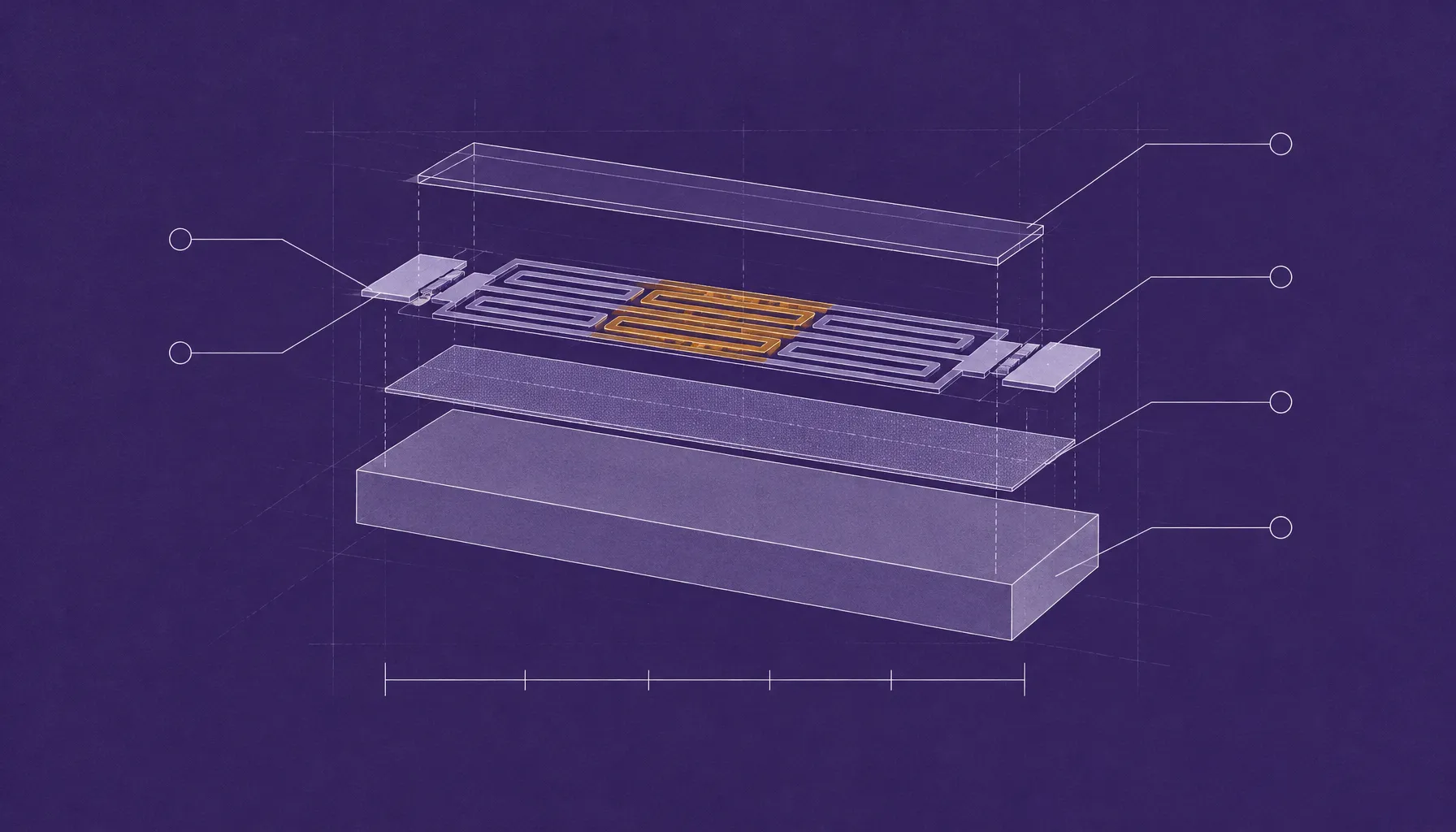
The team made thin NbN films (15 nm thick, on sapphire, with a superconducting critical temperature near 9 K) and patterned them into short, wide strips — 10 µm long, and either 3.2 µm or 6.4 µm wide. The devices were cooled to 6 K and biased at about 80% of their switching current (90 µA for Device A, 220 µA for Device B).
They fired a pulsed 515 nm laser at 100 kHz (pulse width below 170 ps FWHM) at the devices through a lens that focused the beam to a waist of about 0.3 µm, and varied the optical power while keeping alignment, bias, and readout fixed. Detector pulses were amplified and timestamped relative to the laser synchronization signal using a time-correlated single-photon-counting module with a 4 ps bin.
Each measured timing histogram was then fit as a sum of exponentially modified Gaussian curves — asymmetric peaks with a Gaussian core and an exponential tail. Components were assigned to photon numbers based on their time ordering and on how their areas grew with optical power, checked against a Poisson model. From the fits the authors extracted three numbers per component: peak location, width, and tail decay. Dividing the distance between neighboring peaks by their average width gives a normalized separation; the overlap between neighboring peaks gives a best-case assignment fidelity. A simple analytic model then connects the tail decay to the distance of the nearest photon absorption from the strip edge, and the peak location to current crowding from multiple absorption sites.
Why This Matters
Impact on research: The work shows that device geometry — specifically a wide transverse dimension with a short length — changes the trend of timing separation with photon number, not just its magnitude. That opens a design lever for intrinsic, single-element photon-number resolution, as opposed to multiplexed detector arrays that add elements and readout complexity. It also provides a testbed for studying how the spatial distribution of photon absorption feeds into vortex-assisted detection.
Real-world applications (as motivated in the paper):
- Characterizing multiphoton optical states and measuring high-order photon statistics.
- Source and detector calibration in quantum photonics laboratories.
- Photonic quantum information processing, where photon-number information is a resource.
- Quantum communication and precision optical measurement, the broader application space the authors cite for SNSPDs.
Industry relevance: Single-element photon-number discrimination could reduce the hardware burden of multiplexed detector architectures used in quantum photonics products. The paper points to concrete engineering levers — reducing latching to allow operation closer to the switching current, edge engineering to sharpen low-photon-number response, and width plus optical-mode optimization to extend the usable photon-number range.
Future Directions
-
Disentangle the microscopic mechanisms. Hotspot formation and relaxation, quasiparticle diffusion, vortex dynamics, and the quantum nature of detection may all contribute; the authors explicitly frame their model as an interpretation of timing trends rather than a microscopic derivation.
-
Controlled illumination and beam-waist studies. Spatially scanned illumination and calibrated beam-waist measurements would test the model's central claim that transverse absorption position governs the timing response.
-
Bias- and wavelength-dependent timing measurements, together with independently calibrated photon occupancy and full timing-chain characterization, to separate detector physics from readout contributions such as the laser synchronization output, amplifier chain, and constant-fraction discrimination.
-
Device and readout optimization. Reducing latching for operation closer to I_sw, edge engineering to suppress the broad low-photon-number tail, and width/optical-mode optimization to preserve the μ_n evolution over a broader range.
Target Audience
Researchers and engineers working on superconducting photon detectors and quantum photonic hardware, particularly those interested in photon-number resolution without detector multiplexing. The paper assumes familiarity with SNSPD operating principles, time-correlated single-photon counting, and multi-component curve fitting, so it suits graduate students and specialists in the field more than general readers. Scientists studying vortex dynamics in superconducting strips and detector-calibration specialists in quantum optics will also find the timing analysis useful.
Authors’ abstract
Measurements of photon-number-dependent time-of-arrival (TOA) distributions in wide NbN superconducting microstrip single-photon detectors (SMSPDs) are presented. Two \SI{10}{\um}-long devices with widths of \SI{3.2}{\um} and \SI{6.4}{\um} are characterized under pulsed \SI{515}{nm} excitation. The TOA histograms are described by sums of exponentially modified Gaussian (EMG) components, with the wider device exhibiting components assigned to photon numbers up to \(n=8\). Adjacent TOA peaks become more distinguishable relative to their widths at higher photon number, in contrast to the compression of neighboring photon-number timing shifts observed in conventional narrow-wire SNSPDs. For the components assigned to \(n=7\) and \(n=8\), the FWHM-normalized peak separation is \(2.15\), and the fitted EMG distributions yield an equal-prior pairwise TOA-assignment fidelity of \(99.6\%\). The EMG exponential-tail parameter \(τ_n\) decreases strongly with photon number, while the Gaussian-location parameter \(μ_n\) continues to shift between neighboring components. A phenomenological model motivated by absorption-site-dependent vortex processes and collective current redistribution captures these timing trends. These results support wide SMSPDs as a platform for TOA-based photon-number discrimination at high photon number, relevant to multiphoton-state characterization and photonic quantum information processing. The same geometry also provides a setting to examine how the spatial distribution of photon absorption affects vortex-assisted detection.