Research
Periodic conditional measurements on a photonic chip
Overview Research area: Quantum measurement and control, specifically measurement backaction in monitored quantum dynamics, implemented with integrated photonics (femtosecond-laser-written 3D waveguid
- arXiv
- 2610.21465
- Published
- 2026-10-15
- Authors
- Xuan Chen, Ruo-Yu Yin, Xiao-Wen Shang, Xi-Jun Yuan, Ze-Feng Lan, Hong-Jing Du, Yi-Jun Chang, Bao-Jing Liu, Wen-Hao Zhou, Xi Tan, Eli Barkai, Hao Tang, Xian-Min Jin
AI summary
Overview
Research area: Quantum measurement and control, specifically measurement backaction in monitored quantum dynamics, implemented with integrated photonics (femtosecond-laser-written 3D waveguide arrays).
Technical level: Advanced. The paper assumes familiarity with non-Hermitian / non-unitary evolution operators, biorthogonal eigenmode expansions, Floquet language, tight-binding photonic lattices, and quantum-trajectory detection statistics.
Scope (one sentence): The paper develops a unified bright-mode/dark-mode spectral framework for periodic conditional (no-click post-selected) measurements and demonstrates it on a layered 3D photonic chip for state engineering and for controlling first-detection statistics.
What This Paper Is About
When a quantum system is repeatedly interrupted by measurements that only keep the "no detection" outcome, the surviving state is governed by a single non-unitary operator, the survival operator 𝒢 = (𝟙 − P)U(τ). The same operator determines two things that are usually studied separately: the state left along no-detection trajectories, and the probability distribution of when a detection finally occurs. The paper's goal is to show that both are described by one spectrum — bright modes (|μ| < 1, decaying) and dark modes (|μ| = 1, perfectly preserved) — and to demonstrate experimentally that tuning the measurement period τ reshapes this spectrum, thereby programming both the final state and the detection statistics.
Key Contributions
-
A unified spectral framework. The authors show that the conditional final state and the first-detection distribution F_n = |⟨ψ_m|U(τ)𝒢^(n−1)|ψ_in⟩|² both follow from the eigenmodes of 𝒢, split into a bright subspace ℬ = {0 < |μ_j| < 1} and a dark subspace 𝒟 = {|μ_j| = 1}. The total detection probability obeys P_det = Σ F_n = 1 − Σ_{|μ_j⟩∈𝒟} |ζ_j|², so undetected weight is exactly the dark-mode weight.
-
A scalable photonic architecture for repeated conditional measurements. A layer-structured 3D chip written in borosilicate glass implements alternating coherent evolution and
𝟙 − Poperations. Propagation length between layers sets a finite, precisely defined measurement period τ — explicitly contrasted with the quantum Zeno limit of vanishing interval. The design is scalable in Hilbert-space dimension and in the number of measurement steps. -
Two complementary state-engineering routes, demonstrated experimentally. (i) Dark-mode preservation: protecting topological corner states in a 4×4 2D SSH lattice by measuring a bulk site. (ii) Bright-mode selection: excited-state shelving in a V-shaped three-level system, where the longest-lived bright mode is selected by differential decay.
-
Observation of a predicted detection-probability transition. On an effectively infinite one-dimensional lattice (61 waveguides), the total detection probability shows a transition around the critical measurement period γτ_c = π/2 (τ_c ≃ 10.6 mm), and the authors trace its microscopic origin to Floquet near-dark modes with eigenvalues approaching the unit circle.
Main Findings
-
Dark-mode protection of topological corner states. In the topologically nontrivial 2D SSH lattice (intracell separation d_a = 24 μm, intercell d_b = 11 μm), measurements are applied to site (2,3). Corner modes have zero amplitude there, so they are orthogonal to the measured state and form a dark subspace independent of τ. With τ = 5000 μm, the bulk component is effectively eliminated after seven conditional measurements, in agreement between simulation and CCD-captured intensity at steps n = 1, 4, and 7.
-
Bright-mode selection gives excited-state shelving. In the V-shaped three-level system with γ₁ ≫ γ₂ (waveguide separations 8 μm and 20 μm), E_g = 0 and E_e = 4k (k being the propagation-constant change per 1 mW increase in writing power), the naive expectation that the strongly coupled ground state decays fastest is wrong: which bright mode survives depends on E_m and τ. Scanning E_m/k and τ yields two regions converging to final energies 4k (|e⟩) or 0 (|g⟩); near the boundary the two dominant eigenvalue moduli become nearly degenerate and the convergence step diverges (steps over 500 are treated as divergent and left blank). At fixed τ = 6.25 mm and at fixed E_m = 6k, |μ_g| and |μ_e| approach, cross, and exchange ordering, switching the surviving mode. Experimentally, after five measurements the normalized conditional state is predominantly localized in |e⟩.
-
Detection statistics transition on a 1D lattice. For a walker initialized at the central site of a 61-waveguide chain (spacing 14.1 μm, γ ≃ 0.148 mm⁻¹) with measurements at a site ξ = 3a away, an abrupt transition in P_det is observed near the critical period, separating a monotonic regime from a nonmonotonic (oscillatory) one. Samples span measurement periods from 5 to 15 mm in 1 mm increments, and the first five terms F₁–F₅ suffice to estimate P_det because the remaining contribution is negligible.
-
Microscopic origin identified as Floquet near-dark modes. Around τ_c a manifold of Floquet near-dark modes emerges with eigenvalues approaching the unit circle; the cumulative overlap W₁₅ of the 15 largest-|μ| eigenstates with the initial state jumps abruptly near τ_c, and its later oscillatory behavior tracks the oscillatory behavior of P_det as the conditional spectrum is continuously reconstructed.
-
Dark modes can be created by tuning τ, not just by symmetry. Beyond energy eigenstates satisfying ⟨ψ_m|E⟩ = 0, dark modes arise from destructive interference among energy eigenstates whose phases coincide over one period, e^{-iE₁τ} = e^{-iE₂τ}, i.e. τ|E₁ − E₂| = 2mπ. This makes τ an extra control knob that creates or reconstructs dark and near-dark modes without altering the Hamiltonian.
-
Ensemble statistics from a single image. Because the chip's straight measurement waveguides record F_n directly as output intensities (F_n = I_n / I_total, with I_total = Σ_n I_n + I_final), the full measurement record is obtained from one spatially resolved CCD image per setting, without sampling individual detection events over repeated state preparations.
Methodology in Plain English
The team exploits the optical–quantum analogy: in a waveguide array, paraxial light propagation obeys i∂_zψ = Hψ, so propagation distance plays the role of time, and the tight-binding Hamiltonian's couplings and on-site detunings are set by waveguide separations and writing power. They fabricate a layered chip by femtosecond laser direct writing in borosilicate glass. Within each layer, light first evolves coherently for a distance that defines τ; then, at the measurement layer, the waveguide representing the measured state is left straight and continues to the output, while all other waveguides are routed into a fresh layer with an empty measured site and continue evolving. Strong vertical separation between layers prevents unwanted coupling. The straight waveguides literally carry away the "detected" amplitude, so the intensity in the n-th such waveguide equals the probability of first detection at step n, while the intensity in the remaining lattice waveguides gives the post-selected state. They then diagonalize the finite operator 𝒢 numerically to connect the observed behavior to its spectrum.
Why This Matters
Impact on research. The work turns a conceptual link — that post-selected states and detection records share one non-Hermitian operator — into a programmable experimental resource. It shows that the measurement period τ and the choice of measured state are genuine control parameters that reshape the conditional spectrum without modifying the underlying Hamiltonian, which opens a route to Floquet-engineered dark states and to controlled incomplete detection (P_det < 1) in monitored quantum dynamics.
Potential applications (as motivated or implied by the paper):
- Measurement-based quantum state preparation and protection, including topologically protected corner states.
- Excited-state shelving and targeted population of chosen eigenstates for state initialization.
- Conditional-measurement primitives already used in photonic technologies and cited by the paper: photon addition and subtraction, quantum teleportation, entanglement purification, and probabilistic linear optical quantum gates.
- Rapid characterization of monitored-dynamics statistics (as demonstrated, without ensemble sampling).
Industry relevance. The chip is written in borosilicate glass with femtosecond lasers — a fabrication route compatible with integrated photonic quantum hardware. Layer-structured, scalable circuits that realize repeated post-selection could serve photonic quantum computing and simulation platforms, and the single-shot readout of detection statistics is attractive for fast device characterization during development.
Future Directions
- Extending the architecture to more measurement steps and larger Hilbert-space dimensions, which the authors explicitly claim as a scalability advantage, and quantifying the resulting performance limits.
- Using τ and the measured-state choice as systematic design knobs to engineer dark and near-dark mode manifolds on demand, including in two- and three-dimensional monitored lattices.
- Determining how the observed Floquet near-dark-mode mechanism generalizes beyond the one-dimensional tight-binding chain analyzed here, and how it connects to predicted behavior in the strictly infinite lattice.
- Connecting the platform to measurement-based quantum information protocols (the paper's cited applications such as probabilistic linear optical gates and entanglement purification) and assessing the success probabilities involved.
Target Audience
Quantum physicists and photonics researchers working on measurement backaction, monitored quantum dynamics, non-Hermitian and non-unitary evolution, and Floquet engineering; experimentalists building integrated photonic quantum simulators and processors; and graduate students or advanced undergraduates with a background in quantum mechanics who want a concrete, experimentally realized example of how a single non-Hermitian operator governs both post-selected states and detection statistics.
Note: the supplied paper text is truncated partway through Section V (the spectrum analysis for the infinite chain), so the paper's concluding remarks and any further quantitative values are not available and are not reported here.
Authors’ abstract
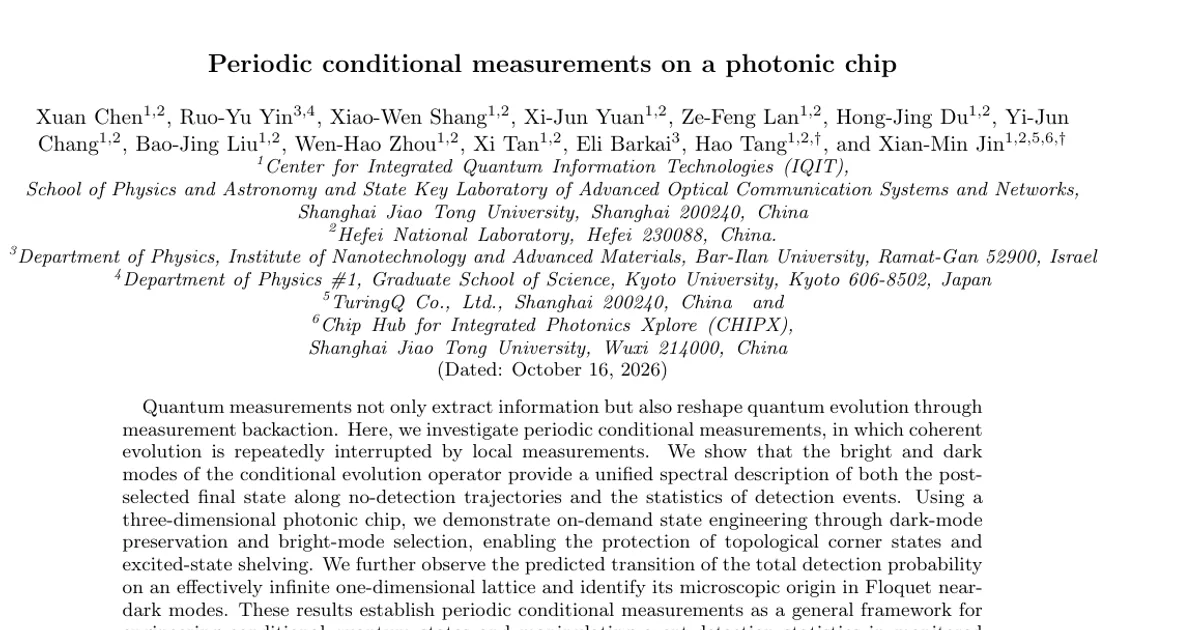
Quantum measurements not only extract information but also reshape quantum evolution through measurement backaction. Here, we investigate periodic conditional measurements, in which coherent evolution is repeatedly interrupted by local measurements. We show that the bright and dark modes of the conditional evolution operator provide a unified spectral description of both the post-selected final state along no-detection trajectories and the statistics of detection events. Using a three-dimensional photonic chip, we demonstrate on-demand state engineering through dark-mode preservation and bright-mode selection, enabling the protection of topological corner states and excited-state shelving. We further observe the predicted transition of the total detection probability on an effectively infinite one-dimensional lattice and identify its microscopic origin in Floquet near-dark modes. These results establish periodic conditional measurements as a general framework for engineering conditional quantum states and manipulating event-detection statistics in monitored quantum dynamics.