Research
Opportunistic full reconstruction of 100-dimensional frequency-bin quantum states
Overview Research area: Quantum photonics — high-dimensional frequency-bin encoding, entanglement characterization, and quantum state tomography (QST), combining electro-optic quantum frequency proces
- arXiv
- 2610.03496
- Published
- 2026-10-02
- Authors
- Hanson H. Nguyen, Zachary Goisman, Chen-You Su, Diego Maragnano, Marco Liscidini, Jason D. McKinney, Hsuan-Hao Lu, Joseph M. Lukens
AI summary
Overview
Research area: Quantum photonics — high-dimensional frequency-bin encoding, entanglement characterization, and quantum state tomography (QST), combining electro-optic quantum frequency processing with Bayesian inference.
Technical level: Advanced. The paper assumes familiarity with density matrices, biphoton frequency combs, spontaneous parametric downconversion, electro-optic phase modulation, and Markov Chain Monte Carlo methods.
Scope: An experimental demonstration that threshold quantum state tomography (tQST), combined with adaptive measurements and parallelized Bayesian inference, fully reconstructs entangled frequency-bin qudit states in Hilbert spaces up to d² = 100 while using only 1.9% of the measurements conventional tomography would need.
What This Paper Is About
Frequency-bin encoding stores quantum information in discrete spectral modes of light, which is attractive because it is compatible with telecom fiber and integrated photonics. The problem is that verifying such states gets expensive fast: a general state in a d²-dimensional two-photon Hilbert space has d⁴ elements, and conventional tomography needs measurement resources that grow rapidly with d, while physically mixing many frequency modes at once is experimentally difficult. The authors show that because entangled biphoton frequency combs are naturally sparse, a "threshold" measurement strategy can pick out only the coherences that matter and reconstruct the state completely — without assuming sparsity in the reconstruction itself.
Key Contributions
-
First experimental implementation of threshold quantum state tomography for frequency-bin states. The protocol uses the Cauchy–Schwarz inequality to rank off-diagonal density matrix elements, measures all diagonal entries, and then probes only the coherences whose inequality ceiling exceeds a chosen threshold t.
-
A record-high full reconstruction, d² = 100. The authors perform Bayesian estimation of entangled two-qudit states for single-qudit dimensions d ∈ {2, 3, …, 10}, reaching a 100-dimensional two-qudit Hilbert space — a 56% increase over the previous 64-dimensional frequency-bin record — with only 190 projections.
-
Demonstration that sparse measurement scales well. The measurement count scales as 2d² − d, a square-root reduction relative to conventional tomography. The d = 8 case (4095 independent real parameters) is reconstructed with 120 projections, versus 1920 distinct experimental settings used in prior randomized work.
-
An experimental roadmap for pushing to much higher dimensions. By analyzing how the electro-optic mixing efficiency J₀²(β)J_k²(β) decays with bin separation k, the authors argue that tQST of entangled qudits up to d ≈ 45 (a 2025-dimensional Hilbert space) should be feasible with lower-half-wave-voltage modulators.
Main Findings
-
Record Hilbert space dimension: Full Bayesian state estimation is achieved for biphoton frequency combs with d² = 100 (d = 10 bins per photon), exceeding the previous 64-dimensional record by 56%. The number of independent parameters for a general 100-dimensional state (10⁴ − 1) is 2.44× that of a 64-dimensional one.
-
Large measurement savings: The d = 10 result uses only 190 projections — less than 2% of the 𝒪(10⁴) measurements for traditional QST, less than 7% of what the randomized approach of prior work would have required (3000 projections, assuming scaling trends continued), and 1.9% of a tomographically complete approach.
-
High fidelity to the hypothesized state: Fidelity with respect to a Werner-state hypothesis exceeds F̂ ≥ 0.844 for all qudit dimensions; the abstract reports ℱ > 0.845. Fidelity to the ideal maximally entangled target, by contrast, falls from F̂ = 0.979(6) at d = 2 to F̂ = 0.65(1) at d = 10 — the authors argue the Werner comparison is the fairer benchmark because it accounts for experimental noise.
-
Genuine high-dimensional entanglement: Bayesian-estimated logarithmic negativity reaches E_N = 2.70(3) ebits at d = 10, a value only possible for qudit dimension d ≥ 7. Agreement with the Werner-state predictions at the measured coincidence-to-accidental ratios (CAR ∈ {108, 87, 77, 106, 92, 31, 27, 31, 31}) is good; the CAR variation is attributed to different pump powers used to reduce statistical noise at higher d.
-
Sparsity confirmed experimentally: The d = 10 joint spectral intensity (1 s integration per point, CAR of ~31) shows appreciable weights only for matched bins, so that for any t > 0.072 only the ρ_(ii)(jj) coherences remain in the measurement schedule. Subsidiary "waffle-iron" peaks appear in the reconstructed matrices at unmeasured points ρ_(ij)(kk), explained by their higher Cauchy–Schwarz ceilings.
-
Electro-optic efficiency is the binding constraint: With V_π = 3.5 V at 25 GHz and a 30 dBm RF limit, the achievable modulation index is β ≤ 8.97, forcing suboptimal choices from the set β ∈ {1.43, 3.83, 7.53, 4.42, 4.81, 5.11, 7.42, 7.83, 8.14}. Optimal β_k scales nearly linearly with bin separation k with a near-unit slope, and the mixing maximum stays within an order of magnitude of the k = 9 case until a sharp drop for k ≥ 47.
-
Convergence diagnostics: Chains of (N, T) = (2¹⁰, 2¹⁸) yield integrated autocorrelation times τ ∈ {0.8, 0.9, 1.1, 1.0, 1.1, 1.6, 14.4, 4.9, 8.5} for d ∈ {2, …, 10}, with the degradation at higher d reflecting the difficulty of exploring larger parameter spaces.
Methodology in Plain English
The team generates entangled photon pairs by pumping a periodically poled lithium niobate waveguide with a 775 nm continuous-wave laser, producing broadband spontaneous parametric downconversion. A Fourier-transform pulse shaper carves the output into discrete frequency bins, each 20 GHz wide and spaced by 25 GHz, with a guardband B = 5 inserted to prevent crosstalk between the signal and idler bands.
Measurement happens in two phases. First, with the modulator off, they raster-scan pairs of signal and idler bins to record the joint spectral intensity — the diagonal of the density matrix — which reveals which entries are large and sets the threshold t. Second, they address each significant coherence individually: the pulse shaper passes only the four bins ω₋ᵢ, ω₋ⱼ, ωᵢ, ωⱼ and applies a phase shift θ to one of them, while an electro-optic phase modulator driven at Ω mixes neighbouring bins. Detecting coincidences between bins ω₋ᵢ and ωⱼ gives a probability that depends on the real part of the coherence for θ = 0 and the imaginary part for θ = π/2. Choosing β so that |J₀(β)| ≈ |J_{j−i}(β)| maximizes the mixing for each pair.
Counts are collected for 30 s per projection, and the full dataset is fed into a Bayesian inference pipeline: a Bures prior over a (4d⁴ + 1)-dimensional parameter vector, a Poissonian likelihood, and a parallel preconditioned Crank–Nicolson MCMC sampler. Multiple independent chains are run and the one with integrated autocorrelation time closest to unity is retained, giving 1024 posterior samples from which means and uncertainties follow automatically.
Why This Matters
Full characterization is the bottleneck for any high-dimensional quantum platform: if you cannot verify the state, you cannot trust it for protocols. This work shows that a measurement-aware strategy can make tomography of 100-dimensional states practical on ordinary laboratory hardware, and — crucially — does so without imposing structural assumptions like low rank or matrix-product-operator form. The Bayesian error bars honestly reflect both statistical noise and the information deliberately left unmeasured.
Potential applications:
- High-dimensional quantum key distribution and entanglement distribution over telecom fiber, where frequency bins are already native to the infrastructure.
- Verification and benchmarking of integrated photonic quantum devices, including chip-scale frequency-bin processors.
- Characterizing cluster states and other resources for measurement-based quantum computing in the frequency domain.
- Certifying high-dimensional entanglement as a resource for quantum communication protocols that require dimension witnesses.
Industry relevance: Frequency-bin encoding is compatible with the telecommunications band and with photonic integrated circuits, and the modulators used are commercial thin-film lithium niobate devices. The result lowers the characterization cost for anyone building frequency-multiplexed quantum hardware, and the authors explicitly point to commercially available modulators with V_π = 0.7 V as the path to the next order of magnitude in dimensionality.
Future Directions
-
Higher modulation index devices. Replacing the current V_π = 3.5 V modulator with a V_π = 0.7 V device would allow β = 44.9 at 1 W RF input power, making d² = 45² two-qudit tQST feasible in principle; cascading EOPMs in series is an alternative route.
-
Nonlinear mixing for efficient projections. Three- and four-wave mixing in χ⁽²⁾ and χ⁽³⁾ media is inherently bin-selective and could implement the required two-bin projections with in principle 100% efficiency, avoiding the dimension-efficiency tradeoff of electro-optic sideband spreading.
-
Scalable reconstruction algorithms. The authors expect full Bayesian inference to struggle as Hilbert spaces approach ~1000 dimensions, and suggest maximum likelihood estimation or projected least-squares as positivity-preserving alternatives.
-
Broader encodings and objective threshold choice. Because tQST probes only two computational-basis states at a time, binary two-bin measurements suffice for time-bin encoding via a single tunable interferometer rather than a nested d-ary tree; the threshold itself could be chosen objectively using the Gini index of the diagonal's uniformity.
Target Audience
Quantum photonics experimentalists and theorists working on high-dimensional encoding, quantum state tomography, or integrated frequency-domain processing; graduate students and postdocs who need a concrete template for combining adaptive measurement design with Bayesian estimation; and engineers developing frequency-multiplexed quantum hardware who want to know the characterization cost of scaling to larger alphabets. Readers without a background in quantum optics and MCMC sampling will find the theory and appendix sections demanding.
Authors’ abstract
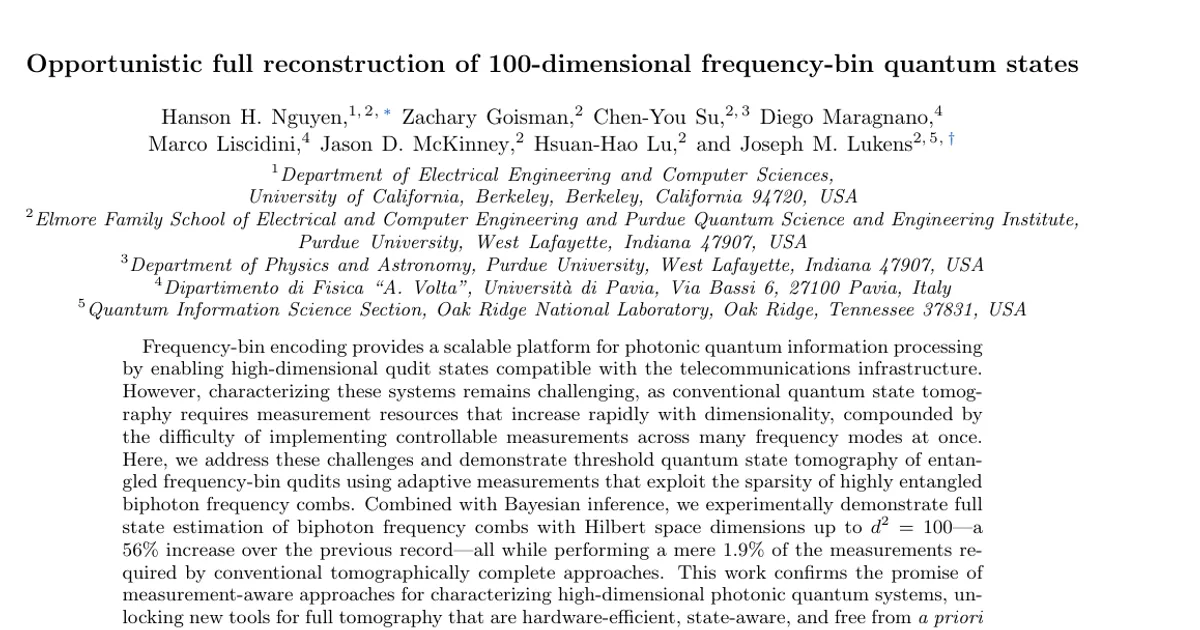
Frequency-bin encoding provides a scalable platform for photonic quantum information processing by enabling high-dimensional qudit states compatible with the telecommunications infrastructure. However, characterizing these systems remains challenging, as conventional quantum state tomography requires measurement resources that increase rapidly with dimensionality, compounded by the difficulty of implementing controllable measurements across many frequency modes at once. Here, we address these challenges and demonstrate threshold quantum state tomography of entangled frequency-bin qudits using adaptive measurements that exploit the sparsity of highly entangled biphoton frequency combs. Combined with Bayesian inference, we experimentally demonstrate full state estimation of biphoton frequency combs with Hilbert space dimensions up to $d^2=100$---a 56% increase over the previous record---all while performing a mere 1.9% of the measurements required by conventional tomographically complete approaches. This work confirms the promise of measurement-aware approaches for characterizing high-dimensional photonic quantum systems, unlocking new tools for full tomography that are hardware-efficient, state-aware, and free from a priori assumptions about state structure.