Research
Nonlocal wavefront shaping through complex media
Overview Research area: Quantum optics — specifically nonlocal wavefront shaping of spatially entangled photon pairs transmitted through complex (aberration and scattering) media. Technical level: Adv
- arXiv
- 2609.01017
- Published
- 2026-09-01
- Authors
- Yanis Trouyet, Neelan Gounden, Pedro Ornelas, Patrick Cameron, Andrew Forbes, Hugo Defienne
AI summary
Overview
Research area: Quantum optics — specifically nonlocal wavefront shaping of spatially entangled photon pairs transmitted through complex (aberration and scattering) media.
Technical level: Advanced. The paper assumes familiarity with spontaneous parametric down-conversion, spatial light modulators, second-order correlation functions, transmission matrices, and adaptive-optics metrics such as the Strehl ratio.
Scope (one sentence): The paper experimentally and numerically demonstrates that phase correction applied to one photon of an entangled pair — a photon that never enters the scattering medium — can restore the spatial correlations of its partner that did pass through the medium.
What This Paper Is About
Scattering and aberration scramble the wavefront of light, and the standard fix is wavefront shaping: placing a spatial light modulator (SLM) or deformable mirror directly in the beam path to undo the distortion. That requirement is a practical bottleneck, because the correction hardware must sit inside the imaging system, which is often too compact or too inaccessible to allow it. This paper asks whether entanglement can remove that constraint: by correcting the idler photon, which never touches the medium, the authors compensate for distortions suffered by the signal photon and recover the pair's original spatial anti-correlations.
Key Contributions
-
Experimental demonstration of nonlocal wavefront shaping. Using type-II SPDC photon pairs at 810 nm, the authors correct distortions in the signal arm by programming a phase mask on an SLM placed only in the idler arm, physically decoupling the correction apparatus from the scattering medium.
-
Correction across two experimental scattering regimes. Low-order aberrations are corrected with a Zernike-based adaptive-optics algorithm through a PDMS layer, and single scattering is addressed with a random-partitioning algorithm through a Parafilm layer with thickness comparable to its scattering mean free path (l_s ~ 100 μm ~ L).
-
Analytical models of the achievable enhancement per regime. The paper derives η_t = 1 + (π/4)(N−1) for the single-scattering case — noting this is identical to the classical wavefront-shaping result — and η_t = 1 + π(N−1)/(4M^b) with b ≈ 0.83 for the multiple-scattering case, where N is the number of active SLM macropixels and M the number of independent output modes.
-
Numerical validation in the multiple-scattering regime. Using an experimentally measured transmission matrix of a thick medium (6 stacked Parafilm layers, L ~ 6 l_s) linking 16×16 SLM input modes to 32×32 camera pixels, the authors simulate the full quantum experiment and compare two different feedback metrics.
Main Findings
-
Low-order aberration correction works, and exceeds the aberration-free reference. Against a PDMS layer, the Zernike algorithm restored a sharp correlation peak, giving a Strehl ratio s = 1.75, above 1. The value above unity indicates the correction also removed aberrations intrinsic to the initial imaging system, which was not perfectly diffraction-limited.
-
Single-scattering enhancement is measurable but far below theory. With a Parafilm layer (l_s ~ 100 μm ~ L), 8×8 active macropixels, and 300 optimization steps, the measured enhancement was η ≈ 2.4, roughly an order of magnitude below the predicted η_t ≈ 50 for N = 64. The authors attribute the gap primarily to G^(2) projection noise limiting convergence and to sample stability over the 12 days of acquisition required for 300 steps.
-
Multiple-scattering enhancement depends strongly on the feedback metric. Optimizing the central correlation value C0 gave η = 1.7, closely matching theory (η_t = 1.63 for N = 256 input modes and M = 1024 output modes). Optimizing instead a single symmetric pixel pair (r_s, r_i) = (r_0, −r_0) gave η = 49.5 — a dramatically larger gain, and one that remained effective regardless of which pixel pair was targeted, including asymmetric pairs.
-
The C0 metric is intrinsically limited in multiple scattering. Because C0 sums all anti-diagonal elements of the output two-photon state, recovering it would require refocusing many distinct two-photon speckles — one per entangled mode pair — with a single phase pattern, which exceeds a single SLM's control degrees of freedom. Optimization therefore converges on partially optimizing only a few speckles.
-
Single-pair targeting recovers near-ideal scaling. Restricting optimization to one mode pair isolates the process and yields an enhancement consistent with the single-scattering expression, explaining the η = 49.5 result.
-
Perfect correction is not generally attainable in scattering. The paper states that in the scattering regime full correction is unachievable because control degrees of freedom (SLM macropixels) are fewer than the spatial modes supported by the medium, and because the SLM shapes phase only.
Methodology in Plain English
The team generates pairs of entangled photons by shining a 405 nm continuous-wave laser on a 1-mm BBO crystal, producing orthogonally polarized 810 nm photon pairs. A 650 nm long-pass filter blocks the pump, and a polarizing beam splitter routes the photons into a signal arm and an idler arm. Half-wave plates at 45° in each arm plus a second polarizing beam splitter let both arms be imaged side by side onto a single SPAD camera, so coincidences between the two regions can be recorded frame by frame.
The signal photon is sent through the distorting element (PDMS for low-order aberrations, Parafilm for single scattering). The idler photon goes to an SLM. Both arms use 4f lens arrangements placing the correction and scattering planes near reciprocal planes to the camera, so the measurement is made in the momentum basis.
The quality metric is C0: the height of the correlation peak in the sum-coordinate projection of the measured two-photon correlation matrix G^(2), which peaks sharply when the photons arrive anti-correlated at the camera. The optimization loop is simple in principle — change the SLM phase, re-measure C0, keep what improves it. For PDMS, the phase is built up mode by mode from Zernike polynomials up to n = 3, m = 3, testing ten coefficient values per mode and fitting a polynomial to pick the best. For Parafilm, an 8×8 grid of macropixels is optimized by randomly selecting half of them, stepping each through 7 phase shifts, fitting a cosine to find the optimal phase, and repeating with a new random subset.
For multiple scattering, real experiments would be prohibitively slow, so the authors simulate the quantum experiment with a matrix formalism (Ψ_out = F D_SLM Ψ_in T_mᵗ) built on a transmission matrix measured from 6 stuck-together Parafilm layers. They run the same random-partitioning optimizer in simulation under two different feedback metrics.
Why This Matters
Impact on research. The work extends nonlocal aberration correction — previously shown for a defocus in one path (Black et al.) and for a multimode fiber corrected one mode pair at a time via a measured transmission matrix (Herrera et al.) — into genuine scattering regimes, and supplies analytical predictions for the attainable enhancement in each. The finding that single-scattering enhancement coincides with the classical wavefront-shaping formula, while multiple-scattering enhancement is suppressed by M^b, gives the field a quantitative benchmark for what nonlocal control can and cannot do.
Real-world applications (as framed by the authors):
- Imaging through scattering environments where a correction system cannot be placed in the primary optical path.
- Inherently compact industrial imaging systems such as microscopes.
- Situations needing correction architectures more complex than a single SLM, such as multi-plane configurations.
- Quantum-secured communication and sensing architectures that depend on preserving entanglement after a scattering channel.
Industry relevance. The selling point is architectural, not just scientific: the aberration-correction hardware is spatially separated from the imaging head. That could simplify instrument design in compact or hard-to-access settings — though the authors are explicit that practical deployment is currently blocked by noise, acquisition speed, and source brightness.
Future Directions
-
Noise and speed. The authors identify measurement noise as the central practical limitation and call for simultaneous improvements in detection sensitivity, acquisition speed, and source brightness. They highlight emerging single-photon time-stamping cameras, such as the Tpxcam series, as a route to substantially better signal-to-noise per correlation measurement.
-
Smarter optimization. Combining advanced signal processing and machine-learning approaches with optimized wavefront-shaping algorithms is proposed to make nonlocal optimization efficient enough to be practical.
-
Closing the theory–experiment gap in single scattering. The measured η ≈ 2.4 versus η_t ≈ 50 means the single-scattering model was not quantitatively validated experimentally (numerical simulations in the Supplemental Material do confirm the formula), leaving a clear target for future experiments with lower noise and better stability.
-
Exploiting the single-pair strategy. The η = 49.5 result for targeting one symmetric pixel pair — versus η = 1.7 for the global C0 metric — suggests that mode-pair-selective nonlocal correction, rather than global correlation recovery, is the more promising operating regime in thick media.
Target Audience
Researchers in quantum imaging and quantum optics, wavefront-shaping and adaptive-optics groups, and biomedical or industrial imaging engineers interested in decoupling correction hardware from the imaging path. It is also relevant to those working on entanglement preservation through scattering channels for quantum communication and sensing. The paper is written for readers comfortable with biphoton amplitude formalisms, transmission-matrix methods, and coincidence-correlation metrics; newcomers would need background reading in SPDC and wavefront shaping.
Authors’ abstract
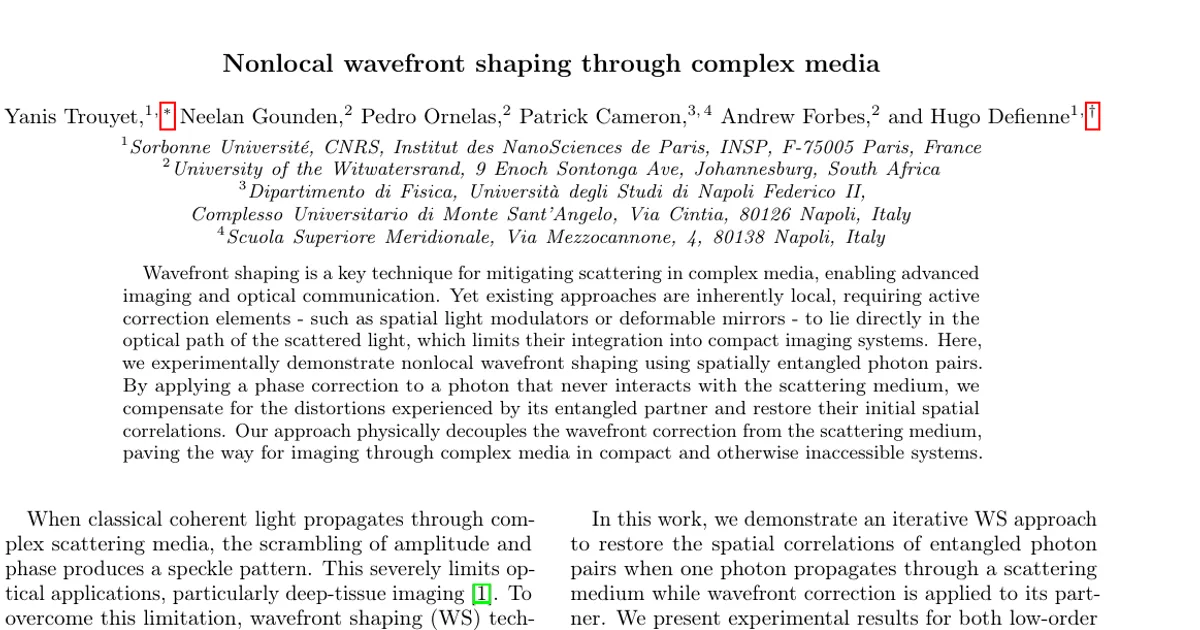
Wavefront shaping is a key technique for mitigating scattering in complex media, enabling advanced imaging and optical communication. Yet existing approaches are inherently local, requiring active correction elements - such as spatial light modulators or deformable mirrors - to lie directly in the optical path of the scattered light, which limits their integration into compact imaging systems. Here, we experimentally demonstrate nonlocal wavefront shaping using spatially entangled photon pairs. By applying a phase correction to a photon that never interacts with the scattering medium, we compensate for the distortions experienced by its entangled partner and restore their initial spatial correlations. Our approach physically decouples the wavefront correction from the scattering medium, paving the way for imaging through complex media in compact and otherwise inaccessible systems.