Research
Non-Hermitian Cooperation Induced Chern Insulator
Overview Research area: Non-Hermitian topological physics and topological band theory in open classical and quantum systems (quantum physics / photonics and acoustics metamaterials). Technical level:
- arXiv
- 2610.09413
- Published
- 2026-10-07
- Authors
- Weiwei Zhu, Bingbing Wang, Mengxiang Xie, Hong-yu Zou, Yang Long, Hong-xiang Sun, Haoran Xue, Jie Ren
AI summary
Overview
Research area: Non-Hermitian topological physics and topological band theory in open classical and quantum systems (quantum physics / photonics and acoustics metamaterials).
Technical level: Advanced.
Scope: A theoretical and numerical study showing that a static lattice containing no magnetic field, no synthetic gauge potential and no time-dependent modulation becomes a Chern insulator when on-site loss and non-reciprocal coupling are present together, with the topology traced to an orbital-angular-momentum-carrying mode of a four-site non-Hermitian "molecule."
What This Paper Is About
Chern insulators are conventionally produced by breaking time-reversal symmetry with magnetic fields, Floquet driving, or synthetic gauge fields, all of which are experimentally demanding in photonic and acoustic platforms. The authors ask whether non-Hermiticity alone—specifically the combination of on-site dissipation and asymmetric (non-reciprocal) hopping—can generate a Chern insulator in a lattice whose Hermitian limit is trivial. Their goal is both to demonstrate the effect and to explain, through an exact reduction, where the emergent topology comes from.
Key Contributions
-
A lattice design requiring no gauge field. The authors propose a static lattice with seven sites per unit cell, four of which carry on-site loss (−iγ, γ > 0) and non-reciprocal couplings κe^{+α} (clockwise) and κe^{−α} (counterclockwise), with the remaining sites Hermitian and coupled by real nearest-neighbor hoppings t. There is no magnetic field, no synthetic gauge potential and no temporal modulation.
-
A "cooperation" criterion for Chern topology. By comparing four parameter regimes—Hermitian limit (γ = 0, α = 0), asymmetric couplings only (γ = 0, α = 1), on-site loss only [γ = 2sinh(1), α = 0], and both together [γ = 2sinh(1), α = 1]—they show that neither non-Hermitian ingredient alone opens a topological gap or produces edge states. Only the coexistence case yields chiral edge states and a nonzero Chern number, reported as C_gap = ±1 (the caption of Fig. 1(g) states C = 1).
-
A mechanism based on a non-Hermitian chiral molecule. The four lossy sites, taken in isolation, form a 4×4 non-Hermitian block whose spectrum contains one slowest-decaying mode well separated from three highly lossy modes. That dominant mode has a 2π phase winding around the four sites, i.e. it carries orbital angular momentum, and its scattering signature is a π/2 phase accumulation between adjacent ports (2π total).
-
An exact mapping to an effective Hofstadter model. A unitary transformation that diagonalizes the non-Hermitian block followed by projection onto the single dominant mode converts the orbital texture into an effective synthetic flux of π/2 per plaquette, reproducing the low-loss bands and chiral edge states of the full lattice.
Main Findings
-
Hermitian limit is trivial. With γ = 0 and α = 0, time-reversal symmetry holds (TH(k)T⁻¹ = H(−k), T = complex conjugation), the spectrum is purely real, and only partial gaps without in-gap states appear.
-
Non-reciprocity alone is trivial. With γ = 0 and α = 1, the system is non-Hermitian but all hoppings remain real, so time-reversal symmetry is preserved; partial and full gaps appear but no boundary modes.
-
Loss alone is trivial despite breaking time-reversal symmetry. With γ = 2sinh(1) and α = 0, the imaginary on-site potential breaks time-reversal symmetry, yet no edge state appears—showing that breaking time-reversal symmetry by itself is insufficient in this lattice.
-
Cooperation produces a Chern insulator. With γ = 2sinh(1) and α = 1, a pair of robust chiral edge states traverses the bulk gap (highlighted in orange in Fig. 1(g)), and the Chern number is C_gap = ±1, consistent with bulk-boundary correspondence.
-
The dominant mode is an OAM carrier. Of the four complex eigenvalues of the chiral molecule, one has a substantially smaller imaginary-part magnitude than the other three; its eigenstate winds by 2π around the four sites, and input-output scattering with four ports gives a π/2 phase per adjacent port pair.
-
Projection reduction captures the full topology. The effective Hofstadter model with π/2 flux per plaquette reproduces the low-loss sector of the original spectrum, including the chiral edge states; the three eliminated fast-decaying modes correspond to the high-loss bulk bands of the original lattice.
-
Edge states survive a geometric defect. In a finite 10×10 lattice with open boundaries, a representative edge state is localized at the boundary; after deliberately removing a portion of the bottom boundary, the gapless edge state persists in the gap and remains extended along the remaining edges rather than scattering into the bulk.
-
Parameters used throughout band calculations: t = 1, κ = 1, with a strip periodic along x and open along y containing ten complete unit cells plus one extra row of sites.
Methodology in Plain English
The authors build a tight-binding model in momentum space and write its Bloch Hamiltonian in block form: a block for the three Hermitian sites, a 4×4 non-Hermitian block for the four lossy sites, and a coupling block between them. They compute projected band structures for a strip geometry (periodic in one direction, open in the other) under the four parameter settings, looking for in-gap states and computing the Chern number.
To explain why the coexistence case is topological, they isolate the four lossy sites as a stand-alone "molecule," diagonalize it, and identify which of its four modes decays slowest—since that mode survives longest and dominates the dynamics. They then apply a unitary transformation that leaves the Hermitian sites untouched and diagonalizes the non-Hermitian block, and project the full Hamiltonian onto only that slowest-decaying mode, discarding the three fast-decaying ones. The phase texture of the retained mode acts like a magnetic flux in the reduced lattice, so the reduced model is a Hofstadter model with π/2 flux per plaquette. Finally, they check robustness numerically on a finite 10×10 lattice with open boundaries, with and without an intentionally removed portion of the bottom edge.
Why This Matters
The paper reframes Chern topology as something that can be generated by the synergy of two dissipative/asymmetric effects rather than inherited from a Hermitian topological parent or imposed by external fields. This matters because magnetic responses are weak and dynamical modulation is difficult in photonic and acoustic systems, whereas gain, loss and non-reciprocal elements are increasingly available. It also supplies a general reduction recipe—identify the dynamically dominant mode and project onto it—that could be transferred to other non-Hermitian platforms.
Real-world applications the paper points toward:
- Robust waveguides and wave manipulation leveraging disorder- and defect-resistant chiral edge transport.
- Non-reciprocal devices built from asymmetric coupling, relevant to isolators and one-way signal routing.
- Topological lasers, listed among the applications motivating Chern topology in classical wave platforms.
- Acoustic, optical, mechanical and electrical circuit implementations, which the authors name as candidate platforms for the mechanism.
Industry relevance: photonic integrated circuits, acoustic and mechanical metamaterial design, and microwave/electrical-circuit hardware where loss and non-reciprocity are native rather than parasitic. No experimental device, fabrication recipe, or platform-specific parameter set is reported, so industrial translation remains speculative.
Future Directions
- Experimental realization. The paper proposes acoustic, optical, mechanical and electrical-circuit platforms but reports no experimental demonstration or concrete device parameters.
- Generalization to other non-Hermitian platforms and lattices. The authors state the projection framework can be generalized, but no other lattice geometries, flux values, or Chern numbers are worked out.
- Quantitative robustness. Only one geometric defect (removal of a portion of the bottom boundary in a 10×10 lattice) is tested; disorder strength, defect density, and systematic perturbation studies are not reported.
- Relationship to other non-Hermitian topology. The introduction discusses exceptional points, point-gap and line-gap topologies, and the non-Hermitian skin effect, but the paper does not analyze how the induced Chern phase interacts with these, nor what happens when gain replaces loss.
Target Audience
Researchers and graduate students in non-Hermitian photonics and acoustics, topological metamaterials, and condensed-matter band theory who already know Bloch Hamiltonians, Chern numbers and bulk-boundary correspondence. The conceptual message—two non-Hermitian ingredients cooperating to induce topology—is accessible to a broader physics audience, but the technical machinery (non-Hermitian Bloch blocks, projection reduction, effective Hofstadter mapping) requires an advanced background.
Authors’ abstract
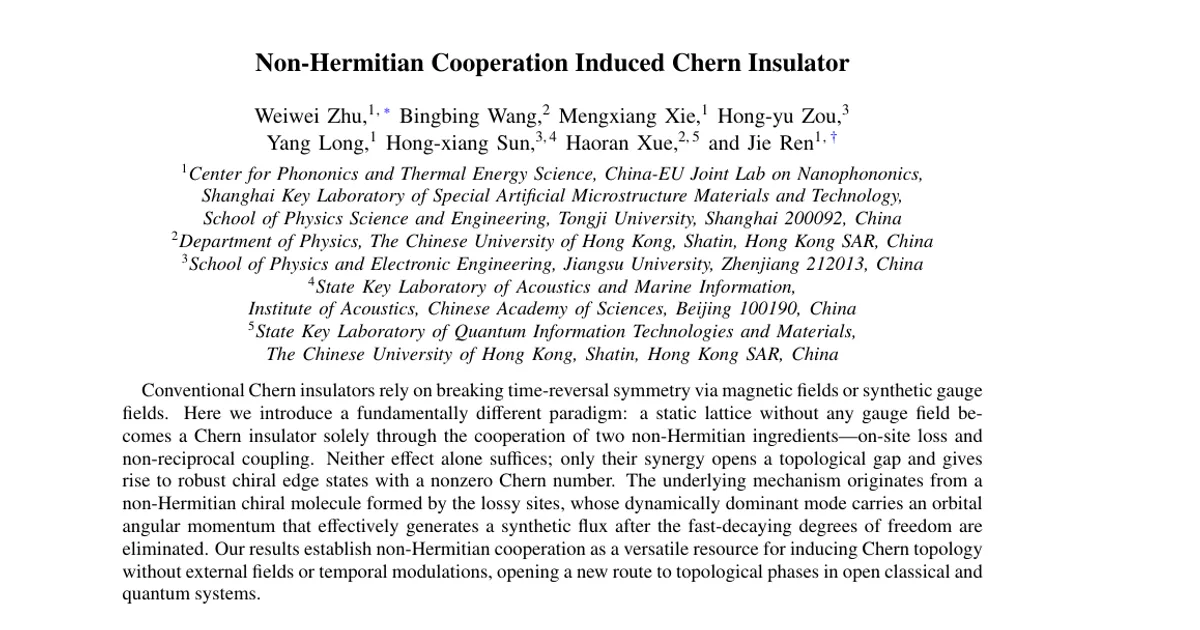
Conventional Chern insulators rely on breaking time-reversal symmetry via magnetic fields or synthetic gauge fields. Here we introduce a fundamentally different paradigm: a static lattice without any gauge field becomes a Chern insulator solely through the cooperation of two non-Hermitian ingredients: on-site loss and non-reciprocal coupling. Neither effect alone suffices; only their synergy opens a topological gap and gives rise to robust chiral edge states with a nonzero Chern number. The underlying mechanism originates from a non-Hermitian chiral molecule formed by the lossy sites, whose dynamically dominant mode carries an orbital angular momentum that effectively generates a synthetic flux after the fast-decaying degrees of freedom are eliminated. Our results establish non-Hermitian cooperation as a versatile resource for inducing Chern topology without external fields or temporal modulations, opening a new route to topological phases in open classical and quantum systems.