Research
Multimode continuous-variable quantum key distribution with CMOS-compatible photonic-electronic integration
Overview Research area: Quantum communication — continuous-variable quantum key distribution (CV-QKD) implemented with silicon-photonic integrated circuits co-integrated with standard CMOS electronics
- arXiv
- 2610.35410
- Published
- 2026-10-26
- Authors
- Yiming Bian, Sarah Bastiaens, Saeed Hakimi, Huy Quang Nguyen, Aboobackkar Sidhique, Cédric Bruynsteen, Govind J. Wanjalkar, Ali Al Hadi Amhaz, Jasper Jans, Axl Bomhals, Ulrik L. Andersen, Tobias Gehring, Xin Yin, Adnan A. E. Hajomer
AI summary
Overview
Research area: Quantum communication — continuous-variable quantum key distribution (CV-QKD) implemented with silicon-photonic integrated circuits co-integrated with standard CMOS electronics, combined with a multimode (dual-polarization) security analysis.
Technical level: Advanced. The paper combines Gaussian quantum information theory (Holevo bounds, covariance matrices, finite-size analysis), photonic integrated circuit design, and deep-submicron analog circuit design. The experimental and theoretical parts are both specialist-level, though the headline results are stated in accessible terms.
Scope: The paper proposes and experimentally demonstrates a two-mode (polarization-multiplexed) CV-QKD architecture built from a silicon-photonic transmitter chip, a silicon-photonic receiver chip co-integrated with a dual-channel 28-nm CMOS transimpedance amplifier, pilot-assisted unitary digital polarization recovery, and a multimode security analysis that retains residual source–receiver correlations, tested over 10 km of deployed fibre.
What This Paper Is About
Scaling QKD from point-to-point links to networks needs two things at once: compact hardware that can be mass-produced, and parallel (multimode) transmission to raise total key throughput or serve multiple users. Combining these runs into a security problem — when two independently modulated signals share a fibre, imperfect separation at the receiver leaks a bit of each signal into the other's measurement, and conventional single-mode security analysis mistakes that leakage for noise an eavesdropper could exploit, which crushes the key rate. The paper's goal is to build a CMOS-compatible photonic–electronic two-mode CV-QKD system and to show that a security analysis which keeps track of the residual cross-mode correlations recovers much of the key rate that the single-mode analysis throws away.
Key Contributions
-
A multimode CV-QKD security framework. The authors formulate an N-to-N Gaussian-modulated coherent-state network and, for each receiver mode, retain all source modes in an N-to-1 subnetwork, so that residual coupling appears as correlations rather than as untrusted excess noise. Both asymptotic and finite-size key-rate bounds are derived, with the finite-size version using a worst-case covariance matrix obtained from multivariate linear regression confidence regions.
-
Pilot-assisted unitary digital polarization recovery. The polarization mixing matrix is estimated from the complex responses of two pilot tones measured in both receiver branches, then projected onto its nearest unitary matrix via singular-value decomposition; the Hermitian transpose of that unitary is applied to the noise-normalized receiver outputs. This removes the need for active optical polarization control while keeping the digital operation physically equivalent to a unitary transformation, which the security model requires.
-
CMOS-compatible photonic–electronic integration. A silicon-photonic transmitter and receiver, both fabricated on IMEC's silicon-photonics platform, with the receiver co-integrated with a dual-channel transimpedance amplifier in 28-nm CMOS, giving a receiver footprint of 1.2 × 3.4 mm² and shot-noise clearances above 20 dB in both channels.
-
A field demonstration over 10 km of deployed fibre. Ten measurement rounds over a campus fibre loop in Ghent, Belgium, analysed with both the multimode and single-mode frameworks on the same digitally recovered data, yielding a mean total finite-size secret-key rate estimate of 6.69 Mbit/s versus 5.97 Mbit/s.
Main Findings
-
Shot-noise clearance: The two receiver channels achieve 21.1 dB and 22.0 dB at 0.3 GHz, with both exceeding 20 dB from approximately 0.1 to 1 GHz, measured at local-oscillator photocurrents of 680 µA and 575 µA. A standalone detector using the same TIA design reached 27 dB at 2.2 mA; the authors attribute the lower clearances here to the lower local-oscillator photocurrents.
-
Simulated distance extension: At 2% residual crosstalk (η_cross = 0.980), the multimode analysis extends the simulated secure distance from 39 km (single-mode analysis) to 84 km, close to the crosstalk-free limit of 89 km. The simulations use V_M = 4 SNU, ε = 0.02 SNU, β = 0.956, N_rec = 10⁹, fibre loss 0.2 dB/km, and ideal detectors.
-
Fourfold crosstalk tolerance: The single-mode analysis only reaches a comparable distance at η_cross = 0.995, which the authors describe as a fourfold tolerance to residual crosstalk. At η_cross = 0.980, the multimode framework keeps a total-rate advantage over single-polarization operation up to approximately 80 km.
-
Field key rates: Averaged over ten rounds, the H-polarization estimate rises from 0.02153 to 0.02504 bits per joint symbol and the V-polarization estimate from 0.02620 to 0.02845, relative improvements of 16.3% and 8.6%. The total rises from 0.04774 to 0.05349 bits per joint symbol, a 12% overall improvement. At 125 MBaud per polarization this corresponds to 3.13 Mbit/s (H), 3.56 Mbit/s (V), and 6.69 Mbit/s total, compared with 5.97 Mbit/s under the single-mode analysis.
-
Round-by-round behaviour: Both polarizations yield positive key-rate estimates in every round, and the multimode estimate exceeds the single-mode estimate throughout. Absolute increases range from approximately 4.56 × 10⁻⁴ to 6.82 × 10⁻³ bits per joint symbol; relative increases range from below 2% (Pol-V, round 9) to approximately 38.9% (Pol-V, round 8), with round 5 showing approximately 19.3% (Pol-H) and 18.3% (Pol-V).
-
Excess-noise reduction: Before recovery, single-mode excess-noise upper bounds range from approximately 0.110 to 0.378 SNU; digital polarization recovery reduces them to below 0.0442 SNU. The multimode analysis lowers them further by an average of 3.20 × 10⁻³ SNU for Pol-H and 1.93 × 10⁻³ SNU for Pol-V across the ten rounds.
-
Residual coupling after recovery: In the round-1 worst-case estimates, unitary recovery leaves quadrature-averaged cross-to-direct transmittance ratios of approximately 2.05 × 10⁻³ (−26.9 dB) for Pol-H and 2.40 × 10⁻³ (−26.2 dB) for Pol-V, with no active optical polarization control. For Pol-H, the receiver mode's correlation with its intended source is 1.9 SNU while its correlation with the orthogonal source has magnitude 0.1 SNU.
-
Flatness of the worst-case search: Across the plotted slices of the key-rate landscape, the rate varies by less than 8 × 10⁻⁴ bits per joint symbol, approximately 6% of the round-1 Pol-H rate.
-
Scope caveat: These are finite-size secret-key rate estimates against collective attacks; error correction and privacy amplification were not executed in this work.
Methodology in Plain English
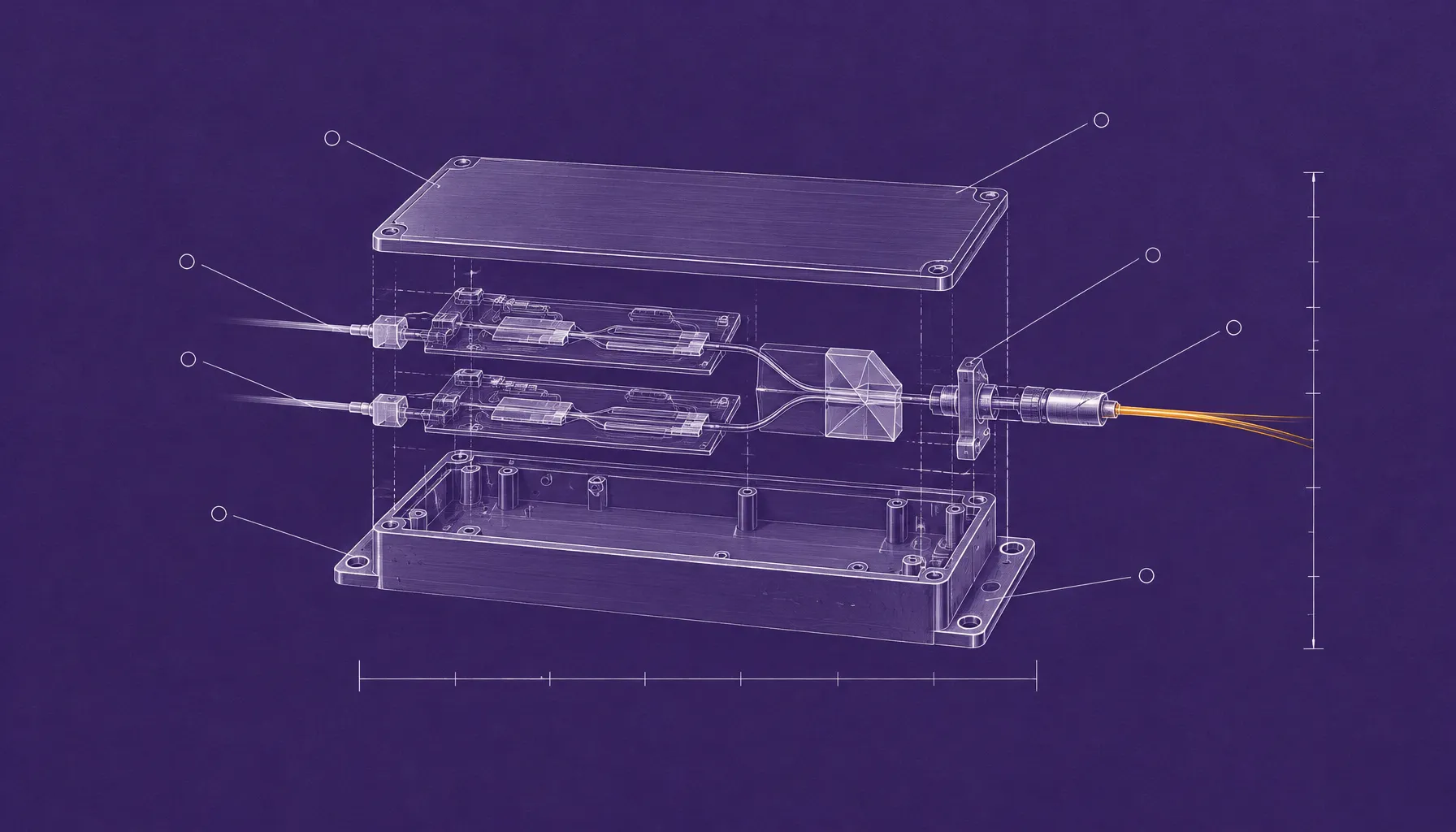
The transmitter is a silicon-photonic chip carrying two parallel IQ modulators, each built from travelling-wave Mach–Zehnder modulators, followed by cascaded thermo-optic attenuators that dim the light down to the quantum level. The chip outputs two channels, which an off-chip polarization beam combiner maps onto orthogonal polarizations in the fibre. The receiver chip splits the incoming signal against a local oscillator in balanced photodiode pairs, one per polarization, and each pair is wire-bonded directly to one channel of a CMOS transimpedance amplifier. That amplifier uses a capacitive-feedback design — a capacitor instead of a feedback resistor — to remove the resistor's thermal noise and to decouple gain from bandwidth, plus an on-chip DC-cancellation loop.
The link is a 10 km round-trip loop of deployed campus fibre with about 4 dB loss, so transmitter and receiver sit in the same building and share a clock, while the local oscillator comes from an independent laser. Because no polarization controller is used, each received channel is a slowly varying mixture of both transmitted polarizations. Each quantum signal carries a frequency-multiplexed pilot tone (100 MHz for Pol-H, 120 MHz for Pol-V); since both pilots appear in both receiver channels, their relative amplitudes and phases reveal the polarization transformation. The authors estimate that 2 × 2 mixing matrix, then project it onto the closest unitary matrix using singular-value decomposition and apply its Hermitian transpose to the measured data — and to the noise-calibration data — so the recovery is mathematically equivalent to a physical polarization rotation, which the security proof can absorb into the eavesdropper's channel.
For security, each receiver mode is analysed together with both source modes rather than just its intended partner. The coupling coefficients and excess noise are estimated jointly by multivariate linear regression, with excess noise fixed at its upper confidence bound and the coupling coefficients jointly optimized inside their confidence region to maximize the eavesdropper's Holevo information; the lowest resulting rate is the worst-case estimate. Ten rounds of 2.5 × 10⁷ symbols per polarization were recorded over several hours, digitized by a 16-bit ADC at 1 GSa/s, and processed with a shared digital signal processing chain.
Why This Matters
The paper connects three things that are usually handled separately — parallel low-noise detection, digital recovery consistent with a security proof, and a key-rate estimate that does not punish incomplete mode decoupling. The practical consequence is that a system can tolerate imperfect mode isolation instead of needing near-perfect optical demultiplexing, which lowers the precision required for digital polarization recovery and hence the computational overhead. Equally important for deployment, the receiver's readout is standard 28-nm CMOS, a volume-manufacturing platform, rather than a custom compound-semiconductor amplifier.
Real-world applications:
- Metropolitan QKD networks built on existing deployed fibre, where polarization drifts and mode coupling are unavoidable and active polarization control adds loss and hardware.
- Multi-user quantum-secured networks, where multiplexed modes let several users or several parallel key streams share one fibre and one receiver architecture.
- Mass-manufacturable QKD modules, since both photonic and electronic parts come from established foundry processes suited to volume production.
- Coexistence with telecom infrastructure, extending the line of work on operating QKD alongside classical data traffic in installed fibre.
Industry relevance: the results speak directly to silicon-photonics foundries and CMOS analog design houses, since the demonstrated receiver is a co-integration of a photonic PIC with a standard-process transimpedance amplifier — the same kind of component supply chain used for high-speed classical optical transceivers.
Future Directions
- Scaling beyond two modes. The authors note that the pilot-assisted unitary recovery extends in form to an N-mode linear mixing channel, and that separating state preparation/detection from the external mode mapping provides a basis for adapting the architecture to spatial modes or wavelength-selective components. Wavelength and spatial multiplexing are the obvious next steps.
- Higher symbol rates. The transmitter modulators show a 6-dB bandwidth of approximately 9 GHz, which the authors state exceeds what is required at the present symbol rate of 125 MBaud, leaving headroom for higher-throughput operation.
- Executing full post-processing. Error correction and privacy amplification were not run here; the reported figures are estimates. Closing that gap on the same hardware is the natural next experimental milestone.
- Handling time-varying coupling and tighter finite-size analysis. The link showed time-varying mixing across rounds, and the differences between low-noise (round 2) and high-noise (round 5) rounds suggest that adapting parameter estimation to drift, and refining the worst-case covariance-matrix search, are open engineering questions.
Target Audience
Researchers and engineers in quantum communication and photonic integration who are working on practical CV-QKD systems; silicon-photonics and CMOS analog circuit designers interested in quantum-grade low-noise readout; and network architects evaluating multiplexed QKD for deployed fibre infrastructure. The multimode security framework section will be most useful to theoreticians working on finite-size security with mode coupling, while the hardware and field-result sections are aimed at experimentalists and system integrators. Readers without a background in Gaussian quantum information or coherent detection will find the theoretical sections demanding.
Authors’ abstract
Multiplexing and photonic-electronic integration offer a route to scalable and high-throughput quantum key distribution (QKD) networks through parallel transmission and compact hardware suited to volume manufacturing. Realizing this route requires multichannel transmitters and receivers, and a security analysis accounting for mode coupling. Here we present a CMOS-compatible photonic-electronic multimode continuous-variable QKD architecture, using polarization multiplexing as a two-mode example. Silicon-photonic transmitter and receiver chips prepare and detect two polarization modes in parallel. The receiver is co-integrated with a dual-channel 28-nm CMOS transimpedance amplifier, providing shot-noise clearances exceeding 20 dB in both channels. Pilot-assisted unitary digital recovery removes the need for active optical polarization control, while a multimode security analysis accounts for the mode crosstalk. At 2 percent residual crosstalk, the multimode analysis extends the simulated secure distance from 39 to 84 km, near the crosstalk-free limit of 89 km. Over 10 km of deployed fibre, the mean total finite-size secret-key rate estimate is 6.69 Mbit/s, 12 percent above the single-mode analysis from the same digitally recovered data. These results establish a route to scalable multimode quantum-secured networks built on technology suited to mass production.