Research
MPStab: an hybrid stabilizers tensor-network quantum circuit simulator
Overview Research area: Classical simulation of quantum circuits — specifically hybrid methods that combine stabilizer (Clifford) simulation with tensor-network/matrix-product-state simulation. Techni
- arXiv
- 2607.24258
- Published
- 2026-07-27
- Authors
- Giulio Crognaletti, Mattia Robbiano, Michele Grossi, Matteo Robbiati
AI summary
Overview
Research area: Classical simulation of quantum circuits — specifically hybrid methods that combine stabilizer (Clifford) simulation with tensor-network/matrix-product-state simulation.
Technical level: Advanced. The paper assumes familiarity with stabilizer tableaux, matrix product states/operators, bond dimension, and Clifford conjugation. The code examples are accessible, but the formalism sections require graduate-level quantum information background.
Scope (1 sentence): The paper presents mpstab, an open-source Python package (v0.1.0) implementing the hybrid stabilizer–matrix product operator (HSMPO) formalism, and benchmarks it against pure tensor-network simulation to map when the hybrid approach is the better classical simulator.
What This Paper Is About
Simulating quantum circuits on classical computers is limited by two competing resources: entanglement (which defeats tensor networks) and non-stabilizerness, or "magic" (which defeats stabilizer simulators). Most circuits contain both, so neither method alone works well. This paper packages a recently proposed hybrid technique — HSMPO, from Mello et al. (Ref. [22]) — into a usable library built on top of Qibo, and then empirically characterizes the circuit regimes (measured in Clifford gates, magic rotations, qubit count, and bond dimension) where this hybrid beats a standard MPS simulator.
Key Contributions
-
An open-source implementation (
mpstab0.1.0). A Python library that decomposes an input circuit into Clifford blocks and single-qubit magic rotations, conjugates each rotation through the preceding Clifford layers so it becomes a Pauli-string rotation, and evolves an MPS through those rotations. Source and documentation are hosted at the authors' GitHub and GitHub Pages links given in the paper. -
A modular engine architecture. Stabilizer and tensor-network backends are independently selectable.
mpstabships with its own implementations plus wrappers for Stim (stabilizers) and Quimb (tensor networks, including a JAX backend for automatic differentiation). TheHSMPOclass is the user-facing interface, and the package can be registered as a Qibo backend. -
An analytical cost model and a phase map. The paper derives explicit complexity expressions for
mpstaband for standard MPS simulation (Eqs. 13 and 14) and uses their ratio to draw a cost map over Clifford/non-Clifford gate counts spanning zero to one million gates, at L = 50 qubits with worst-case interaction range ℓ = L. -
A benchmark protocol with a built-in accuracy certificate. A tunable ansatz gives independent control over entanglement and magic, and a fidelity lower bound derived from the MPS norm deficit certifies accuracy without ever computing the exact state.
Main Findings
-
The dressed-rotation MPO has bond dimension exactly two, regardless of Pauli-string weight. A rotation
exp(-iθΣ_γ/2)is a linear combination of the identity and the Pauli string; each is bond dimension one, so their combination is bond dimension two. A rotation spanning the entire system costs no more to represent than a single-qubit rotation. -
Clifford work is polynomial and exact; tensor-network work is approximate. Backpropagating an observable through N_C Clifford gates costs O(N_C · L). Evolving the state through N_nC magic rotations costs O(χ³ N_nC) overall. The stabilizer part introduces no approximation error; the MPS truncation does.
-
The analytical cost model predicts the measured crossover. In wall-clock tests at L = 35 and L = 80 qubits with depth D = 1, as the single-qubit magic percentage sweeps from 0% to 100%,
mpstabtime rises monotonically while pure Quimb stays essentially flat. The predicted crossover (setting C_mps/C_mpstab = 1) falls inside the interval where the measured curves actually cross at both system sizes, validating the model's leading-order scaling. -
Two distinct regimes appear in the cost map. For moderate χ_mpstab (the left column, χ_mpstab = 8), the iso-cost contour is arched:
mpstabis cheaper in a finite window of N_C that closes at very large Clifford counts, where the N_nC · N_C dressing overhead dominates. For larger χ_mpstab (32 and 256), that term is subleading and the boundary becomes a straight diagonal in log–log scale set by the cubic bond-dimension gap (χ_mps/χ_mpstab)³. -
Increasing the bond-dimension saving expands the favourable region. Moving χ_mps/χ_mpstab from 1.1 to 2.5 systematically enlarges the
mpstab-favourable area, consistent with the cubic scaling of the standard method. -
The advantage concentrates at low magic and high Clifford content. The paper states the
mpstabadvantage is most pronounced at low N_nC and high N_C, where the stabilizer formalism absorbs the bulk of the entanglement structure and non-Clifford overhead stays modest. -
Not reported in the supplied content: the fidelity-comparison results at β = 0.4 and β = 0.8 (Fig. 8), and the wall-clock scaling-with-system-size results (Fig. 9). The provided text is truncated mid-sentence at the start of the "Fidelity advantage at fixed bond dimension" discussion, so those specific numbers and conclusions cannot be summarized.
Methodology in Plain English
Any quantum circuit can be rewritten as alternating blocks: a chunk of Clifford gates, then a single rotation around a Pauli axis, then another Clifford chunk, and so on. The key trick is that a Clifford gate can be commuted past a rotation — but the rotation's axis gets transformed in the process. A local Z-rotation, after being pushed through a CNOT and two Hadamards, becomes a two-qubit X⊗X interaction. So instead of simulating the original circuit, the simulator simulates a string of non-local Pauli-string rotations followed by one residual Clifford circuit.
The two halves are then handled by whichever tool is better suited. The residual Clifford part is applied to the observable rather than the state (Heisenberg picture, using stabilizer tableau arithmetic, exact and cheap). The non-local rotations are applied to the state as matrix product operators (Schrödinger picture), which is where truncation at a maximum bond dimension χ enters.
For benchmarking, the authors build an ansatz with two knobs: β, the fraction of single-qubit rotations that are non-Clifford (called "magic retention"), and k, a CNOT-ladder cutoff that sets entanglement. A fraction 1−β of the rotations use angles that are multiples of π/2, keeping them Clifford. The magic-to-Clifford ratio per layer is Lβ / (L(1−β) + k(k−1)/2). Each configuration is run for M = 20 random initializations of the non-Clifford rotations. Because the underlying tensor-network engine is the same Quimb code with the same contraction optimizer and backend in both arms, any difference is attributable to the hybrid formalism rather than implementation details. Accuracy is tracked through a fidelity lower bound equal to the squared norm of the truncated state, which is rigorous because unitary evolution preserves norm exactly, so any norm deficit comes purely from truncation.
Why This Matters
Establishing where classical simulation succeeds and where it fails is exactly how the boundary of quantum advantage gets drawn. A simulator that extends the reachable regime — Clifford-dominated circuits with moderate magic — lets researchers validate larger algorithms, run longer dynamics, and avoid claiming quantum advantage for problems a laptop can still handle.
Real-world and practical applications indicated in the paper:
- Variational algorithm development:
mpstabcan be used inside optimization pipelines, with Quimb's JAX backend providing automatic differentiation for gradients. - Error mitigation: the
modelsmodule includes data-driven error-mitigation methods built on the HSMPO formalism, andexpectation_from_partitioncan replace magic gates with Clifford gates at a chosen probability (the example uses 0.7 with random replacement). - Magic/entanglement diagnostics: the
modelsmodule provides exact or stochastic estimates of the Stabilizer Rényi Entropy. - Hybrid quantum-classical pipelines: registering
mpstabas a Qibo backend lets it sit alongside Qibo's interface to real quantum devices.
Industry relevance: the package targets the same user base as Qiskit, Cirq, PennyLane, Qulacs, Stim, Quimb, ITensor.jl, TenPy and Quantum Tea, and its Qibo integration makes it a drop-in option for teams already using that stack. It is most relevant to groups benchmarking quantum hardware roadmaps, where knowing the true classical baseline is a prerequisite for any advantage claim.
Future Directions
- Noise simulation. The paper explicitly states this is planned for future releases: "will be expanded in future releases including new features, such as noise simulation."
- Alternative engine pairings. The authors note the current stabilizer-backpropagation / tensor-network-evolution split was merely the first mechanism implemented, and suggest deriving analytical forms of non-local rotations with a stabilizer engine and then synthesizing a digital circuit from them, or adopting richer tensor-network ansätze.
- Integration with Pauli propagation and similar hybrids. The paper points to Pauli propagation (Ref. [26]) as an alternative hybrid worth incorporating, and notes a similar solution has already been implemented in Ref. [2].
- Variational and device-facing workflows. Extending HSMPO use into variational contexts (the paper cites QiboML, Ref. [25]) and hybrid quantum-classical pipelines with real hardware.
Target Audience
Researchers and developers working on classical simulation of quantum circuits who need to push past statevector limits; quantum algorithm designers who want to know whether their circuit is classically simulable before claiming advantage; and practitioners already using Qibo, Quimb, or Stim who want a hybrid tool with selectable backends. Readers primarily interested in applications rather than simulation methodology will find the benchmarks and the cost map (Fig. 5) the most directly useful parts.
Authors’ abstract
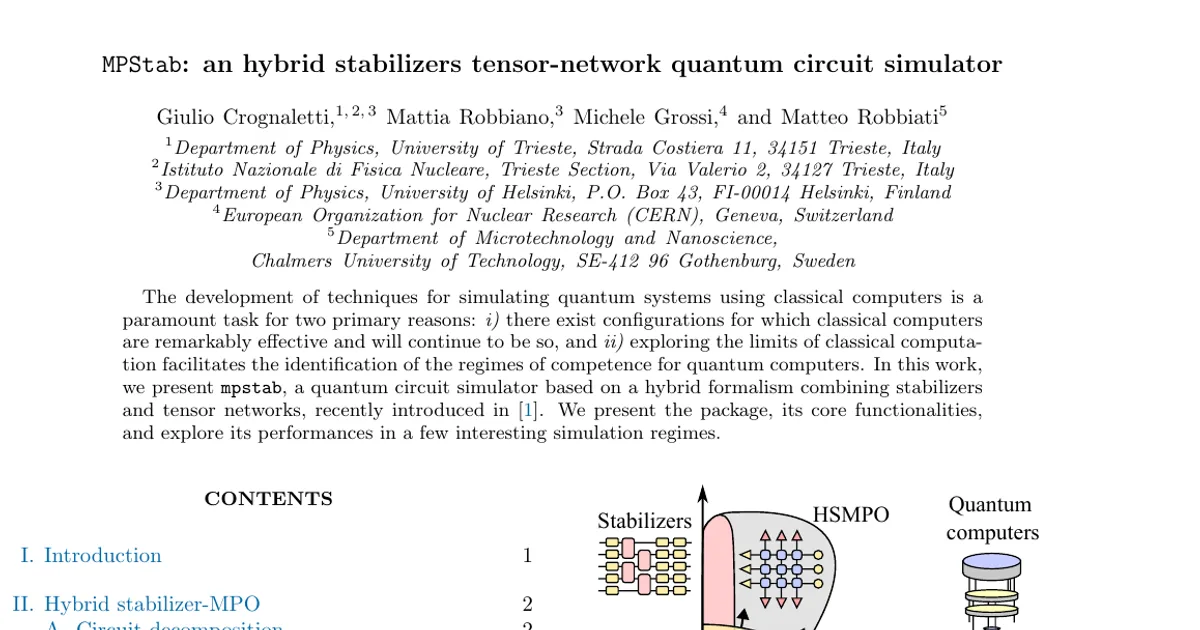
The development of techniques for simulating quantum systems using classical computers is a paramount task for two primary reasons: i) there exist configurations for which classical computers are remarkably effective and will continue to be so, and ii) exploring the limits of classical computation facilitates the identification of the regimes of competence for quantum computers. In this work, we present MPStab, a quantum circuit simulator based on a hybrid formalism combining stabilizers and tensor networks, recently introduced in Ref. [1]. We present the package, its core functionalities, and explore its performances in a few interesting simulation regimes.