Research
Mixed-State Symmetry-Protected Topology and Strong-to-Weak Spontaneous Symmetry Breaking in a Superconducting Qubit Array
Overview Research area: Experimental quantum many-body physics in superconducting circuits — mixed-state symmetry-protected topological (SPT) order, measurement-induced entanglement, and strong-to-wea
- arXiv
- 2608.24993
- Published
- 2026-08-25
- Authors
- Qian Cao, Zhen Bi, Kater W. Murch
AI summary
Overview
Research area: Experimental quantum many-body physics in superconducting circuits — mixed-state symmetry-protected topological (SPT) order, measurement-induced entanglement, and strong-to-weak spontaneous symmetry breaking (SW-SSB). Technical level: Advanced (assumes familiarity with stabilizer states, SPT phases, quantum channels, and density-matrix correlation functions), though the experimental methods are described concretely. Scope: A five-qubit transmon experiment showing that a single one-dimensional cluster state can display string order, measurement-conditioned GHZ order, or mixed-state SW-SSB depending on how information about one sublattice is handled.
What This Paper Is About
The authors ask how the hidden topological order of a one-dimensional cluster state survives, changes, or reappears once parts of the system are measured, dephased, or discarded. Using a five-qubit superconducting array, they prepare a cluster state and then subject it to two kinds of controlled information loss: weak dephasing of one sublattice, and projective measurement of one sublattice in a tunable basis. The goal is to connect three theoretically proposed notions — average SPT order, measurement-induced long-range entanglement, and SW-SSB — within one device and one underlying state.
Key Contributions
- Finite-size observation of average SPT order. By driving the readout resonators of the odd sublattice (Q1, Q3, Q5) to induce calibrated dephasing, the authors show that odd-sublattice string orders decay while the even-sublattice string order remains conserved, consistent with the structure expected for an average symmetry-protected topological phase.
- Measurement-induced interpolation between GHZ and paramagnetic states. Measuring Q2 and Q4 in a tunable basis M_i(θ_i) = cos θ_i X_i + sin θ_i Z_i and postselecting on (m2, m4) = (1, 1) drives the remaining qubits between a long-range-entangled GHZ state and a separable paramagnetic state, verified by three-qubit state tomography.
- Finite-size signature of SW-SSB in a traced-out cluster state. Discarding the measurement record yields a reduced state ρ1,3,5 = (1/8)(I + X1X3X5) whose conventional correlators vanish while nonlinear fidelity correlators remain near unity, both before and after projecting onto the positive symmetry-charge sector.
- A unified system–environment framing. The paper argues that decoherence and measurement do not simply degrade cluster-state order; rather, which degrees of freedom are treated as the environment and whether their record is retained determine whether the order appears as ASPT string order, conditioned GHZ order, or SW-SSB.
Main Findings
- Device and gate performance: The five fixed-frequency transmons (Q1–Q5 at 4.244, 4.076, 3.996, 3.938, and 3.837 GHz) are coupled by tunable couplers with idle frequencies 4.635, 4.581, 4.506, and 4.398 GHz. The residual ZZ interaction at the idle point is minimized to ~3.2 kHz and can be increased to ~17.6 MHz for gate operation. Interleaved randomized benchmarking gives four CZ fidelities of 0.960, 0.923, 0.978, and 0.948, with infidelity attributed primarily to leakage into higher transmon levels.
- Cluster-state fidelity: The prepared state's fidelity is lower-bounded at F_LB = 0.706 ± 0.003 via stabilizer measurements, against a gate-limited estimate of F_CZ^lim = 0.822.
- Selective decay of string order: Under odd-sublattice dephasing, the strings S_o = Z2X3Z4 and S_o′ = X1Z2Z4X5 decay, whereas S_e = Z1X2X4Z5 remains robust. The paper traces this to S_e commuting with every Kraus operator of the dephasing channel, making it an exactly conserved observable, while odd-sublattice Z errors randomize the sign of the odd strings across trajectories.
- Measurement-induced long-range order: Near θ2 = θ4 = 0 (X basis), the conditioned state shows ⟨Z1Z5⟩ ≈ 1, the few-spin limit of ferromagnetic order, and tomography reveals coherence between |000⟩ and |111⟩. The fidelity to a phase-corrected GHZ state is F = 0.667 ± 0.003, exceeding the 0.5 threshold for genuine tripartite entanglement (reported as 67% in the figure).
- Paramagnetic limit: For measurement angles θ2 = θ4 = π/2, the projected state approaches |+⟩1⊗|+⟩3⊗|+⟩5 with fidelity F = 0.888 ± 0.002 (89% in the figure), and long-range correlations vanish.
- Symmetry-charge leakage: The measured symmetry charge Tr(ρ1,3,5 U) ≅ 0.60 for U = X1X3X5 corresponds to 80% and 20% populations in the positive- and negative-charge sectors, i.e., a 20% leakage from the target sector.
- SW-SSB table: For the unprojected state, ⟨Z1Z5⟩ = 0.053, ⟨Z1Z3⟩ = 0.018, ⟨Z3Z5⟩ = 0.025, with fidelity correlators F15 = 0.949, F13 = 0.978, F35 = 0.956. For the symmetry-projected state, the conventional correlators are 0.033, 0.010, and −0.007, with fidelity correlators 0.985, 0.994, and 0.988. Vanishing linear correlators coexisting with near-unity fidelity correlators constitute the finite-size SW-SSB signature.
Methodology in Plain English
The team built a chain of five superconducting qubits connected by adjustable couplers, which let them switch nearest-neighbor interactions on and off quickly. They started every qubit in an equal superposition (a "+" state) and applied four controlled-Z gates in sequence to create the cluster state, using shaped flux pulses chosen to limit leakage and nonadiabatic errors. They checked the state by measuring its stabilizer operators and converting those into a lower bound on fidelity, and they corrected readout errors with calibrated assignment matrices and iterative Bayesian unfolding.
To study decoherence, they did not add noise artificially with gates; instead they weakly drove the readout resonators of the odd-numbered qubits, which produces a well-understood dephasing channel whose strength p_i they calibrated independently with Ramsey measurements. They then measured the three string operators, using rotationally invariant combinations of X and Y correlators to cancel phase shifts caused by the drive.
To study measurement, they rotated qubits Q2 and Q4 by a chosen angle, measured them projectively, kept only the (1,1) outcomes, and reconstructed the state of Q1, Q3, and Q5 by tomography while applying an XY-4 dynamical-decoupling sequence to suppress phase errors. Finally, they repeated the analysis without conditioning — mathematically equivalent to tracing out Q2 and Q4 — and computed both ordinary two-point correlators and nonlinear fidelity correlators, the latter also after projecting the reconstructed density matrix onto the positive symmetry-charge sector.
Why This Matters
The work turns several abstract proposals about mixed-state topology into a single, controllable tabletop setting. It shows that decoherence need not be purely destructive: the same underlying cluster state can look topologically ordered, long-range entangled, or symmetry-broken depending on bookkeeping about the environment. This gives experimentalists concrete, finite-size observables — string orders and fidelity correlators — that can be compared directly with theory, and it links the language of measurement-based quantum computing to that of mixed-state phases of matter.
Applications and implications:
- Measurement-based quantum computing: The demonstrated ability to convert a short-range-entangled cluster state into a GHZ state by measuring a sublattice is the same mechanism that powers measurement-based computation; characterizing how noise degrades it informs hardware requirements.
- Decoherence-robust quantum memories: The finding that one symmetry sector's string order is exactly conserved under a whole family of noise channels suggests encoding information in observables that commute with the dominant error processes.
- Benchmarking quantum processors: String-order and fidelity-correlator measurements offer diagnostics of correlated noise and leakage that go beyond randomized benchmarking alone.
- Foundational tests of mixed-state phases: Distinguishing genuine mixed-state order from finite-size artifacts becomes experimentally tractable in architectures like this one.
Industry relevance: Superconducting transmon arrays with tunable couplers are the leading platform for gate-based quantum computing. Techniques for calibrating dephasing channels, mitigating readout error, and quantifying how order survives noise map directly onto the metrology and control problems industrial quantum-hardware teams face. The connection to measurement-based schemes is relevant to architectures that trade unitary depth for measurement and feed-forward.
Future Directions
- Finite-size scaling: Larger qubit arrays are needed to distinguish the finite-size signatures reported here from genuine mixed-state phases, particularly by scaling string and fidelity correlators.
- Scalable probes of nonlinear correlations: Full state tomography will not scale; the authors identify developing probes of fidelity correlations without reconstruction as a central experimental challenge.
- Real-time monitoring and feedback: Resolving individual quantum trajectories and tracking symmetry-charge evolution could open routes to measurement- and feedback-induced phase transitions, and repeated adaptive measurements might engineer nonequilibrium many-body or quantum-critical states.
- Open question on boundary sectors: The prepared state selects a specific edge sector (K1 = K5 = +1), and the bare even-sublattice symmetry U_e is only realized in an endpoint-dressed form Ũ_e = K2K4; how other edge choices modify the observed mixed-state order is left for future work.
Target Audience
Quantum-information and condensed-matter theorists working on mixed-state phases, SPT order, and measurement-induced phenomena; experimentalists in superconducting quantum computing interested in device-level characterization of decoherence and measurement backaction; and graduate students or advanced readers who want a worked, concrete example connecting abstract mixed-state topology to measurable correlators.
Data and code are available at https://doi.org/10.5281/zenodo.22033124.
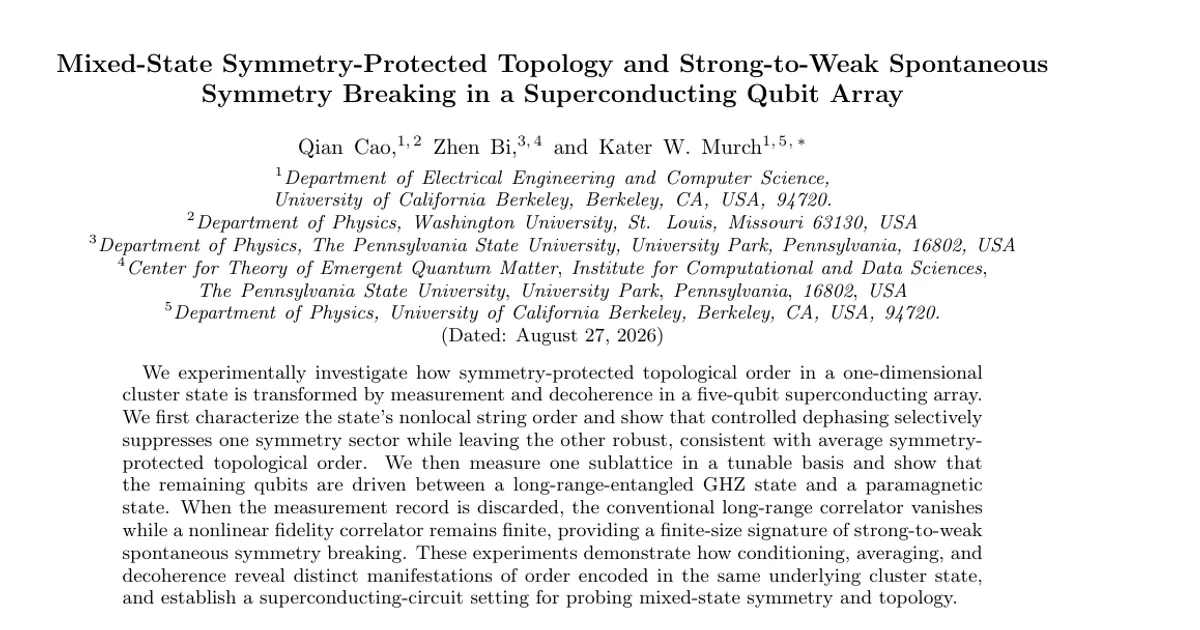
Authors’ abstract
We experimentally investigate how symmetry-protected topological order in a one-dimensional cluster state is transformed by measurement and decoherence in a five-qubit superconducting array. We first characterize the state's nonlocal string order and show that controlled dephasing selectively suppresses one symmetry sector while leaving the other robust, consistent with average symmetry-protected topological order. We then measure one sublattice in a tunable basis and show that the remaining qubits are driven between a long-range-entangled GHZ state and a paramagnetic state. When the measurement record is discarded, the conventional long-range correlator vanishes while a nonlinear fidelity correlator remains finite, providing a finite-size signature of strong-to-weak spontaneous symmetry breaking. These experiments demonstrate how conditioning, averaging, and decoherence reveal distinct manifestations of order encoded in the same underlying cluster state, and establish a superconducting-circuit setting for probing mixed-state symmetry and topology.