Research
Lowering the implementation barrier of neutral-atom quantum computing with agentic workflows
Overview Research area: Quantum computing — neutral-atom (Rydberg-array) hardware, AI/LLM agentic workflows, quantum simulation and combinatorial optimization. Technical level: Intermediate. The paper
- arXiv
- 2607.25834
- Published
- 2026-07-28
- Authors
- Constantin Dalyac, Alexandre Dauphin, Loïc Henriet, Christophe Jurczak
AI summary
Overview
Research area: Quantum computing — neutral-atom (Rydberg-array) hardware, AI/LLM agentic workflows, quantum simulation and combinatorial optimization.
Technical level: Intermediate. The paper is written to be readable by quantum scientists, but the core subject — automating the path from a paper to a QPU experiment — is explained largely in operational rather than theoretical terms.
1-sentence scope: The paper documents an LLM-agent workflow built on Pasqal's software stack that turns published papers, patents, or natural-language requests into experiments executed on cloud-accessible neutral-atom QPUs, and stress-tests it on three case studies plus a classification of 633 arXiv papers.
What This Paper Is About
Quantum processors are now reachable through the cloud, yet turning a published protocol into a running hardware experiment still demands fluency in protocol design, compilation, simulation, cloud execution, and noisy-data interpretation — a barrier that often exceeds the effort of the original scientific idea. The authors build an agentic workflow, with the researcher kept in the loop for validation, that automates that engineering chain on two Pasqal QPUs. The paper asks both whether the workflow can execute real experiments end-to-end, and where human scientific judgment remains irreplaceable.
Key Contributions
-
An agentic workflow spanning the full pipeline. Six modular skills —
paper_to_spec,spec_to_sequence,validate_emu,noise_emulate,qpu_submit, andharvest_and_analyze— are orchestrated through a single machine-readable artifact,experiment_spec.json, so any change to the specification propagates to all downstream stages. Built on Pulser, the emu-mps emulator, and the Pasqal Cloud SDK, and run with Anthropic's Claude Code using the models Opus 4.8 and Fable 5. -
Three end-to-end case studies of increasing difficulty. A reproduction of a landmark 2019 Kibble-Zurek result (Keesling et al.) on QPUs FC1 and SA1; a preparation of frustrated magnetic phases from a Guo et al. theory paper with no proposed implementation; and a multi-round graph-coloring algorithm taken from a Pasqal patent.
-
A documented catalogue of agent failure modes. The paper reports specific, expert-caught errors: an inadequate observable choice in the triangular-lattice study and a plausible but incorrect hardware diagnosis (Rydberg-blockade leakage) in the graph-coloring study that actually stemmed from a coordinate/bitstring ordering bug.
-
A corpus-scale feasibility survey. A second, lighter agent classified 526 of 633 identified Rydberg-array arXiv papers against present-day QPU capabilities, showing that 258 (49.0%) are implementable today and quantifying which hardware upgrades would unlock the remainder.
Main Findings
-
Z3 was correctly identified as unreachable; Z2 was not. Prompted toward the Z3 phase of Keesling et al., the agent found that hitting the targeted regime at the spacing floor forces Ω/2π down to 0.087 MHz, stretching the dynamical timescale so that neither one Rabi period nor the nearest-neighbour interaction time fit inside FC1's 6 μs sequence cap. The Z2 phase, by contrast, is native: at the 5 μm spacing floor and full Ω, Rb/a = 1.28 falls inside the ordering lobe.
-
Reproduction succeeded across two QPUs and two device generations. The reconstructed density-density correlator G(r) matched the 2019 data within statistical error at all 20 lattice sites probed, with fitted correlation lengths of ξ = 3.9 sites (paper), 4.2 (56-atom ring on FC1, 2000 shots) and 4.2 (96-atom ring on SA1, 1000 shots). Noise emulation predicted 80% noise retention, with the saturated order parameter reaching 71% of its ideal value.
-
Speed of the first campaign. Fewer than an hour and three researcher prompts were needed to get QPU jobs running, with the agent recovering autonomously from a paused QPU and job errors.
-
Frustrated triangular-lattice phases are detuning-limited. FC1's maximum detuning of |δ|/2π ≤ 10 MHz set the verdicts: the 1/3-filling phase (δ_c1/Ω = 1.22) is feasible at full Ω/2π = 2 MHz; the 1/2-filling order-by-disorder phase (δ/Ω ≈ 9.5) is marginal, requiring halving to Ω/2π ≈ 1 MHz; the 2/3-filling phase (δ_c2/Ω = 17.8) is infeasible, demanding Ω/2π ≲ 0.6 MHz.
-
The agent chose the wrong observable. Of the four observables in the Guo et al. paper, the agent retained only the structure factor and the mean magnetisation; the latter is not the one-body order parameter and cannot distinguish the target pattern from any other state at the same density. Expert review redirected it to the staggered magnetisation m (with shot-resolved ⟨|m|⟩ because of three-fold degeneracy) and to finite-size scaling, using rhombic L×L registers with L ≡ 1 mod 3, giving N = 49 and N = 100.
-
The plateau was observed, with a quantified shortfall. QPU data clearly display the 1/3 plateau; a deficit of roughly half the QMC amplitude is attributed to finite-size rounding, diabatic ramp excitations, and hardware noise, with the emulated noise band enveloping the data (a = 5.3 μm, Rb/a = 1.21, Ω/2π = 2 MHz, a 4 μs linear detuning ramp from δ_i = −4 MHz, 300 shots per point).
-
Human effort scaled with physical subtlety. Example A needed 3 human messages; Example B needed 43 exchanges to reach a physically accurate implementation.
-
Graph coloring approached the classical optimum. On 75 random unit-disk graph instances (density 0.35, Rb = 10 μm, N from 15 to 80), with beam width w = 3 and n_s = 200 shots per round per branch, the QPU matched the DSATUR chromatic number exactly on all 10 instances at N = 20 (mean gap 0.00), with the gap growing to at most 1.44 ± 0.50 at N = 80 and never exceeding 2 across all 75 instances (overall mean 0.84). The classical chromatic number is 4–5 throughout.
-
The "leakage" diagnosis was a labelling bug. Confronted with a high rate of constraint-violating shots, the agent attributed it to Rydberg-blockade leakage on the QPU; the actual cause was a mismatch between the ordering of atomic coordinates and the ordering of measured bitstrings. Only expert scrutiny of the raw shot-to-graph mapping surfaced it.
-
Nearly half the literature is already runnable. Of 633 Rydberg-array theory papers, 526 were classifiable: 225 (42.8%) implementable today and 33 (6.3%) with modest adaptation, totalling 258 (49.0%). The rest need XY-type interactions (141 papers, 26.8%), local addressing (87, 16.5%), N > 100 (17, 3.2%), mid-circuit measurement (9, 1.7%), basis rotations beyond on/off readout (5, 1.0%), or are genuinely under-specified (9, 1.7%). XY interactions and local addressing together account for approximately 85% of the non-implementable papers.
Methodology in Plain English
The team wrapped Pasqal's existing open-source and cloud tools in a set of agent "skills," each owning one stage of the experimental pipeline: read a source document and write a specification, compile that specification into a pulse sequence, simulate it without noise, simulate it with the device's live noise model, submit it to the QPU, and turn the returned bitstrings into scientific observables.
The pivotal design choice is that everything passes through one structured file, experiment_spec.json, which the researcher can inspect and edit before anything executes. No protocol reaches hardware without first passing emulation: a noiseless reference run is compared against a noise-aware run using parameters fetched live from the cloud SDK, indicating whether the target observable should survive real hardware. Because the noise envelope is widened by a calibration-offset band, measured QPU data can later be judged against an acceptance region rather than a single prediction.
The case studies were deliberately chosen to probe different failure surfaces. In the first, the authors intentionally aimed the agent at a phase (Z3) they knew from domain expertise would be out of reach, to see whether it would recognize the limitation. The second gave a deliberately open-ended prompt on a theory paper with no proposed implementation. The third used a patent as the source, testing whether the workflow mines a corpus beyond journals.
For the literature survey, a separate and lighter agent ran a five-rule decision tree over each paper's full text — system size N ≤ 100, global drive only, Ising or blockade interactions, no mid-circuit measurement, and computational-basis readout without tomography — recording rule-level justifications with citations so classifications could be audited without full manual review. Nine arXiv abstract queries executed on 2026-05-23 returned 1,966 raw hits, deduplicating to 1,108 unique papers, filtered to 633 after removing off-topic matches.
Why This Matters
The paper argues that the operational bottleneck in quantum experimentation has shifted. Coordinating tools, navigating device interfaces, and generating experiments are now tasks an agent handles well; selecting physically meaningful observables, recognizing subtle assumptions, and judging whether a signal supports a claim remain human. The troubling corollary is that agent failures can look like success: in Example B the pipeline ran smoothly and produced plausible data while measuring the wrong quantity.
The structured-specification approach also has a reproducibility angle. Reproducing a published quantum experiment normally requires reconstructing implicit engineering knowledge only partially captured in the manuscript; encoding protocols as executable specifications preserves that layer and lets it be re-instantiated on new devices.
Real-world applications:
- Quantum simulation of many-body phases. Preparing and certifying ordered phases (Z2 density waves, 1/3-filling plateaus) on Rydberg arrays, with noise-aware emulation screening which observables will survive before hardware time is spent.
- Combinatorial optimization. Graph coloring via iterative independent-set peeling, benchmarked here against DSATUR on random unit-disk graphs.
- Hardware roadmap prioritization. The corpus classification gives a demand-driven view: XY interactions and local addressing would unlock roughly 85% of currently inaccessible proposals.
- Democratizing cloud QPU access. Researchers without device-specific engineering knowledge can reach hardware through natural-language instructions.
Industry relevance: The work is directly commercial — three authors are at PASQAL and the fourth at Quantonation Ventures, and the experiments ran on standard public Pasqal Cloud accounts available to external users (FC1 in Sherbrooke, Québec, Canada; SA1 in Saudi Arabia). It is effectively a template for how quantum vendors may expose hardware to non-specialist users, and a reproducible-artifact pitch to the wider research community.
Future Directions
- Expanding the detuning range or rescaling the blockade ratio. The authors note that the 1/2- and 2/3-filling lobes are restricted solely by maximum detuning, and could be unlocked by either approach — the latter a regime already accessed on academic setups.
- Hardware co-design driven by literature demand. The survey quantifies exactly which capabilities (XY interactions, local addressing) would unlock the largest fraction of published proposals, providing a quantitative target list for future device generations.
- Better evaluation of agents on physical accuracy, not just execution success. The authors explicitly call for this, given that both reported failures produced smooth pipelines and plausible-looking results.
- Executable publications. Turning static manuscripts into structured, re-instantiable specifications that can be revisited, verified, and extended as hardware and software evolve.
Target Audience
Quantum physicists and experimentalists considering running protocols on neutral-atom hardware; quantum software and compiler engineers; research groups who own a protocol but not a device; vendor teams designing cloud APIs and hardware roadmaps; and science-of-AI researchers interested in concrete, expert-audited failure modes of LLM agents in a physical science. Readers seeking detailed derivations of the Kibble-Zurek mechanism or quantum Monte Carlo phase diagrams will not find them here — the physics serves as testbed for the workflow rather than the subject.
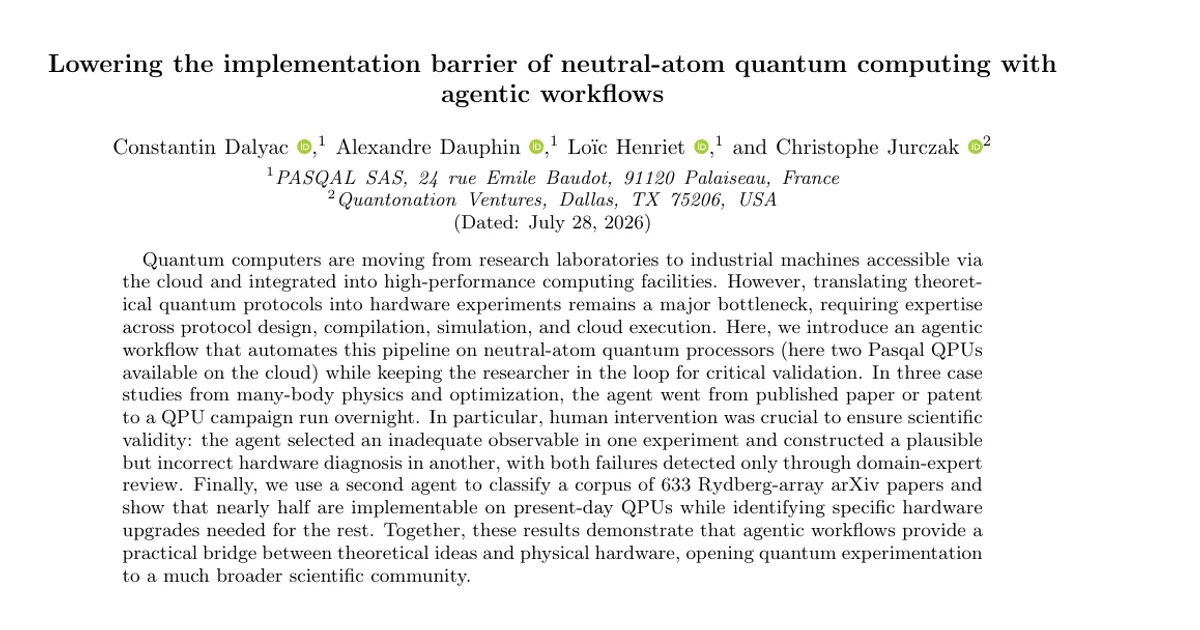
Authors’ abstract
Quantum computers are moving from research laboratories to industrial machines accessible via the cloud and integrated into high-performance computing facilities. However, translating theoretical quantum protocols into hardware experiments remains a major bottleneck, requiring expertise across protocol design, compilation, simulation, and cloud execution. Here, we introduce an agentic workflow that automates this pipeline on neutral-atom quantum processors (here two Pasqal QPUs available on the cloud) while keeping the researcher in the loop for critical validation. In three case studies from many-body physics and optimization, the agent went from published paper or patent to a QPU campaign run overnight. In particular, human intervention was crucial to ensure scientific validity: the agent selected an inadequate observable in one experiment and constructed a plausible but incorrect hardware diagnosis in another, with both failures detected only through domain-expert review. Finally, we use a second agent to classify a corpus of 633 Rydberg-array arXiv papers and show that nearly half are implementable on present-day QPUs while identifying specific hardware upgrades needed for the rest. Together, these results demonstrate that agentic workflows provide a practical bridge between theoretical ideas and physical hardware, opening quantum experimentation to a much broader scientific community.