Research
Identifying the Sign of Coherent Over-Rotations with Logarithmically Many Pauli Settings
Overview Research area: Quantum computing hardware characterization and calibration — specifically quantum parameter estimation, Fisher information, and measurement-design theory for coherent gate err
- arXiv
- 2607.21663
- Published
- 2026-07-23
- Authors
- Yi Pan, Meng Hsiu Tsai, Weihang You, Hanqi Jiang, Junhao Chen, Wei Zhang, Isaac Lyngaas, Yingfeng Wang, Tianming Liu
AI summary
Overview
Research area: Quantum computing hardware characterization and calibration — specifically quantum parameter estimation, Fisher information, and measurement-design theory for coherent gate errors.
Technical level: Advanced. The paper is written for readers comfortable with classical and quantum Fisher information, Cramér–Rao bounds, Pauli channels, and linear algebra over $\mathbb{F}_2$. The core ideas are stateable in plain language, but the proofs are technical.
Scope (one sentence): The paper proves that a single computational-basis histogram cannot determine the sign of coherent over-rotation angles at any sample size, and shows that adding $\lceil \log_2(n+1) \rceil$ product-Pauli measurement settings — provably the minimum for the complete single- and two-qubit family — restores closed-form signed recovery.
What This Paper Is About
Calibrating a quantum processor means estimating error parameters from measured data, and the usual intuition is that a hard-to-estimate parameter simply has a weak signal that more shots will eventually resolve. The authors show this intuition fails for coherent over-rotations — small systematic miscalibrations where a gate rotates a qubit too far (or too little) by the same amount on every run, typically $\eta \sim 0.01$–$0.1$ rad on today's devices. For commuting weight-1 and weight-2 transverse over-rotations with known support, the default single-basis ($Z$) histogram is exactly invariant under a sign-flip group, so no estimator can recover the sign of the angles at any sample size — and getting the sign wrong in a calibration correction doubles the error it was meant to remove. The goal is to characterize exactly what the passive histogram can and cannot identify, and to design a minimal set of added measurements that fixes the problem.
Key Contributions
-
An exact sign degeneracy of the passive histogram. The authors prove that the $Z$-basis outcome distribution is invariant under a sign group acting on the coherent angles, of order $2^{n+1}$ for the complete singleton-and-pair family with $n \geq 2$, at every angle and every rate. This yields a two-point risk bound: for any estimator, randomized ones included and with no unbiasedness assumption, $\max{R(\eta), R(\eta')} \geq \tfrac{1}{4}|\eta - \eta'|^2$ at every sample size.
-
Characterization of what a single histogram cannot see. They give a closed-form kernel and rank formula for the passive Jacobian, identifying coherent–stochastic "null directions" in which a small coherent rotation and a matching stochastic flip rate change the histogram identically to first order. At $\eta = 0$ the obstruction becomes continuous, with infinite Cramér–Rao bound for every coherent angle.
-
Coverage as a necessary and sufficient condition, with a minimal code. They prove that a product-Pauli design resolves the signed angles uniformly if and only if it covers the support, and that when it does, each angle is returned in closed form as $\tan \eta_S = -\langle Y_i X_{S\setminus{i}}\rangle / \langle Z_i \rangle$, without knowing the stochastic rates. The twirl-free separating code $B^\star$ of $\lceil \log_2(n+1)\rceil$ settings achieves this, and for the complete family no product-Pauli augmentation of $Z^n$ uses fewer.
-
A conditioning floor and a divergence threshold. They derive the explicit floor $c_B = \min{(1-2p)^n, \sqrt{\lambda_2}}$ for the separating code at $\eta=0$, and prove that below coverage, along full-rank approaches to $\eta = 0$, the worst-direction sample complexity of any finite-variance locally unbiased estimator diverges as $\Omega(\eta^{-2})$.
Main Findings
-
The passive fit fails on signs at every budget. In exact computation the single-histogram fit "stays at chance on the signs at every budget," while the closed-form inverse of the covering design recovers them. This is not a statistics problem — it is a symmetry of the data map.
-
Wrong-sign corrections are actively harmful. Because an over-rotation is removed by rotating back through the same angle, a calibration correction applied with the wrong sign doubles the rotation error it should remove.
-
At zero angle the obstruction is continuous. At $\eta = 0$ the Fisher information is singular along every coherent direction and the Cramér–Rao bound is infinite; no finite-variance, locally unbiased, first-order estimator recovers $\eta_S$ from the single histogram. The authors show the extended singular bound is required: the naive pseudoinverse number $g^\top F_Z^+ g$ is finite and misleading, whereas the correct value is $+\infty$ whenever the gradient has a kernel component.
-
At generic angles the continuous defect clears for $5 \leq n \leq 8$. At exactly $\eta = 0$ every coherent direction lies in the kernel ($r_H = |G|$). At $n = 3$ with weight-1 and weight-2 generators, all six coherent generators lie in the null space at $\eta = 0$ ($r_H = 6$), and a generic small angle lifts one combination, leaving $r_H = 5$. At generic nonzero angles a single histogram becomes full rank for $n \geq 5$ in the computed range $n \leq 8$ — but the sign degeneracy persists regardless.
-
Small worked case, $n=2$. For generators $X_1, X_2, X_1X_2$ on $|00\rangle$, the three nontrivial $Z$-expectations are $E_1 = d_1 d_{12}\cos\eta_1\cos\eta_{12}$, $E_2 = d_2 d_{12}\cos\eta_2\cos\eta_{12}$, $E_{12} = d_1 d_2\cos\eta_1\cos\eta_2$ with $d_a = 1-2p_a$. Every coherent angle enters only through a cosine, so all coherent derivatives vanish at $\eta=0$ and $r_H = |G| = 3$. Two added settings ($\lceil\log_2 3\rceil = 2$) lift $r_H$ to 0.
-
Finite-sample cost of the wrong design, quantified. At $n=3$ with all $\eta_S = \theta_{\text{coh}}$, $p_S = 0.05$, 40 seeds, and 8192 shots split equally across settings, the enriched $Z$-only estimator incurs 68×, 33×, 25×, and 17× the MSE of the separating code at $\theta_{\text{coh}} = 0.05, 0.10, 0.15, 0.20$ respectively, with 40-seed bootstrap intervals excluding unity at every angle. The error is bias-dominated at $0.05$ and $0.10$ and variance-dominated at $0.15$ and $0.20$.
-
Variance of the closed-form inverse. A delta-method expansion gives $\mathrm{Var}(\hat\eta_S) = \frac{1}{N_Q D_i^2} + o(N_Q^{-1})$ for $N_Q$ shots on the covering setting, where $D_i = (1-2p)^n$ for the complete family at uniform rate. The damping that cancels exactly between numerator and denominator does not cancel from the fluctuations.
-
Rank is easier than coverage, and conditioning exposes the gap. Equal-size random product-Pauli designs reach $r_H = 0$ in 54% of trials at $n=3$ and approximately 100% at $n = 4$–$6$, but rank at a nonzero reference is weaker than coverage. A stratified design leaving the singleton ${1}$ uncovered still reaches $r_H = 0$ at the tested reference, but has $\sigma_{\min} = 0$ at $\eta=0$ and $\sigma_{\min} \approx 7\times 10^{-4}$ at the reference, costing up to 6× the finite-sample error (RMSE 0.140 versus 0.023 at $n=3$).
-
The separating code attains the floor. At $n=3$, $p=0.05$, it has $\sigma_{\min} = c_B = 0.73$ at $\eta = 0$ (consistent with $0.9^3 \approx 0.73$) and $\sigma_{\min} \approx 0.72$ at the generic reference. It matches a greedy log-det $D$-optimal search at $n=4$ and exceeds it at $n=3$, where the greedy design reaches only $\sigma_{\min} = 0.097$.
-
Which floor branch wins depends on $n$. At $p = 0.05$ the angular branch gives $c_B = 0.73$ at $n=3$ and $0.21$ at $n=15$, verified against the exact stochastic block through $n=18$. The branches cross near $n = 20$; beyond it $\sqrt{\lambda_2}$ is smaller and falls to $\leq 9.42\times 10^{-6}$ at $n=63$, against $(1-2p)^{63} = 1.3\times 10^{-3}$. Both branches are exponentially small in $n$, so $c_B$ is a fixed-$n$, small-$p$ guarantee.
-
A non-asymptotic link between conditioning and error. For any locally unbiased estimator, $N \cdot \mathrm{MSE} \geq 2^n p_{\min},\sigma_{\min}^{-2}$ in parity coordinates, with $p_{\min}$ the smallest outcome probability; the constant $2^n p_{\min}$ equals 1 at a uniform reference. Since a sub-coverage design has $\sigma_{\min}(J) = O(|\eta|)$ along a full-rank approach, its worst-direction cost diverges as $\Omega(\eta^{-2})$. In matched-budget simulation the shot equivalent $(\mathrm{RMSE}{\text{single}}/\mathrm{RMSE}{\text{code}})^2$ grows from about 18× to 109× at $n=3$ as $\eta$ falls from 0.2 to 0.025.
-
Hardware check. Angle magnitudes recovered on two IBM Heron processors with injected errors at $n=3$ follow the predicted conditioning ordering.
-
The logarithmic count is a Pauli-alphabet floor. Two non-Pauli product settings measuring $(X \pm Y)/\sqrt{2}$ on every qubit, added to $Z^n$, determine every signed angle of the complete family at any $n$, since their difference measures $\langle X_iY_j + Y_iX_j\rangle$, which the paper's identities give as $-(\langle Z_i\rangle + \langle Z_j\rangle)\tan\eta_{ij}$.
Methodology in Plain English
The authors treat calibration as a statistical estimation problem and ask what a single fixed-basis measurement can identify on its own, rather than assuming active protocols are needed.
Step 1 — Model the device passively. A device takes a $Z$-diagonal input, applies commuting weight-1 and weight-2 transverse over-rotations of small angle $\eta_S$ together with stochastic Pauli flips of rate $p_S$, and returns the computational-basis histogram. The observation map sends $\theta = (\boldsymbol{\eta}, p)$ to that histogram.
Step 2 — Compute the Fisher information and its kernel. The classical Fisher information $F_Z$ governs any estimator built on this histogram, and its kernel coincides with the kernel of the parity Jacobian $J_Z$. Writing the Jacobian in block form $[H \mid B_\Omega R]$ (up to invertible row and column scalings), the authors show the stochastic columns span $\mathrm{col}(B_\Omega)$, so only the part of $H$ outside that span is identifiable. This yields an explicit null-space basis $v(u) = (u, \tfrac{1}{2} d \odot c(u))$, in which each invisible direction pairs a coherent move against the exact stochastic move that cancels it.
Step 3 — Find the discrete symmetry. Separately from the first-order analysis, they exhibit an exact reparametrization $\eta_S' = g(\prod_{i\in S} s_i)\eta_S$ with $p' = p$ that leaves the outcome distribution identical at every angle — arising because conjugating by a product of $Z_i$'s flips the signs of the $X_S$ generators while fixing the input and readout. The group order follows from the $\mathbb{F}_2$-rank of the matrix of rows $(1, \mathbf{1}_S)$.
Step 4 — Change what is measured. They define coverage as a combinatorial property of the setting list: every singleton generator needs a setting with $Y$ on its qubit, and every pair generator needs a setting with $X$ and $Y$ on its two qubits. They prove necessity (an uncovered generator contributes no term odd in $\eta_S$ to any measured row) and sufficiency (constructing the closed-form ratio, in which damping and spectator cosines cancel).
Step 5 — Make it minimal and well-conditioned. They connect coverage to binary separating codes from group testing, giving the $\lceil \log_2(n+1)\rceil$ construction and a matching lower bound by counting $Y$-signatures. They then analyze conditioning via the smallest singular value, proving the Jacobian is block-diagonal across Pauli-row subspaces at $\eta = 0$ so that $\sigma_{\min} = \min{\sigma_{\text{coh}}, \sigma_{\text{stoch}}}$.
Step 6 — Validate. Exact computation checks the theory, numerical simulation measures finite-sample MSE and the conditioning–RMSE association across a sampled design population, and injected-error experiments on IBM Heron hardware test the predicted ordering.
Why This Matters
Impact on research. The result reframes a standard assumption in quantum characterization: that a hard-to-estimate parameter has a weak but nonzero signal resolvable with more statistics. Here the obstruction is a symmetry of the data map, so it is immune to shot count. This changes what "characterization" must mean for coherent errors and gives a sharp, provable dividing line between measurement designs that work and designs that only appear to work because they reach full rank at a convenient nonzero reference point. It also introduces a new object to the separating-code literature — the commuting-Pauli-channel coherent–stochastic kernel — with an accompanying conditioning floor.
Real-world applications (as motivated by the paper's calibration framing):
- Superconducting and trapped-ion processor calibration, where coherent over-rotations at the $\eta \sim 0.01$–$0.1$ rad level are described as a leading error and where a sign error in the correction doubles rather than removes the fault.
- Gate-error characterization toolchains that currently fit an over-rotation parameter to a default histogram, which the paper shows cannot recover the sign.
- Measurement-budget planning for device bring-up, since the floor $c_B$ gives a fixed-$n$ guarantee and the $\Omega(\eta^{-2})$ result tells operators that sub-covering designs degrade as calibration improves the device.
- Benchmarking and validation of error models used downstream in error mitigation and error correction, where a wrong-signed coherent error can systematically bias the model.
Industry relevance. Hardware vendors and cloud quantum providers ship calibration pipelines; the paper's count $\lceil\log_2(n+1)\rceil$ added settings and closed-form inverse are directly implementable circuit-level changes, and the result that the passive fit "stays at chance on the signs" is a concrete warning about a widely used default readout. The authors include an industry affiliation (GyriQAI, Inc.) and test on IBM Heron hardware.
Future Directions
- Noncommuting weight-1 and weight-2 generators. The paper states this as one of two obstructions left open beyond the commuting regime; the conjugation lemma that reduces general transverse families to the $X$-type case relies on pairwise commutation.
- Unknown support. All results assume generators with known support; the paper lists unknown support as the second open obstruction and returns to both in its Section VIII.
- Extending the exact-rank regime. The Fisher-rank statements are exact at $\eta = 0$ and in its neighborhood, with the continuous defect verified to clear only for $5 \leq n \leq 8$ in the computed range; whether this holds beyond $n=8$ is not established.
- From the asymptotic rate to finite-shot behavior. The authors note explicitly that the $\Omega(\eta^{-2})$ rate is asymptotic and that their fixed-shot fits do not measure it, leaving a gap between the proven scaling and practical shot budgets.
- Beyond the Pauli alphabet. The logarithmic count is shown to be a floor within product-Pauli settings, but two non-Pauli settings measuring $(X\pm Y)/\sqrt{2}$ determine every signed angle at any $n$ — leaving open the optimal count for more general measurement alphabets.
Target Audience
Quantum characterization and calibration researchers; theorists working on parameter estimation, Fisher information, and singular statistical models; experimentalists on superconducting or trapped-ion platforms who build calibration and benchmarking pipelines; and measurement-design/group-testing researchers interested in a new application domain. The paper is also relevant to graduate students in quantum information who want a worked example of how an exact symmetry, rather than a small Fisher information, can make a parameter fundamentally non-estimable.
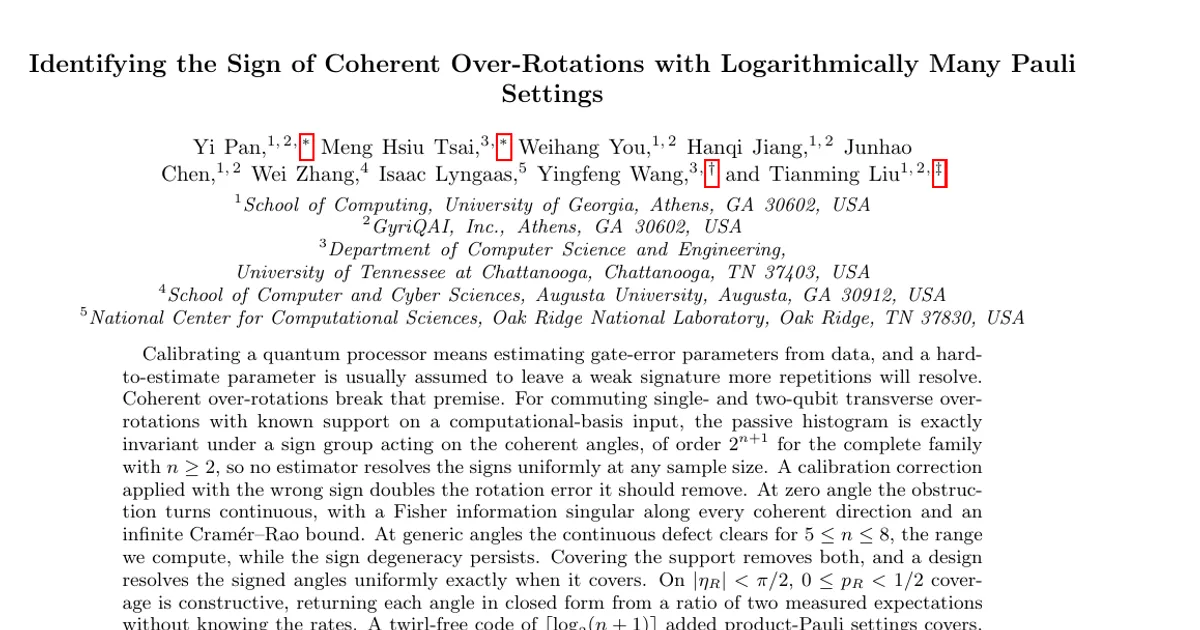
Authors’ abstract
Calibrating a quantum processor means estimating gate-error parameters from data, and a hard-to-estimate parameter is usually assumed to leave a weak signature more repetitions will resolve. Coherent over-rotations break that premise. For commuting single- and two-qubit transverse over-rotations with known support on a computational-basis input, the passive histogram is exactly invariant under a sign group acting on the coherent angles, of order $2^{n+1}$ for the complete family with $n\ge2$, so no estimator resolves the signs uniformly at any sample size. A calibration correction applied with the wrong sign doubles the rotation error it should remove. At zero angle the obstruction turns continuous, with a Fisher information singular along every coherent direction and an infinite Cramér-Rao bound. At generic angles the continuous defect clears for $5\le n\le8$, the range we compute, while the sign degeneracy persists. Covering the support removes both, and a design resolves the signed angles uniformly exactly when it covers. On $|η_R|<π/2$, $0\le p_R<1/2$ coverage is constructive, returning each angle in closed form from a ratio of two measured expectations without knowing the rates. A twirl-free code of $\lceil\log_2(n+1)\rceil$ added product-Pauli settings covers, and for the complete family none uses fewer. Conditioning then sets the Cramér-Rao cost, and we give its floor explicitly. Exact computation matches the theory, the passive fit stays at chance on the signs at every budget while the closed-form inverse recovers them, and angle magnitudes on two IBM Heron processors follow the conditioning ordering.