Research
Identifying local unitary equivalence based on reduction of quantum states
Overview Research area: Quantum information theory — classification of multipartite quantum states under local unitary (LU) transformations, with applications to entanglement theory and quantum resour
- arXiv
- 2607.20266
- Published
- 2026-07-22
- Authors
- Yanjun Chu, Chenyang Cui, Yuhang Xie, Mengli Liu, Shao-Ming Fei
AI summary
Overview
- Research area: Quantum information theory — classification of multipartite quantum states under local unitary (LU) transformations, with applications to entanglement theory and quantum resource theory.
- Technical level: Advanced (assumes comfort with density matrices, spectral decomposition, partial traces, unitary groups, and LU invariants).
- Scope: The paper introduces a "reduction" procedure that turns a class of degenerate multipartite states into pure or non-degenerate states, proves this preserves LU equivalence, and applies the resulting criteria to explicit qutrit, three-qubit, and AME(4,3)-derived examples.
What This Paper Is About
Deciding whether two quantum states are related by local unitaries applied on each subsystem is hard in general, and the standard criteria fail when a state has degenerate eigenvalues because the eigenvectors are not unique. The authors focus on states with one highly degenerate eigenvalue and all remaining eigenvalues simple, and show that subtracting out the degenerate eigenvalue (producing a "reduced state") turns the hard problem into one that existing tools can solve. They then use this to certify LU equivalence for concrete families of states, including single-parameter families built by perturbing absolutely maximally entangled (AME) states.
Key Contributions
- A reduction theorem: For a multipartite state on $\bigotimes_{i=1}^{t} H_i$ with $D = d_1\cdots d_t$, the authors define $\hat{\rho} = \frac{1}{\lambda_k D - 1}(\lambda_k \mathbb{I}_D - \rho)$ (nullifying the highest-multiplicity eigenvalue $\lambda_k$) and prove that $\rho$ and $\rho'$ are LU equivalent if and only if $\hat{\rho}$ and $\hat{\rho}'$ are LU equivalent.
- A complete discrimination framework split by case: When the reduced states are pure, the existing pure-state invariant machinery applies directly; when the reduced states are mixed but non-degenerate on their support, the LU invariants of Ref. [38] can be computed on the support projections instead.
- Worked criteria for structured spectra: Explicit reductions for states with exactly two distinct nonzero eigenvalues (both multiplicity orderings, $D-1$ and $1$) and for states with $s$ distinct nonzero eigenvalues where only $\lambda_1$ is degenerate with multiplicity $D-s+1$.
- A verified application to AME-derived states: A proof that two families of single-parameterized 4-partite qutrit states, built by perturbing AME(4,3) states of different combinatorial origins, are mutually LU equivalent.
Main Findings
- Reduction preserves LU equivalence: The central theorem establishes an exact equivalence between the original degenerate pair and the reduced pair $\hat{\rho}, \hat{\rho}'$; the affine map is the same for both states, so spectra are automatically matched.
- Two-eigenvalue case reduces to pure states: If the nonzero eigenvalues are $\lambda_1 > \lambda_2 > 0$ with multiplicities $D-1$ and $1$, the reduced states have eigenvalues $1$ and $0$ (multiplicities $1$ and $D-1$), i.e., they are pure. Then $J^s(\hat{\rho}) = J^s(\hat{\rho}') = 1$ automatically, so only the invariant family in Eq. (5) needs to be checked.
- Example 1 (two qutrit states): Two $9\times 9$ states share eigenvalues $3/25$ (multiplicity 8) and $1/25$ (multiplicity 1). Their reductions are the pure states $\frac{1}{\sqrt{3}}(|00\rangle+|11\rangle+|22\rangle)$ and $\frac{1}{\sqrt{3}}(|02\rangle+|11\rangle+|20\rangle)$; the computed invariants agree, so the originals are LU equivalent.
- Example 2 (three qubit states): Two states with eigenvalues $2/9$ (simple) and $1/9$ (multiplicity 7) reduce to the GHZ states $|GHZ_0^+\rangle$ and $|GHZ_1^-\rangle$, which are connected by $I_2 \otimes I_2 \otimes \begin{pmatrix}0&1\-1&0\end{pmatrix}$, so the originals are LU equivalent.
- Example 3 (mixed non-degenerate reductions): Two qutrit states with eigenvalues $1/8$ (multiplicity 7), $3/32$, and $1/32$ reduce to rank-2 states supported on two-dimensional subspaces. The invariant traces $\mathrm{Tr}[(A_1)^{\alpha}(A_2)^{\beta}]$ are shown to match for all non-negative integers $\alpha,\beta$ with $\alpha+\beta$ even (splitting into $c_{\alpha,\beta}(2+2^{\beta})$ for even $\beta$ and $c_{\alpha,\beta}(2-2^{\beta})$ for odd $\beta$), establishing LU equivalence.
- AME application: For the 4-partite qutrit states $\rho_1(p) = \frac{1-p}{80}\mathbb{I}{81} - \frac{1-81p}{80}|\Phi\rangle\langle\Phi|$ and $\rho_2(p) = \frac{1-p}{80}\mathbb{I}{81} - \frac{1-81p}{80}|\Psi\rangle\langle\Psi|$, the reductions are exactly $|\Phi\rangle\langle\Phi|$ and $|\Psi\rangle\langle\Psi|$. Since $|\Psi\rangle = u_1\otimes u_2\otimes u_3\otimes u_4|\Phi\rangle$ for some $u_i \in U(3)$ (Ref. [37, Theorem 1]), the two families are LU equivalent for all $p \in (0, \frac{1}{81}) \cup (\frac{1}{81}, 1)$, with $p = \frac{1}{81}$ excluded to avoid a singular denominator.
- Combinatorial bridge: $|\Phi\rangle$ is constructed from the orthogonal array OA(9,4,3,2), while $|\Psi\rangle$ comes from a pair of orthogonal Latin squares — the reduction method supplies a new link between these two constructions of AME(4,3) states.
Methodology in Plain English
- Diagnose why existing tools fail. The standard LU criteria (Ref. [33]) work by asking whether a certain coset of the unitary commutant contains a tensor-decomposable element, and the invariant approach (Ref. [38]) uses eigenvectors. For degenerate states, eigenvectors within a degenerate subspace can be mixed arbitrarily, so those constructions become non-unique and impractical.
- Shift the spectrum instead of the eigenvectors. By forming $\hat{\rho} = \frac{1}{\lambda_k D - 1}(\lambda_k \mathbb{I}_D - \rho)$, the most degenerate eigenvalue is sent to zero, and the surviving eigenvalues are fixed linear rescalings of the original gaps. This is a global (not local) transformation applied identically to both states, which is why it can be inverted and why LU equivalence is untouched. The authors note that requiring $\lambda_k$ to be the maximal eigenvalue comes from positivity needed to use the Ref. [38] invariants, not from the equivalence theorem itself.
- Apply the right existing criterion to the reduced state. If the reduced state is pure, compute invariants of the form $\mathrm{Tr}[(A_i A_j^\dagger)(A_k A_l^\dagger)\cdots]$ (Eq. 5) using the single coefficient matrix; if it is mixed but has a non-degenerate support, compute the same invariants for the support projections.
- Confirm with concrete examples. Three explicit low-dimensional examples are worked by hand to show that the invariants can actually be evaluated and compared.
- Apply to parameterized AME-derived families. Recognize that the reduction removes the parameter $p$ entirely, leaving the underlying AME pure states, whose LU relation was already known via permutation-based invariants.
Why This Matters
- Fills a gap in LU classification: Degenerate states are precisely where the well-developed invariant and fixed-subgroup criteria break down; the paper provides a route around that obstacle for a structurally important class of states.
- Connects to resource theory: States with one dominant degenerate eigenvalue and simple remaining eigenvalues appear as extreme points of sets of absolutely positive partial transpose states, so classifying them bears on structured resources in quantum resource theory.
- Turns an intractable check into a finite invariant computation: For the targeted class, the problem becomes checking Eq. (4) and Eq. (5) on pure states or on non-degenerate support projections.
Real-world applications (as motivated in the paper):
- Multipartite quantum key distribution: The authors note that LU equivalence of $\rho_1(p)$ and $\rho_2(p)$ allows interconversion without changing the entanglement resource value, so an easier-to-prepare state can substitute for a harder one.
- Quantum teleportation and dense coding: Both are listed among the protocols underpinned by entanglement, where LU-invariant classification informs which states are interchangeable resources.
- Quantum computation and cryptographic protocols: Also cited as entanglement-dependent tasks where equivalent states can be swapped.
- Entanglement measures and separability criteria: LU invariants are used to construct entanglement measures and separability criteria, so better classification feeds directly into these tools.
Industry relevance: providers of quantum communication hardware and entanglement-based protocols benefit from knowing when a state prepared by one experimental route is operationally interchangeable with another, which simplifies state preparation and verification.
Future Directions
- Extending beyond the one-degenerate-eigenvalue class: The theorem is stated for states where exactly one eigenvalue has high multiplicity and the rest are simple; states with multiple degenerate eigenvalues, or with degeneracy plus rank deficiency, are not covered.
- Bipartite versus multipartite scope: The invariant tools of Ref. [38] are recalled for bipartite states, and the paper's examples include tripartite and 4-partite cases; a systematic treatment of general $t$-partite reduced mixed states with non-degenerate support remains to be developed.
- Wider AME families and local dimensions: The application covers AME(4,3) states from two combinatorial constructions; extending to AME states from other combinatorial structures and to multipartite systems with unequal local dimensions (as in Ref. [37]) is a natural next step.
- Operational and numerical cost: The paper does not report a complexity analysis or numerical benchmarking of the invariant computation for large $D$ or large invariant degree; establishing scalable algorithms would make the framework practical beyond small examples.
Target Audience
Researchers and graduate students in quantum information theory working on entanglement classification, LU/SLOCC equivalence, quantum resource theory, or AME and $k$-uniform states; also mathematicians interested in invariant theory, tensor decompositions, and combinatorial designs underlying AME constructions. Readers should be comfortable with density-matrix formalism and partial traces, since the paper is written at a technical, proof-driven level.
Authors’ abstract
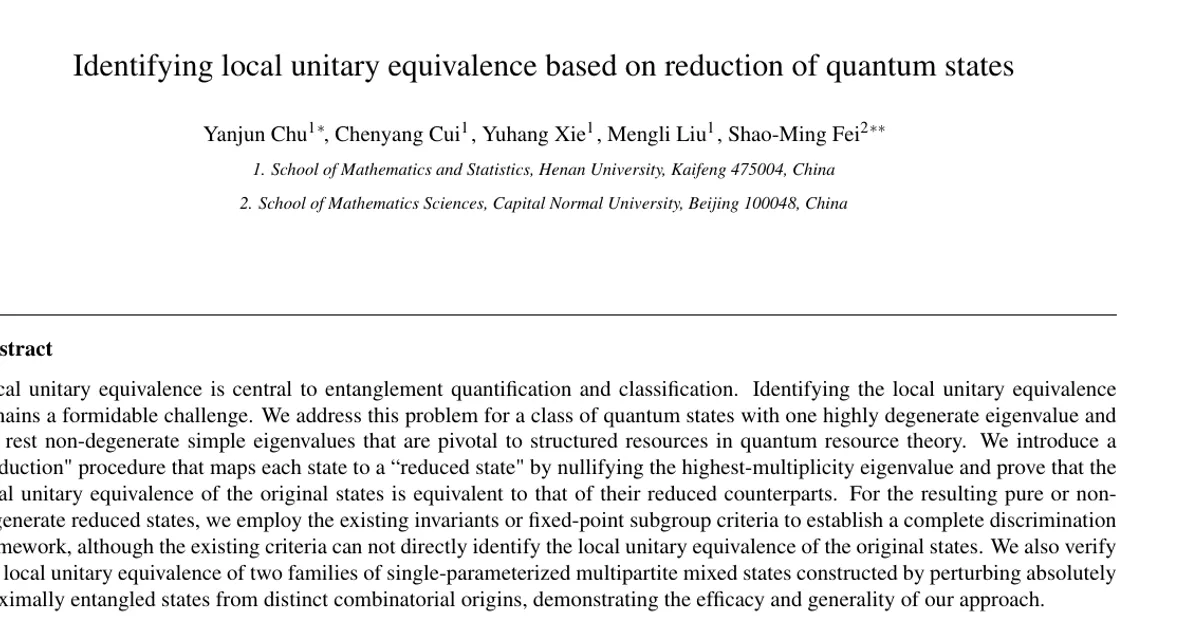
Local unitary equivalence is central to entanglement quantification and classification. Identifying the local unitary equivalence remains a formidable challenge. We address this problem for a class of quantum states with one highly degenerate eigenvalue and the rest non-degenerate simple eigenvalues that are pivotal to structured resources in quantum resource theory. We introduce a ``reduction" procedure that maps each state to a ``reduced state" by nullifying the highest-multiplicity eigenvalue and prove that the local unitary equivalence of the original states is equivalent to that of their reduced counterparts. For the resulting pure or non-degenerate reduced states, we employ the existing invariants or fixed-point subgroup criteria to establish a complete discrimination framework, although the existing criteria can not directly identify the local unitary equivalence of the original states. We also verify the local unitary equivalence of two families of single-parameterized multipartite mixed states constructed by perturbing absolutely maximally entangled states from distinct combinatorial origins, demonstrating the efficacy and generality of our approach.