Research
High-efficiency photonic GHZ measurements with linear optics
Overview Research area: Linear-optics quantum photonics — specifically joint (projective) measurements of photons used as entangling primitives in photonic quantum computing, quantum networks and quan
- arXiv
- 2610.41524
- Published
- 2026-10-30
- Authors
- Stefan N. van den Hoven, Love A. Pettersson, Anders S. Sørensen, Stefano Paesani
AI summary
Overview
Research area: Linear-optics quantum photonics — specifically joint (projective) measurements of photons used as entangling primitives in photonic quantum computing, quantum networks and quantum repeaters.
Technical level: Advanced. The paper assumes familiarity with dual-rail photonic qubits, stabilizer formalism, GHZ/Bell states, interferometer unitaries (beam splitters and phase shifters), fusion-based quantum computing (FBQC) and resource-state counting.
Scope: The paper introduces a family of linear-optical GHZ measurements built from four-mode interferometers that beat previous success probabilities, generalizes them to n-photon GHZ measurements, and evaluates them in three applications (graph-state/resource generation, entanglement distribution between spin-photon interfaces, and fault-tolerant fusion-based computing).
What This Paper Is About
Standard photonic entangling operations — Bell measurements, or "fusions" — interfere only two photons at a time and are limited to a 50% success probability, with prior four-photon GHZ measurement schemes succeeding only 1/8 of the time. The authors ask whether the many-body interference that gives photonic systems their computational power can be built directly into such measurements, and propose linear-optical GHZ measurement circuits that succeed more often. They then show how these circuits generalize to larger GHZ measurements and what they buy in practical photonic architectures.
Key Contributions
-
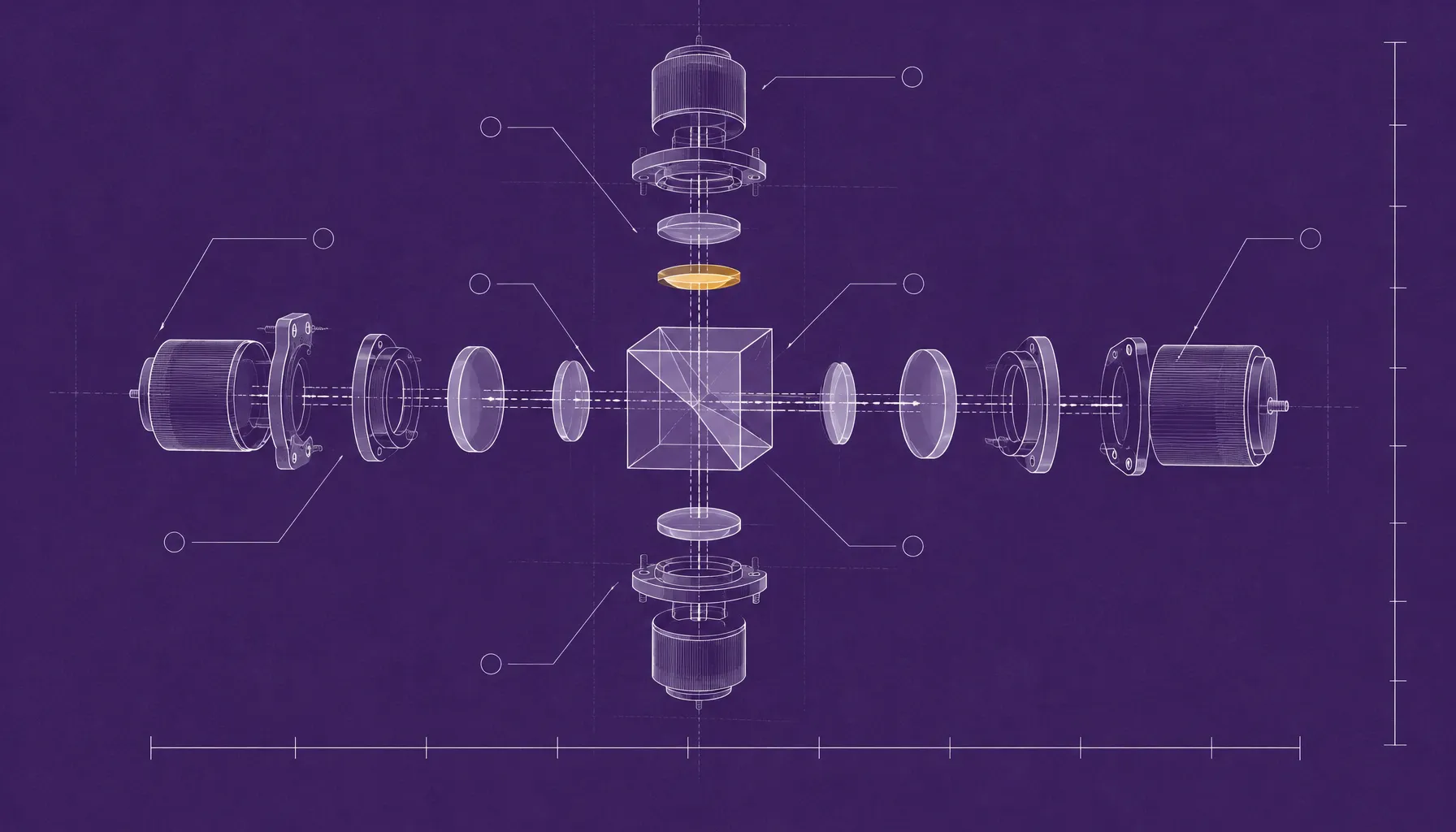
A high-efficiency four-body GHZ measurement. A linear-optical design using four-mode Hadamard interferometers (
H_4) that projects four photons onto a 4-GHZ state with success probability 9/32, compared with 1/8 for previous schemes (Refs. [31, 35, 9]) — an improvement factor of 9/4. -
Adaptive variants that keep failures useful. Because non-adaptive failures can project onto the
W_4state or the(4,2)-Dicke stateD_4^(2), the authors give feed-forward strategies that switch the second interferometer based on the first subsystem's detection pattern, guaranteeing that every outcome is a stabilizer-state projection. -
Generalization to n-body GHZ measurements with exponential scaling advantage. Distributing dual-rail qubits over
N = n/2four-mode Hadamard subsystems yields a rigorous lower bound scaling as ≈ 0.572^n versus the prior 0.5^n, with numerical evidence suggesting ≈ 0.6192^n (checked up to n = 30). -
Three concrete application analyses. Resource-state generation (reduced 3-GHZ cost), entanglement generation across four remote spin-photon interfaces (1.7× fewer attempts), and an FBQC architecture with an improved distinguishability threshold of 1 − 𝒱 = 7.36%.
Main Findings
-
Four-photon success probability is 9/32. The derivation is explicit: 6 of the 16 four-GHZ states split two photons into each subsystem, and the probability of avoiding bunching in both subsystems is 3/4, giving 6/16 × 3/4 = 9/32. Prior schemes identify only 2 of 16 GHZ states, capping them at 1/8.
-
Failure outcomes are still entangled. Non-adaptive failures project onto a state locally Pauli-equivalent to
W_4(probability 1/2, when one and three photons are detected in the two subsystems), onto a state locally Pauli-equivalent to the(4,2)-Dicke state (probability 3/32, when both subsystems bunch), or onto all four qubits in the Z basis (probability 1/8, when all four photons land in one subsystem). -
Adaptive strategies make every outcome a stabilizer projection. With
H_4in the second subsystem if the first anti-bunches and two parallel beam splitters otherwise, the circuit gives a 4-GHZ state with probability 3/16, two Bell states with probability 1/8, one Bell state with probability 1/2, and a computational-basis projection with probability 3/16. Switching the second subsystem toI_4instead gives 4-GHZ with probability 3/16 and computational-basis projection with probability 13/16. -
Exponential improvement for large n. The analytical lower bound takes the form P > (1/2^{2N})[L_N L̃_N (2/2^N) + (2^N − L_N)(2/2^N)] with n = 2N, where L_N is the Lucas number φ^N + (1−φ)^N and L̃_N = L_N for odd N, L_N − 2 for even N. This scales as ≈ 0.572^n, versus 0.5^n for prior art; numerics suggest ≈ 0.6192^n.
-
Cube graph from a 14-qubit caterpillar. One rotated two-body fusion followed by a single four-body GHZ projection converts a 14-qubit caterpillar state into the loss-tolerant cube graph with probability 9/64 ≈ 14%, above the 12.5% obtained from the corresponding sequence of three Bell-type fusions.
-
Lower 3-GHZ resource costs. The {2,2}-Shor-encoded 6-ring drops from 1520 to approximately 1140 3-GHZ states; the {2,2}-Shor-encoded 4-star (equivalently the m = 4 repeater graph) drops from 256 to approximately 100; and the same cost of about 1140 also suffices for the more loss-tolerant {3,2}-Shor-encoded 6-ring, which had no prior-scheme entry in the comparison table.
-
Fewer entangling attempts between four spin-photon interfaces. Using one four-body fusion instead of a sequence of two-body fusions reduces the average number of attempts by a factor of 1.7.
-
Improved FBQC threshold. For a fusion-based decomposition of the Raussendorf lattice using four-body fusions, Monte Carlo simulation across lattice sizes gives a distinguishability threshold of 1 − 𝒱 = 7.36% (𝒱 being the Hong–Ou–Mandel dip visibility), an 84% increase over the 4% threshold reported for the two-body-fusion repeat-until-success architecture of Ref. [16]. The four-body measurement also removes the need for ancilla resource states, lowering the required emitter count by a factor of 2.
-
Relation to a patent application. The authors note that a concurrent patent application [10] proposes a "four-way fusion" equivalent to their Fig. 1 scheme; their additions are adaptivity, the n-GHZ generalization, and the application analyses.
Methodology in Plain English
Each photonic qubit is encoded in two rails (two spatial modes). The circuit routes one rail of each qubit into one four-mode interferometer and the other rail into a second one, so each subsystem sees two photons from the four qubits. The interferometer chosen is the four-mode Hadamard: its transition amplitudes all have equal magnitude and phases of only 0 or π, so the two halves of the GHZ superposition interfere either constructively or fully destructively depending on the sign of the XXXX stabilizer — reading that sign off the detection pattern. The same interferometer, viewed backwards, turns detection of two anti-bunched photons into a determination of the pairwise ZZ stabilizer signs for the qubits feeding that subsystem; bunched detection gives no such information, which is what produces the 3/4 factor. Success probability is computed assuming the incoming photons are marginally completely mixed (reduced density matrix equal to the identity).
For larger GHZ states, the qubits are spread over N = n/2 such Hadamard subsystems with periodic boundary conditions. The success probability is bounded analytically by counting, via generating functions, how many computational-basis states put exactly two photons in every subsystem, and then how many bunch/anti-bunch configurations still reveal all pairwise Z stabilizers. The counting is turned into a closed form using Lucas numbers; a companion state-transition analysis (19 states in the appendix) handles the alternative wiring pattern. Applications are assessed with standard graph-state rewriting, resource counting in 3-GHZ states, and Monte Carlo simulations of the fusion network.
Why This Matters
The paper argues that photonic quantum technologies need not be assembled exclusively from two-photon Bell measurements: genuine many-body interference can serve as a native primitive that creates large amounts of entanglement in a single probabilistic step. This is a shift in how the elementary building block of fusion-based architectures is chosen, and it shows up as concrete reductions in overhead rather than only as a better abstract success probability.
Applications the paper examines:
- Graph-state and resource-state generation — fewer 3-GHZ states needed for Shor-encoded rings and stars used in loss-tolerant photonic computing, and a higher-probability route from an emitter-generated 14-qubit caterpillar to the cube graph.
- Entanglement distribution between remote spin-photon interfaces — one four-body measurement instead of sequential pairwise fusions, cutting the average number of attempts by 1.7×, which matters because loss forces spin reinitialization and restarting earlier steps.
- Fusion-based quantum computing — a Raussendorf-lattice decomposition needing no ancilla resource states, half the emitter count, and a 7.36% distinguishability threshold versus 4%.
- Quantum repeater and network architectures — the paper frames GHZ measurements as natural for multi-party entanglement, citing repeater and network use cases for Bell measurements generally.
Industry relevance: the results target hardware-facing metrics — emitter count, number of 3-GHZ resource states, entangling attempt counts, and photon-distinguishability tolerance — which are the quantities that determine feasibility for photonic quantum computing built on quantum emitters and linear optics.
Future Directions
- Applying adaptivity to the n-GHZ case. The generalization is analyzed non-adaptively; the authors state that adaptive strategies could ensure stabilizer-state projections there too.
- Handling odd photon numbers. The Hadamard-subsystem construction is restricted to an even number of qubits; for odd n the authors suggest first performing a type-I fusion between two qubits and then applying the projection.
- The alternative generalization. The second route — splitting dual-rail qubits into two subsystems with large Hadamard matrices — is left to future work because retrieving the pairwise Z stabilizers is difficult there.
- Boosting with ancillas and beyond linear optics. Since ancillary photonic resource states can raise Bell-measurement success rates, the authors expect similar strategies to enhance these GHZ measurements, and they call for many-body building blocks beyond linear optics and architectures that exploit their platform's native capabilities.
Target Audience
Researchers and graduate students in photonic quantum information — particularly those working on linear-optics quantum computing, fusion-based quantum computing, quantum repeaters and quantum networks, graph-state/resource-state engineering, and spin-photon interface architectures. It is also relevant to readers interested in multiphoton interference as a computational resource, and to hardware-oriented teams evaluating emitter counts, resource-state budgets and distinguishability requirements for scalable photonic machines.
Authors’ abstract
Probabilistic and destructive Bell-measurements, also known as fusions, constitute a fundamental primitive for photonic quantum technologies. These operations rely only on pairwise photonic interference, whereas the computational power of photonic quantum systems originates from many-body interference. Here, we introduce a family of high-efficiency linear-optical GHZ measurements based on four-mode interferometers and show that incorporating many-body interference into this ubiquitous primitive leads to more efficient entangling operations. For the four-photon case, the success probability is $9/32$, and adaptive variants ensure that unsuccessful events project onto useful stabilizer states. We further show that the approach naturally generalizes to larger GHZ measurements, yielding an exponentially higher success probability than previous linear-optical schemes. Finally, we demonstrate practical advantages for graph-state resource generation, entanglement distribution between remote spin-photon interfaces, and fusion-based quantum computing. Our results establish high-efficiency many-body measurements as a new primitive for scalable photonic quantum information processing.