Research
Hardware-Efficient Ground-State Preparation using Variational Imaginary-Time Majorana Evolution
Overview Research area: Quantum computing for electronic structure — specifically classical pre-training of compact ground-state preparation circuits for molecular systems, combining Majorana Propagat
- arXiv
- 2610.01954
- Published
- 2026-10-01
- Authors
- Federico Santona, Manuel G. Algaba, Aeishah Ameera Anuar, Anna M. Wernbacher, Prachi Sharma, Fedor Šimkovic
AI summary
Overview
Research area: Quantum computing for electronic structure — specifically classical pre-training of compact ground-state preparation circuits for molecular systems, combining Majorana Propagation (MP) with operator-projected variational imaginary-time evolution (OVQITE).
Technical level: Advanced. The paper is methods-heavy, building on Majorana algebra, truncated operator propagation, McLachlan's variational principle, and fermionic circuit ansätze. Readers need familiarity with second quantization and variational quantum algorithms.
Scope (one sentence): The paper introduces and benchmarks VIME, a classical pre-training algorithm that reuses a single compiled Majorana surrogate graph to perform imaginary-time parameter updates on a new compressed tUPS ansatz, and compares its energy accuracy and circuit resources against VMPE and ADAPT-VMPE on hydrogen chains, the ruthenium complex TLD-1411, and the acene series.
What This Paper Is About
Preparing a good approximate ground state is a prerequisite for fault-tolerant quantum chemistry algorithms such as quantum phase estimation, but existing variational routes produce circuits that are far too deep — ADAPT-VMPE can require on the order of 10⁴ CNOTs at system sizes of scientific interest. The authors ask whether the cost advantages of classical Majorana Propagation can be preserved in substantially shallower circuits. Their answer is to replace direct energy minimization with an imaginary-time parameter-update rule (OVQITE) evaluated entirely through one compiled Majorana surrogate graph, paired with a new compressed ansatz (c-tUPS).
Key Contributions
-
VIME algorithm. A classical pre-training algorithm that couples OVQITE to Majorana Propagation, so that a single compiled Hamiltonian surrogate graph supplies the energy, the pool expectation values, the anticommutator expectation values, and the full Jacobian in one backward pass plus one joint forward pass — replacing the naive N_exp = 2|S_τ|(N_θ+1)+1 separate expectation-value evaluations (which scale as O(N⁴N_θ) for a molecular Hamiltonian pool of O(N⁴) operators).
-
c-tUPS ansatz. A compressed variant of the tiled Unitary Product State ansatz: it keeps the fixed tile structure with three variational parameters per tile but uses only half as many length-four Majorana rotations, which lowers truncated-MP cost and, in the authors' tests, yields lower variational energies than tUPS. By jointly synthesizing the operations in each tile it requires only 10 CNOTs per tile under all-to-all connectivity, versus previously reported 20–21 CNOTs for tUPS.
-
A new truncation scheme. Beyond standard Majorana-length truncation with paired acceptance and a sine-order truncation, the authors introduce orbital truncation, which retains only monomials whose support spans at most o* spatial orbitals. They stress this is not an active-space approximation: the Hamiltonian and orbital space are unchanged, only the propagated operator expansion is truncated.
-
Benchmarks against VMPE and ADAPT-VMPE on hydrogen chains, TLD-1411, and the acene series, reporting both MP-based energy accuracy against DMRG references and the corresponding CNOT counts and two-qubit depths.
Main Findings
-
TLD-1411 accuracy: For active-space calculations up to (26e,26o) — 52 qubits — VIME with c-tUPS reaches chemical precision against DMRG reference energies, with energy errors approximately 400 times smaller than those from ADAPT-VMPE.
-
TLD-1411 circuit resources: The same comparison is achieved with more than an order of magnitude fewer CNOTs and over two orders of magnitude lower two-qubit depth than ADAPT-VMPE.
-
Acene series up to heptacene: In a (30e,30o) active space (60 qubits), VIME with c-tUPS matches or improves on the MP-reported energy accuracy of the selected ADAPT-VMPE comparison points while reducing CNOT counts by factors of 3.3–26 and two-qubit depth by 36–167. The abstract summarizes the upper ends as up to 26 times fewer CNOTs and 167 times lower two-qubit depth.
-
Classical cost is comparable: Across both molecular families, these circuit-resource reductions come at allocated CPU-hours of the same order of magnitude as ADAPT-VMPE.
-
Hydrogen chains: MP truncation errors remain manageable for the structured c-tUPS ansatz, and on the same ansatz VIME gives both lower energies and larger ground-state overlaps than VMPE.
-
A caveat about direct minimization: When VMPE directly minimizes the energy on the same c-tUPS circuit architectures for TLD-1411, the estimated energies are driven substantially below the DMRG references — i.e. the surrogate's variational minimum does not track the reference as the imaginary-time update does.
-
Accuracy validation: The quantities entering the VIME parameter update are checked against exact statevector calculations, and MP truncation error is studied across structured circuit architectures. The authors note that the average-case accuracy guarantees of MP (mean-squared error bounded by 2^{1−N} + (ew*/N)^{w*/2} for a random ensemble) do not directly extend to structured circuits.
-
Graph-size trade-off: The anticommutator channel requires retaining all propagation paths to surviving root monomials, so the VIME surrogate graph is larger than an energy-only MP graph. The reference-state contraction is still handled in O(D_root) operations and storage without forming the full matrix.
Methodology in Plain English
Majorana Propagation simulates a fermionic circuit entirely on a classical computer by running the observable backwards through the gates, term by term, and cutting off the expansion when terms get too long. Because that cutoff does not depend on the rotation angles, the whole propagation can be compiled once into a graph in which only the edge weights change when the angles change — so repeated energy evaluations are cheap.
The authors' key move is to get more than the energy out of that single graph. A short backward pass gives the energy. A longer forward pass then carries several "channels" at once: one for the expectation values of the Hamiltonian's terms, one for the anticommutator terms needed for the imaginary-time velocity, and one per variational parameter for the Jacobian. With those pieces they solve a regularized least-squares problem for how fast each parameter should move in imaginary time, take a step, and repeat until the update direction goes to zero or the energy stops decreasing. In effect, the classical surrogate decides the trajectory; the resulting circuit is what would later be run on hardware as a state-preparation subroutine.
To keep circuits short they design c-tUPS, a tile-based ansatz in which groups of orbitals share a fixed structure with three parameters per tile, using half as many four-Majorana rotations as the original tUPS, and synthesized so each tile needs 10 CNOTs.
The paper reports numerical/classical results only; no execution on quantum hardware is presented.
Why This Matters
The paper reframes the practical bottleneck of early fault-tolerant quantum chemistry: not just ansatz expressivity, but whether the state-preparation circuit is shallow enough to run and the pre-training accurate enough to be trusted. It shows that imaginary-time dynamics, rather than direct energy minimization, may be the better classical target when the surrogate is truncated — the VMPE collapse below DMRG references in TLD-1411 is a concrete warning about minimizing a truncated surrogate energy directly.
Real-world applications:
- Catalysis: the authors motivate strongly correlated electronic structure by molecular catalysis, where multi-configurational character defeats single-reference methods.
- Energy storage: materials for energy storage are cited as a second motivating domain.
- Quantum materials: strongly correlated materials design and characterization.
- Downstream quantum algorithms: the trained circuits serve as initial states for fault-tolerant routines such as quantum phase estimation, whose cost depends critically on ground-state overlap.
Industry relevance: The work comes from IQM Quantum Computers, and its emphasis on CNOT counts, two-qubit depth, and CPU-hours speaks directly to what near-term hardware owners care about — whether a chemistry workflow fits a device's coherence budget and a realistic classical compute allocation. A 10-CNOT tile and order-of-magnitude CNOT reductions change feasibility estimates for embedding such circuits in larger algorithms.
Future Directions
- Extending the accuracy analysis beyond random ensembles. The MP guarantees assume random length-four generators and uniform angles; structured ansätze such as c-tUPS violate these assumptions, and a tailored truncation-error theory is left open.
- Choosing and combining truncation schemes. Length truncation with paired acceptance, sine-order truncation, and the newly introduced orbital truncation are presented as alternatives, but no unified prescription for selecting cutoffs across molecular families is given.
- Pushing to larger active spaces and heavier elements. The benchmarks stop at 52 qubits for TLD-1411 and 60 qubits for heptacene; scaling behavior of graph size, CPU-hours, and accuracy for larger strongly correlated systems remains to be established.
- From pre-training to execution. The paper treats the trained circuit as a state-preparation subroutine for downstream algorithms; demonstrating the full pipeline with hardware execution and quantifying how MP truncation error propagates into, for example, phase-estimation energy estimates is a natural next step.
Target Audience
Researchers and engineers working on near-term and early fault-tolerant quantum chemistry — particularly those using classical surrogates (Majorana Propagation, VMPE, ADAPT-VMPE) for circuit pre-training, and those designing compact fermionic ansätze. It is also relevant to quantum algorithm developers who need shallow initial states for phase estimation, and to computational chemists interested in how classical DMRG references can be approached with quantum-ready circuits. Beginners will find it difficult without background in second quantization and variational methods.
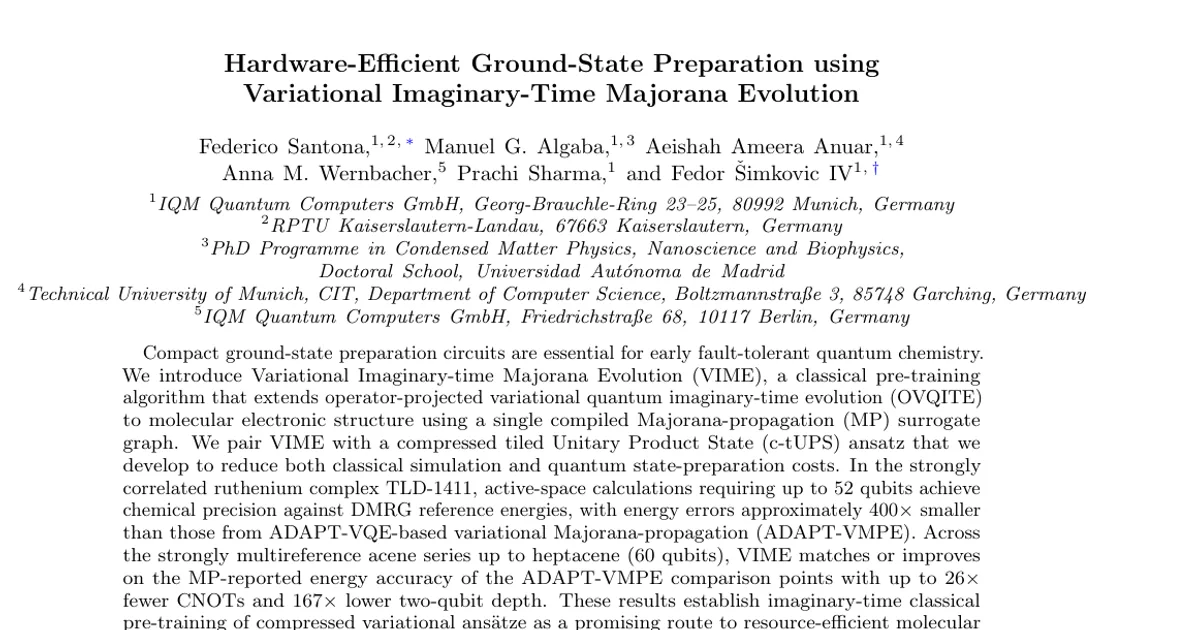
Authors’ abstract
Compact ground-state preparation circuits are essential for early fault-tolerant quantum chemistry. We introduce Variational Imaginary-time Majorana Evolution (VIME), a classical pre-training algorithm that extends operator-projected variational quantum imaginary-time evolution (OVQITE) to molecular electronic structure using a single compiled Majorana-propagation (MP) surrogate graph. We pair VIME with a compressed tiled Unitary Product State (c-tUPS) ansatz that we develop to reduce both classical simulation and quantum state-preparation costs. In the strongly correlated ruthenium complex TLD-1411, active-space calculations requiring up to 52 qubits achieve chemical precision against DMRG reference energies, with energy errors approximately $400\times$ smaller than those from ADAPT-VQE-based variational Majorana-propagation (ADAPT-VMPE). Across the strongly multireference acene series up to heptacene (60 qubits), VIME matches or improves on the MP-reported energy accuracy of the ADAPT-VMPE comparison points with up to $26\times$ fewer CNOTs and $167\times$ lower two-qubit depth. These results establish imaginary-time classical pre-training of compressed variational ansätze as a promising route to resource-efficient molecular ground-state preparation.