Research
Granthi: Higher-Order Quantum Programming via Unitary Wiring
Overview Research area: Quantum programming languages, specifically programming-language theory (linear type theory, denotational semantics, normalization, and compilation) applied to quantum computat
- arXiv
- 2608.20443
- Published
- 2026-08-20
- Authors
- Samson Abramsky, Radha Jagadeesan
AI summary
Overview
Research area: Quantum programming languages, specifically programming-language theory (linear type theory, denotational semantics, normalization, and compilation) applied to quantum computation.
Technical level: Advanced. The paper assumes familiarity with linear lambda calculi, proof nets/natural deduction, and finite-dimensional Hilbert space semantics; the informal tour in §4 makes parts of it readable without that background.
One-sentence scope: The paper defines Granthi, a purely unitary higher-order quantum language in which quantum programs are first-class values, shows that every well-typed program normalizes to a canonical wiring form with a unitary boundary interpretation, and describes an OCaml-to-pytket implementation that compiles the currently supported fragment to executable circuits.
What This Paper Is About
Most mainstream quantum programming languages split into two layers: a classical host language that gets all the higher-order structure (functions, abstraction, program generation), and a quantum layer restricted to first-order operations on qubits and registers. Granthi asks what happens if that split is removed and the quantum language itself is higher-order, with quantum programs as first-class values that can be passed, returned, and coherently composed. The goal is a language whose every well-typed program—including a program of function type—acts unitarily at its interface, and whose programs can be compiled to unitary circuits.
Key Contributions
- Language design. A purely unitary linear language in which open quantum components are first-class values and coherent sums provide tag-preserving control, so control can remain in superposition rather than being observed.
- Canonicalization and semantics. A deterministic normalization procedure producing canonical wiring forms, plus a boundary interpretation for open and higher-order terms (a term of type
A ⊸ Bdenotes a unitary between the negative and positive sectors selected by its canonical normal derivation). - Circuit realization. A type-directed compiler for canonical wiring forms, with physical layouts for tags and payloads, together with a realization theorem under a stated backend-correctness assumption (BC).
- Implementation and validation. An OCaml-to-pytket implementation supporting controlled lifting,
QSwitch, phase-sensitive routing, and finite control datatypes, tested by regression checks and matrix comparisons.
Main Findings
- Higher-order reversibility is ordinary unitarity relocated. The paper's central claim is that higher-order reversibility is not a new kind of unitarity but unitarity moved from closed data to exposed interfaces. A term
f : A ⊸ Bis an open circuit fragment with a structured interface, not an invertible map from the data space ofAto that ofB. - Application is connection, not consumption. In the canonical-form semantics, an irreducible application is interpreted as wiring: the proof net for
evalidentifiesα₂withα₁andβ₁withβ₂, connecting the argument's output port to the function's input port. Currying is the corresponding rewiring in the other direction. - Sums are coherent, not observational. The
⊕type has no injections and no projections, since those are irreversible. The surfacecaseconstruct runs one of two branches without measuring and preserves the choice in its result type,(A ⊕ B) ⊗ C, with both branches sharing the same complete linear contextΓ. The paper describes this as close in spirit to Qunity's use of sum types, but pushes the discipline into the primitive sum interface itself. - Every well-typed Source program has a unitary boundary interpretation. This holds for terms of function type, not only for closed first-order programs. Under backend correctness (BC), the reference compiler produces a unitary circuit realizing that interpretation on its typed physical layout.
- The scope is deliberately a unitary kernel. Measurement, mixed states, classical feedback, and recursion are all absent. The intended deployment is inside a larger adaptive quantum language that prepares inputs, invokes the unitary kernel, measures, branches, and calls the next kernel.
- The quantum switch is expressible as a higher-order term.
QSwitch : (A ⊸ A) ⊗ (A ⊸ A) ⊗ (QBool ⊗ A) ⊸ (QBool ⊗ A)appliesgthenfon one branch andfthengon the other; preparing the control in|+⟩ = H|0⟩yields coherent control of the composition order. Closed instances compile to static circuits. - Interference on control-flow history is supported. Routing a witness
w : WitwhereWit = Aux ⊕ QBool, phasing one route, undoing the routing, and applying a Hadamard exposes relative phase as a computational-basis distinction—without collapsing the computation. - Finite label types elaborate away. Programmer-facing datatypes such as
ℤ₅with named labels and reversible operations (permute,select) are eliminated by elaboration before Source typing, mapping datatypes to canonicaln-ary sums with no recursive types. Thekick₅example appliesRz(2πk/5) = e^{-iπkZ/5}under control of a group elementkthat may itself remain in superposition. - No quantitative benchmarks are reported. Validation is described as regression checks and matrix comparisons; the paper content provided does not give numeric success rates, circuit sizes, or runtime figures.
Methodology in Plain English
The authors take the standard programming-language response to effects and transpose it to the boundary between an adaptive host and a unitary core. With classical effects, unrestricted β-reduction only becomes sound once an evaluation discipline (say call-by-value) fixes the operational order; Granthi does the analogous thing for higher-order unitary kernels by normalizing the linear functional structure first, holding quantum operations as opaque constants, and only afterwards exposing the boundary on which those constants must act unitarily.
Concretely: the source language is a linear lambda calculus with tensor, coherent sum, and linear implication, built on a one-dimensional base type b̸ from which quantum systems are assembled as sums (for example QBool := b̸ ⊕ b̸). Every variable must be used exactly once, so copying, discarding, and projection are unavailable. Programs are normalized deterministically into canonical wiring forms; the boundary semantics interprets those forms as unitaries on finite-dimensional Hilbert spaces; and a type-directed compiler lays out tags and payloads physically and emits circuits. The implementation is an OCaml DSL whose PPX frontend accepts literal OCaml programs, elaborating them through a higher-order Core IR to executable circuits via pytket. Proofs are collected in the appendices of this full version.
Why This Matters
The paper reframes a design choice that is usually taken for granted. The confinement of higher-order structure to a classical host is not mandated by quantum mechanics—the quantum switch shows that coherent control over program composition is physically meaningful—so a first-order quantum layer reflects convention rather than a fundamental limit. Granthi gives a worked-out type theory and compilation path for the alternative.
Real-world applications (as motivated in the paper):
- Phase estimation and qubitization, where the paper notes that conjugation and coherent reordering (including the quantum switch) recur as higher-order combinators.
- Amplitude amplification, whose basis changes and reflections are cited as instances of the same patterns.
- LCU and Hamiltonian simulation, via SELECT/multiplexed oracles—the staged
selectconstruction over closed operations is designed for exactly this. - Group-coherent pattern matching and phase kicks, illustrated by the
ℤ₅example applyingRz(2πk/5)under a group-element control.
Industry relevance: compiler writers and language designers for quantum SDKs get a concrete account of how to expose higher-order abstraction at the quantum layer rather than only in the classical driver, including a compilation route through a mainstream toolchain (pytket) and a clear statement of what must be assumed about the backend (backend correctness, BC).
Future Directions
- Lifting the unitary restriction. Measurement, mixed states, classical feedback, and recursion are all excluded; each brings equational laws under which unitary equality is no longer the governing invariant, and the paper frames integration into an adaptive host as the intended deployment rather than a solved problem.
- Extending the executable fragment. The paper states that the "currently supported executable fragment" is implemented end-to-end, implying further Source constructs remain to be compiled.
- Recursive and larger finite datatypes. Elaboration currently maps label types to canonical
n-ary sums with no recursive types; whether this scale to richer data abstractions compatible with coherence is open. - Backend correctness in practice. The realization theorem is conditional on (BC); establishing that assumption for concrete hardware-oriented compilation pipelines and layouts is a natural next step.
Target Audience
Researchers in quantum programming languages and programming-language theory (linear logic, semantics, normalization, compilation); compiler engineers building quantum SDKs who want higher-order abstraction at the quantum layer; and graduate students with a background in type theory or categorical semantics who want a worked-out example of treating quantum programs as first-class open components. Readers seeking experimental benchmark data or hardware results will not find them here.
Authors’ abstract
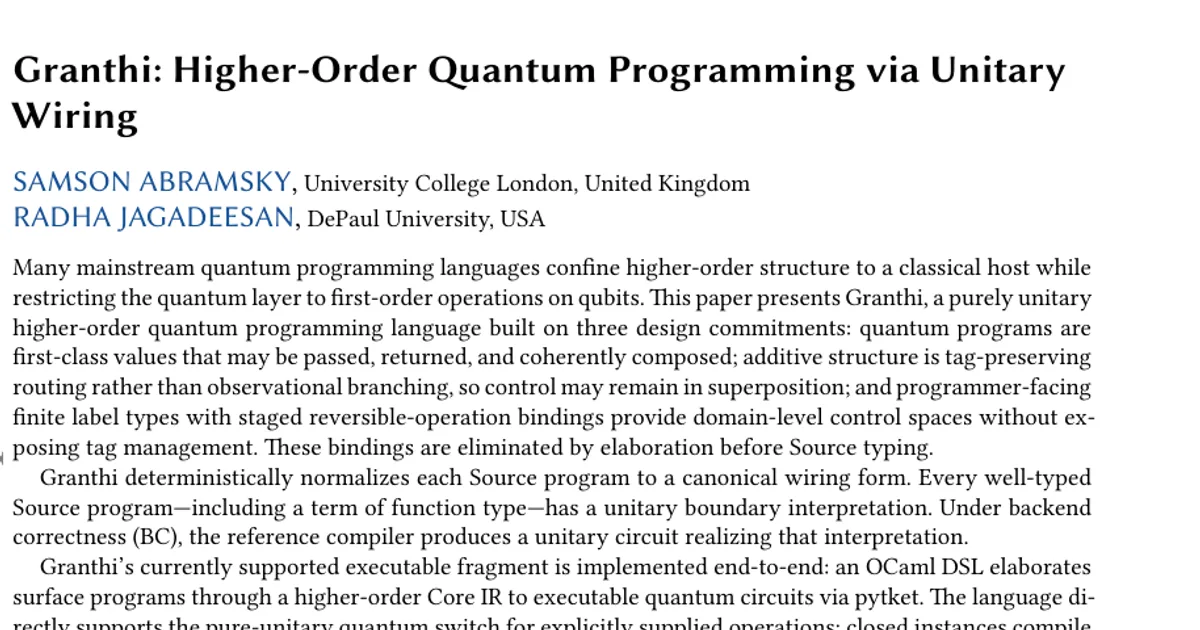
Many mainstream quantum programming languages confine higher-order structure to a classical host while restricting the quantum layer to first-order operations on qubits. This paper presents Granthi, a purely unitary higher-order quantum programming language built on three design commitments: quantum programs are first-class values that may be passed, returned, and coherently composed; additive structure is tag-preserving routing rather than observational branching, so control may remain in superposition; and programmer-facing finite label types with staged reversible-operation bindings provide domain-level control spaces without exposing tag management. These bindings are eliminated by elaboration before Source typing. Granthi deterministically normalizes each Source program to a canonical wiring form. Every well-typed Source program, including a term of function type, has a unitary boundary interpretation. Under backend correctness (BC), the reference compiler produces a unitary circuit realizing that interpretation. Granthi's currently supported executable fragment is implemented end-to-end: an OCaml DSL elaborates surface programs through a higher-order Core IR to executable quantum circuits via pytket. The language directly supports the pure-unitary quantum switch for explicitly supplied operations; closed instances compile to static circuits. It also supports interference on control-flow history and structured finite control, all within the purely unitary fragment