Research
Finite-Resolution Limits on Quantum Uniqueness
Overview Research area: Mathematical foundations of quantum mechanics, specifically the representation theory of the Weyl form of the canonical commutation relations, with connections to polymer quant
- arXiv
- 2608.22001
- Published
- 2026-08-22
- Authors
- Seramika Ariwahjoedi, Sameer Ahmad Mir, Mir Faizal
AI summary
Overview
Research area: Mathematical foundations of quantum mechanics, specifically the representation theory of the Weyl form of the canonical commutation relations, with connections to polymer quantization and loop-quantum-gravity-motivated kinematics.
Technical level: Advanced. The argument is built from C*-algebra theory (twisted group algebras, amenability, Fell's approximation theorem, faithful representations) and assumes familiarity with the Stone–von Neumann theorem.
Scope (one sentence): The paper proves that no finite-resolution experimental protocol probing Weyl displacement operators can certify the strong-continuity (regularity) hypothesis on which the Stone–von Neumann uniqueness theorem depends, because a non-regular polymer state can reproduce any finite set of such expectation values to arbitrary accuracy.
What This Paper Is About
Canonical quantization of a single degree of freedom is normally declared unique by the Stone–von Neumann theorem, but that theorem only applies after one assumes the Weyl translation groups are strongly continuous — a condition called regularity. The authors ask whether this continuity assumption can ever be established by a real experiment, which after all only implements finitely many calibrated displacements, measures finitely many bounded expectation values, and reports them with finite error bars. They show that it cannot: finite agreement with ordinary Schrödinger quantum mechanics is compatible with a genuinely non-regular representation, so regularity must be added as separate physical input rather than derived from data.
Key Contributions
-
A formulation of finite experimental resolution directly at the level of Weyl operators. A protocol is specified by a finite set of calibrated displacement labels S = {ξ₁, …, ξ_m} ⊂ ℝ², which algebraically generates a subgroup Γ_S = span_ℤ(S) and a norm-closed protocol algebra C_S = C*({W(γ) : γ ∈ Γ_S}).
-
A precise one-sided operational compatibility criterion. Representation π₂ is defined to be (S, η)-operationally compatible with π₁ if, for every density operator ρ₁ and every finite collection of test observables A₁, …, A_n ∈ C_S with ‖A_j‖ ≤ 1, some ρ₂ exists making all expectation-value differences at most η.
-
A main theorem comparing regular and polymer representations. For every regular Weyl representation, every density operator, every finite family of bounded protocol observables, and every η > 0, a polymer density operator supported on a finite direct sum of invariant polymer sectors reproduces all the same expectation values to within η.
-
A structural bridge to quantum-gravity-motivated quantization. The authors argue that the polymer construction is the finite-dimensional prototype of the mechanism by which the Ashtekar–Lewandowski representation realizes finite holonomy and flux transformations on a non-regular kinematical Hilbert space, where Stone–von Neumann uniqueness is replaced by uniqueness theorems for diffeomorphism-covariant holonomy–flux algebras.
Main Findings
-
Regularity is the sole analytic hypothesis of Stone–von Neumann. The Weyl relations fix the algebraic composition law W(ξ)W(η) = e^{−(i/2)σ(ξ,η)}W(ξ+η) with W(ξ)* = W(−ξ) and σ(ξ,η) = λμ′ − μλ′; regularity is a separate strong-continuity requirement at the identity of the one-parameter translation groups.
-
Finite protocols do not test the relevant limit. A protocol accesses only the subgroup Γ_S generated by finitely many settings and induces no topology on it beyond the discrete one; the notation ξ_n → 0 refers to the Euclidean topology of the full parameter space ℝ², which no internal protocol operation implements.
-
The polymer representation is a genuine but non-regular representation. On ℋ_pol = ℓ²(ℝ_d) (the real line with discrete topology and counting measure), the action π_pol(W(λ,μ))|x⟩ = e^{iμ(x+λ/2)}|x+λ⟩ satisfies the Weyl relations exactly, yet ‖π_pol(W(λ,0))|x⟩ − |x⟩‖² = 2 for any nonzero λ, so λ ↦ π_pol(W(λ,0)) is discontinuous at λ = 0 in the strong operator topology.
-
Main theorem (finite-data indistinguishability). Given a finite protocol S, η > 0, a regular Weyl representation π, a density operator ρ, and A₁, …, A_n ∈ C_S with ‖A_j‖ ≤ 1, there exists a density operator ρ_pol on ℋ_pol supported on a finite direct sum of invariant polymer sectors such that |Tr(ρ π(A_j)) − Tr(ρ_pol π_pol(A_j))| ≤ η for every j = 1, …, n. No finite collection of bounded protocol observables can operationally exclude the polymer representation on expectation values alone.
-
The proof route is standard C*-algebraic. Γ_S is a finitely generated abelian group, hence amenable, so its full and reduced twisted group C*-algebras coincide and C_S ≃ C*(Γ_S, c); the Weyl C*-algebra for a non-degenerate finite-dimensional symplectic space is simple, making π_pol faithful; Fell approximation then gives vector states matching any state on a finite set, with a finite-support replacement step controlled by |⟨ψ, A_j ψ⟩ − ⟨φ, A_j φ⟩| ≤ 2‖ψ − φ‖ for unit vectors and ‖A_j‖ ≤ 1.
-
The result does not claim physical equivalence. The authors state explicitly that regular and polymer quantizations are not asserted to be physically identical in every respect; the claim is only that finite Weyl-displacement data cannot decide regularity.
-
Additional input is required to distinguish representations. Hamiltonian dynamics, energy regularity, semiclassicality, a strongly continuous time-evolution group with appropriate domain properties, coarse graining, or a continuum limit are named as the structures that could select or exclude a representation.
-
Scope caveats stated by the authors. The paper reports no experimental data and no numerical benchmarks, dataset sizes, or model performance figures; it explicitly notes that it does not establish matter polymer quantization as physically correct or phenomenologically equivalent to Schrödinger dynamics.
Methodology in Plain English
The authors first separate two things that are usually bundled together: the algebraic rules for composing phase-space translations (the Weyl relations), and an extra smoothness assumption (regularity) that lets you take limits and thereby recover ordinary position and momentum operators. They then model what a real experiment can actually do — pick finitely many displacement settings, each with finite calibration tolerance, and estimate finitely many bounded expectation values with finite statistics — and define the algebra generated by exactly those accessible operations.
The technical core is a comparison argument. Because the group generated by finitely many displacement labels is abelian, it is amenable, which means the two standard ways of completing its twisted group algebra agree. That lets the authors treat the protocol algebra as a twisted group C*-algebra and invoke Fell's approximation theorem, which says that in a faithful representation any state can be mimicked on any finite list of observables by a finite mixture of ordinary vector states. Since the polymer representation is faithful, they can take any state coming from a regular representation and find polymer vector states matching it on the chosen observables within half the allowed error. A second step replaces those polymer vectors by finitely supported ones, with a controlled error, so the resulting polymer state lives on a finite direct sum of invariant sectors. The two error pieces are chosen to sum to less than η, giving the theorem.
Why This Matters
Impact on research. The paper relocates a foundational question. Rather than asking whether non-regular quantizations are mathematically admissible (they are), it asks whether experiment could ever force regularity, and answers that finite Weyl data cannot. This sharpens the logical status of the Stone–von Neumann theorem: it remains exactly valid for irreducible regular representations, but its continuity hypothesis is shown to be an extra analytic and physical input rather than an operational consequence. For quantum-gravity-motivated quantization programs, this removes a prima facie objection — non-regular polymer kinematics are not excluded by finite kinematical Weyl data — while simultaneously placing the burden of proof on dynamics and semiclassical recovery.
Real-world applications (as framed by the paper):
- Continuous-variable quantum technologies: displacement operations realized as Gaussian primitives and characterized via rotated-quadrature measurements, homodyne sampling, and tomographic reconstruction with finitely many local-oscillator phases and samples.
- Quantum process validation: process tomography and self-consistent tomography variants, which yield only finite input–output probabilities and a finite reconstructed model.
- Benchmarking of quantum devices: randomized benchmarking, which provides finite-data estimates of average error rates without pointwise continuity information.
- Foundational modelling for loop-quantum-gravity-inspired quantizations of matter fields, where polymer-type kinematics arise from holonomies of the Ashtekar–Barbero connection and fluxes of the densitized triad.
Industry relevance. The paper reports no experimental data, no device benchmarks, and no dataset sizes, so it makes no direct industrial performance claim. Its relevance to quantum-hardware and quantum-software practice is indirect: it delineates what finite-tomography and benchmarking data can and cannot certify about the underlying representation, which matters for anyone who wants to claim that a device or model has been shown to realize standard continuous-variable quantum mechanics.
Future Directions
- Dynamical selection criteria. Determine which additional structures — a strongly continuous time-evolution group, a Hamiltonian with specified domain properties, energy regularity, or semiclassicality — actually succeed in distinguishing regular from polymer representations, and how much of that structure is needed.
- Continuum and coarse-graining limits. Work out how a regular Schrödinger description emerges as an effective theory from polymer kinematics through coarse graining or a low-energy continuum reconstruction, since the present result covers only kinematics.
- Extension beyond a single degree of freedom. The proof is carried out for one canonical degree of freedom with a non-degenerate finite-dimensional symplectic vector space; generalizing the finite-protocol comparison to field-theoretic and diffeomorphism-covariant holonomy–flux settings is left open.
- Making the compatibility notion quantitative for real protocols. Translate the abstract (S, η)-compatibility bound into statements about specific tomographic or benchmarking protocols with explicit tolerances, and identify which observables outside C_S would be needed to break the degeneracy.
Target Audience
Mathematical physicists and quantum-foundations researchers comfortable with C*-algebras and representation theory; philosophers of physics interested in the operational status of uniqueness theorems; and quantum-gravity researchers working on polymer quantization and loop-quantum-gravity kinematics who want a precise statement of what finite experiments can and cannot say about non-regular representations. Readers seeking experimental results, numerical benchmarks, or device-level performance data will not find them here — the paper states that it contains no experimental data and that all results are theoretical.
Authors’ abstract
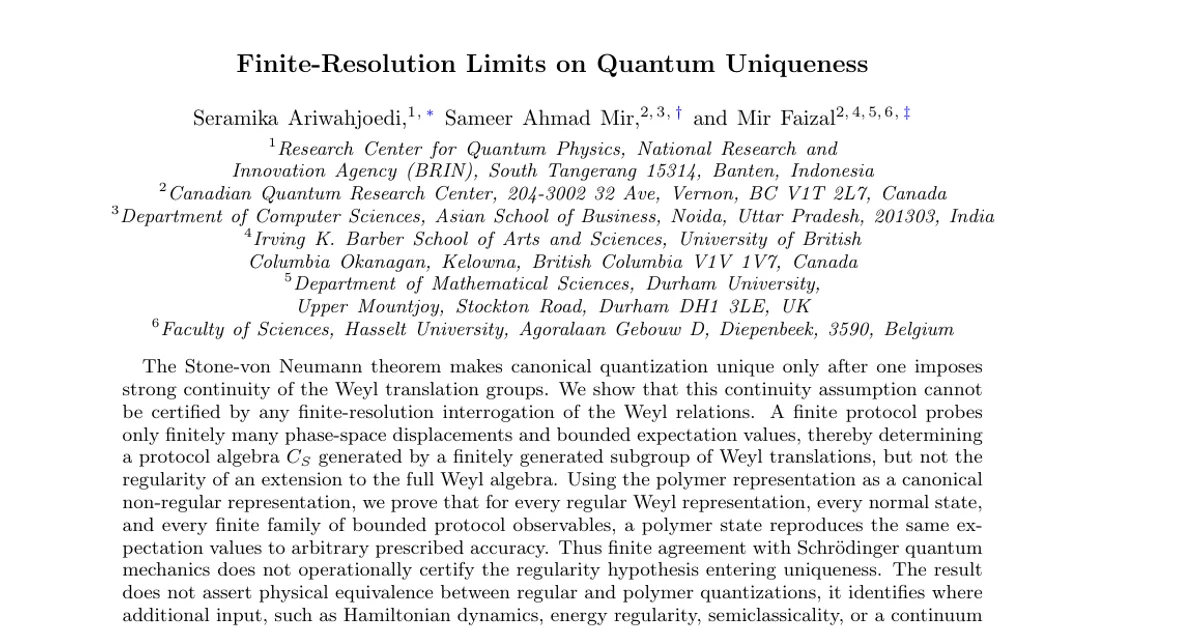
The Stone-von Neumann theorem makes canonical quantization unique only after one imposes strong continuity of the Weyl translation groups. We show that this continuity assumption cannot be certified by any finite-resolution interrogation of the Weyl relations. A finite protocol probes only finitely many phase-space displacements and bounded expectation values, thereby determining a protocol algebra \(C_S\) generated by a finitely generated subgroup of Weyl translations, but not the regularity of an extension to the full Weyl algebra. Using the polymer representation as a canonical non-regular representation, we prove that for every regular Weyl representation, every normal state, and every finite family of bounded protocol observables, a polymer state reproduces the same expectation values to arbitrary prescribed accuracy. Thus finite agreement with Schrödinger quantum mechanics does not operationally certify the regularity hypothesis entering uniqueness. The result does not assert physical equivalence between regular and polymer quantizations, it identifies where additional input, such as Hamiltonian dynamics, energy regularity, semiclassicality, or a continuum limit, is required to distinguish or select representations. In this precise sense, non-regular polymer kinematics are not excluded by finite Weyl data alone, a point of direct relevance to quantum-gravity motivated quantizations.