Research
Fermionic Gaussian Scrooge Ensembles in Deep Thermalization
Overview Research area: Quantum many-body physics — deep thermalization, random-state ensembles, and free-fermion dynamics. Technical level: Advanced. The paper uses replica field theory, large-N sadd
- arXiv
- 2610.01209
- Published
- 2026-10-01
- Authors
- Ning Sun, Pengfei Zhang
AI summary
Overview
Research area: Quantum many-body physics — deep thermalization, random-state ensembles, and free-fermion dynamics.
Technical level: Advanced. The paper uses replica field theory, large-N saddle-point methods, and Gaussian-state techniques, though its central message is stated in accessible terms.
Scope: The paper defines a random-ensemble target called the fermionic Gaussian Scrooge (fGS) ensemble and shows that it universally describes the projected ensembles generated by measurement in free-fermion systems, both analytically for the SYK₂ model and numerically for random Gaussian circuits with U(1) symmetry.
What This Paper Is About
When you measure most of a quantum many-body system, the unmeasured remainder is left in a random pure state drawn from a "projected ensemble." In chaotic systems this ensemble is known to converge to the Scrooge ensemble, a maximally random distribution consistent with the average density matrix. Free-fermion systems are nonchaotic and their states must stay Gaussian, so the standard Scrooge ensemble does not apply; the authors ask what the correct universal target ensemble is, and construct and test it.
Key Contributions
-
Defines the fermionic Gaussian Scrooge ensemble. The fGS ensemble is introduced as a distortion of the Gaussian Haar ensemble by the average density matrix, constructed separately in the even and odd fermion-parity sectors, with the Gaussian Haar measure built from single-particle rotations drawn uniformly from SO(2N_A).
-
Derives the moment structure and identifies a new symmetry. The k-th moment of the fGS ensemble involves an integral over replica rotations in SO(n), rather than the sum over replica permutations that characterizes the conventional Scrooge ensemble. This reveals an enlarged symmetry of Gaussian states in the replicated Hilbert space.
-
Proves exact emergence in the SYK₂ model at arbitrary times. For the quadratic Sachdev-Ye-Kitaev model initialized in a thermofield double state, the projected-ensemble moments are shown analytically to equal the fGS moments at any evolution time, with the replica rotations arising from a continuous family of saddle-point solutions.
-
Provides numerical evidence in U(1)-symmetric Gaussian circuits. For brick-wall random Gaussian circuits with charge conservation, the projected ensemble converges to the fGS ensemble as circuit depth increases, across four parameter combinations of initial-state parameters p and θ.
Main Findings
-
Gaussianity is the organizing constraint. Because free-fermion evolution and occupation-number measurements both preserve Gaussianity, post-measurement states satisfy Wick's theorem and are fully determined by their correlation matrices. The universal target must therefore be a maximally random ensemble within the Gaussian manifold, not the full Hilbert space.
-
Parity-resolved definition. The fGS ensemble is built within each fermion-parity sector: ρ = p₊ρ₊ ⊕ p₋ρ₋, and the ensemble in each sector is a distortion of the Gaussian Haar ensemble by the normalized sector density matrix ρ±.
-
Correct first moment. The first moment of the fGS ensemble equals ρ± in each sector, and summing both sectors gives ρ, as required for consistency with the average density matrix.
-
Replica rotations replace replica permutations. The k-th moment takes the form of a trace over replicas k+1 through n of an integral over SO(n) of a rotated ρ±^⊗n, with the rotation generator built from replicated Majorana bilinears. This is the sharp structural contrast with the conventional Scrooge ensemble.
-
Exact result for SYK₂. Working with a thermofield double state built from an EPR state satisfying iγ_j γ_{j+N}|EPR⟩ = |EPR⟩ and evolved under H = Σ_{j<k} iV_{jk}γ_jγ_k with variance V²/(4N), the authors show that the path integral over subsystem A in the multi-replica saddle-point expansion reproduces exactly ρ^⊗n. Combined with an integral over replica rotations, this matches the fGS moment formula at arbitrary evolution time t.
-
Saddle-point symmetry origin. The saddle-point equations are invariant under O(N){f} × O(N){b}, generated by independent replica rotations on the forward and backward branches and by reflections of single replicas. For one replica there are two solutions related by reflection; the replica-diagonal family obtained by choosing either solution per replica generates replica rotations when acted on by U_r(R).
-
Numerical convergence in Gaussian circuits. With N_A = 4, N_B = 300, and N_s = 10⁵ sampled measurement outcomes, the deviation Δ_fGS^(k) between projected-ensemble and fGS correlation-matrix moments decreases as circuit depth increases, for p ∈ {0.2, 0.5} and θ ∈ {π/4, π/10}.
-
Charge fluctuations suppress measurement-induced charge constraints. Despite measuring in the occupation-number basis, the projected ensemble agrees with the fGS ensemble built from the total density matrix in each parity sector. The authors attribute this to charge fluctuations in the initial state, whose variance scales with N for any p < 1 and θ ∈ (0, π/2), preventing measurements on B from strongly constraining the charge on A as N → ∞.
-
A concrete sampling scheme. The Supplemental Material shows that purifying ρ with an auxiliary system A′ and applying a Haar-random Gaussian unitary on A′ before occupation-number measurement produces exactly a probabilistic mixture of the even- and odd-parity fGS ensembles with weights p₊ and p₋. This is the scheme used to estimate the fGS moments numerically.
-
Not reported. The paper displays Δ_fGS^(k) graphically but does not quote specific numerical values for the deviations, nor a list of the circuit depths simulated.
Methodology in Plain English
The authors split a free-fermion system into a small subsystem A (with 2N_A ~ O(1) Majorana modes) and a large subsystem B. They evolve the whole system under Gaussian dynamics — either a quadratic Hamiltonian or a random Gaussian circuit — then projectively measure paired Majorana operators (or, in the circuit case, occupation numbers) on B. Each measurement outcome m leaves a pure Gaussian state on A with a Born-rule probability, and the collection of these states is the projected ensemble.
To characterize this ensemble they use two objects: the k-th tensor moment of the many-body states, useful for analytics, and the k-th tensor moment of the correlation matrices, useful for numerics. They then compare these to the moments of the fGS ensemble.
For the SYK₂ model, the moments of the unnormalized post-measurement states are written as a path integral over n replicas on a contour of length L = 2t + β, with imaginary-time, forward real-time, and backward real-time branches weighted by η_s = 1, i, and −i. Averaging over the Gaussian couplings produces a bilocal self-energy, and the problem is solved in a large-N saddle-point approximation; the moments depend only on λ, the fraction of +1 measurement outcomes. Classifying the saddle points by their symmetries yields the replica-rotation integral that matches the fGS moment formula.
For the circuit case, they exploit the fact that Gaussian dynamics and Gaussian measurements can be simulated by evolving only the 2N × 2N correlation matrix, which allows system sizes far beyond exact state-vector methods. They evolve a brick-wall circuit of Haar-random U(2) two-site gates, measure B, and compare sampled moments against fGS moments estimated from 10⁵ samples drawn via the canonical-purification construction.
Why This Matters
Impact on research. Deep thermalization has been studied mainly for chaotic, interacting systems. This work extends the program to noninteracting fermions, where ergodicity is restricted to the Gaussian manifold, and identifies a clean structural signature — replica-rotation symmetry instead of replica-permutation symmetry — separating Gaussian from interacting universality. It also provides a rare analytically exact result at arbitrary time, not just in a late-time limit, and it ties the projected-ensemble language to the replica-rotation symmetry already known from measurement-induced phases in free-fermion systems.
Potential applications:
- Benchmarking fermionic quantum simulators and random-circuit sampling: the fGS ensemble gives a computable reference distribution against which measured projected ensembles can be compared.
- Classical validation of measurement protocols: because Gaussian states are efficiently representable, the fGS target can be evaluated at system sizes (here N_B = 300) that are out of reach for general interacting numerics.
- Characterizing charge-conservation effects in cold-atom and fermionic-lattice experiments where U(1) symmetry and occupation-number readout are natural.
- Informing measurement-based state-preparation and random-state-design protocols restricted to the Gaussian manifold.
Industry relevance. Quantum-computing platforms that encode fermions — superconducting circuits, neutral-atom arrays, and Majorana-based architectures — rely on mid-circuit measurement and randomized benchmarking. Understanding the universal distribution of post-measurement states, and how charge conservation modifies it, is directly relevant to validating such hardware and to designing efficient classical simulability checks for fermionic circuits.
Future Directions
-
Nonunitary dynamics. The authors propose extending the analysis to free-fermion dynamics with measurements or postselection, and asking whether the projected ensemble undergoes a transition.
-
The interacting crossover. Adding weak interactions throughout the system is argued to gap the replica-rotation modes, leaving only saddle points related by replica permutations and reducing the target to the conventional Scrooge ensemble. Quantifying this crossover is an open problem.
-
Non-Gaussian average density matrices. The ensemble definition in Eq. (4) can be carried over to a non-Gaussian ρ, which the authors suggest could arise in SYK₂ when interactions are added only inside subsystem A, since the saddle-point equations for B are unaffected.
-
Experimental confirmation. Testing the predicted convergence in a fermionic simulator with tunable Gaussian circuits and occupation-number readout would directly probe the replica-rotation symmetry.
Target Audience
This paper is aimed at theoretical quantum many-body physicists and quantum information researchers working on thermalization, random-state ensembles, measurement-induced phenomena, and free-fermion dynamics. It will be most useful to readers already comfortable with replica tricks, Gaussian-state formalism, and large-N saddle-point methods. Experimentalists working on fermionic quantum simulators with mid-circuit readout will find the conceptual framing and the concrete Gaussian-circuit protocol accessible, though the SYK₂ derivation requires graduate-level field-theory background.
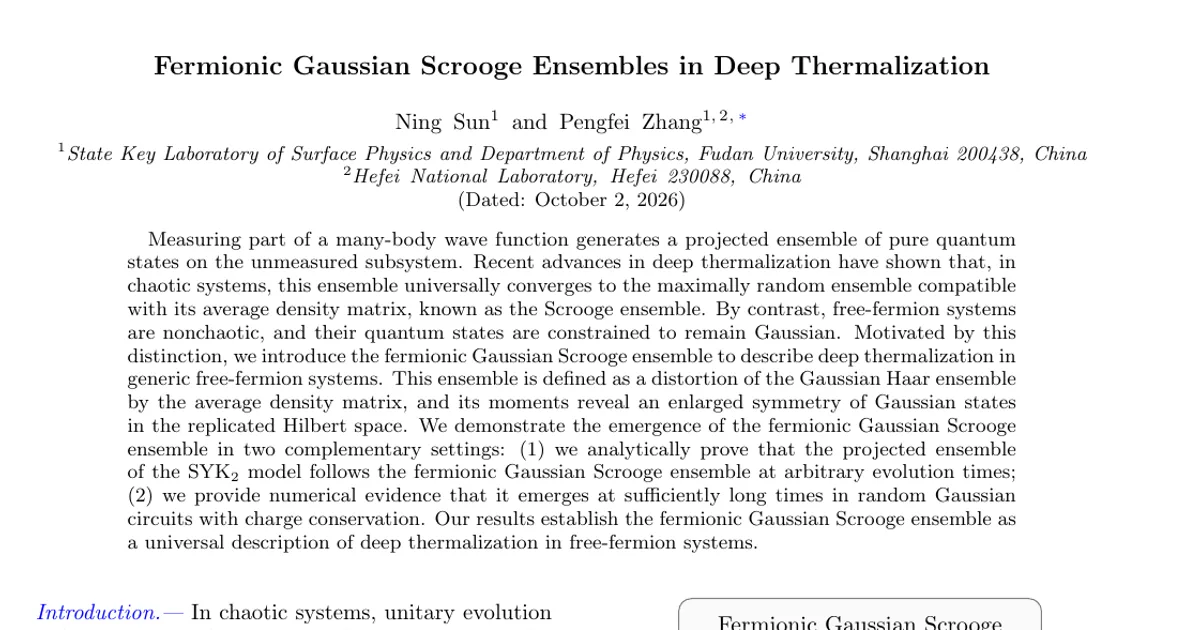
Authors’ abstract
Measuring part of a many-body wave function generates a projected ensemble of pure quantum states on the unmeasured subsystem. Recent advances in deep thermalization have shown that, in chaotic systems, this ensemble universally converges to the maximally random ensemble compatible with its average density matrix, known as the Scrooge ensemble. By contrast, free-fermion systems are nonchaotic, and their quantum states are constrained to remain Gaussian. Motivated by this distinction, we introduce the fermionic Gaussian Scrooge ensemble to describe deep thermalization in generic free-fermion systems. This ensemble is defined as a distortion of the Gaussian Haar ensemble by the average density matrix, and its moments reveal an enlarged symmetry of Gaussian states in the replicated Hilbert space. We demonstrate the emergence of the fermionic Gaussian Scrooge ensemble in two complementary settings: (1) we analytically prove that the projected ensemble of the SYK$_2$ model follows the fermionic Gaussian Scrooge ensemble at arbitrary evolution times; (2) we provide numerical evidence that it emerges at sufficiently long times in random Gaussian circuits with charge conservation. Our results establish the fermionic Gaussian Scrooge ensemble as a universal description of deep thermalization in free-fermion systems.