Research
Experimental validation of a compact fault-tolerant architecture for trapped ions
Overview Research area: Quantum error correction (QEC) and fault-tolerant quantum computing, demonstrated experimentally on trapped-ion hardware. Technical level: Advanced. The abstract assumes famili
- arXiv
- 2609.03194
- Published
- 2026-09-02
- Authors
- Noah Berthusen, Ali Lavasani, Asmae Benhemou, M. S. Allman, Joan Dreiling, Brian Estey, Cameron Foltz, Trent Jacobs, Michael Mills, Annie Jihyun Park, Adam P. Reed, David Hayes, Tzvetan S. Metodi, Andrew C. Potter
AI summary
Overview
Research area: Quantum error correction (QEC) and fault-tolerant quantum computing, demonstrated experimentally on trapped-ion hardware.
Technical level: Advanced. The abstract assumes familiarity with stabilizer codes, code distance, logical Clifford gates, GHZ states, and code-to-code conversion.
Scope (one sentence): The paper introduces the $[[20,2,6]]$ $C_4$-Helix code as a compact fault-tolerant architecture for the early fault-tolerant regime and experimentally validates its main components on a 98-qubit trapped-ion processor.
What This Paper Is About
Quantum error correction has reached the point where encoded logical operations can beat their unencoded physical counterparts, but low-error memory alone is not enough for useful fault-tolerant computation. A workable architecture also needs efficient encoding, cheap logical operations, and a route to the non-Clifford resources that universality requires. This paper proposes a specific architecture built around a small code, the $C_4$-Helix code, and tests its major pieces on real hardware rather than only in simulation.
Key Contributions
-
A concrete architecture for the early fault-tolerant regime. The authors put forward the $[[20,2,6]]$ $C_4$-Helix code (in standard $[[n,k,d]]$ notation: 20 physical qubits, 2 logical qubits, distance 6) as the organizing principle for a full fault-tolerant stack, not merely a memory experiment.
-
Experimental repeated error correction. They run repeated QEC cycles on Quantinuum Helios, a 98-qubit trapped-ion processor, and report a logical error rate per logical qubit per cycle.
-
Full logical Clifford benchmarking under active correction. They exercise the complete Clifford group on the two logical qubits of a single codeblock while error correction is running, rather than benchmarking gates in isolation.
-
A fault-tolerant interface to a second code family. They demonstrate a chain-map interface connecting $C_4$-Helix to a distance-5 surface code, showing that the compact code can interoperate with a more conventional architecture.
Main Findings
-
Repeated QEC error rate: The experiment achieves an error of $4.6^{+6.2}_{-2.6}\times10^{-5}$ per logical qubit per QEC cycle. The asymmetric confidence interval is wide on the upper side, so the central value should be read with that spread in mind.
-
Logical Clifford performance: Benchmarking the complete Clifford group on the two logical qubits of a single codeblock under active error correction yields $2.8^{+1.0}_{-1.6}\times10^{-4}$ error per two-qubit logical Clifford.
-
Cross-code interfacing works: A fault-tolerant chain-map interface between $C_4$-Helix and a distance-5 surface code is used to prepare a heterogeneous three-logical-qubit GHZ state with a fidelity lower bound of $99.925^{+0.068}_{-0.245}%$. The "heterogeneous" qualifier indicates the logical qubits do not all live in the same code.
-
Encoded beats unencoded: In each of these demonstrations, the encoded implementation outperforms the corresponding unencoded physical baseline, and does so without postselection — meaning the result does not depend on discarding unfavorable runs after the fact.
-
Simulated path to lower error: Circuit-level simulations indicate that improvements in physical fidelity would move the same architecture into the $10^{-6}$ to $10^{-8}$ logical-error regime targeted for early fault-tolerant computation. These are simulation projections, not measured hardware results in this paper.
-
Framing claim: The authors conclude that $C_4$-Helix is a hardware-validated fault-tolerant architecture rather than a bare quantum memory.
Methodology in Plain English
The team picked a code that is deliberately small and efficient: it stores two logical qubits in twenty physical qubits, which keeps the encoding overhead modest compared with larger surface-code blocks. They implemented this code on a 98-qubit trapped-ion machine and ran repeated cycles of error correction, measuring how often the logical information went wrong per cycle. To test whether the architecture is useful and not just stable, they ran every gate in the Clifford group on the encoded qubits while correction was active, and measured the resulting logical gate error.
Because practical machines will likely mix code types — a compact code for some tasks, a surface code for others — they built a fault-tolerant translation layer (a chain map) between the $C_4$-Helix code and a distance-5 surface code. They validated that interface by preparing an entangled GHZ state spanning three logical qubits drawn from the two different codes. Throughout, they compared each encoded result against the same operation performed on unencoded physical qubits, and they did not use postselection to improve the numbers. Finally, they used circuit-level simulations to estimate how the architecture would perform if the underlying physical error rates improved.
Why This Matters
Impact on research. Most QEC milestones have been memory experiments. This work tests the harder claim that a whole architecture — encoding, a universal-enough gate set, and an interface to another code — can be validated together on hardware. The demonstrated code-to-code interface is notable because modular and heterogeneous architectures are widely discussed but rarely executed experimentally, and because it shows a compact code can hand off logical information to a well-understood surface code rather than standing alone.
Real-world applications. The abstract does not enumerate applications, so the following are the general areas fault-tolerant quantum computing is expected to serve, not claims made by the paper:
- Simulation of molecular and materials electronic structure, where classical methods scale poorly.
- Cryptographic tasks and analysis relevant to post-quantum security planning.
- Optimization problems where quantum heuristics may offer advantages.
- Fundamental physics simulation, such as lattice gauge theories and quantum dynamics.
Industry relevance. The work was done on a commercial trapped-ion platform, which matters for organizations deciding which hardware modality and which code family to build around. An architecture that keeps physical-qubit overhead low while still supporting logical gates and cross-code communication is directly relevant to roadmaps for early fault-tolerant machines, and the reported comparison against unencoded baselines is the kind of evidence needed to justify the engineering cost of error correction.
Future Directions
-
Reaching the $10^{-6}$–$10^{-8}$ regime. The paper's simulations suggest that better physical fidelity is the main lever. Demonstrating that improvement on hardware is the obvious next experimental step.
-
Non-Clifford resources. The abstract frames access to non-Clifford resources as a required component of the architecture but reports Clifford benchmarking only. Fault-tolerant magic-state injection or distillation on this code remains to be shown.
-
Scaling past one codeblock. The Clifford benchmark covers the two logical qubits of a single codeblock. Multi-block operation, lattice surgery or equivalent between $C_4$-Helix blocks, and larger logical registers are open.
-
Maturation of the heterogeneous interface. The chain map to the distance-5 surface code was validated through a GHZ-state preparation. Repeated, sustained operation across the boundary — and its cost in space and time — are natural follow-ups.
Target Audience
Quantum information researchers working on error correction and fault tolerance; experimentalists on trapped-ion and other high-fidelity platforms; hardware and architecture teams at quantum computing companies planning fault-tolerant roadmaps; and graduate students or advanced practitioners who already understand stabilizer codes and logical gate benchmarking and want to see how an architecture-level proposal is validated end to end.
Note: only the abstract was available for this summary. Numerical results, error models, circuit details, and simulation parameters beyond those quoted above are not described here because the abstract does not report them.
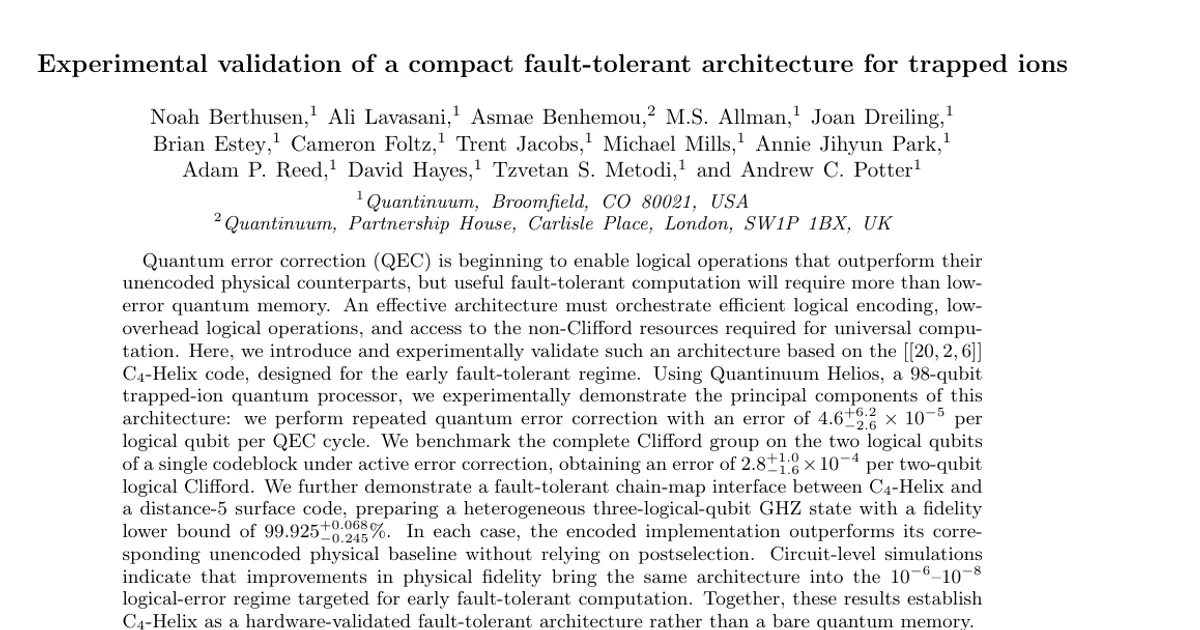
Authors’ abstract
Quantum error correction (QEC) is beginning to enable logical operations that outperform their unencoded physical counterparts, but useful fault-tolerant computation will require more than low-error quantum memory. An effective architecture must orchestrate efficient logical encoding, low-overhead logical operations, and access to the non-Clifford resources required for universal computation. Here, we introduce and experimentally validate such an architecture based on the $[[20,2,6]]$ $C_4$-Helix code, designed for the early fault-tolerant regime. Using Quantinuum Helios, a 98-qubit trapped-ion quantum processor, we experimentally demonstrate the principal components of this architecture: we perform repeated quantum error correction with an error of $4.6^{+6.2}_{-2.6}\times10^{-5}$ per logical qubit per QEC cycle. We benchmark the complete Clifford group on the two logical qubits of a single codeblock under active error correction, obtaining an error of $2.8^{+1.0}_{-1.6}\times 10^{-4}$ per two-qubit logical Clifford. We further demonstrate a fault-tolerant chain-map interface between $C_4$-Helix and a distance-5 surface code, preparing a heterogeneous three-logical-qubit GHZ state with a fidelity lower bound of $99.925^{+0.068}_{-0.245}\%$. In each case, the encoded implementation outperforms its corresponding unencoded physical baseline without relying on postselection. Circuit-level simulations indicate that improvements in physical fidelity bring the same architecture into the $10^{-6}$-$10^{-8}$ logical-error regime targeted for early fault-tolerant computation. Together, these results establish $C_4$-Helix as a hardware-validated fault-tolerant architecture rather than a bare quantum memory.