Research
Exact logical error rates for magic state cultivation
Overview Research area: Quantum error correction and fault-tolerant quantum computing, specifically magic state cultivation and the exact evaluation of logical error rates. Technical level: Advanced.
- arXiv
- 2609.18922
- Published
- 2026-09-16
- Authors
- Kwok Ho Wan, Ainhoa Zapirain
AI summary
Overview
Research area: Quantum error correction and fault-tolerant quantum computing, specifically magic state cultivation and the exact evaluation of logical error rates.
Technical level: Advanced. The paper assumes familiarity with stabiliser codes, circuit-level noise models, Pauli propagation and tensor networks, though its results (rational numbers and power series) are stated concretely enough to be used without following every derivation.
Scope (one sentence): The paper computes exact acceptance and logical error rates, as rational fractions at fixed noise strengths and as exact power series in $x = p/(1-p)$ through order $x^{10}$, for the $d=3$ and $d=5$ magic state cultivation circuits distributed in Clifft and SOFT, using actual $T$ gates rather than the $S$-gate proxy.
What This Paper Is About
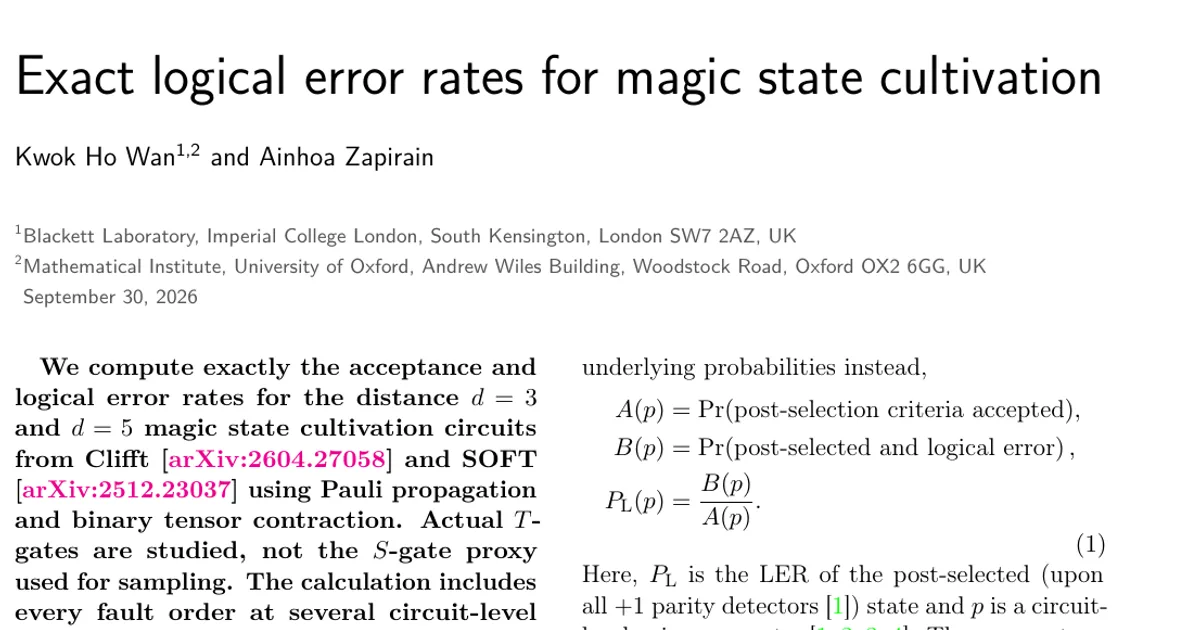
Magic state cultivation produces the encoded magic states that fault-tolerant quantum computers need, and its logical error rates are claimed to be as low as $10^{-6}$ to $10^{-9}$. At those rates, Monte Carlo sampling is impractically expensive, so published numbers rely on sampling the much more numerous rejected attempts and, in some cases, on an $S$-gate proxy rather than the real $T$-gate circuit. This paper replaces sampling with an exact calculation: it computes the probability that cultivation post-selection accepts, $A(p)$, and the joint probability that it accepts with a logical error, $B(p)$, for the $d=3$ and $d=5$ circuits, and then takes $P_{\mathrm{L}}(p) = B(p)/A(p)$.
Key Contributions
-
Exact fractions at fixed noise strengths. Using Pauli propagation combined with binary tensor contraction evaluated in modular arithmetic, the authors obtain the acceptance rate $A(p)$ and logical error rate $P_{\mathrm{L}}(p)$ as exact rational numbers at several circuit-level noise strengths $p$ for the full $d=5$ circuit, and at $p=10^{-3}$ for the $d=3$ circuit.
-
Exact series expansions through order $x^{10}$. Writing $x = p/(1-p)$, they give exact rational coefficients for $P_{\mathrm{L}}(x)$ through degree ten, with remainder $O(x^{11})$, so the rate can be evaluated at any small $p$ rather than only at the simulated points.
-
Resolution of the $T$-gate versus $S$-gate proxy question. The calculation uses actual $T$ gates, not the $S$-gate proxy used for sampling, and the results still recover the published Clifft and SOFT values at both $d=3$ and $d=5$ to within their sampling uncertainty.
-
Identification of the true fault distances. The leading terms of the exact series show that the $d=3$ and $d=5$ cultivation circuits have fault distances $d_{\text{fault}} = 2$ and $d_{\text{fault}} = 3$ respectively, lower than their code distances, which explains the similar distance-degrading effects reported from the companion code of Quantum 10, 2134 (2026).
Main Findings
-
$d=5$ logical error rate at $p=10^{-3}$: the all-orders exact calculation gives $P_{\mathrm{L}}^{(5)}(p=10^{-3}) = 3.32842537\ldots \times 10^{-9}$, the decimal expansion of an exact fraction reconstructed via modular primes.
-
$d=5$ exact series: through $x^{10}$, $$P_{\mathrm{L}}^{(5)}(x) = \tfrac{574}{375}x^{3} + \tfrac{972959741}{810000}x^{4} + \tfrac{2678166036893}{4860000}x^{5} + \tfrac{46204605652071071}{1458000000}x^{6} + \tfrac{20165667601860828941}{14580000000}x^{7} + \tfrac{34708968532201339967}{656100000}x^{8} + \tfrac{12146976079587122943200741}{6561000000000}x^{9} + \tfrac{28153927149162391481472671659}{472392000000000}x^{10} + O(x^{11}),$$ with every coefficient an exact rational number.
-
$d=3$ results: at $p=10^{-3}$, $P_{\mathrm{L}}^{(3)}(p=10^{-3}) = 8.982790954\ldots \times 10^{-7}$, and $P_{\mathrm{L}}^{(3)}(x) = \tfrac{32}{75}x^{2} + \tfrac{2009039}{4500}x^{3} + O(x^{4})$, with complete coefficients through $x^{10}$ given in the paper's Table 6.
-
Whole-circuit $d=5$ acceptance and logical error rates (Table 1): at $p=0.00050$, $A = 0.379184137167$ and $P_{\mathrm{L}} = 2.846165501072 \times 10^{-10}$; at $p=0.00075$, $A = 0.233599896243$ and $P_{\mathrm{L}} = 1.165527889094 \times 10^{-9}$; at $p=0.00100$, $A = 0.143955584096$ and $P_{\mathrm{L}} = 3.328425371418 \times 10^{-9}$; at $p=0.00150$, $A = 0.0547199749366$ and $P_{\mathrm{L}} = 1.591266806530 \times 10^{-8}$; at $p=0.00200$, $A = 0.0208263641922$ and $P_{\mathrm{L}} = 5.175102366142 \times 10^{-8}$. Displayed decimals are rounded; stored values are exact fractions.
-
Sampling cost avoided: at $p=10^{-3}$ the $d=5$ acceptance is about $14.395\ldots%$ and $B = 4.7914541\ldots \times 10^{-10}$, so direct sampling would need roughly $2.1 \times 10^{9}$ attempts on average to see one accepted outcome carrying a logical error.
-
Higher orders matter: the leading $x^{3}$ term is less than half of the $d=5$ logical error rate at $p=10^{-3}$. Truncating at $K=3$ gives $S_{K} = 1.5352678660 \times 10^{-9}$ with relative error $5.387 \times 10^{-1}$; $K=5$ gives $3.2950960775 \times 10^{-9}$ and $1.001 \times 10^{-2}$; $K=7$ gives $3.3283701142 \times 10^{-9}$ and $1.660 \times 10^{-5}$; $K=8$ gives $3.3284234413 \times 10^{-9}$ and $5.799 \times 10^{-7}$; $K=9$ gives $3.3284253094 \times 10^{-9}$ and $1.863 \times 10^{-8}$; $K=10$ gives $3.3284253696 \times 10^{-9}$ and $5.427 \times 10^{-10}$.
-
Agreement with published numerics: the exact values and the tenth-order series lie inside the published Clifft and SOFT intervals at every shared noise strength, and the acceptance agrees with SOFT's reported values. At $d=3$ the exact values lie inside both the Clifft and the Gidney–Shutty–Jones state-vector intervals.
-
Fault distance is lower than code distance: $d_{\text{fault}} = 2$ for the $d=3$ circuit and $d_{\text{fault}} = 3$ for the $d=5$ circuit, read directly off the leading orders $x^{2}$ and $x^{3}$ in the exact series. A concrete two-fault pattern in the $d=3$ double-checking stage ($X_{3}$ in the fold layers and $Y_{9}$ in the unfold layer) passes post-selection with no detector firing with probability $1/4$, and every accepted output carries a logical error.
-
Series accuracy: keeping terms through $x^{10}$ agrees with the exact fraction to a relative error below roughly $10^{-7}$, with remainder bounds in the paper's Appendix F covering noise strengths where no exact fraction is available.
Methodology in Plain English
The authors avoid sampling entirely by computing the two underlying probabilities directly.
First, they split the cultivation circuit into stages: injection, a $d=3$ double-checking stage, a purely Clifford code-growth stage, a $d=5$ double-checking stage, and a noiseless final readout. The non-Clifford $T$ gates sit almost entirely in the two double-checking stages, and the Clifford growth stage is handled by an exact average.
They then use Pauli propagation, which carries the measured observable backwards through the circuit instead of pushing states forwards. A Clifford gate maps one Pauli string to one Pauli string, while a $T$ gate splits one string into two, with coefficients $+1/\sqrt{2}$ and $-1/\sqrt{2}$. Nothing is sampled: all branches are kept with their signs, and branches reaching the same Pauli string are added and can cancel. A worked example shows 128 propagated terms collapsing to a single logical observable $M_{L} = (X_{L}-Y_{L})/\sqrt{2}$, because 112 of the 128 strings flip a code stabiliser and have zero expectation on the ideal state while the remaining 16 combine into logical operators.
For each double-checking stage they compute a "response" $(F_{A}, F_{B})$ to each incoming Pauli error: the probability of passing post-selection, and the probability of passing with a logical error. To keep these tables small, they group errors that differ only by a code stabiliser, labelling each error by its stabiliser syndrome plus two parity bits. This reduces the number of table entries from $4^{7} = 16{,}384$ to $256$ at $d=3$, and from $4^{19} \approx 2.75 \times 10^{11}$ to $1{,}048{,}576$ at $d=5$.
Finally, gates, depolarising noise and post-selection conditions are written as small tensors, and the whole network is contracted — for the noisy growth stage, 569 factors sharing a single parity constraint, with a carefully chosen contraction order that keeps intermediates small. The same network is evaluated twice: once with a rational $p$ in modular arithmetic to produce exact fractions, and once with polynomials in $x = p/(1-p)$ truncated at degree ten to produce exact series coefficients. Multiplying each incoming error's weight by its response and summing gives $A(p)$ and $B(p)$, and hence $P_{\mathrm{L}} = B/A$.
Why This Matters
The paper supplies a trustworthy reference value for a quantity that is otherwise accessible only through very expensive sampling, and it shows that the shortcut used to make sampling feasible — the $S$-gate proxy — was not hiding a discrepancy. It also shows that the headline code distance overstates the protection actually delivered, with $d_{\text{fault}} = 2$ and $3$ rather than $3$ and $5$.
Real-world applications:
- Resource estimation for fault-tolerant machines: logical error rates at the $10^{-6}$ to $10^{-9}$ level set the number of magic state factories, physical qubits and time steps required, so exact values tighten overhead budgets.
- Validating simulation and sampling pipelines: the exact fractions and intervals give a ground truth against which Monte Carlo estimators and circuit-level noise simulators can be checked.
- Circuit and check design: knowing that the $d=3$ check has $d_{\text{fault}} = 2$ points to concrete fault patterns that a redesigned double-checking stage would need to suppress.
- Verification tooling for quantum compilers: the Pauli-propagation plus tensor-contraction pipeline is a template for exactly certifying small but heavily non-Clifford subcircuits used in larger architectures.
Industry relevance: exact, sampling-free error characterisation of cultivation subcircuits is directly useful to groups building fault-tolerant hardware, where a single mis-estimated logical error rate propagates into multi-year resource forecasts. The first author lists a current affiliation with PsiQuantum, indicating industrial interest in this style of exact analysis.
Future Directions
-
Including the missing stages. The escape, grafting and decoding stages are explicitly outside the scope, and the full end-to-end cultivation cost cannot be quoted until they are included.
-
Extending beyond $d=5$ and beyond degree ten. The series is truncated at $x^{10}$ with $O(x^{11})$ remainder; higher orders, and the larger colour codes needed for lower target error rates, would require further contraction and grouping work.
-
Applying the pipeline to other circuit distributions and other cultivation protocols. The authors treat SOFT as the source of truth, note that the same circuits appear in Clifft and SymFT, and use unitary injection; other injection or checking variants have not been characterised exactly.
-
Redesigning checks to raise $d_{\text{fault}}$. Since the $d=3$ check admits a two-fault accepted logical error with probability $1/4$ for that fault pattern, a natural next question is which modifications to the double-checking stage would push the fault distance up toward the code distance.
Target Audience
Quantum error correction and fault-tolerance researchers who need reliable logical error rate numbers for magic state cultivation; architects performing resource estimation for fault-tolerant architectures; developers of circuit-level simulators and verification tools who want a benchmark with exact rather than sampled answers; and graduate students studying Pauli propagation, tensor-network contraction, or the gap between code distance and fault distance in realistic circuits.
Authors’ abstract
We compute exactly the acceptance and logical error rates for the distance $d=3$ and $d=5$ magic state cultivation circuits from Clifft [arXiv:2604.27058] and SOFT [arXiv:2512.23037] using Pauli propagation and binary tensor contraction. Actual $T$-gates are studied, not the $S$-gate proxy used for sampling. The calculation includes every fault order at several circuit-level noise strengths ($p$). We provide a series expansion form to the logical error rates, through order $(p/(1-p))^{10}$. The analytical results recover the numerical values from Clifft and SOFT at both $d=3$ and $d=5$ to within their sampling uncertainty. Then, we show that the $d=3$ and $d=5$ circuits actually have fault distances of $d_{\text{fault}}=2$ and $d_{\text{fault}}=3$ respectively, explaining the similar distance degrading effects from the companion code of [Quantum 10, 2134 (2026)].