Research
Error-Generator-Level Compression for Fast Quantum Gates
Overview Research area: Quantum control theory for superconducting qubits — specifically, pulse-level error suppression for fast gates in multilevel (transmon) systems. Category: Quantum Physics (quan
- arXiv
- 2607.28922
- Published
- 2026-07-31
- Authors
- Razvan Stanescu, Hugo Ribeiro
AI summary
Overview
Research area: Quantum control theory for superconducting qubits — specifically, pulse-level error suppression for fast gates in multilevel (transmon) systems. Category: Quantum Physics (quant-ph).
Technical level: Advanced. The paper builds on Magnus-expansion control theory and assumes familiarity with interaction-picture dynamics, transmon anharmonicity, and average gate fidelity; the summary below translates the core ideas into plainer terms.
Scope (one sentence): The paper introduces "error-generator-level compression," a Magnus-based control principle that keeps a high-dimensional perturbative error model intact while restricting the implemented microwave waveform to a handful of experimentally simple coefficients, and demonstrates it on a four-level transmon model.
What This Paper Is About
Fast gates on weakly anharmonic superconducting circuits suffer from coherent errors absent in an ideal qubit: leakage into noncomputational levels, unwanted phases, and off-resonant couplings. Existing analytic fixes such as DRAG use simple envelopes, while numerical optimal control can find better pulses but optimizes the final unitary and may require many waveform parameters that are hard to calibrate. The paper asks whether one can suppress all the modeled error channels at a chosen perturbative order while still implementing a waveform with only a few adjustable knobs.
Key Contributions
-
A compression principle that compresses the waveform, not the error model. The pulse is restricted to a few independently adjustable coefficients, but every computational-subspace error and leakage coupling in the projected truncated Magnus generator at the chosen order is retained. Nothing is dropped by error channel.
-
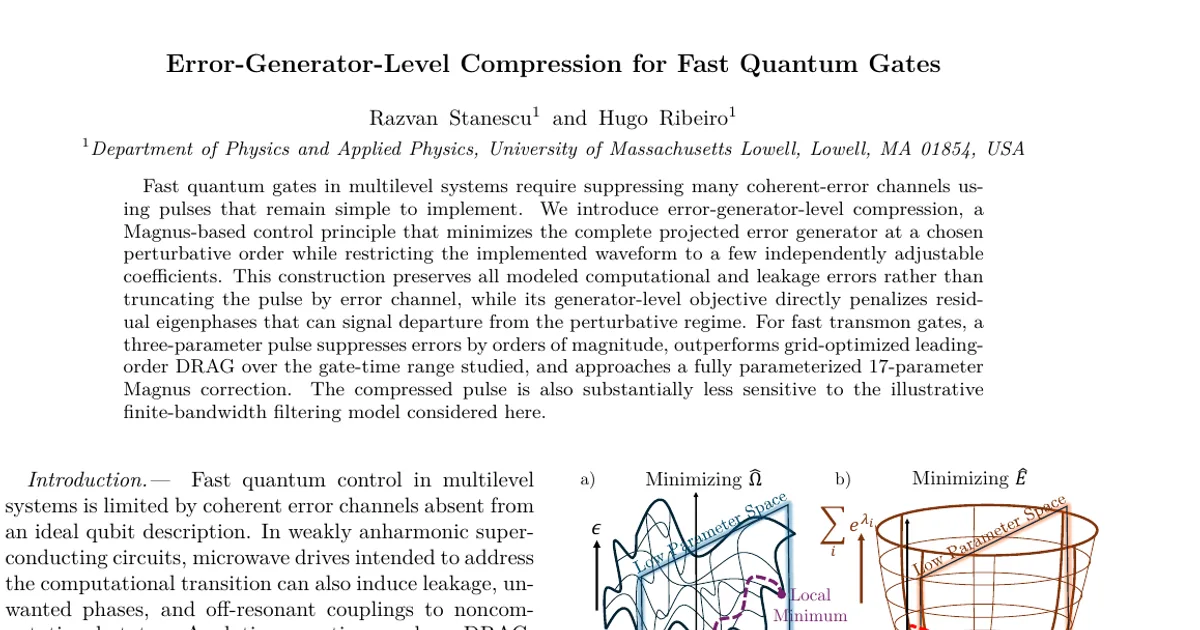
A generator-level spectral cost function. The objective is built from the Hermitian truncated error generator Ê⁽ⁿ⁾ = −i Ω̂⁽ⁿ⁾(t_f), projected onto the relevant blocks (computational-subspace errors plus leakage couplings, with dynamics internal to the complement discarded and the common-phase component removed). The cost is Φ⁽ⁿ⁾ = Tr(exp[Ê⁽ⁿ⁾_rel] + exp[−Ê⁽ⁿ⁾_rel] − 2𝟙_supp) = 2 Σ_j (cosh[λ_j⁽ⁿ⁾] − 1), which is convex in the diagnostic generator and minimized when the projected residual eigenphases vanish.
-
An explicit link to average fidelity error. Near the perturbative origin the cost reduces to Φ⁽ⁿ⁾ = Tr[(Ê⁽ⁿ⁾_rel)²] + O((Ê⁽ⁿ⁾_rel)⁴) = ‖Ê⁽ⁿ⁾_rel‖_F² + O(‖Ê⁽ⁿ⁾_rel‖_F⁴), and at the optimum Φ⁽ⁿ⁾(c⋆⁽ⁿ⁾)/4 ≲ ε ≲ Φ⁽ⁿ⁾(c⋆⁽ⁿ⁾)/3.
-
A three-parameter transmon demonstration against two benchmarks. The compressed pulse is compared with grid-optimized leading-order DRAG and with a fully parameterized 17-parameter fourth-order Magnus correction in a four-level transmon model at E_J/E_C = 50.
Main Findings
-
Three parameters suffice for orders-of-magnitude suppression. At the shortest gate time shown, |α₂|t_f = 5.74, average fidelity errors are 10^(−0.78) for the uncorrected pulse, 10^(−1.8) for grid-selected DRAG, 10^(−2.4) for the three-parameter compressed Magnus pulse, and 10^(−3.1) for the fully parameterized 17-parameter correction. The paper reports this as roughly a factor of 42 improvement over the uncorrected pulse, roughly a factor of 4 over grid-selected DRAG, and within roughly a factor of 5 of the fully parameterized correction.
-
Speed advantage at fixed error. An average fidelity error of 10^(−3) is reached at |α₂|t_f ≃ 7.8 with the three-parameter compressed pulse versus |α₂|t_f ≃ 11.5 for grid-selected DRAG — a gate time approximately 32% shorter.
-
Naive truncation fails. Keeping only the largest error channels predicted by the fourth-order generator (a three-parameter truncation) performs poorly and can even exceed the uncorrected baseline at longer gate times, because higher-order commutators regenerate canceled operators.
-
Unitary-fidelity objectives can be fooled. Minimizing the truncated residual unitary exp[Ω̂⁽⁴⁾] works at shorter gate times but fails at longer ones, where unitary periodicity produces competing minima with a small-looking residual despite a large diagnostic generator. Constraining the three largest predicted fourth-order error components to vanish does not fix this. Minimizing Φ⁽⁴⁾ instead suppresses the eigenphases directly.
-
Long-gate-time gap. At the longest gate times the three- and 17-parameter pulses differ by roughly two orders of magnitude; the paper notes this regime is less experimentally relevant because relaxation and dephasing increasingly dominate.
-
Reduced sensitivity to finite-bandwidth filtering. Under an illustrative Gaussian 3 dB bandwidth model applied to the modified baseband envelopes (carrier and detuning unchanged, no renormalization of amplitudes or pulse areas, filter tails truncated to the gate interval), the 17-parameter pulse begins to degrade for ω_BW/|α₂| ≲ 5, consistent with its fourth harmonic ω₄/|α₂| = 8π/5.74 ≃ 4.38, whereas the three-parameter pulse degrades only near ω_BW/|α₂| ∼ 1.
-
Reported pulse values. At |α₂|t_f = 5.74 the compressed pulse uses a_x/E_C = −0.017, b_y/E_C = 0.301, and Δ/E_C = 0.065, where g_x(t) = a_x[1 − cos(2πt/t_f)], g_y(t) = b_y sin(2πt/t_f), and Δ is a constant detuning of the drive, ω_d = ω₀₁ + Δ.
Methodology in Plain English
The Hamiltonian is split into a piece that generates the intended operation, a piece containing the coherent errors (scaled by a formal bookkeeping parameter ε set to one at the end), and control pieces restricted to what the hardware can actually apply. Moving to the interaction picture, perfect error cancellation would require the final-time evolution to equal the identity; since solving that exactly is as hard as the driven problem itself, the cancellation is imposed order by order in a Magnus expansion.
The unknown correction fields are expanded in a Fourier basis with frequencies ω_j = 2πj/t_f, using [1 − cos(ω_m t)] and sin(ω_l t) terms, which automatically makes the correction vanish at the start and end of the protocol. Projecting the order-εⁿ generator onto the target subspace turns cancellation into a finite set of algebraic equations for the Fourier coefficients — linear if the available controls span the needed error directions, otherwise nonlinear through higher-order commutators.
Rather than solve the full high-dimensional system (the projected generator here contains 11 independent error components for the four-level transmon), the authors vary only a small subset of coefficients and evaluate the complete projected generator analytically at each trial point. The three-parameter compressed pulse keeps one Fourier coefficient per quadrature plus the constant detuning. Optimization minimizes the cosh-based spectral penalty instead of the final unitary.
Simulations use the four lowest transmon eigenstates (computational subspace plus two leakage levels; a three-level truncation is stated to be not quantitatively accurate in this regime) at E_J/E_C = 50 with ħ = 1, targeting a π/2 rotation about x with an uncorrected envelope f_x(t) = θ₀/(n₀,₁t_f)[1 − cos(2πt/t_f)] and f_y = 0. Performance is scored by the average fidelity error ε = 1 − (Tr(ÔÔ†) + |Tr(Ô)|²)/[d(d+1)] with Ô = Û_ideal† P̂ Û(t_f) P̂ and d = 2, which captures both in-subspace coherent error and leaked population. The DRAG benchmark uses g_DRAG,y(t) = −(β/α₂) ḟ_x(t) with a discrete grid search over β = 0, 0.1, …, 1.0 at each gate time, taking the pointwise minimum; the authors state this is a lower envelope of sampled fixed-β curves, not a continuous optimization. The 17-parameter reference is built with the iterative singular/ill-conditioned construction of the cited prior work.
Why This Matters
The work reframes pulse design: instead of asking which error channels to cancel, it asks how few waveform knobs are needed to cancel them all at a given perturbative order. That matters for calibration overhead, since every additional pulse parameter is another thing to calibrate and another thing that room-temperature electronics, cryogenic wiring, and on-chip transfer functions can distort.
Applications:
- Fast single-qubit gates on fixed-frequency transmons, where leakage and phase errors limit gate times.
- Calibration-light pulse deployment on hardware where the drive chain has limited bandwidth and pulse shape fidelity is a bottleneck.
- Benchmarking and diagnostics — the generator-level cost gives an interpretable scalar tied to physical error channels, useful for comparing pulse families.
- Cross-talk and multiqubit extensions, which the authors note can be incorporated whenever they can be represented in a truncated Magnus generator with restricted control parametrization.
Industry relevance: superconducting-quantum-computing hardware groups, control-electronics and cryogenic-instrumentation vendors, and teams building calibration pipelines for gate sets. The result that a three-parameter pulse beats a grid-searched DRAG envelope while being substantially less sensitive to bandwidth filtering is directly relevant to practical pulse delivery.
Future Directions
- Extending generator-level compression beyond single-qubit gates to multiqubit settings and cross-talk channels, as the authors suggest is possible within the framework.
- Resolving the open issue of coefficient-space convexity: the cost is convex in the diagnostic generator, but convexity in the Fourier coefficients follows only when the generator depends affinely on them; singular or ill-conditioned cases generate polynomial dependence.
- Addressing the performance gap at longer gate times, where the three-parameter and 17-parameter pulses differ by roughly two orders of magnitude, and understanding which additional coefficients buy the most error reduction.
- Testing the construction against experimental waveform distortion beyond the single illustrative Gaussian finite-bandwidth model considered here, including transfer functions measured on real wiring.
Target Audience
Quantum-control researchers and superconducting-qubit experimentalists who design or calibrate microwave pulses; graduate students comfortable with Magnus expansions and transmon physics who want an accessible entry point to generator-level control; and hardware/calibration engineers who need simple, few-parameter pulse corrections that survive realistic bandwidth limitations.
Authors’ abstract
Fast quantum gates in multilevel systems require suppressing many coherent-error channels using pulses that remain simple to implement. We introduce error-generator-level compression, a Magnus-based control principle that minimizes the complete projected error generator at a chosen perturbative order while restricting the implemented waveform to a few independently adjustable coefficients. This construction preserves all modeled computational and leakage errors rather than truncating the pulse by error channel, while its generator-level objective directly penalizes residual eigenphases that can signal departure from the perturbative regime. For fast transmon gates, a three-parameter pulse suppresses errors by orders of magnitude, outperforms grid-optimized leading- order DRAG over the gate-time range studied, and approaches a fully parameterized 17-parameter Magnus correction. The compressed pulse is also substantially less sensitive to the illustrative finite-bandwidth filtering model considered here.