Research
Error-Corrected Quantum Optimization via Rydberg Atom Array Embeddings
Overview Research area: Quantum optimization on neutral-atom (Rydberg) hardware; specifically, embedding general combinatorial optimization problems into Rydberg atom arrays and exploiting the resulti
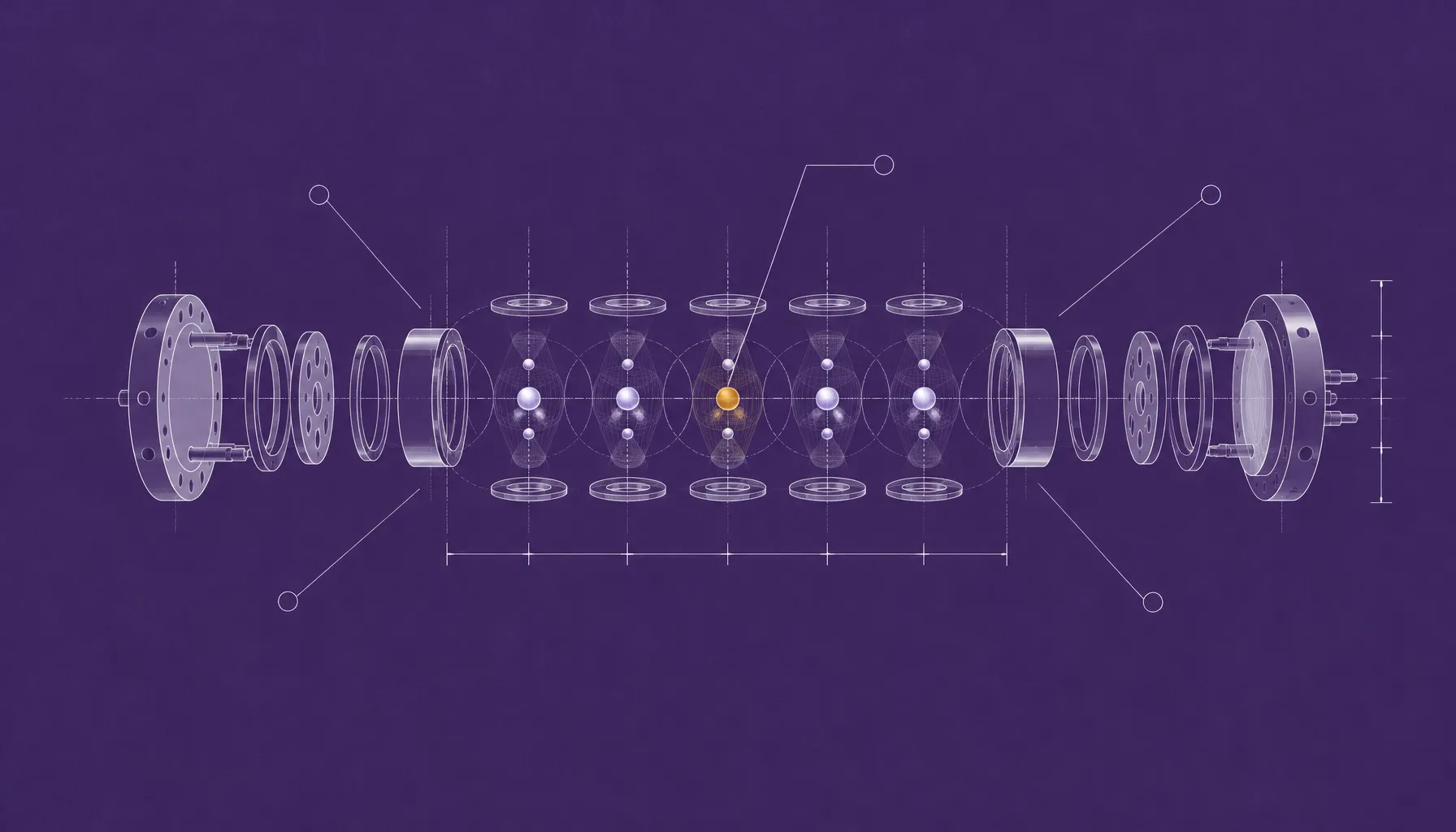
- arXiv
- 2610.39670
- Published
- 2026-10-29
- Authors
- Andrew Byun, Berend Klaver, Arinjoy De, Pedro Ildefonso, Davit Khachatryan, Alexei Bylinskii, Michael Schuler, Wolfgang Lechner
AI summary
Overview
Research area: Quantum optimization on neutral-atom (Rydberg) hardware; specifically, embedding general combinatorial optimization problems into Rydberg atom arrays and exploiting the resulting structure for classical error correction.
Technical level: Advanced. The paper assumes familiarity with adiabatic quantum computing, maximum independent set problems, Rydberg blockade physics, maximum-weight independent set (MWIS) embeddings, and classical coding theory notions such as syndromes and decoders.
Scope (one sentence): The paper argues that the auxiliary atoms introduced by Rydberg gadget embeddings — chiefly the Parity Architecture-based embedding — form a classical nonlinear error-correcting code ("Rydberg-Parity code"), introduces a tailored "Cluster" decoder, and benchmarks it numerically (threshold p_th ≳ 26%) and experimentally on the QuEra Aquila QPU (average success rate ≳ 8% for layouts up to 107 atoms).
What This Paper Is About
Rydberg atom arrays natively solve the maximum (weight) independent set problem only on unit-disk graphs defined by the physical blockade geometry. To attack general combinatorial problems, researchers use "gadgets" — small atom arrangements implementing constraints and long-range links — but these add many auxiliary atoms, seemingly pure overhead. This paper shows that the redundancy those auxiliaries create can instead be read as a classical error-correcting code: each "superatom" must host exactly one Rydberg excitation, so simply counting local excitations reveals errors. The goal is to design and validate a decoder that exploits this structure to recover correct optimization solutions from noisy hardware readouts.
Key Contributions
-
Reframing embedding overhead as an error-correcting code. The authors formalize the Rydberg-Parity embedding as the "Rydberg-Parity code," in which the auxiliary atoms required for gadgetization supply redundancy at no additional hardware cost.
-
Superatom decomposition and syndrome extraction. They show that the fundamental LINK and 3BODY gadgets are themselves amalgamations of dimer and trimer "superatoms," each obeying an exactly-one Rydberg-excitation constraint, and that violations of these constraints define a local error syndrome obtained purely by counting excitations.
-
The Cluster decoder. They introduce a scalable decoding algorithm that resolves errors locally using lookup tables of valid gadget configurations, and expands/merges unresolved regions only when a unique correction cannot be found. The decoder is designed specifically because the code is strictly nonlinear (number checks rather than parity checks), which rules out standard linear-code decoders.
-
Numerical threshold and QPU benchmark. They report an error threshold of p_th ≳ 26% under a simple bit-flip noise model across different layout geometries, and demonstrate on the QuEra Aquila QPU that the Cluster decoder recovers exact optimization solutions with an average success rate of ≳ 8% for systems of up to 107 atoms, including cases where bare hardware and standard greedy post-processing find none.
Main Findings
-
Superatoms enforce exactly-one excitation: Within superatom substructures (dimers of size two in the LINK gadget, trimers of size three in the 3BODY gadget), the Rydberg blockade plus the condition 0 < Δ_k < U_ij constrains valid low-energy configurations to exactly one Rydberg excitation.
-
Local syndromes at no hardware cost: A superatom syndrome σ_S = 0 (constraint satisfied) or σ_S = 1 (constraint violated) is extracted by locally counting Rydberg excitations; superatoms with zero or multiple excitations are flagged as errors without any extra physical resources.
-
The code is strictly nonlinear: The codewords of an unweighted dimer, W = {|01⟩, |10⟩}, are not closed under bitwise addition, since |01 ⊕ 10⟩ = |11⟩ violates the exactly-one constraint. Standard linear-code decoders therefore do not apply.
-
Local optimality enables decoding: Because the ground-state energy of an amalgamated blockaded Hamiltonian is bounded below by the sum of its gadget ground-state energies and the bound is attained only when a configuration satisfies all constraints, every MWIS of the amalgamated graph restricts exactly to a MWIS on each individual gadget. This lets the decoder validate a global solution subgraph by subgraph without solving the full problem.
-
Numerical error threshold: The Cluster decoder achieves p_th ≳ 26% under a simple bit-flip noise model, across different layout geometries.
-
Experimental recovery on hardware: On the QuEra Aquila QPU, the Cluster decoder recovers exact optimization solutions with an average success rate of ≳ 8% for layouts of up to 107 atoms, including instances where the bare hardware readout and standard greedy post-processing (such as GreedyMIS) find no exact solution.
-
Beyond a single embedding scheme: The authors state that the superatom principle extends to other Rydberg blockade-based embeddings; crossing lattice gadgets also decompose into superatoms, while 3D quantum wires require a generalized local constraint (treated in the appendices).
-
Coefficient independence: Because the error-correction scheme depends only on the geometry and local constraints of the embedding, it is independent of the problem coefficients J. The theory is developed at J = 0 (degenerate ground-state manifold) without loss of generality, while experiments benchmark instances with J ≠ 0.
Methodology in Plain English
The authors start from the standard workflow for neutral-atom optimization: map a general problem (QUBO or HUBO) to a parity-encoded graph, then embed that graph into a physical layout of atoms using two building blocks — a LINK gadget that copies a bit from one end of a chain to the other, and a 3BODY gadget that enforces a three-variable parity constraint. Gadgets are glued together by "amalgamation," sharing atoms at their connection points and summing the detunings assigned to shared sites.
The key observation is that each gadget is itself just a stack of small atomic clusters (dimers and trimers) small enough that the blockade forbids more than one excitation. In any valid low-energy state, each such cluster holds exactly one excitation. So after a hardware run, the experimenter measures the bitstring, walks over every cluster, and counts excitations. Clusters with zero or more than one excitation are flagged.
The decoder then works in rounds. It groups adjacent flagged clusters into "clusters" of interest and tries to fix each one locally, holding all atoms outside the cluster fixed and consulting precomputed tables of every valid configuration for each gadget type. If the fixed boundary conditions single out one valid configuration, the cluster is solved. If not — typically because an error lies outside the assumed-clean boundary — the cluster is grown to include neighboring superatoms, and overlapping clusters are merged. The loop terminates when every cluster is resolved (producing a valid bitstring) or when an unresolved cluster spans the whole graph (decoding failure). Numerical simulations under a bit-flip noise model establish the threshold, and experimental data from the QuEra Aquila QPU test the scheme on real hardware instances.
Why This Matters
Impact on research: The paper reframes embedding overhead — normally treated as a cost to be minimized — as a designed-in resource for error mitigation on analog quantum devices, where full active quantum error correction is out of reach. It links Rydberg gadget geometry to classical coding theory, introduces a genuinely nonlinear code with counting-based syndromes, and shows that embedding, computation, and error correction can emerge from the same physical structure.
Real-world applications (as motivated by the paper's framing of general combinatorial optimization):
- Logistics and routing: General QUBO/HUBO instances beyond unit-disk geometry, such as vehicle routing and scheduling problems that require long-range connectivity.
- Satisfiability and constraint programming: SAT instances, which the paper cites as a class systematically mappable onto Rydberg hardware via gadgets.
- Integer factorization: Cited as an application of crossing-lattice embeddings, relevant to cryptographic benchmarking.
- Physics simulation and spin models: Many-body spin models cited as targets for gadget-based embedding.
Industry relevance: The work is a collaboration between the University of Innsbruck, Parity Quantum Computing, and QuEra Computing, and is benchmarked on a commercially available neutral-atom QPU (Aquila). It suggests a practical route to improving solution quality on near-term analog hardware through co-designed decoding software rather than hardware changes, which matters for vendors and users of neutral-atom optimizers.
Future Directions
- Extending the decoder to other embedding families: The authors note the superatom principle extends to crossing lattices (which decompose into superatoms) and to 3D quantum wires, where a generalized local constraint is required; fully developing and benchmarking decoders for these cases is a natural next step.
- Noise models beyond simple bit flips: The reported p_th ≳ 26% is derived under a simple bit-flip noise model; whether the threshold holds under more realistic hardware noise (including loss, detection error, and diabatic transitions) is an open question.
- Scaling the experimental demonstration: The QPU benchmark covers layouts up to 107 atoms; scaling to larger arrays and quantifying how the ≳ 8% average success rate behaves with system size remains to be established.
- Integrating decoding with the sweep itself: Since the code is independent of the problem coefficients J, a broader question is how decoding could be combined with embedding-level design choices or with greedy post-processing to compound their respective gains.
Target Audience
Researchers and practitioners in quantum optimization, neutral-atom quantum computing, and quantum error mitigation — particularly those working on embedding strategies, gadget design, and classical post-processing for analog quantum devices. It is also relevant to coding theorists interested in nonlinear codes with counting-based syndromes, and to industry teams evaluating practical performance of Rydberg optimizers. The paper is not beginner-friendly: it presumes comfort with blockaded Hamiltonians, MWIS formulations, and parity encodings.
Authors’ abstract
Rydberg atom quantum optimizers naturally encode the maximum independent set problem on geometric graphs. However, to solve general combinatorial optimization problems on more complex topologies, an embedding is required to overcome the limited-range native interactions. Such embeddings use gadgets, specific arrangements of atoms, which inevitably introduce ancillary atoms. Here, we show that this apparent overhead instead provides an intrinsic resource for error correction. Specifically, we demonstrate that the Parity Architecture-based Rydberg embedding naturally forms a classical error-correcting code, a principle that extends to other Rydberg blockade-based embeddings. Within superatom substructures, exact Rydberg-excitation-number constraints provide local error syndromes at no additional hardware cost and give rise to a strictly nonlinear code. To correct bit-flip errors, we introduce the precisely tailored Cluster decoder, which exploits these local constraints and the underlying gadget structure. Numerically, this approach achieves an error threshold of $p_{\text{th}}\gtrsim26 \%$ across different layout geometries. Experimentally, on the QuEra Aquila QPU, the Cluster decoder recovers exact optimization solutions with an average success rate of $\gtrsim8\%$ for systems of up to 107 atoms, even when bare hardware and standard greedy post-processing find none. A Rydberg atom array embedding is therefore not merely a hardware mapping of an optimization problem, but a co-designed architecture for quantum optimization in which embedding, computation, and error correction emerge from the same physical structure.