Research
Efficiently and Reliably Measuring Information Processing Capacity in Dynamical Systems via Kernels
Overview Research area: Quantum reservoir computing and dynamical-systems characterisation, sitting at the intersection of kernel methods, orthogonal-polynomial theory, and quantum information process
- arXiv
- 2610.03281
- Published
- 2026-10-02
- Authors
- Alessio Benavoli, Felix Binder, Cangxiong Chen
AI summary
Overview
Research area: Quantum reservoir computing and dynamical-systems characterisation, sitting at the intersection of kernel methods, orthogonal-polynomial theory, and quantum information processing.
Technical level: Advanced. The paper assumes familiarity with reservoir computing, fading-memory Hilbert spaces, orthogonal polynomials, reproducing-kernel Hilbert spaces, and U/V-statistics.
Scope (one sentence): The paper replaces the combinatorial enumeration of orthogonal-polynomial basis functions used to compute Information Processing Capacity with a closed-form kernel expression, yielding a scalable estimator with an unbiased finite-sample correction and a single statistical test for comparing two systems.
What This Paper Is About
Information Processing Capacity (IPC) measures how many linearly independent functions of past inputs a dynamical system can reconstruct from its internal states, and it is the standard benchmarking metric in quantum reservoir computing. The standard recipe requires enumerating orthogonal polynomials of delayed inputs up to a maximum degree and delay, and the number of such terms grows combinatorially, so in practice the total IPC is truncated and is widely acknowledged to be underestimated. The authors show that the same total can be written as the trace of a projection matrix times a tensor-product kernel matrix, which sums over all polynomial degrees at once and never enumerates basis functions individually.
Key Contributions
-
Kernel-IPC (KIPC) framework. A derivation (Theorem 1) showing that the limit of
(1/n_T) Tr(Π K_⊗(U,U))equals a weighted infinite sumΣ_ι λ_ι IPC_ιover the full, untruncated basis, whereΠ = X(XᵀX)⁻¹Xᵀis the projection onto the system's state matrix. -
Closed-form infinite-degree kernels. Proposition 1 and Corollary 1 give convergent closed-form kernels for Hermite polynomials (Mehler kernel), Laguerre polynomials (Hardy-Hille formula), and Jacobi polynomials (Bailey's formula), with Legendre polynomials as the α=β=0 special case, written in terms of the complete elliptic integral of the first kind
R(z). -
Unbiased finite-sample estimator and cost analysis. Proposition 2 removes the diagonal of the V-statistic to give a U-statistic estimator that is unbiased for finite
n_T, with overall computational complexityO(m n_T²)wherem = τ_max, and an asymptotic bound (Theorem 2)≤ Σ_{n=0}^{n_s} λ_nthat mirrors the classical0 ≤ C^tot ≤ n_sbound. -
Statistical comparison and linear/nonlinear decomposition. A single null-hypothesis test for comparing the KIPC of two dynamical systems, replacing the per-basis-function tests used in standard IPC, plus Corollary 2, which isolates the linear component of KIPC.
Main Findings
-
Combinatorial blow-up is quantified. The number of basis functions of degree
dis|B_d| = (τ_max + d − 1 choose d); forτ_max = 20andd = 10this equals 20,030,010. The authors note that practitioners often add a warning that reported total IPC may be underestimated because of truncation, citing [29, Appendix B]. -
Truncation produces genuinely wrong answers, not just small errors. In Example 1 (
τ_max = m = 8), two regression matrices built from Legendre polynomials both have standard total IPC equal to 3 in then_T → ∞limit. Recovering the degree-50 term in the second system would require evaluatingΣ_{d=1}^{50} (m + d − 1 choose d) = 1,916,797,310individual IPC terms, which the authors state cannot be obtained computationally, so the standard total IPC for that system is incorrectly estimated as 2. -
KIPC recovers the correct asymptotic values. The closed-form limits are
ρ/3 + ρ²/5 + (ρ²/5)(ρ/3)andρ/3 + ρ⁵⁰/101 + (ρ²/5)(ρ/3), matching theory where explicit enumeration is infeasible. -
The naive kernel trace is upward-biased. With
ρ = 0.95andn_T = 10⁴, 10⁵, 3·10⁵, 8·10⁵, the biased estimator gives 0.829, 0.583, 0.561, 0.556 for the first system and 0.651, 0.399, 0.383, 0.376 for the second, against theoretical values of approximately 0.5543 and 0.3745. -
The unbiased estimator converges much faster. The U-statistic of Proposition 2 gives 0.552, 0.554, 0.554 and 0.373, 0.374, 0.374 at the same
n_Tvalues, reaching near-accurate estimates already atn_T = 10⁴, at identical computational cost. -
Runtime is dominated by the
n_T²kernel matrix. Measured wall-clock times are 0.4 s (n_T = 10⁴), 22 s (10⁵), 173 s (3·10⁵) and 1200 s (8·10⁵) on a laptop with an Nvidia GPU RTX PRO 3000 Blackwell. -
The eigenvalue weighting makes Assumption 1 explicit. Standard IPC implicitly assumes capacity decreases with degree and delay but cannot evaluate the infinite sum; KIPC encodes that assumption as weights
λ_ι < 1forι ≠ 0, decreasing with degree, which is exactly what makes the infinite series converge. The authors note that the delay-dependence of the weights is discussed later in Section III.2, which falls outside the truncated text supplied. -
Validation scope. The abstract reports validation on an echo state network and demonstration on a disordered spin chain for quantum reservoir computing; the numerical outcomes of those experiments are not contained in the truncated content provided here.
Methodology in Plain English
Standard IPC asks, one basis function at a time, how well a linear readout from the reservoir's states can reproduce that function of past inputs, and then adds up all those scores. Because the functions are products of orthogonal polynomials at different delays, there are astronomically many of them.
The authors borrow a trick from kernel methods. Instead of listing every polynomial, they define a function that measures similarity between two short windows of past input, constructed so that its series expansion contains every polynomial of every degree with a chosen weight. For Legendre polynomials the weights are ρⁿ/(2n+1), and the resulting similarity function has a closed form involving an elliptic integral. Taking the tensor product of this one-dimensional kernel across m delays automatically generates all cross-products of polynomials at all delays and degrees.
The total capacity then becomes a single matrix computation: build the kernel matrix between all pairs of input windows, project it onto the subspace spanned by the reservoir states, and take the trace. No basis functions are ever written down, and no maximum degree is imposed. To correct for finite sample size, the authors drop the diagonal of the resulting double sum and rescale, which converts a biased V-statistic into an unbiased U-statistic. They also show how to compute this without ever allocating large n_T × n_T matrices in memory, using the algorithm in Appendix A.2.
Why This Matters
IPC is the dominant task-independent benchmark in quantum reservoir computing, where researchers use it to compare architectures, input-embedding strategies, readout schemes, and the effect of measurement back-action. If the metric systematically under-reports capacity whenever a system implements high-degree nonlinearities, then comparisons across platforms can be misleading, and highly nonlinear systems can be unfairly penalised. KIPC removes both the truncation bias and the multiple-testing problem that inflates standard IPC through spurious correlations.
Real-world applications (as implied by the paper's framing):
- Benchmarking quantum reservoir computing hardware, including the disordered spin chain reservoir studied here.
- Comparing classical reservoir systems such as echo state networks on a principled, non-task-specific basis rather than through suites like NARMA or delay-line tasks.
- Characterising how much nonlinear memory a physical device provides, which is directly relevant to analogue and neuromorphic hardware evaluation.
- Screening candidate reservoir configurations or input-encoding schemes before committing to expensive experimental characterisation.
Industry relevance: Any group building or selecting a physical reservoir — quantum, photonic, spintronic, or analogue electronic — needs a cheap, unbiased, statistically defensible capacity number. A method whose cost is O(m n_T²) and that requires no combinatorial enumeration is far more practical for automated hardware benchmarking pipelines than a method that needs over a billion regression problems.
Future Directions
-
Handling non-standard input distributions. The authors flag as Issue 4 that the appropriate orthogonal basis depends on the input distribution, which may be unknown, and that IPC is then not optimally calculable. Only the Legendre (uniform input) case is worked through in detail, so extending the kernel construction to arbitrary or estimated input measures remains open.
-
Delay weighting and the eigenvalue schedule. The weights
λ_ιare chosen to make the series converge and to encode Assumption 1, but the paper indicates a later section discusses the delay-dependence of these weights. How to set them principledly — and how sensitive conclusions are toρ— is a live question. -
Scaling beyond current
n_T. Runtime grows asn_T², reaching 1200 s atn_T = 8·10⁵. Faster estimators, stochastic trace estimation, or subsampling of the kernel matrix would broaden applicability to long experimental time series. -
Broader empirical validation. The visible results are on constructed regression matrices; systematic comparison of KIPC against standard IPC across many reservoir types and quantum platforms, together with the reported null-hypothesis test in practice, is the natural next step.
Target Audience
Researchers and graduate students in quantum reservoir computing and quantum machine learning who need a defensible capacity benchmark; reservoir-computing practitioners in the echo-state-network and physical-reservoir communities frustrated by truncation warnings in reported IPC values; and methodologists in kernel methods or statistical learning interested in the connection between orthogonal-polynomial expansions, reproducing-kernel Hilbert spaces, and U-statistics.
Authors’ abstract
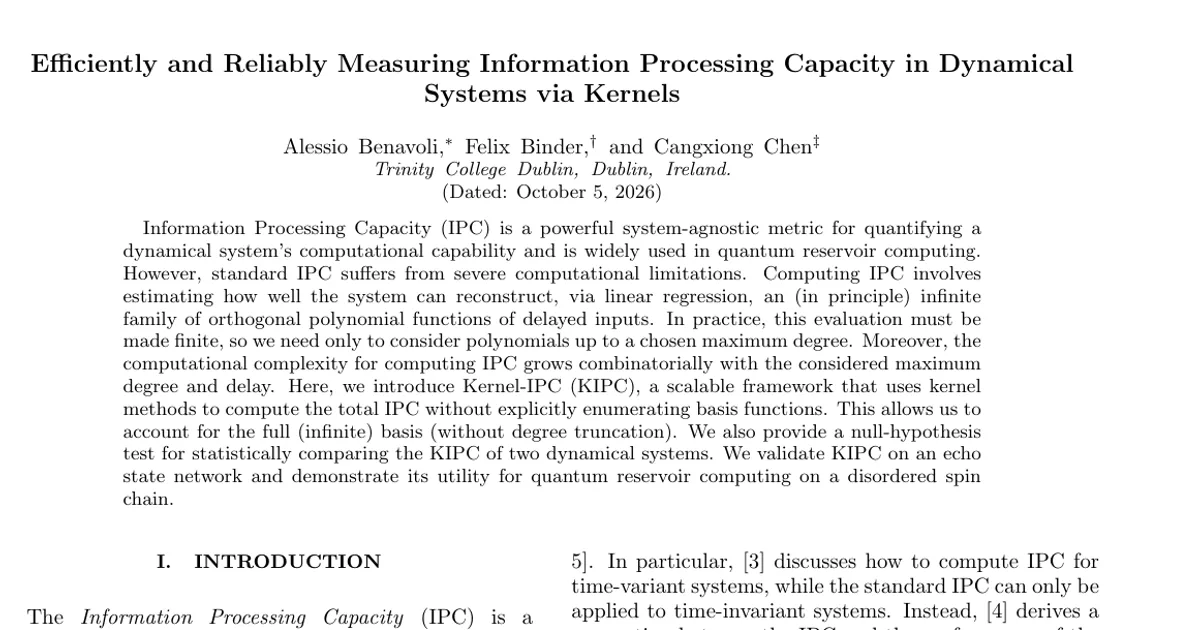
Information Processing Capacity (IPC) is a powerful system-agnostic metric for quantifying a dynamical system's computational capability and is widely used in quantum reservoir computing. However, standard IPC suffers from severe computational limitations. Computing IPC involves estimating how well the system can reconstruct, via linear regression, an (in principle) infinite family of orthogonal polynomial functions of delayed inputs. In practice, this evaluation must be made finite, so we need only to consider polynomials up to a chosen maximum degree. Moreover, the computational complexity for computing IPC grows combinatorially with the considered maximum degree and delay. Here, we introduce Kernel-IPC (KIPC), a scalable framework that uses kernel methods to compute the total IPC without explicitly enumerating basis functions. This allows us to account for the full (infinite) basis (without degree truncation). We also provide a null-hypothesis test for statistically comparing the KIPC of two dynamical systems. We validate KIPC on an echo state network and demonstrate its utility for quantum reservoir computing on a disordered spin chain.