Research
Efficient Synthesis of Multi-Controlled Toffoli Gates with Ternary Clifford$+P_9$ Gates
Overview Research area: Quantum circuit synthesis and fault-tolerant quantum compilation — specifically the decomposition of multi-controlled Toffoli (MCT) gates using qutrit (three-level) hardware wi
- arXiv
- 2609.29884
- Published
- 2026-09-24
- Authors
- Amit Saha, Francesco Arzani
AI summary
Overview
Research area: Quantum circuit synthesis and fault-tolerant quantum compilation — specifically the decomposition of multi-controlled Toffoli (MCT) gates using qutrit (three-level) hardware within the ternary Clifford+$P_9$ gate model.
Technical level: Advanced. The paper assumes familiarity with the ternary Clifford group, magic-state ($P_9$) injection costs, and reversible-circuit resource analysis.
Scope (one sentence): The paper proposes and analyses a balanced-tree decomposition of multi-controlled Toffoli gates that temporarily uses the qutrit state $|2\rangle$ as a workspace marker, achieving exact closed-form $P_9$ counts, logarithmic depth, and a fourfold reduction in clean ancilla qutrits relative to recursive baselines derived from prior work.
What This Paper Is About
A multi-controlled Toffoli gate flips a target qubit only when every one of its $n$ control qubits is $1$, and building it gets expensive fast as $n$ grows. Conventional binary fault-tolerant approaches pay in non-Clifford gates, in ancillary qubits, and in circuit depth. This paper shows how to borrow the third level of a qutrit ($|2\rangle$) as a transient "flag" that records whether a group of controls is all-ones, and then arranges these flags in a balanced binary tree so that independent control groups are checked in parallel rather than one after another.
Key Contributions
-
A tree-structured intermediate-qutrit decomposition. The construction uses two primitives: a leaf block that checks three binary controls with one ternary Clifford SUM gate plus one state-selective $C_2(\mathrm{INC})$, and an internal merge block that combines two previously computed subtree markers with one additional control using three state-selective increments and one clean ancillary qutrit. Correctness is proved by induction on tree height (Theorem 1).
-
Exact resource formulas for balanced widths. For $n = 2^h - 1$ with $h \geq 2$, the paper derives $N_{P_9}^{\mathrm{tree}}(n) = 6n+3$ logical $P_9$ injections, $N_{\mathrm{anc}}^{\mathrm{tree}}(n) = (n-3)/4$ clean ancillary qutrits, and depth $\Theta(\log_2 n)$.
-
A constructive width–cost frontier. If only $1 \leq A \leq (n-3)/4$ merge ancillas are kept live simultaneously, the cost becomes $N_{P_9}^{\mathrm{tree}}(n,A) = 9n - 6 - 12A$, with low-width endpoint $9n-18$ at $A=1$ and depth $\Theta(n)$; batched scheduling gives $D(n,A) = O(\log n + n/A)$.
-
An extension to arbitrary control widths. Choosing a balanced core $m = 2^h - 1 \leq n$ and appending the remaining $n-m$ controls sequentially preserves the $6n+3$ count, requires $(m-3)/4$ ancillas, and yields depth $O(\log m + n - m)$.
Main Findings
- $P_9$ count matches the strongest recursive baseline exactly. The tree uses $6n+3$ injections, identical to Baseline B (the recursively extended ancilla-free Toffoli of Bocharov et al.), and slightly more than Baseline A's $6n$.
- Ancilla cost drops by a factor of four asymptotically. Baseline B needs $n-2$ clean ancillas; the tree needs $(n-3)/4$, giving $\lim_{n\to\infty} N_{\mathrm{anc}}^{\mathrm{tree}}(n)/N_{\mathrm{anc}}^{(B)}(n) = 1/4$ (Baseline A needs $n-1$).
- Depth changes from linear to logarithmic. Both recursive baselines have depth $\Theta(n)$ due to sequential nesting; the balanced tree has depth $\Theta(\log_2 n)$ because nodes at the same level act on disjoint qutrits and can be scheduled simultaneously.
- The expensive toggle is paid exactly once. The number of $C_2(X_{01})$ gates is always one, regardless of the number of controls; all remaining cost comes from state-selective increments, each costing $3P_9$, while the strict toggle costs $15P_9$. The circuit contains $2n-4$ state-selective gates total, giving $3(2n-4)+15 = 6n+3$.
- Deferred cleanup is what buys the low count. Merge ancillas are not reset immediately; their cleanup is postponed to the global inverse traversal. Reusing them earlier would add $12P_9$ per removed ancilla (four state-selective gates), which is the origin of the width–cost frontier.
- The frontier is explicitly not claimed to be globally optimal. The authors describe it as "constructive and model-specific."
- Arbitrary widths can lose the logarithmic advantage. For $n = 2^{h+1}-2$ with $m = 2^h - 1$, one has $n-m = m = \Theta(n)$, so the sequential extension has depth $\Theta(n)$; logarithmic scaling holds only when $n-m = O(\log n)$.
- Worked instance. The fifteen-control circuit in the Supplemental Material requires $93P_9$ injections and three clean ancillary qutrits, consistent with $6(15)+3 = 93$ and $(15-3)/4 = 3$.
Methodology in Plain English
Instead of asking "is control 1 on? and control 2? and control 3?..." one at a time, the circuit splits the controls into small groups. Each group of three is checked by a tiny block that writes a temporary marker — the qutrit state $|2\rangle$ — onto one of its own qutrits if and only if all three are $1$. These groups are checked simultaneously because they touch different qutrits.
At the next level, pairs of group-markers are combined with one extra control: a clean ancilla counts how many of the two child markers are "hot," reaching $|2\rangle$ when both are, and that in turn promotes the middle control to $|2\rangle$ only if the middle control was $1$. This repeats up the tree until a single root marker encodes the AND of every control. One strict toggle on the target then fires. Finally the whole tree is run backwards — this is the key trick — so every temporary marker is erased and every ancilla returns to $|0\rangle$ without needing separate garbage collection.
The authors then count resources by classifying each gate: the SUM gate is Clifford (cost $0$), each $C_2(\mathrm{INC})$ costs $3P_9$, and the single $C_2(X_{01})$ toggle costs $15P_9$. Correctness is established with truth tables for the two primitives and an induction argument up the tree, and depth follows from observing which nodes can run in parallel.
Why This Matters
Impact on research. The paper connects two lines of work — binary logarithmic-depth MCT synthesis using conditionally clean ancillae (which the authors note relies on measurement-assisted uncomputation, mid-circuit measurement, and classical feed-forward, with overhead sensitive to measurement latency and coherent scheduling) and ternary Clifford+$P_9$ fault tolerance. It offers a measurement-free route to logarithmic depth with exact, closed-form resource counts rather than asymptotic estimates.
Real-world applications (drawn from the primitives the paper cites):
- Reversible arithmetic circuits, where wide multi-controlled operations dominate cost.
- Oracle construction for quantum search algorithms such as Grover's.
- Amplitude amplification subroutines.
- Fault-tolerant compilation toolchains that must budget non-Clifford resource states.
Industry relevance. The cost metric is logical $P_9$ injections, i.e. magic-state preparation — historically the dominant cost in fault-tolerant architectures. Cutting clean-ancilla demand by 4× and depth from linear to logarithmic directly reduces the qubit budget and the coherence-time burden for hardware that can address a third level, and matters for qutrit-capable platforms and compilation stacks targeting them.
Future Directions
- Richer fault-tolerant cost models. The authors call for evaluating the predicate tree under models that include magic-state distillation, error-correction cycles, routing overhead, and architecture-dependent connectivity constraints.
- Alternative intermediate-qutrit encodings that might further reduce the $P_9$ count or the ancilla requirement.
- Algorithmic-level embedding. Dropping the decomposition into larger reversible subroutines (arithmetic circuits, oracle constructions, amplitude amplification) to quantify impact beyond the primitive.
- Higher-dimensional qudits. Extending the same temporary-level principles beyond qutrits to reveal further tradeoffs among non-Clifford cost, ancillary workspace, and depth.
An open question the paper itself leaves implicit: whether the $(n-3)/4$ ancilla figure or the $9n-6-12A$ frontier can be improved upon, given that the authors explicitly decline to claim global optimality. The paper reports no explicit depth constant in the main text (an upper bound is deferred to the Supplemental Material) and no hardware-level or simulation benchmarks.
Target Audience
Researchers and compiler engineers working on fault-tolerant quantum circuit synthesis, particularly those interested in qudit/qutrit architectures, magic-state budgeting, and reversible-circuit primitives. It is also useful for readers tracking the tradeoff between binary logarithmic-depth MCT constructions (which require mid-circuit measurement and feed-forward) and measurement-free ternary alternatives. Readers without background in the ternary Clifford+$P_9$ model will need the cited prior work (Bocharov et al.) to follow the cost accounting.
Authors’ abstract
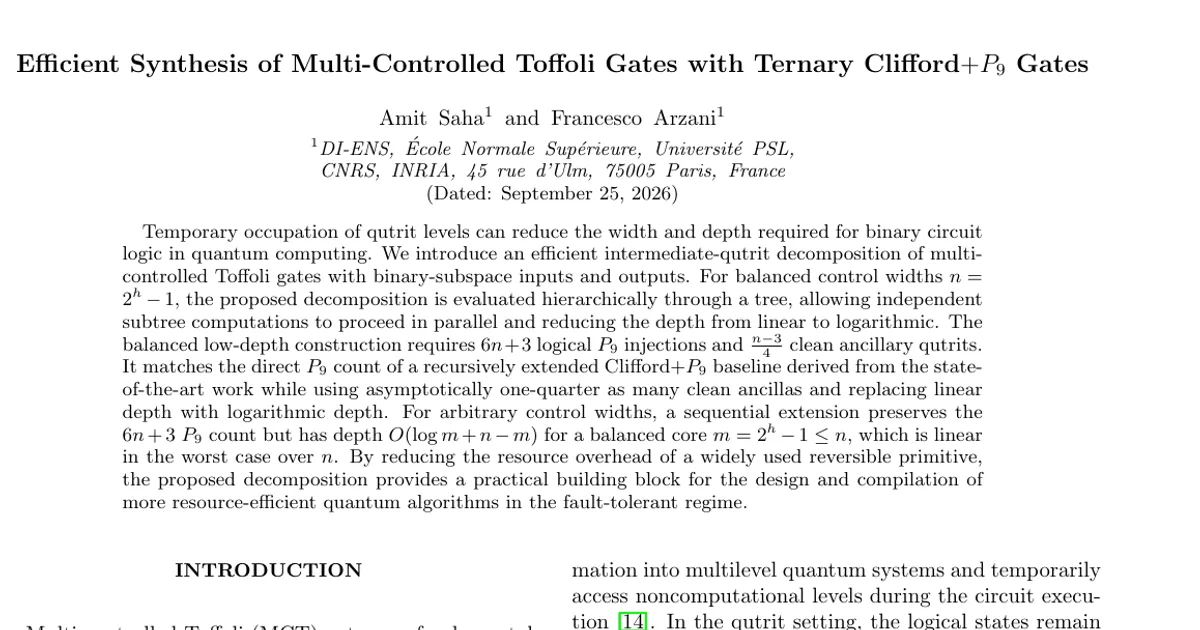
Temporary occupation of qutrit levels can reduce the width and depth required for binary circuit logic in quantum computing. We introduce an efficient intermediate-qutrit decomposition of multi-controlled Toffoli gates with binary-subspace inputs and outputs. For balanced control widths $n=2^h-1$, the proposed decomposition is evaluated hierarchically through a tree, allowing independent subtree computations to proceed in parallel and reducing the depth from linear to logarithmic. The balanced low-depth construction requires $6n+3$ logical $P_9$ injections and $\frac{n-3}{4}$ clean ancillary qutrits. It matches the direct $P_9$ count of a recursively extended Clifford+$P_9$ baseline derived from the state-of-the-art work while using asymptotically one-quarter as many clean ancillas and replacing linear depth with logarithmic depth. For arbitrary control widths, a sequential extension preserves the $6n+3$ $P_9$ count but has depth $O(\log m+n-m)$ for a balanced core $m=2^h-1\leq n$, which is linear in the worst case over $n$. By reducing the resource overhead of a widely used reversible primitive, the proposed decomposition provides a practical building block for the design and compilation of more resource-efficient quantum algorithms in the fault-tolerant regime.