Research
Efficient Ground-State Manifold Amplification for Rydberg Atom Arrays via Houdayer Cluster Updates
Overview Research area: Quantum optimization / hybrid quantum-classical algorithms; specifically maximum independent set (MIS) problems on Rydberg atom arrays, combined with classical Monte Carlo post
- arXiv
- 2610.28528
- Published
- 2026-10-20
- Authors
- Andrew J. Ochoa, Martin J. A. Schuetz, Helmut G. Katzgraber
AI summary
Overview
- Research area: Quantum optimization / hybrid quantum-classical algorithms; specifically maximum independent set (MIS) problems on Rydberg atom arrays, combined with classical Monte Carlo post-processing (Houdayer cluster updates).
- Technical level: Intermediate (accessible to readers with basic familiarity with combinatorial optimization and quantum annealing; the algorithmic core is explainable without deep physics).
- Scope: A single empirical study applying a classical cluster-recombination algorithm to 43 MIS problem instances whose seed solutions come from QuEra's Aquila analog quantum device, measuring how much the diversity and quality of the returned solutions can be amplified after the fact.
What This Paper Is About
Quantum optimization hardware can produce good solutions to hard combinatorial problems, but it returns only a small, biased sample of the many equally optimal answers — tens to hundreds of distinct configurations, even when the true ground-state manifold contains millions. The authors ask a precise question: how much more of that optimal solution set is hiding inside a quantum measurement record, recoverable by purely classical means? Their answer is a post-processing scheme, based on Houdayer cluster updates, that recombines pairs of quantum-returned solutions into large families of new, guaranteed-feasible solutions, and because exact ground-state degeneracies are known for these instances, they can measure rather than merely bound how much of the manifold they recover.
Key Contributions
-
Quantifying what a measurement record contains. Across 43 instances spanning three hardness families, the authors measure how many additional distinct configurations can be recovered from a neutral-atom measurement record beyond those the device reports: a median amplification of 24.3× overall, 8.9× over the 35 instances whose seeds were already optimal, and up to 11923× for instance HP1478, at a cost of 18 minutes of laptop time across the entire dataset, measured end to end.
-
Coverage measured against exact degeneracies. Because exact ground-state degeneracies are available for these instances, the recovered fraction of the manifold is measured rather than bounded — a median of 21%, and provably complete on six instances. This converts the method's non-ergodicity from a caveat into a quantified quantity.
-
An audit of what the hardware actually determined. Comparison against exact reference optima shows the quantum seed pool sat strictly below the true optimum on 8 of the 43 instances, including six of the nine hard instances. On three of these, classical recombination discovered strictly larger independent sets than the hardware found, reaching the exact optimum on one.
-
An adaptive, saturation-based stopping criterion that keeps the recovery cost negligible relative to the hardware run being post-processed, with a bounded worst case, plus a feasibility argument showing the cluster exchange respects the independence constraint by construction on Rydberg MIS instances (extending prior work on classical solvers and superconducting annealers to neutral-atom hardware).
Main Findings
- Amplification is large and consistent: Across the full 43-instance dataset, amplification factors range from 1.0× to 11923×, with a median of 24.3× and a mean of 657.2×. The distribution is strongly right-skewed, driven by a handful of instances with unusually large degenerate manifolds.
- The record extends far beyond what the device reports: The largest manifold explored, for instance HP1478, expanded 165 quantum solutions into 1967339 configurations (11923×). Instance L16_seed4392 (hard family) went from 20 seeds to 127329 configurations (6366×).
- Three instances showed no amplification, and that is the correct outcome: L3_seed3849, L5_seed4703, and L5_seed2142 (7, 20, and 20 atoms) sat at exactly 1.0×; their seed pools already contained the complete ground-state manifold, so 1.0× is the best attainable result rather than a failure.
- Coverage of the true manifold is partial but measurable: Post-processing recovers a median of 21% of the ground-state manifold, and provably all of it for six instances. A joint fit over two predictors gives f ∝ D_MIS^(−0.58±0.04) · n_seed^(1.40±0.12) with R² = 0.89: at fixed seed pool size, coverage falls with manifold size; at fixed manifold size, it rises with the number of seeds.
- Hardness does not predict amplification: Amplification shows no significant correlation with the hardness parameter H (Spearman ρ = −0.03, p = 0.86), and coverage shows none either (ρ = −0.17, p = 0.33). Within the Benchmark family the pattern is nonmonotonic: the easiest instance HP1478 (H = 1.478, QAA success rate 35.2%) gives the highest amplification in the dataset, the hardest HP1435 (H = 1435) still gives 1104× from 107 initial solutions, while the intermediate HP125 (H = 125.5) amplifies by only 2.7× because hardware returned just 3 seeds.
- Classical post-processing sometimes beats the quantum hardware outright: On three instances the classical algorithm found independent sets larger than those the hardware produced — 35 to 36 atoms for L12_seed829, and 68 and 67 to 70 atoms for the two L17 instances. These reach the exact optimum in one case and come within one atom in the other two.
- The seed pools were often suboptimal: The quantum seed pool sat strictly below the true optimum on 8 of 43 instances — six of the nine hard instances, Benchmark instance HP1435 (size 44 against a true optimum of 45), and standard instance L16_seed4816 (size 63 against 64). On the remaining 35, the seed pool already reached the certified optimum.
- The adaptive stopping criterion works in practice: 38 of 43 instances reached exhaustive pairwise exploration, while 5 saturated before processing all pairs. The maximum number of pairs processed in any pass was 16539, and in any higher-level pass 6951 (the second-level pass of L17_seed46) — well below the 10^5 pair hard cutoff, which was never reached.
- Amplification is not simply proportional to seed count: Instances with similar initial counts can differ by orders of magnitude in final count, reflecting differences in the underlying ground-state manifold structure (whether it is connected or fragmented in configuration space) rather than sampling volume.
- Validation passed cleanly: All 15511 solutions from the three instances where post-processing found a larger independent set passed post-hoc checks of independence, maximality and target cardinality, a 100% pass rate. The authors' independent transfer-matrix dynamic programming reproduced both the optimum size and exact degeneracy for all 121 reference instances that record them.
Methodology in Plain English
The problem is set up on unit disk graphs: atoms sit at graph vertices, and the Rydberg blockade radius decides which pairs are connected by an edge. An independent set is a selection of atoms with no two neighbors chosen — the goal is the largest such set.
Step 1 — Get seeds from quantum hardware. Each instance is run on QuEra's Aquila device, with 1000 shots per instance (49 to 946 surviving post-selection, median 426). Because real measurements sometimes pick adjacent atoms, a two-stage greedy repair fixes them: first remove the most conflicted vertices until no violations remain, then greedily add vertices that keep independence, restoring maximality. This runs in O(|E|) time per candidate and typically preserves the optimal or near-optimal set size. The repair leaves most measurements intact — on average 92% to 94% of atoms in a repaired seed come from the measurement itself for the 30 standard instances, and 90% to 93% for the nine hard instances. The resulting seed pools hold between 2 and 493 distinct solutions (mean 57.0, median 16).
Step 2 — Recombine pairs classically (Houdayer cluster updates). Take two solutions. Find the vertices where they disagree (the symmetric difference), and split those vertices into connected components, called clusters. The vertices both solutions agree on — the "backbone" — stays fixed. Because the clusters are disconnected from one another, each can be independently swapped between the two parents, generating 2^c candidate solutions from one pair. In the worked example (instance atoms_L8_seed3066, 51 atoms, 135 unit-disk edges, |MIS| = 16), two optimal solutions share an 8-atom backbone, their disagreement splits into c = 8 clusters, and the pair yields 2^8 = 256 candidates, of which 254 are new. The largest observed c was 14. Every candidate is independent by construction, so nothing is rejected.
Step 3 — Why quality can improve, not just diversity. When both parents are the same size, every cluster is balanced between them, so the exchange is size-preserving. When parents share a suboptimal size, some clusters are imbalanced, and taking the larger side yields a strictly larger independent set. This is the mechanism behind the quality improvements: for L12_seed829, 17 of the 2016 seed pairs contain at least one imbalanced cluster, and for L17_seed46 all 6 do.
Step 4 — Control the cost. Candidate pairs come only from the original seed pool, so the work is bounded in advance; solutions are stored as frozen sets for O(1) deduplication. Pools with fewer than 10^4 pairs run exhaustively. Larger pools use a sliding window of 500 consecutive pairs, halting when new discoveries fall below 0.1% of the current pool size, with a 10^5 pair hard cutoff.
Step 5 — Validate. Every solution in the final pool is checked for independence, maximality and target size. Reference optima and degeneracies come from the dataset of the earlier study; for the four Benchmark instances, which have no reference entry, the authors recomputed optima directly (|MIS| = 46, 47, 45, and 45 for HP125, HP1412, HP1435 and HP1478), with two structurally different exact methods agreeing on all four.
Why This Matters
Impact on research. The paper reframes a familiar limitation of quantum optimizers — biased, sparse sampling — as a recoverable resource rather than a dead end. By measuring coverage against exact degeneracies instead of bounding it, it gives the field a template for honestly auditing what hardware actually delivered, including detecting cases where the amplified manifold is a suboptimal one. The finding that cheap classical recombination can occasionally outperform the quantum device itself is a useful calibration point for claims about quantum advantage in optimization.
Real-world applications:
- Design space exploration and engineering search, where an ensemble of many diverse near-optimal configurations is more useful than a single best answer.
- Post-optimization constraint injection, where a large pool of pre-computed solutions lets new constraints be applied cheaply afterwards instead of re-running the solver.
- Robustness and sensitivity analysis, which requires many structurally different solutions to test how a decision degrades under perturbation.
- Ensemble methods and entropy/thermodynamic calculations, which need statistically representative samples of the optimal manifold rather than a biased handful.
Industry relevance. The post-processing is entirely classical, runs in seconds to minutes on commodity hardware (18 minutes of laptop time for the whole dataset), and sits as a drop-in layer on top of existing quantum or classical samplers. That makes it attractive as a near-term value-add for hardware vendors and for practitioners who already have access to annealers but find their sampling diversity inadequate.
Future Directions
- Breaking the non-ergodicity barrier. The method offers no guarantee of complete manifold coverage and can only reach configurations connected to its seeds by recombination. Whether complementary moves, or seeding from fragmented manifold components, can extend reach is left open — the authors note the connected-versus-fragmented distinction as the governing structural factor.
- Scaling to larger devices. The paper observes that degeneracy grows rapidly with atom count, so larger arrays should make the raw sampling problem worse rather than better. Whether the amplification factors measured here at 7 to 231 atoms persist, degrade, or improve at larger scale is untested.
- Tighter integration with hardware pipelines. The seeds used here come from vanilla full-graph QAA runs, whereas the reference qReduMIS pipeline reaches the optimum on all nine hard instances. Combining cluster post-processing with such reduction-based pipelines, or with iterative re-pairing of discovered solutions rather than a fixed seed pair list, is a natural extension.
- Understanding when amplification predicts quality. Amplification correlates with manifold size and seed count rather than hardness, and coverage follows a fitted power law; turning that into a predictive theory that could tell a user in advance how much is recoverable from a given measurement budget remains an open question.
Target Audience
Researchers and practitioners in quantum optimization and quantum annealing who work with neutral-atom or superconducting samplers and care about sampling diversity, not just best-found energy; algorithm developers interested in hybrid quantum-classical post-processing; and computational physicists studying ground-state manifolds and degeneracy in combinatorial problems. It is also valuable for readers skeptical of quantum optimization claims, since its audit-against-exact-reference framing is a model of careful benchmarking. Readers without any background in graph problems or annealing will find the algorithmic core accessible but may need to consult the referenced prior work for context on MIS, unit disk graphs and the Rydberg blockade encoding.
Authors’ abstract
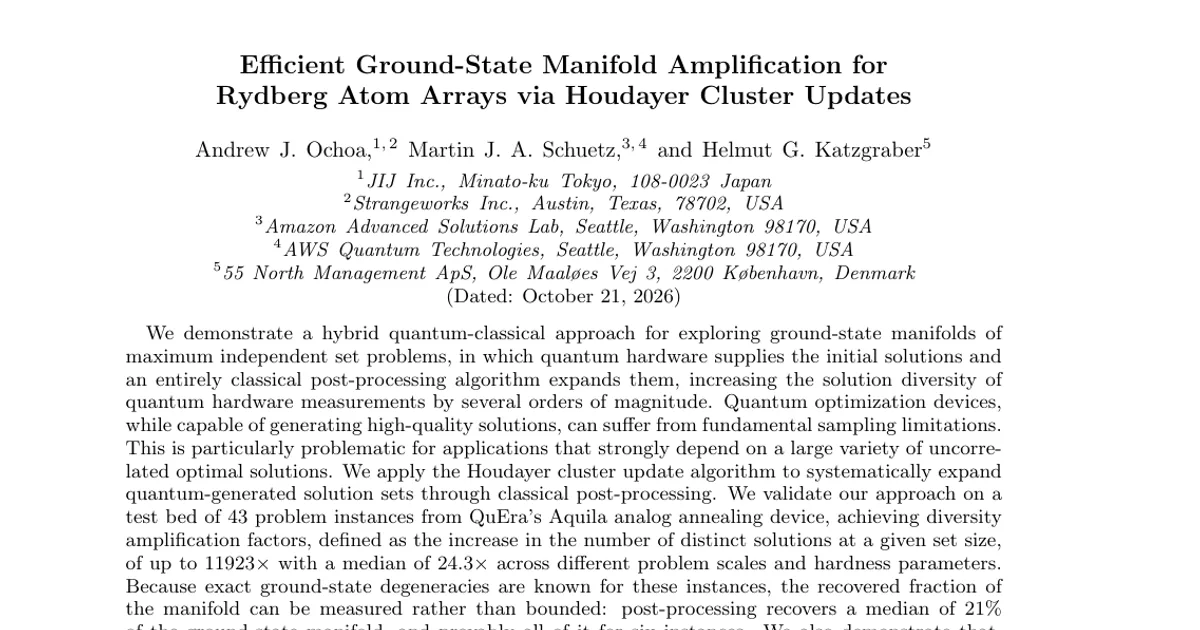
We demonstrate a hybrid quantum-classical approach for exploring ground-state manifolds of maximum independent set problems, in which quantum hardware supplies the initial solutions and an entirely classical post-processing algorithm expands them, increasing the solution diversity of quantum hardware measurements by up to several orders of magnitude. Quantum optimization devices, while capable of generating high-quality solutions, can suffer from fundamental sampling limitations. This is particularly problematic for applications that strongly depend on a large variety of uncorrelated optimal solutions. We apply the Houdayer cluster update algorithm to systematically expand quantum-generated solution sets through classical post-processing. We validate our approach on a test bed of 43 problem instances from QuEra's Aquila analog annealing device, achieving diversity amplification factors, defined as the increase in the number of distinct solutions at a given set size, of up to 11923x with a median of 24.3x across different problem scales and hardness parameters. Because exact ground-state degeneracies are known for these instances, the recovered fraction of the manifold can be measured rather than bounded: post-processing recovers a median of 21% of the ground-state manifold, and provably all of it for six instances. We also demonstrate that, in some cases, the classical post-processing can discover independent sets larger than those found by the quantum hardware, thus improving on solution quality and not just diversity. While the method is non-ergodic and cannot guarantee complete manifold coverage, it consistently discovers a larger number of high-quality, and in some cases strictly better, configurations than quantum sampling alone. This work demonstrates how simple classical post-processing can enhance the utility of quantum optimization results.