Research
Efficient classical simulation of large-scale unitary cluster Jastrow circuits
Overview Research area: Quantum computing for quantum chemistry — specifically, classical simulation algorithms that benchmark and challenge large-scale quantum chemistry experiments on near-term quan
- arXiv
- 2607.21337
- Published
- 2026-07-23
- Authors
- Hrishikesh Belagali, Thomas Van Camp, R. Pradeep, Sourin Das, Namit Anand, Ryan LaRose
AI summary
Overview
Research area: Quantum computing for quantum chemistry — specifically, classical simulation algorithms that benchmark and challenge large-scale quantum chemistry experiments on near-term quantum hardware.
Technical level: Advanced. The paper is written for researchers familiar with second quantization, fermionic many-body physics, and quantum circuit simulation, though the central message is accessible without the mathematics.
Scope (one sentence): The paper presents and demonstrates an exact, polynomial-time classical algorithm for computing the energy of any single-layer unitary cluster Jastrow (UCJ) quantum circuit, and uses it to show that the largest such chemistry experiment to date is easily reproducible on a laptop.
What This Paper Is About
Recent quantum chemistry experiments on superconducting hardware have claimed to outperform classical computers in computing ground-state energies of strongly correlated molecules using the unitary cluster Jastrow (UCJ) and local UCJ (LUCJ) ansatz. This paper asks a pointed question: is a single layer of that ansatz actually classically hard? The authors answer no, by deriving a provably polynomial-time classical algorithm that computes the energy of any single-layer UCJ circuit exactly, regardless of whether the circuit respects hardware locality constraints, and then using it to beat the reported experimental result through classical circuit optimization.
Key Contributions
-
A provably efficient classical algorithm. The paper proves (Theorem 1) that the energy of a single-layer UCJ circuit over a second-quantized fermionic Hamiltonian with N orbitals can be computed exactly on a classical computer in O(N⁷) time — for any UCJ circuit, whether or not the Jastrow operator has been sparsified into the hardware-friendly local variant.
-
Reproduction of the largest reported UCJ experiment. The algorithm reproduces the 77-qubit, 10,570-gate iron sulfur cluster circuit from Sci. Adv. 11, 25 (2025) — which the original authors ran on an IBM quantum computer with classical post-processing on up to 6400 nodes of Fugaku — in less than a minute on a 2025 MacBook Pro M5 with 16GB of memory.
-
Beating the quantum result via classical optimization. Using the fast energy evaluation to optimize circuit parameters (L-BFGS-B, 2367 iterations), the authors obtain a ground-state energy of −326.796 Ha, lower than the −326.645 Ha achieved by the experiment with sample-based quantum diagonalization (SQD).
-
Scaling demonstration to 160 qubits. The algorithm computes single-layer UCJ energies for hydrogen chains up to 80 atoms (160 qubits), the size of the largest quantum computers currently available from IBM.
Main Findings
-
Exact, locality-free simulation: The algorithm works for fully general UCJ circuits with all Jastrow interactions present, not only the sparsified LUCJ form. The authors simulate the full circuit as well as hardware-tailored variants (truncated hexagonal, hexagonal, square lattice topologies).
-
Energy results for the n = 72 qubit iron sulfur cluster (Table 1): Truncated Hex LUCJ-1.5 (identical to the circuit run in the original experiment): −323.051 Ha; Hartree-Fock: −326.547 Ha; Truncated Hex LUCJ-1: −326.553 Ha; Hex LUCJ-1: −326.553 Ha; Square LUCJ-1: −326.556 Ha; UCJ-1: −326.559 Ha; Truncated Hex LUCJ-1.5 + SQD from the original work: −326.645 Ha; Optimized UCJ-1 (this paper): −326.796 Ha; CCSD (noted as unconverged): −326.828 Ha; DMRG from the original work: −327.239 Ha.
-
Comparison of computational cost: The SQD result of −326.645 Ha came from a 1.44-hour run on 6400 nodes of Fugaku. On an NVIDIA GH200 Grace Hopper node, this paper's energy evaluation takes around seven seconds, and the full optimization runs in three hours.
-
Empirical scaling below the worst case: For hydrogen chains the best-fit runtime is N^4.448, smaller than the worst-case O(N⁷) bound, attributed to memoization (caching) of computed matrix elements.
-
Single-layer UCJ energies track Hartree-Fock: Initialized from CCSD parameters, UCJ1 energies closely follow Hartree-Fock; the maximum difference between HF and UCJ1 is 16 mHa. The Figure 2 caption states an average difference of 12 mHa with a standard deviation of 5 mHa, while the Results text states an average difference of 11 mHa with a standard deviation of 5 mHa.
-
Optimized single layers approach CCSD: Parameter optimization with 1000 L-BFGS-B iterations up to n = 40 qubits yields energies within a few mHa of CCSD.
-
Weak vs. strong simulation: The algorithm computes energies (weak simulation) but cannot sample bitstrings (strong simulation). It therefore cannot support bitstring-based post-processing such as SQD — yet it still achieves a lower energy than SQD did, purely through circuit optimization.
-
One layer is insufficient for quantum advantage: The authors conclude that at least L ≥ 2 layers of the (L)UCJ ansatz are necessary for any beyond-classical computation in this setting.
-
Comparison to prior simulation approaches: Matchgate + CPHASE simulation has reached one layer of a 52-qubit LUCJ circuit with 57 CPHASE gates, whereas the full UCJ circuit for the n = 72 iron sulfur cluster contains 2556 CPHASE gates — far beyond that technique's reach.
Methodology in Plain English
Rather than simulating the quantum state itself — which would require exponentially many amplitudes — the algorithm pushes the observable backwards through the circuit. In physics language, this is Heisenberg evolution: instead of evolving the state forward and then measuring, you evolve the Hamiltonian backward so that it acts on the simple initial state.
The procedure has three stages:
-
Undo the orbital rotations. The final orbital rotation in the circuit is a change of single-particle basis. Applying it to the Hamiltonian is exact and only requires updating the one-electron and two-electron integral tensors — costs O(N³) and O(N⁵) respectively. Crucially, the number of terms in the Hamiltonian stays the same; only their coefficients change. This contrasts with Pauli or Majorana backpropagation schemes where the number of terms explodes and must be heuristically truncated.
-
Undo the Jastrow operation. The Jastrow part is a product of number-operator exponentials. Conjugating the Hamiltonian through it leaves the term count unchanged but attaches a scalar phase and a vector (number-operator) phase to each term, at O(N⁵) cost overall.
-
Evaluate on a single Slater determinant. After backpropagation, the energy reduces to matrix elements of the transformed Hamiltonian between non-orthogonal Slater determinants. Löwdin's formula evaluates these as determinants of small N_occ × N_occ matrices, computed via LU factorization. Since there are O(N²) one-body and O(N⁴) two-body terms, the total cost is O(N⁷).
A subtlety the authors address: the matrix S in Löwdin's formula may in principle be singular. In that case they fall back on the generalized non-orthogonal Wick's theorem (Burton), computing a singular value decomposition and removing orbitals and phases corresponding to zero singular values — same O(N⁷) asymptotic runtime, same energies in all tested examples.
Why This Matters
Impact on research. The paper reframes the interpretation of recent large-scale quantum chemistry experiments. It shows that the single-layer UCJ circuits these experiments execute sit comfortably within classical reach, and that the previously claimed super-polynomial classical simulation cost of (L)UCJ circuits does not hold for one layer. This is a direct challenge to claims of quantum advantage in chemistry, and it complements the existing hardness result that sampling from UCJ circuits can encode IQP computations — a gap the authors make explicit by distinguishing weak from strong simulation. It also provides a fast, exact classical baseline against which future quantum chemistry experiments must be benchmarked.
Applications (as motivated by the paper's context):
- Benchmarking quantum chemistry hardware experiments. The algorithm gives an exact classical reference energy for any single-layer UCJ circuit, including the specific iron sulfur cluster and protein-ligand fragment circuits that have already been run on hardware.
- Molecular electronic structure problems. Iron sulfur clusters and hydrogen chains are used as testbeds for strongly correlated electronic structure; fast classical energy evaluation accelerates ansatz and circuit-design studies before committing to hardware time.
- Circuit design and parameter optimization. Because energy evaluation takes seconds, parameter optimization of UCJ circuits becomes practical, and the authors demonstrate that optimized one-layer circuits can beat hardware-plus-SQD results.
- Informing resource estimation. The finding that L ≥ 2 is required for any beyond-classical result gives experimentalists a concrete target for circuit depth when planning future experiments.
Industry relevance. The work is directly relevant to groups running variational chemistry workloads on superconducting hardware — including IBM's quantum computing program and the Fugaku-based HPC post-processing pipeline used in the original experiment. It also matters for HPE/Hewlett Packard Labs (an author affiliation) and for anyone allocating expensive supercomputer or quantum resources. The largest single-layer circuits reported so far — up to 77 qubits and 10,570 gates, and separately up to 94 qubits and 101,602 gates for protein-ligand fragments — are all within the class this algorithm can handle.
Future Directions
- Extending beyond one layer. The algorithm fails for L ≥ 2 because orbital rotations between Jastrow operations destroy the diagonal structure that makes Löwdin's formula applicable. The authors suggest an efficient classical algorithm for that case is unlikely, given that alternating layers of operators are known to be universal, and Givens rotations plus CZ gates are known to be universal for quantum chemistry — but the question is left open.
- Designing two-layer experiments. The paper explicitly calls for L ≥ 2 experiments, noting the gate counts will be challenging on current hardware, and observing that two layers may be necessary but perhaps not sufficient for quantum advantage in chemistry.
- Recovering strong simulation. The inability to sample bitstrings blocks the use of SQD-style error-mitigation post-processing. Finding a way to sample, or to combine weak-simulation energies with other error-mitigation strategies, is a natural next step.
- Improving the empirical scaling. The observed N^4.448 scaling from memoization suggests room for further algorithmic and implementation optimization beyond the O(N⁷) worst case, which would push classical reach further.
Target Audience
Quantum computing and quantum chemistry researchers evaluating claims of quantum advantage, experimentalists planning variational chemistry experiments on superconducting hardware, and HPC/simulation specialists interested in exact classical baselines. It is also valuable for reviewers and funding agencies assessing whether a given chemistry demonstration is genuinely beyond classical computation. The mathematical development in the appendices assumes comfort with second quantization and commutator algebra, but the main text and results table are readable by anyone familiar with variational quantum algorithms.
Authors’ abstract
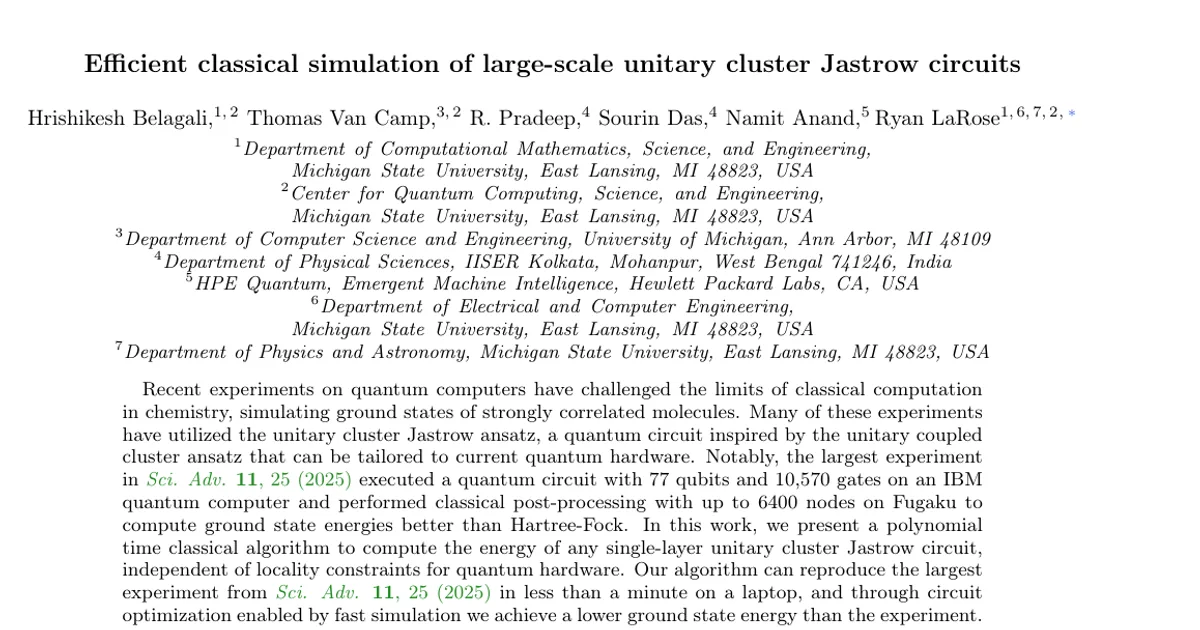
Recent experiments on quantum computers have challenged the limits of classical computation in chemistry, simulating ground states of strongly correlated molecules. Many of these experiments have utilized the unitary cluster Jastrow ansatz, a quantum circuit inspired by the unitary coupled cluster ansatz that can be tailored to current quantum hardware. Notably, the largest experiment in Sci. Adv. 11, 25 (2025) executed a quantum circuit with 77 qubits and 10,570 gates on an IBM quantum computer and performed classical post-processing with up to 6400 nodes on Fugaku to compute ground state energies better than Hartree-Fock. In this work, we present a polynomial time classical algorithm to compute the energy of any single-layer unitary cluster Jastrow circuit, independent of locality constraints for quantum hardware. Our algorithm can reproduce the largest experiment from Sci. Adv. 11, 25 (2025) in less than a minute on a laptop, and through circuit optimization enabled by fast simulation we achieve a lower ground state energy than the experiment.