Research
Data-driven structural diagnostics and autonomous alignment of complex optical systems
Overview Research area: Quantum physics / photonics engineering — automated alignment and structural diagnostics of complex free-space optical systems, with neutral-atom quantum processors as the moti
- arXiv
- 2609.05984
- Published
- 2026-09-05
- Authors
- Peng Zhu, Chen Chen, Shuchang Ma, Dezhou Deng, J. F. Chen, Peng Chen
AI summary
Overview
Research area: Quantum physics / photonics engineering — automated alignment and structural diagnostics of complex free-space optical systems, with neutral-atom quantum processors as the motivating platform.
Technical level: Intermediate. The core ideas (cavity transmission imaging, CNN regression, PLS dimensionality reduction) are accessible with basic optics and machine-learning background, though the PLS loadings and sample-complexity argument require some care.
Scope (one sentence): The paper demonstrates a cavity-probe-based, data-driven framework that combines a ResNet-18 inverse model with partial least squares diagnostics to diagnose and autonomously align a 5-DOF optical cavity from gross misalignment in tens of seconds, and extends the approach to 2-DOF and 9-DOF configurations.
What This Paper Is About
Large-scale neutral-atom quantum processors rely on intricate free-space optical beam-delivery networks, where a single misaligned component can silently corrupt the whole beam path — and where conventional optimizers stall in "cold-start" conditions of gross misalignment. The authors use a high-finesse optical cavity as a sensitive probe of everything upstream, then train a neural network to invert the measured transmission image directly into a 5-DOF correction vector. The goal is to replace blind, experience-dependent trial-and-error alignment with a quantitative, data-derived map of which control axes actually matter, and to close the loop so the system both recovers from cold start and maintains itself against drift.
Key Contributions
- A unified diagnostic-plus-control framework. End-to-end deep-learning inversion is paired with partial least squares (PLS) analysis, so the network's predicted control vectors are decomposed into latent directions ranked by covariance with fundamental-mode purity — extracting an interpretable sensitivity hierarchy rather than a black-box policy.
- Experimental discovery of a reduced effective dimensionality. The nominally 5-DOF control space is shown to concentrate in a three-dimensional subspace accounting for 80.3% of the explained variance, with the dominant PLS1 direction (40.6% of purity-relevant variance) loading most strongly on the downstream mirror angles and the lens axial position.
- A hybrid global-plus-local alignment protocol validated in hardware. A neural-network global navigator traverses the cold-start regime in an average of 2.25 iterations, then a diagnostics-informed single-axis linear scan refines the alignment; across 40 randomized trials the protocol converged every time, raising mean mode purity above 60% in the global phase and stabilizing it above 90% after the local scan within tens of seconds.
- A scalability argument backed by three DOF configurations. Validation MAE stayed below 0.1 for 2-DOF (0.008, ~100 samples), 5-DOF (0.063, ~5000 samples) and 9-DOF (0.042, ~9000 samples), supporting an approximately linear training-data scaling law N ≈ 1000k that contrasts with the exponential cost of grid search and is explained by a frozen backbone plus a small regression head.
Main Findings
- The control space is effectively three-dimensional, not five. PLS1 accounts for 40.6% of the purity-relevant control variance, PLS1–PLS2 together account for 64.9%, and PLS1–PLS3 cumulatively capture 80.3%; the residual PLS4–PLS5 directions contribute only 16.9%.
- Sensitivity hierarchy is explicit in the loadings. PLS1 loads on θx2 = 0.576, θy1 = 0.546, θy2 = 0.490, Z_lens = 0.307, and θx1 = 0.188. PLS2 loads on Z_lens = 0.653, θx1 = −0.511, θy1 = −0.438, θy2 = 0.342, and θx2 = −0.056. The lens axial position bridges both response-driven axes, indicating a structural coupling between focusing and downstream angular steering.
- Global navigation converges in a few iterations. Averaged over 40 independent trials launched from randomized gross misalignments (well beyond the 2 mm lateral offset at which hill climbing fails), the mean trajectory reaches the 60% purity switching threshold in ~2.25 iterations.
- Local fine-tuning reliably crosses 90%. Once above 60% purity, a single coordinate-descent cycle over the five axes — scanned in the order set by the PLS loadings — is typically sufficient to exceed 90% mode purity, with the entire local stage finishing within 45 s.
- Convergence succeeded in all 40 trials under real sensor noise and mechanical backlash.
- The vision model agrees with electro-optical ground truth. Camera-B purity estimates match photodetector measurements with a mean absolute percentage error of 3.81%, inside the stated ±5% tolerance.
- Benchmarking against standard optimizers shows a large speedup. Compared with Genetic Algorithms and stochastic parallel gradient descent (SPGD) under equivalent initial misalignment, the proposed protocol reaches target purity in a few iterations — a convergence-speed improvement of more than two orders of magnitude — while the conventional methods typically require hundreds of iterations and risk local optima.
- Single-shot capability exists but is not the statistical norm. Some individual trials hit optimal alignment in one forward pass, yet the average was 2.25 iterations; the authors attribute this to mechanical backlash in the motorized mirror mounts, Poisson-noise-dominated signal at severe misalignment, and a residual normalized MAE of ~0.07.
- Higher dimensionality did not degrade accuracy. The 9-DOF validation error (0.042) came in below the 5-DOF value (0.063), which the authors attribute to the larger 9-DOF training set combined with the comparatively weak coupling of the added upstream mirrors to the cavity output.
- Closed-loop latency is 10 ms end to end for the image–inference–actuation cycle.
Methodology in Plain English
The hardware is a 5-DOF resonant cavity: two tilt mirrors on dual-axis motorized mounts plus a mode-matching lens on a motorized translation stage, fed by a 150 μW fiber laser at λ = 626 nm into a cavity with finesse ~20000. Camera B watches the transmitted spatial intensity profile while the laser frequency is swept, and frames are collapsed into a standardized average intensity projection (AIP) image. Camera A separately tracks the centroid of the reflected beam through a PBS/HWP/QWP assembly, providing a slow-drift feedback channel.
The training data came from manually aligning the cavity near optimal coupling, then injecting algorithmic random perturbations across all five axes to drive the hardware into strongly coupled misalignment regimes, collecting 5,000 labeled image–parameter pairs (split 85% training / 15% validation). A ResNet-18 with its classification head swapped for a regression head maps one AIP image to the five control values in a single forward pass.
The distinctive analytical step is applying PLS to the network's predicted control vectors together with the corresponding mode purities. Because PLS orders latent directions by covariance with the response, the first component is by construction the direction most strongly coupled to optical output — giving an experimentally grounded answer to "which knob matters most, and what is it coupled to." That hierarchy then dictates the control protocol: the network acts as a global navigator along the principal subspace, and once predicted purity exceeds 60%, control hands off to a sequential single-axis linear scan whose axis order follows the PLS loadings, each axis swept over discrete steps and halted at maximum purity.
For the scaling study, the authors added a 2-DOF reference (bi-axial tilt of one mirror) and a 9-DOF configuration (inserting an upstream mirror pair, Mirrors C and D). The 9-DOF dataset required roughly 20 hours of continuous automated quasi-random sweeping to reach N ≈ 9000 samples. The linear-scaling argument rests on the observation that the ResNet-18 backbone (~11.2 million parameters) is frozen and only the terminal regression head trains: a fixed 512→256 layer costs 131,328 parameters, dimension-independent, while the 256→k layer adds only 257k. Total trainable parameters are P_head = 131,328 + 257k, so at k = 100 the variable term is 25,700 — under 20% of the fixed term — and sample complexity is governed by covering the parameter manifold at fixed per-axis resolution, giving N_min ∝ k.
Why This Matters
The work reframes optical alignment from a craft skill into a measurable structural problem: instead of asking an operator to hunt through five coupled knobs, it produces a ranked, quantitative map of which physical couplings dominate the optical response. For neutral-atom quantum computing — where hundreds or thousands of independently addressed qubits depend on free-space optical arrays such as spatial light modulators and acousto-optic deflectors — this addresses both the initial cold-start bottleneck and the long-term drift that degrades control errors over time.
Potential applications:
- Cold-atom and neutral-atom quantum processors: rapid bring-up and continuous maintenance of beam-delivery networks feeding atom arrays.
- Massively scaled phase-controlled platforms: the authors specifically point to cold-atom qubit arrays and orbital angular momentum communication meshes, where internal structural coupling grows geometrically with node count.
- Multi-DOF optical instrument manufacturing and service: the diagnostic suite offers a systematic sensitivity analysis for hardware with continuous parameter spaces, replacing blind empiricism.
- Autonomous optical laboratories: standardized control interfaces (the authors name the Model Context Protocol, MCP) paired with LLM orchestration agents that invoke the inverse model and PLS diagnostics as tools, allowing high-level natural-language commands to schedule data acquisition, retraining, and policy deployment.
Industry relevance: the 10 ms closed-loop latency, commodity camera hardware, and lightweight ResNet-18 backbone make the approach compatible with real-time control electronics rather than offline post-processing. The linear sample-scaling claim — datasets on the order of 5×10^4 to 10^5 samples for 50–100 DOF platforms — reframes high-DOF autocalibration as an engineering budget problem rather than an intractable combinatorial one, which matters for anyone commercializing free-space optical hardware.
Future Directions
- Validating the extrapolation. The linear scaling law N ≈ 1000k and the "up to 100 DOF" feasibility claim are theoretical extrapolations from three experimentally validated points (2, 5, and 9 DOF); higher-DOF systems remain to be demonstrated in hardware.
- Closing the accuracy gap to enable true single-shot alignment. The ~0.07 normalized MAE, motor backlash, and Poisson-limited low-signal regimes each prevent reliable one-pass coupling; hardware improvements or noise-aware training could shrink the 2.25-iteration average toward 1.
- Automating the human-in-the-loop pipeline. The authors propose LLM-based orchestration agents layered over standardized interfaces (MCP) to manage adaptive probing, retraining, and inference-policy updates autonomously.
- Testing whether the low-dimensional manifold assumption survives at scale. The scaling argument explicitly holds only "provided the underlying control manifold remains low-dimensional due to physical constraints" — an assumption worth stress-testing on real large-array beam-delivery systems.
Target Audience
Experimental quantum physicists and quantum-hardware engineers working on neutral-atom platforms; optical engineers responsible for aligning multi-DOF free-space systems; and applied machine-learning researchers interested in physics-constrained inverse problems where interpretable dimensionality reduction (PLS) is used to justify and structure a learned control policy. Readers focused on the theory of cavity optics will find the treatment applied rather than foundational, while those seeking a practical autocalibration blueprint — including the exact parameter counts, sample budgets, and convergence statistics — will find the paper directly actionable.
Authors’ abstract
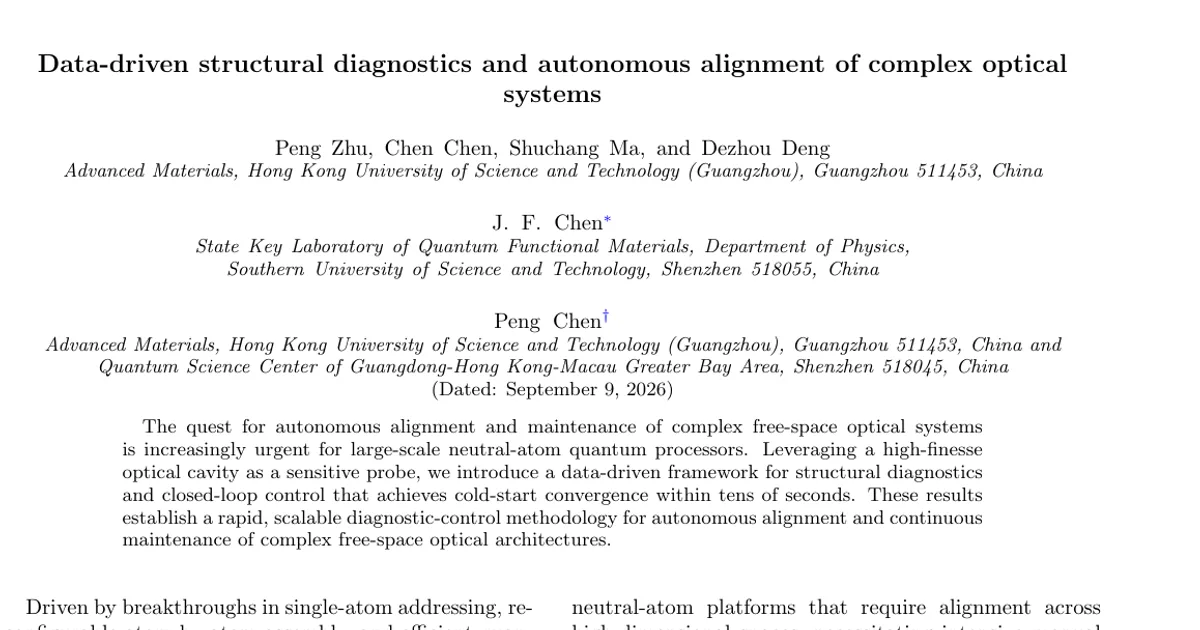
The quest for autonomous alignment and maintenance of complex free-space optical systems is increasingly urgent for large-scale neutral-atom quantum processors. Leveraging a high-finesse optical cavity as a sensitive probe, we introduce a data-driven framework for structural diagnostics and closed-loop control that achieves cold-start convergence within tens of seconds. These results establish a rapid, scalable diagnostic-control methodology for autonomous alignment and continuous maintenance of complex free-space optical architectures.