Research
Correlated Coherent Errors in Stabilizer Codes: A General Cumulant Framework and Interference-Based Error Suppression
Overview Research area: Quantum error correction (QEC) theory — specifically, how correlated coherent errors (systematic over-rotations that persist across qubits and across QEC cycles) propagate thro
- arXiv
- 2607.22503
- Published
- 2026-07-24
- Authors
- Rohan N Rajmohan, Antoine Brillant, Peter Groszkowski, Alireza Seif, Jens Koch, Aashish Clerk
AI summary
Overview
Research area: Quantum error correction (QEC) theory — specifically, how correlated coherent errors (systematic over-rotations that persist across qubits and across QEC cycles) propagate through stabilizer codes, and how encoding choices can be used to suppress them.
Technical level: Advanced. The paper is built on stabilizer formalism, Pauli transfer/superoperator expansions, logical channel theory, and cumulant expansions of noise-averaged quantities. A reader needs comfort with stabilizer codes, syndrome decoding, and Gaussian random variables.
Scope (one sentence): The paper derives an exact logical channel for repeated QEC cycles under spatially and temporally correlated coherent Z noise, converts it into a non-perturbative cumulant framework for the noise-averaged logical infidelity valid for arbitrary stabilizer codes and correlation structures, and uses it to introduce an encoding strategy (PROSE) that selects the best stabilizer eigenspace as the codespace.
What This Paper Is About
Real quantum hardware suffers coherent errors — systematic rotation angles rather than random bit-flips — and those angles are typically correlated across qubits and across successive error-correction cycles. Existing analyses of such noise are mostly numerical, or restricted to specific codes and specific correlation patterns. The authors build a general analytical treatment: an exact description of the logical channel produced by many QEC cycles under correlated coherent Z noise, plus a cumulant expansion that gives a tractable, non-perturbative expression for the noise-averaged logical infidelity for any stabilizer code and any correlation structure.
Key Contributions
-
Exact logical channel for correlated coherent Z noise. For a fixed noise realization, the authors derive a closed-form expression for the effective channel induced on a chosen stabilizer eigenspace by any number of QEC cycles, generalizing earlier results that existed only for repetition codes. The channel reduces to three coefficients (identity, logical-Z dephasing, and a coherent logical-Z rotation), and the noise-averaged logical infidelity is written exactly as ε(R) = (1 − Re⟨Γ(R,θ⃗)⟩)/3 with Γ a product over cycles.
-
Discovery of codespace (stabilizer eigenspace) dependence. The induced channel depends on which joint eigenspace of the stabilizer generators is chosen to store the logical qubit — a dependence with no analogue in stochastic Pauli error models. It arises from coherent interference among error amplitudes within each syndrome class, and is absent in phase-flip repetition codes because those have no nontrivial Z stabilizers.
-
A general cumulant-expansion framework. A second-order cumulant expansion of Γ yields ε(R) ≈ (1 − Re[exp(κ₁(R) + κ₂(R)/2)])/3, with explicit scaling in the number of cycles R, noise strength, and correlation time R_c. The expansion is non-perturbative in the noise and, for Gaussian correlations, shows the physics depends only on the parity of the code's Z distance d_Z and is otherwise universal across stabilizer codes.
-
PROSE encoding and a comparative assessment of suppression strategies. PROSE (PROtected Stabilizer Eigenspace) encoding picks the stabilizer eigenspace that minimizes logical infidelity; the paper argues this eigenspace can be efficiently identified in many relevant situations. PROSE is compared against logical dynamical decoupling, logical Pauli twirling, and physical Pauli twirling, and combined with logical Pauli twirling.
Main Findings
-
Codespace choice matters under coherent noise. Because error amplitudes add coherently within a syndrome-specific set, the phases (−1)^{φ_P̂} set by the chosen eigenspace determine whether interference is constructive or destructive. The same code, under the same noise, can perform differently depending on the encoding eigenspace.
-
Cumulant signs have distinct physical meanings. The first cumulant κ₁(R) = −2Σ⟨χ^ZZ⟩ is non-positive and increases infidelity; it corresponds to the noise-averaged probability of an incoherent logical error over R cycles. The second cumulant splits into a coherent part κ₂^coh ≤ 0 (accumulation of coherent logical Z errors, increasing infidelity) and an incoherent part κ₂^incoh ≥ 0 (partial cancellation of incoherent logical errors across cycles, decreasing infidelity).
-
Explicit scaling laws. For odd Z distance, the incoherent coefficient scales as θ^{d_Z+1} and the coherent coefficient as θ^{d_Z}, giving κ₁ ∼ R σ^{d_Z+1}, κ₂^coh ∼ R R_c σ^{2d_Z}, and κ₂^incoh ∼ R R_c σ^{2d_Z+2}. The coherent part dominates the second cumulant for weak noise, but only matters relative to neglected corrections when inter-cycle correlations are long-ranged (R_c ≫ 1).
-
Parity of the Z distance controls the physics. For Gaussian noise and odd d_Z, the leading contributions come from "dominant uncorrectable errors" of weight (d_Z+1)/2, with a combinatorial prefactor f(d_Z) = ((d_Z+1)/(2d_Z)) · C(d_Z, (d_Z+1)/2) in the coherent coefficient. The even-d_Z case is treated only briefly and shows qualitatively different behavior.
-
Correlations are not intrinsically harmful. Contrary to the usual assumption that noise correlations degrade QEC, the authors show that with a suitable choice of encoding eigenspace or suppression technique, even positive correlations can reduce logical infidelity below the uncorrelated baseline — correlations become a resource.
-
PROSE combined with logical Pauli twirling is competitive or better. The combination matches or outperforms dynamical decoupling and Pauli twirling of physical qubits, particularly in the small-infidelity regime under stationary noise. The paper states which features of correlated coherent errors each technique suppresses.
-
Numerical protocol. Logical infidelity is computed by sampling random error angles, evaluating Γ per realization, and averaging — avoiding the repeated circuit shots that full QEC simulations would require. The exact expression is used for all numerical results.
-
No specific numerical benchmark values are reported in the provided text. The quantitative comparisons of the suppression protocols appear in the sections (V and VI) whose detailed results are not included in the excerpt summarized here.
Methodology in Plain English
The authors model the noise as a rotation about the Z axis of every data qubit in every QEC cycle, with random angles that may be correlated between qubits and between cycles. The error-correction machinery itself — syndrome measurement and the recovery operation — is assumed perfect, so the analysis isolates how the code intrinsically responds to correlated coherent noise. Decoding uses a maximum-likelihood decoder that assumes ordinary uncorrelated stochastic Z errors, with flip probabilities matched to the marginal error probabilities of the real noise.
They then track what a full QEC cycle does to states inside a chosen stabilizer eigenspace. Because the error is coherent, the amplitudes of different Pauli errors that produce the same syndrome add as complex numbers rather than as probabilities, and the result is a compact channel with three coefficients. Composing many cycles gives an exact formula for the logical infidelity of a single noise realization. To handle the noise average, they exponentiate each cycle's contribution and apply a second-order cumulant expansion — a resummation that stays accurate where a naive Taylor expansion in noise strength would not. Specializing to zero-mean Gaussian correlations makes the dependence on the covariance matrix explicit and produces the scaling laws.
Armed with this, they scan over possible codespaces: since the channel depends on which eigenspace is used, one can simply choose the best one (PROSE). They compare this against standard tricks — dynamical decoupling, twirling the logical qubit, twirling the physical qubits — and against combinations of them.
Why This Matters
Impact on research. The framework replaces case-by-case numerical studies with a general analytic tool that applies to any stabilizer code and any correlation structure. It identifies a new degree of freedom — the choice of stabilizer eigenspace — that stochastic Pauli models cannot see, and it reframes noise correlations from a nuisance into a potential resource. It also gives a clean explanation of the parity-of-distance and universality structure of Gaussian correlated noise.
Real-world applications (as motivated by the paper's framing of coherent, slowly fluctuating dephasing):
- Superconducting-qubit processors, where systematic over-rotations and slowly drifting control fields produce spatially and temporally correlated Z errors across many cycles.
- Trapped-ion and neutral-atom platforms with slowly fluctuating laser or control noise that persists longer than a QEC cycle.
- Choosing codespaces and encoding conventions in near-term experiments without redesigning the code itself.
- Deciding which error-suppression budget to spend on: dynamical decoupling, physical twirling, logical twirling, or simply a different encoding eigenspace.
Industry relevance. The comparison of PROSE against dynamical decoupling and Pauli twirling speaks directly to the calibration and control-software layer of quantum hardware stacks, since these are standard mitigation options available today. A strategy that costs no extra gates but only a change of encoding basis is attractive for hardware with limited gate budgets.
Future Directions
- Beyond Z-only coherent noise. The analysis assumes correlated coherent Z rotations on data qubits; extending the framework to correlated X/Y coherent errors, or to non-Pauli and non-Gaussian noise, is a natural next step.
- Even Z distance. The even-d_Z case is only discussed briefly and behaves qualitatively differently; a full treatment would complete the universality picture.
- Imperfect QEC gadgets. The syndrome measurement and recovery are assumed noiseless here; incorporating measurement errors and their interplay with correlated coherent data noise is left open.
- Finding optimal eigenspaces at scale. PROSE requires identifying the best stabilizer eigenspace; the paper argues this is efficient "in many relevant situations," leaving the general scaling of that search and its integration with practical decoders as open questions.
- Experimental validation of the predicted eigenspace dependence and of the correlation-as-resource effect on real hardware is not reported.
Target Audience
Quantum error-correction theorists and graduate students working on stabilizer codes and logical channel analysis; hardware and control engineers at superconducting, trapped-ion, or neutral-atom quantum computing groups who need to reason about systematic coherent noise; and researchers building noise-mitigation toolchains who want an analytic alternative to brute-force simulation of correlated error models.
Authors’ abstract
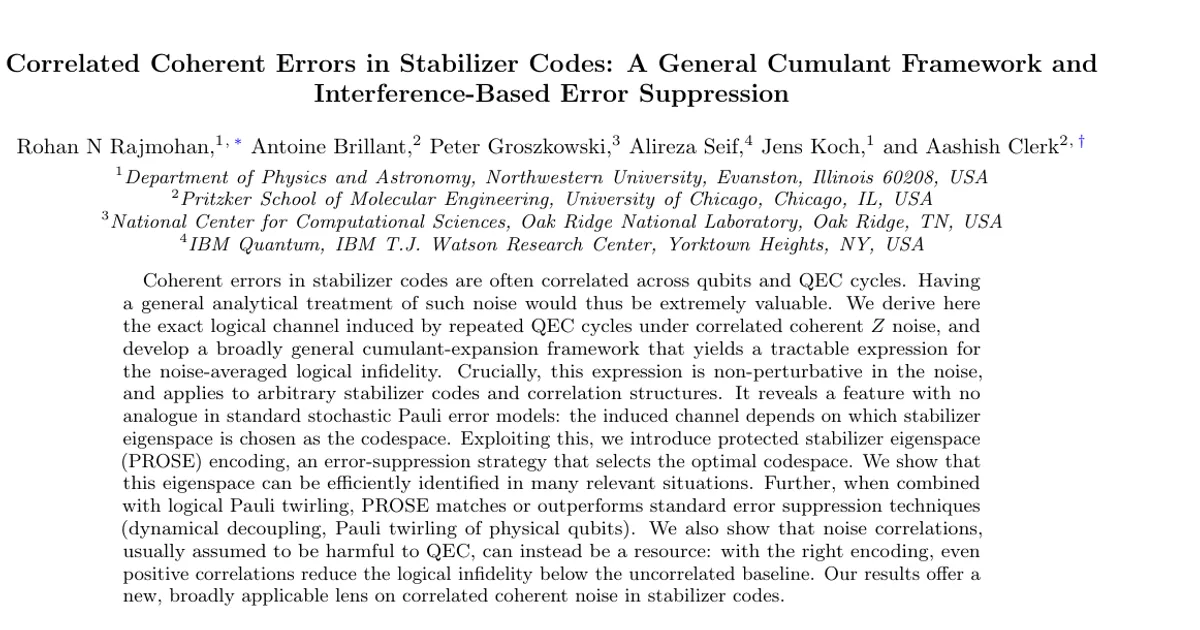
Coherent errors in stabilizer codes are often correlated across qubits and QEC cycles. Having a general analytical treatment of such noise would thus be extremely valuable. We derive here the exact logical channel induced by repeated QEC cycles under correlated coherent $Z$ noise, and develop a broadly general cumulant-expansion framework that yields a tractable expression for the noise-averaged logical infidelity. Crucially, this expression is non-perturbative in the noise, and applies to arbitrary stabilizer codes and correlation structures. It reveals a feature with no analogue in standard stochastic Pauli error models: the induced channel depends on which stabilizer eigenspace is chosen as the codespace. Exploiting this, we introduce protected stabilizer eigenspace (PROSE) encoding, an error-suppression strategy that selects the optimal codespace. We show that this eigenspace can be efficiently identified in many relevant situations. Further, when combined with logical Pauli twirling, PROSE matches or outperforms standard error suppression techniques (dynamical decoupling, Pauli twirling of physical qubits). We also show that noise correlations, usually assumed to be harmful to QEC, can instead be a resource: with the right encoding, even positive correlations reduce the logical infidelity below the uncorrelated baseline. Our results offer a new, broadly applicable lens on correlated coherent noise in stabilizer codes.