Research
Computationally Efficient Optimization of Per-Qubit Clifford Deformation for Non-uniform Biased Noise
Overview Research area: Quantum error correction (QEC) — specifically compile-time noise tailoring for fault-tolerant quantum computers, combining stabilizer-code theory, biased-noise hardware calibra
- arXiv
- 2608.17870
- Published
- 2026-08-18
- Authors
- Won Joon Yun, Andrew Nemec, Jonathan M. Baker
AI summary
Overview
Research area: Quantum error correction (QEC) — specifically compile-time noise tailoring for fault-tolerant quantum computers, combining stabilizer-code theory, biased-noise hardware calibration, and classical search/optimization.
Technical level: Intermediate to Advanced. The paper assumes familiarity with stabilizer/CSS codes, syndromes, logical operators, and decoders (MWPM, BP+OSD, Chromobius), though its core idea — re-labelling which physical axis each qubit's error rates are presented on — is explainable without heavy formalism.
Scope (one sentence): The paper presents Chameleon, a decoder-free, code-agnostic compiler that chooses a per-qubit Clifford deformation ("frame") minimizing an analytical upper bound on logical error rate, and shows it reduces LER on surface, color, and bivariate-bicycle codes while cutting frame-selection time from days to seconds or minutes.
What This Paper Is About
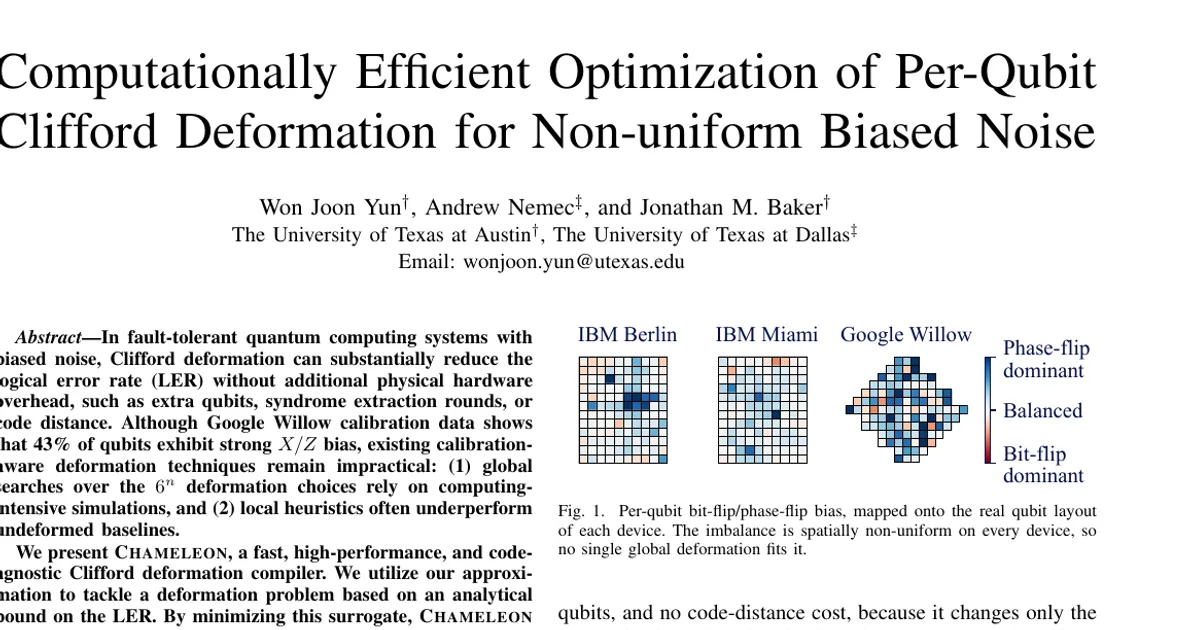
Real superconducting qubits do not fail symmetrically: relaxation, dephasing, and crosstalk make some qubits mostly bit-flip-prone, others mostly phase-flip-prone, and the pattern varies across the chip (43% of Google Willow qubits exceed a bias of η_q = 1.5, versus 13% on Berlin and 6% on Miami). Clifford deformation exploits this by conjugating each qubit's noise with a single-qubit Clifford, which permutes its (p_X, p_Y, p_Z) error vector without adding qubits, rounds, or code distance.
The problem is choosing the deformation. The space is 2^n for identity/Hadamard frames and 6^n for all six rate-distinct permutations, and prior methods either validate each candidate by Monte Carlo decoding — 10^6 to 10^8 shots per candidate, so about 1.2 days per calibration map for the [[72,12,6]] bivariate bicycle code — or use cheap local heuristics that ignore decoding ambiguity. The goal is to pick a good frame without a decoder in the loop.
Key Contributions
-
A decoder-free surrogate for logical error rate. Chameleon replaces exact LER evaluation with a sum of per-operator Bhattacharyya upper bounds. For an ambiguity operator ℓ, the bound is Γ_ℓ(F) = ∏_{q∈ℓ} γ(r_c^q(F)) with γ(r) = 2√(r(1−r)), reducing per-operator cost from O(2^w) to O(w). Per-class scores U_X(F) and U_Z(F) sum these bounds over retained operators.
-
A reusable, code-only ambiguity lookup table. The set of low-weight "ambiguity operators" (nontrivial logical operators that produce no syndrome) depends only on the code, so it is enumerated once offline and reused across every calibration map. This shrinks the complete class-X set from 1.68×10^7 operators (12.3 GiB) to 2,497 operators (1.9 MiB) for surface code d=7, from 2.62×10^5 (148 MiB) to 4,078 (2.3 MiB) for color code d=7, and from 4.40×10^12 (4.5 PiB) to 45,483 (50 MiB) for BB72.
-
A two-stage search over frame space. Step 2 runs the cross-entropy method over the binary {I,H}^n space (15 iterations, 200 candidates per iteration, lowest-scoring 10% kept as elite, Bernoulli parameters initialized at 0.5 and clipped to [0.02, 0.98], 3,000 candidates evaluated). Step 3 warm-starts a categorical CEM over the full 6^n space and deploys the full-frame result only if it improves the objective by more than τ = 20%.
-
Two deployment objectives and code-agnostic scope. The same machinery supports worst-axis memory protection, min_F max{U_X(F), U_Z(F)}, and single-axis protection U_{c*}(F) for workloads such as magic-state preparation, and applies to all CSS stabilizer-code families once the ambiguity set is supplied.
Main Findings
-
Surrogate fidelity grows with device bias. Spearman rank correlation between the surrogate and measured worst-axis LER is weak on the least-biased device, IBM Miami (ρ = 0.34 for surface code, 0.54 for color code), but rises to ρ = 0.89–0.98 on Google Willow. The abstract reports an average rank correlation of ρ = 0.8 and ρ = 0.89–0.94 on the most strongly biased system. The delocalized BB36 code is already faithful on Miami (ρ = 0.90) and reaches 0.84–0.98 across all maps.
-
Compilation time collapses. Chameleon finds a frame in 9.4 seconds for a distance-7 surface code, 39 seconds for a distance-7 color code, and 3.1 minutes for BB72, replacing a 1.2-day decoder-validated search for BB72 (7.2 days for surface d=7 and 4.2 days for color d=7 under an idealized 1 μs-per-shot decoder). The measured BP+OSD decoder is about 3.3×10^3 times slower per shot than that idealized assumption.
-
LER reductions relative to the best prior baseline. Maximum reductions of 19% (13% on average) for surface codes, 16% (7%) for color codes, and 10% (4%) for bivariate bicycle codes. The maximum gain for every code family occurs on the most strongly biased system. In Figure 2's distance-5 Willow example, Chameleon achieves the lowest LER among the six evaluated policies without decoder validation.
-
Both prior approaches fail often. Across 1,756 code-map instances, 29% of global deformation choices are worse than the undeformed code, and the per-qubit local rule of Tiurev et al. underperforms the original CSS code in 27% of instances.
-
Decoder choice, not deformation, explains much of the residual loss. In Table I (IBM Berlin, undeformed CSS, phenomenological, five-seed mean), exact matching shows 0% Type-B (decoder-attributable) share, while Chromobius reaches 44% at color d=3 and 86% at color d=5, and BP+OSD reaches 42% on BB18 and 64% on BB36 — motivating the paper's focus on Type-A (decoding ambiguity) failures.
-
Enumeration must be truncated. Retaining only operators up to a weight cutoff keeps the LUT tractable: W = d+2 for surface, color, BB18, and BB36, and W = d+10 for larger BB codes, with 800 iterations of randomized Gaussian elimination plus translation-orbit expansion for BB72.
Methodology in Plain English
The reasoning starts from why logical errors happen at all. Two different physical error patterns can trigger exactly the same syndrome while having different logical effects; their product is a nontrivial logical operator that the syndrome cannot detect, which the authors call an ambiguity operator. A perfect decoder picks the more likely of the two patterns, so failure occurs when the truth was the less likely one. That failure probability depends on the calibrated per-qubit error rates, which is precisely what a deformation changes.
Step 1: enumerate ambiguity operators for the code once, offline, keeping only low-weight ones because high-weight operators contribute negligibly at low physical error rates. For codes too large to enumerate (BB72), the authors instead use randomized Gaussian elimination to pull one representative of each nontrivial logical class down to low weight, repeat it to reduce the number of high-weight operators, and expand by the BB code's translation orbit.
Step 2: score a candidate frame without simulating anything. Instead of comparing all 2^{w−1} competing pattern pairs inside a weight-w operator, they multiply one Bhattacharyya coefficient per qubit, which upper-bounds the aggregate rare-event likelihood up to a frame-independent constant. Summing these over retained operators gives a per-logical-class score; a memory objective minimizes the worse of the two class scores, a single-axis objective minimizes one.
Step 3: search. Exhaustive evaluation of 2^n is infeasible, so the cross-entropy method samples candidate frames from per-qubit distributions, keeps the best 10%, and updates the distributions toward that elite set — first over identity/Hadamard choices, then over all six frames, accepting the full-frame answer only if it beats the binary answer by more than 20%.
Validation uses stim, PyMatching, Chromobius, and ldpc exactly as provided in the baseline implementations, with common random numbers across policies, at least 500 logical-failure events per reported result, and phenomenological noise at p = 0.005 for geometric codes with d ≤ 5 and p = 0.01 for distance-7 geometric codes and the BB family. Because real calibration maps contain no Y-dominant qubits, the authors also add a synthetic "xyz" field that fixes each qubit's total rate and draws its dominant axis uniformly from {X, Y, Z} at bias η = 10 by default.
Why This Matters
For research, the paper reframes deformation selection as an offline combinatorial problem over a code-derived operator set rather than a per-map simulation campaign, and it separates failures a code/deformation can fix (Type-A ambiguity) from failures that belong to the decoder (Type-B). That separation, quantified in Table I, suggests deformation and decoder improvement are complementary rather than competing levers.
Real-world applications:
- Superconducting QEC memories: a compile-time pass that balances logical X and Z failure rates without extra qubits, syndrome-extraction rounds, or distance — the paper notes undeformed surface-code X and Z failure rates differ by up to 6.6× at distance 7 on Willow-derived maps.
- Magic-state preparation and other single-axis workloads: the one-axis objective targets the logical class a specific consumer circuit depends on.
- qLDPC and bivariate-bicycle deployments: the 3.1-minute BB72 result makes per-map deformation practical for codes where the 6^n space (10^28 choices for [[36,4,6]]) rules out random search with decoder validation.
- Bias-preserving hardware: the framing extends to platforms with intentionally strong bias, such as cat qubits and dual-rail encodings, where a global tailored deformation may already suffice but per-qubit refinement is available.
Industry relevance centers on calibration drift: because frame selection drops from about a day to seconds-to-minutes, the deformation can be recomputed as calibration data changes, avoiding the situation where the calibration is stale before the frame is decided. The abstract positions Chameleon as a "Clifford deformation layer" insertable into an FTQC stack with no decoder modifications.
Future Directions
- Circuit-level noise. The evaluation uses the phenomenological model explicitly because of the time needed for circuit-level simulation; whether the surrogate ordering and the reported LER gains survive full circuit-level noise is untested here.
- Scaling ambiguity enumeration. BB72 required a heuristic (randomized Gaussian elimination plus translation orbits) and a raised cutoff W = d+10; codes much larger than BB72 would need better operator-collection methods, and the accuracy cost of the heuristic relative to full enumeration is only partially characterized.
- Co-design with better decoders. With Chromobius at 86% Type-B share on color d=5 and BP+OSD at 64% on BB36, a large fraction of observed failures is not addressable by deformation; tightening those decoders would let the Type-A gains dominate.
- Broader calibration coverage, including Y-dominant qubits. The paper states that measured calibration maps contain no Y-dominant qubits and therefore relies on synthetic maps to exercise the full 6^n frame space; validating Step 3 on hardware that actually exhibits such qubits is left open.
Target Audience
QEC and fault-tolerance researchers who work on biased noise, code deformation, and decoder-aware compilation; quantum compiler and control-stack engineers who need per-calibration-map optimization within a runtime budget; and hardware teams on superconducting or bias-preserving platforms who want a low-overhead way to convert measured per-qubit asymmetry into logical-error-rate gains. Readers without stabilizer-code background will find Sections II and IV accessible but will need outside material for the decoding and bound derivations.
Authors’ abstract
In fault-tolerant quantum computing systems with biased noise, Clifford deformation can substantially reduce the logical error rate (LER) without additional physical hardware overhead, such as extra qubits, syndrome extraction rounds, or code distance. Although Google Willow calibration data shows that $43\%$ of qubits exhibit strong $X/Z$ bias, existing calibration-aware deformation techniques remain impractical: (1) global searches over the $6^n$ deformation choices rely on computing-intensive simulations, and (2) local heuristics often underperform undeformed baselines. We present Chameleon, a fast, high-performance, and code-agnostic Clifford deformation compiler. We utilize our approximation to tackle a deformation problem based on an analytical bound on the LER. By minimizing this surrogate, Chameleon finds an optimized deformation that empirically reduces the LER with substantially lower computational overhead. In our evaluation, using calibration models derived from real superconducting devices, Chameleon demonstrates that improvements in our surrogate are strongly correlated with actual LER reductions, with an average rank correlation of $ρ=0.8$ and $ρ=0.89$-$0.94$ on the most strongly biased system. It also reduces classical computational time from $1.2$ days to $3.1$ minutes for the BB72 code. Chameleon achieves maximum LER reductions of $19\%$ ($13\%$ on average) for surface codes, $16\%$ ($7\%$) for color codes, and $10\%$ ($4\%$) for bivariate bicycle codes relative to competing baselines. The maximum gains for all code families are observed on the most strongly biased system.