Research
Bath dimension and initial entropy for closed repeated use of a quantum channel
Overview Research area: Quantum information theory, specifically quantum Shannon theory, channel resource accounting, and quantum memory/recycling. Technical level: Advanced. The paper assumes fluency
- arXiv
- 2609.18267
- Published
- 2026-09-16
- Authors
- Seth Douglas
AI summary
Overview
Research area: Quantum information theory, specifically quantum Shannon theory, channel resource accounting, and quantum memory/recycling.
Technical level: Advanced. The paper assumes fluency with CPTP maps, Stinespring dilations, entropy exchange, smooth conditional entropies, diamond-norm channel distance, and the quantum privacy funnel.
Scope (one sentence): The paper characterizes exactly how much bath dimension and how much initial state entropy are needed to serve repeated uses of one fixed finite-dimensional quantum channel inside a closed device with no reset, discard, fresh ancilla, or uncounted controller.
What This Paper Is About
A quantum channel is normally "charged" once: a single use costs one environment (a dilation) of dimension at most (q^2) if it starts pure. Serving many inputs in sequence from one closed device is a different problem, because the device must keep whatever producing earlier outputs left behind. This paper asks what the exact trade-off is between the bath dimension (R_T) and the actual initial entropy (S(\omega_T)) when the same bath, initial state, and unitary are fixed in advance and reused for every one of (T) inputs, with error required to vanish against arbitrary adaptive quantum users. The answer is an achievable rate region with two intrinsic channel quantities, one of which is identified with an affine transform of the zero-leakage quantum privacy funnel.
Key Contributions
-
An exact achievable rate region under a closed, fully counted contract. With (r=\lim \log_2(R_T)/T) and (s=\lim S(\omega_T)/T), the region is exactly (s\ge 0), (r+s\ge h(\Phi)), and (r-s\ge \kappa(\Phi)), giving a minimum dimension rate of ((h+\kappa)/2) attained with initial entropy rate ((h-\kappa)/2) and a spectrum flat on its support.
-
A converse that holds at every finite horizon. Theorem 2.2 assumes no entropy-rate limit, constrains the same actual initialization entropy through two separate legal experiments, and has constants explicit in each horizon's own error.
-
Active support repair and exactification. Theorem 4.1 corrects an approximate finite collision so its Choi support lies inside the target's, with the positive initial spectrum unchanged and a gain penalty depending only on the fixed channel, not on the bath dimension, initial spectrum, or auxiliary dimension. Combined with Theorem 3.1 this yields (\kappa_{\mathrm{exact}}=\kappa).
-
A closed adaptive implementation of encoder-only fully quantum Slepian–Wolf recycling. Theorem 5.1 and Appendix A turn the split into a device obeying the paper's definition: spectral concentration uniform over adaptive controllers, one physical seed reused across every block and returned jointly independent of the whole future-accessed exterior, reversible flat-stock preparation on exact integer wires, and every residue allocated and counted in one closed bath.
Main Findings
-
Exact rate region. The achievable pairs are precisely (s\ge 0), (r+s\ge h), (r-s\ge \kappa). Past the corner, every further bit of initial entropy costs a bit of dimension, since (r\ge \kappa+s) there. For (q=1), all intrinsic costs and the minimum rate vanish.
-
Two intrinsic channel quantities. (h(\Phi)=\max_\rho S(\Phi^c(\rho))) is Schumacher's entropy exchange maximized over inputs, independent of the minimal dilation by environment isometries. (\kappa(\Phi)=\sup_{\rho>0}\lim_{\varepsilon\downarrow 0}k_{\rho,\varepsilon}) is a smoothed independent-reference extension cost, with the positive-error limit taken before the full-rank supremum and no bound on the auxiliary dimension.
-
Privacy-funnel identification. At each fixed full-rank input, the positive-error limit equals (S(\chi_\rho)-\mathsf{P}{\mathrm{q}}^{\psi{\mathsf{EQ}}}(0)), an affine transform of the zero-leakage quantum privacy funnel of Datta, Hirche and Winter, with their (X=\mathsf{E}), (Y=\mathsf{Q}), (R=\mathsf{A}), (W=\mathsf{Z}). The exact fixed-input form is (K_0(\rho)=S(\chi_\rho)-\mathsf{P}{\mathrm{q}}^{\psi{\mathsf{EQ}}}(0)).
-
Bracketing of (k_{\rho,\varepsilon}). (k_{\rho,\varepsilon}) is nonincreasing in (\varepsilon) and lies between (S(\rho)-\log q) and (S(\chi_\rho)), so its positive-error limit exists and is finite.
-
Uniform collision gain. (\kappa=\lim_{\eta\downarrow 0}\inf_{D_\diamond(\Phi_C,\Phi)\le\eta} g_C), where (g_C=\max_\rho f_C(\rho)) and (f_C(\rho)=S(\Gamma_C(\rho))-S(\tau)) for a finite collision with unitary (U) and bath state (\tau). The proof uses physical flags to convexify gain functions, then a finite-dimensional separation argument (classical minimax) for the uniform step.
-
Support repair with explicit costs. Every sufficiently (\eta)-close finite collision on (R) bath dimensions admits a support-repaired collision on ((k+1)R) dimensions with channel error at most (\eta+\varepsilon_\eta), where (\varepsilon_\eta=O_\Phi(\eta^{1/6})), and gain increase at most (\beta_q(\varepsilon_\eta)), where (\beta_q(\varepsilon)=4\varepsilon\log q+(1+\varepsilon)H_2(\varepsilon/(1+\varepsilon))). A further counted flagged correction implements (\Phi) exactly on at most ((k+1)R+k) dimensions with gain increase tending to zero uniformly in (R) and (\tau).
-
Entropy versus dimension is a genuine distinction. A four-dimensional bath initialized with eigenvalues ((3/4,1/4,0,0)) has log dimension 2, log rank 1, actual entropy (H_2(1/4)\approx 0.8113), and entropy deficit (2-H_2(1/4)\approx 1.1887); its minimal purifier dimension is 2, but those inert degrees of freedom are not available workspace.
-
Separation from the closest antecedent contract. Rybár and Ziman's repeatable quantum memory channel fixes one finite device for exact single-use marginals with uncorrelated inputs. Proposition 8.1 shows that one fair shared bath bit controlling (\mathbb{I}) or (Z) is a legitimate marginal dephasing repeater in their sense, but its complete service error is at least (1-2^{1-T}), already (1/2) at (T=2). No resolution of their original question is claimed.
-
Worked channels. Dephasing, pure replacement, and a qubit channel with (0<\kappa<h) are treated. Proposition 7.4 gives a lower bound on (\kappa) that is an optimization over the input space alone; Proposition 7.5 brackets a single-qubit channel with (0<\kappa<h), showing the non-degenerate case occurs and the two degenerate edges are not the only cases.
-
Stated limits. (\kappa) is an ordered limit of an infimum with no attainment, no bound on auxiliary dimension, and no assertion of computability or continuity in (\Phi); the thresholds in Section 6 are finite but not effective. Nothing bounds circuit size or latency, requires the bath to be returned, or extends beyond one fixed memoryless channel visited once per input.
Methodology in Plain English
The paper first fixes a precise contract (Definition 1.1): for every horizon (T), one bath dimension (R_T), one user-independent initial state (\omega_T), and one unitary (W_T) applied at every visit, all chosen before the user sees anything. The output is returned before the next input arrives, and the tester is adaptive with arbitrary finite quantum memory and references. An inaccessible purifier of (\omega_T) is allowed as an analysis device only; the device never acts on it, so it is not charged.
The converse is proved by running two separate legal experiments on the same fixed device. The first feeds fresh purified copies of a full-rank input, keeps every output register, and uses global purity plus the service error to telescope a reference-conditioned entropy: each visit's entropy decrease is at least (k_{\rho,\delta_T}), so (\log R_T-S(\omega_T)\ge T k_{\rho,\delta_T}). The second experiment feeds an input attaining (h), where purity and subadditivity give (\log R_T+S(\omega_T)\ge Th-2\delta_T T\log q-H_2(\delta_T)). Because the device is fixed before either tester is chosen, the two eventual inequalities hold simultaneously, and adding them gives the minimum-rate bound. No entropy-rate limit is assumed.
For the forward direction, the paper translates the abstract infimum into physical finite collisions (a unitary and a bath state), proves a uniform minimax statement over inputs at positive accuracy, repairs an approximate collision's Choi support into the target's using a coefficient projection plus an amplified Gram completion, and then exactifies with a counted flagged correction. The resulting exact witness is expanded into an all-horizon device using the encoder-only fully quantum Slepian–Wolf split, with block coding, one physical seed reused across blocks, and every clock, workspace, and residue allocated inside the single closed bath.
Why This Matters
Impact on research. The paper makes "how much bath" and "how mixed the bath starts" two separate, non-interchangeable axes, which single-use dilation theory does not determine. It converts a hardware-style question (closed repeated use) into an exact information-theoretic rate region, identifies one of its two channel quantities with a known privacy functional, and gives a clean separation from the repeatable-memory-channel contract. It also provides reusable technical tools: the support-repair theorem and the closed adaptive implementation of Slepian–Wolf recycling.
Potential real-world applications (framed as implications, not claims in the paper):
- Quantum repeaters and quantum memories, where the same physical register must serve many sequential transmissions without being reset.
- Quantum communication hardware with constrained environment size, such as satellite or cryogenic links where fresh ancillas are expensive.
- Fault-tolerant quantum computing control, where a fixed workspace must process a stream of gates or syndrome measurements.
- Architectures where the cost of preparing a mixed initial state is a real resource to be budgeted alongside memory dimension.
Industry relevance. The trade-off ((h+\kappa)/2) gives a concrete target for hardware designers: shrinking the bath below that rate requires paying in initial entropy, and vice versa. The explicit counting of seeds, clocks, workspace, and parked residues is directly relevant to resource accounting in near-term devices, even though the paper claims no efficient circuit synthesis.
Future Directions
- Computability and continuity of (\kappa). The paper explicitly claims neither computability of (\kappa) nor continuity in (\Phi); establishing either, or effective bounds on the Section 6 thresholds, is open.
- Circuit synthesis and latency. No bound on circuit size or latency is given; turning the closed adaptive construction into efficient, explicit circuits is a natural next step.
- Channels with memory or multiple visits per input. The result covers one fixed memoryless channel visited once per input; extending beyond that is left open.
- Bath-return requirements and neighbouring contracts. The paper has no bath-return requirement, marginal or independent, and does not resolve Rybár and Ziman's original question; analyzing return requirements and related contracts is a further direction.
Target Audience
Quantum information theorists working on quantum Shannon theory, channel resource theories, and quantum memory; researchers in quantum communication and repeater architecture who need to budget environment size and initial randomness; and graduate students with a background in CPTP maps, Stinespring dilations, and conditional entropies who want a rigorous example of how an operational contract is converted into an exact rate region.
Authors’ abstract
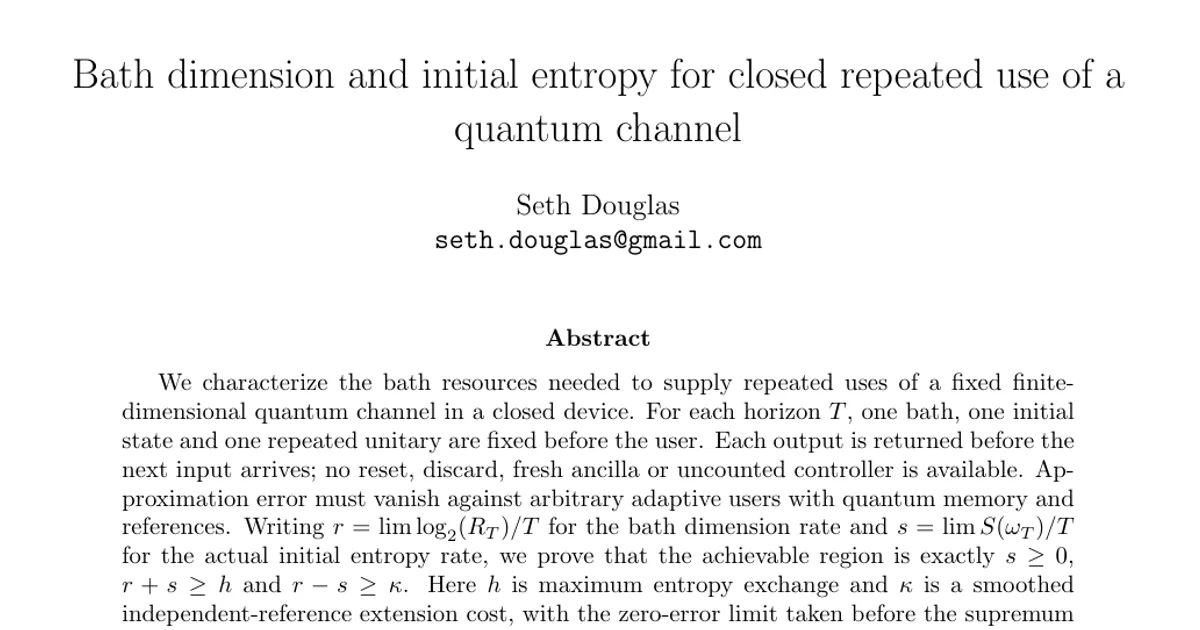
We characterize the bath resources needed to supply repeated uses of a fixed finite-dimensional quantum channel in a closed device. For each horizon $T$, one bath, one initial state and one repeated unitary are fixed before the user. Each output is returned before the next input arrives; no reset, discard, fresh ancilla or uncounted controller is available. Approximation error must vanish against arbitrary adaptive users with quantum memory and references. Writing $r=\lim \log_2(R_T)/T$ for the bath dimension rate and $s=\lim S(ω_T)/T$ for the actual initial entropy rate, we prove that the achievable region is exactly $s\ge 0$, $r+s\ge h$ and $r-s\geκ$. Here $h$ is maximum entropy exchange and $κ$ is a smoothed independent-reference extension cost, with the zero-error limit taken before the supremum over full-rank inputs. Its exact fixed-input form is an affine transform of the zero-leakage quantum privacy funnel. The minimum dimension rate is $(h+κ)/2$. The proof combines entropy converses, a bath-dimension-independent support repair, and a closed adaptive implementation of encoder-only fully quantum Slepian--Wolf recycling. All seeds, clocks, workspace and retained residues are counted. Worked examples include dephasing, pure replacement and a qubit channel with $0<κ<h$. No computability of $κ$ or efficient circuit synthesis is claimed.