Research
An Analytically Trained Variational Surrogate for Quantum Phase Estimation on NISQ Hardware
Overview Research area: Quantum computing — quantum algorithms for quantum chemistry (Quantum Phase Estimation, variational circuits, NISQ-era error mitigation). Technical level: Intermediate. Readers
- arXiv
- 2607.20943
- Published
- 2026-07-23
- Authors
- Mousumi Kundu, Ashish Kumar Patra, Anurag K. S. V., Ruchika Bhat, Sai Shankar P., Alok Shukla, Jaiganesh G
AI summary
Overview
Research area: Quantum computing — quantum algorithms for quantum chemistry (Quantum Phase Estimation, variational circuits, NISQ-era error mitigation).
Technical level: Intermediate. Readers should be comfortable with qubits, quantum circuits, and the idea of a molecular ground-state energy; the paper's central idea (replacing a circuit simulation with a closed-form formula) is explained in enough detail to be followed without a specialist background.
Scope (one sentence): The paper proposes and experimentally tests a framework in which a shallow variational quantum circuit is trained on a purely classical, closed-form probability distribution — rather than on a simulated QPE circuit — to reproduce Quantum Phase Estimation output for the hydrogen molecule on IBM superconducting hardware.
What This Paper Is About
Quantum Phase Estimation can, in principle, read out a molecule's ground-state energy, but its circuit is far too deep to run on today's noisy quantum hardware. A previous workaround trained a shallow variational circuit to imitate QPE's measurement distribution, but it still required simulating the full QPE circuit to generate the training data — a cost that grows exponentially and defeats the purpose. This paper removes that bottleneck by computing the training target directly from a known mathematical formula (the Dirichlet kernel), using only the exact ground-state energy, the number of ancilla qubits, and the time-evolution parameter.
Key Contributions
-
A simulation-free training pipeline for QPE surrogates. The training target distribution is evaluated analytically via the squared Dirichlet kernel, requiring only the FCI ground-state energy, the ancilla count n_a, and the evolution time τ. The authors state that no quantum circuit simulation is used at any stage of training.
-
A quantitative argument that this matters. The paper derives that the QPE circuit depth scales as 𝒪(2^{n_a} · m · n_s^4) and reduces to 𝒪(m · n_s^4 / ε), while classical state-vector simulation of QPE costs 𝒪(2^{n_s+n_a}) memory — the bottleneck the analytical target avoids, since the Dirichlet evaluation costs only 𝒪(2^{n_a}).
-
A four-stage hardware study on IBM superconducting devices using H₂ with a symmetry-tapered Hamiltonian: (i) linear vs. full entangler comparison, (ii) layer sweep from p = 1 to p = 5, (iii) R_Y–CZ ansatz comparing ideal-simulator-trained vs. noisy-simulator-trained parameters, and (iv) a supplementary depth study at p ∈ {8, 64} with and without XpXm dynamical decoupling.
-
A four-metric evaluation protocol — Hellinger distance, fidelity error, total variation distance, and Jensen–Shannon divergence — replacing the single χ² statistic used in prior surrogate work, with a common shot budget of N_shots = 100,000 across every configuration.
Main Findings
-
Linear entangler wins on hardware: Comparing linear and full entangler topologies for the R_Y–R_Z–CZ ansatz, with and without XpXm dynamical decoupling, the linear entangler is identified as the optimal topology across the four distributional metrics.
-
One layer is best under noise: Sweeping VQC depth from p = 1 to p = 5 for the linear-entangler R_Y–R_Z–CZ ansatz, the single-layer configuration is identified as optimal on noisy hardware.
-
Chemical accuracy is recovered: The trained surrogate recovers the molecular ground-state energy with |ΔE| = 1.786 × 10⁻⁴ Hartree, below the stated chemical accuracy threshold of 1.59 × 10⁻³ Hartree.
-
Reduced ansatz also tested on hardware: The single-layer linear-entangler R_Y–CZ configuration (fewer parameters: (p+1)·n_a versus 2(p+1)·n_a) was run without dynamical decoupling, with ideal-simulator-trained and noisy-simulator-trained parameters compared on all four metrics. The specific per-metric values for each stage are not reported in the portion of the paper available here.
-
Depth–decoupling interplay probed: A supplementary analysis executes the R_Y–CZ ansatz at p ∈ {8, 64} with and without XpXm DD. The paper's background section notes from prior literature that DD helps only when idle windows are long enough, and can degrade performance in deep circuits due to pulse calibration errors; the numerical outcome of this supplementary sweep is not included in the excerpt provided.
-
Target distribution is sharply peaked: For the n_a = 11 ancilla qubits used, the dominant bitstring typically concentrates 90–95% of the probability mass, with the rest in side lobes — motivating the 100,000-shot budget so that JSD and other tail-sensitive metrics are stable.
Methodology in Plain English
-
Pick a small, well-understood molecule. Hydrogen (H₂) at the equilibrium bond length R = 0.74 Å, in the STO-3G minimal basis, with integrals and the exact FCI ground-state energy computed using PySCF.
-
Shrink the problem. Map fermions to qubits with the Jordan–Wigner transformation (via Qiskit Nature), then apply ℤ₂ symmetry tapering, which the paper says eliminates two of the four qubits and leaves a Hamiltonian written as a short combination of Pauli strings.
-
Write down the answer instead of computing it. QPE's measurement distribution has a known closed form — a squared Dirichlet kernel — determined by the exact energy, the ancilla count, and the evolution time. The authors evaluate this formula classically, with a shift that removes the identity term c₀ and the nuclear repulsion E_nuc so the phase reflects the physically relevant electronic energy.
-
Train a small circuit to match it. A shallow variational circuit with R_Y and optionally R_Z rotations plus CZ entanglers is optimized with COBYLA (a gradient-free optimizer needing one circuit execution per step) to minimize the L¹ distance between its measured output histogram and the analytical target. Parameters start at zero.
-
Run it on real hardware and score it. The trained circuits are executed on IBM Quantum superconducting devices with 100,000 shots per configuration, and the resulting histograms are compared to the target using Hellinger distance, fidelity error, total variation distance, and Jensen–Shannon divergence — with and without XpXm dynamical decoupling, and across different depths.
-
Read the energy back out. The dominant measured bitstring k* converts to an energy estimate via |E_est| = 2πk* / (2^{n_a} · τ), which is then compared to the exact FCI value.
Why This Matters
Impact on research: The paper attacks a self-defeating feature of prior surrogate approaches: to avoid running a deep QPE circuit, they simulated it classically, which becomes exponentially expensive. If the target distribution really can be written down analytically, surrogate training becomes genuinely scalable with problem size, and the "QPE replacement block" idea becomes practical for embedding inside larger algorithms.
Real-world applications:
- Drug and materials discovery: faster, cheaper estimates of molecular ground-state energies on near-term hardware.
- Battery and catalyst design: energy landscapes of small molecules and reaction intermediates where chemical accuracy (≈1.59 × 10⁻³ Hartree) is the relevant bar.
- Quantum algorithm engineering: a reusable shallow "QPE block" that can be dropped into larger circuits on NISQ devices.
- Benchmarking quantum hardware: the four-metric protocol and depth-vs-DD study give a template for evaluating noisy devices on distributional tasks rather than single-number accuracy.
Industry relevance: The work is done on IBM Quantum superconducting hardware with Qiskit tooling, addresses NISQ-era circuit-depth constraints directly, and produces a pipeline where the expensive classical step is a cheap closed-form evaluation — an attractive cost profile for cloud quantum computing where shots and queue time are the scarce resources.
Future Directions
- Scaling beyond H₂. The paper's own depth analysis names LiH (n_s = 12), BeH₂ (n_s = 14), and water (n_s = 14) as systems where the 𝒪(n_s^4) scaling becomes prohibitive; testing whether the analytically trained surrogate remains accurate for these is the obvious next step.
- Better ansätze and optimizers. Since a single layer beat deeper circuits under noise, the natural question is whether hardware-aware ansatz design or noise-robust optimization can recover the expressibility lost by staying shallow.
- Firming up the depth–decoupling picture. The supplementary p ∈ {8, 64} study raises the question of where the crossover lies — at what depth dynamical decoupling switches from helping to hurting — which the paper frames as directly relevant to NISQ variational algorithm design.
- Integration into larger circuits. The whole premise is that a trained surrogate can substitute for the QPE block inside a bigger algorithm; demonstrating that end-to-end, rather than only on the distribution-matching task, is an open validation step.
Target Audience
Quantum computing researchers working on near-term algorithms and quantum chemistry simulation; graduate students and practitioners interested in variational methods, error mitigation, and hardware benchmarking; and quantum-chemistry or materials-science groups evaluating whether current hardware can deliver chemically accurate energies. Readers new to the field will find the introduction and theory sections accessible, but will need some familiarity with QPE and variational circuits to follow the experimental design.
Authors’ abstract
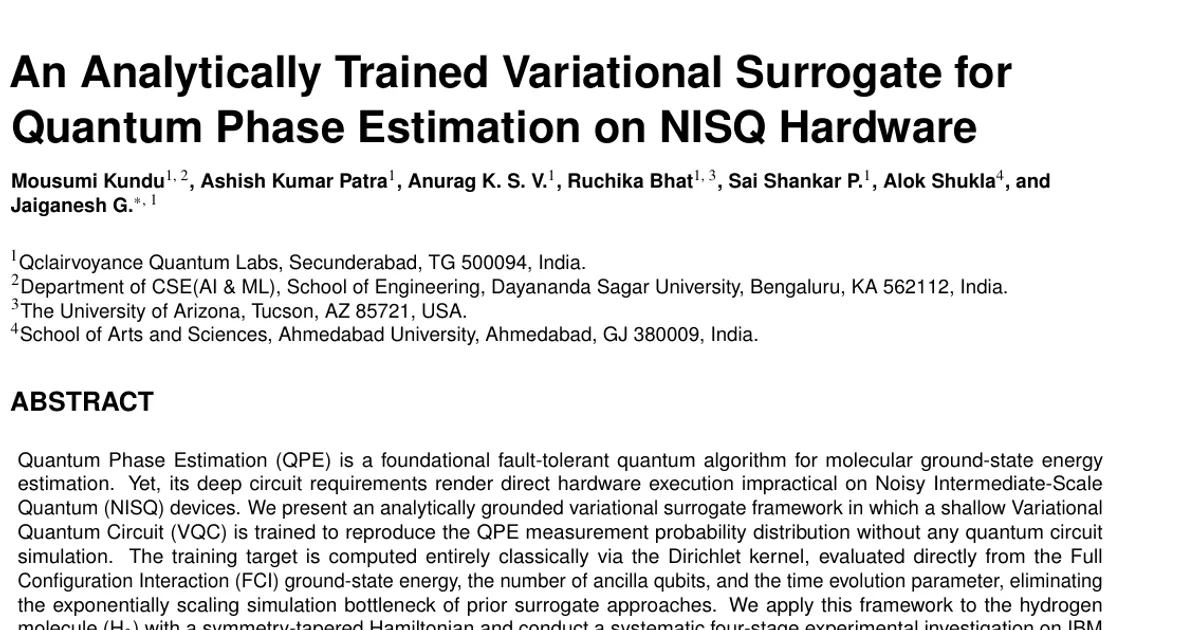
Quantum Phase Estimation (QPE) is a foundational algorithm for molecular ground-state energy estimation, but its deep circuit requirements make direct hardware execution impractical on Noisy Intermediate-Scale Quantum (NISQ) devices. We present an analytically grounded variational surrogate framework in which a shallow Variational Quantum Circuit (VQC) is trained to reproduce the QPE measurement distribution without any quantum circuit simulation. The training target is computed entirely classically via the Dirichlet kernel, evaluated directly from the Full Configuration Interaction (FCI) ground-state energy, the ancilla qubit count, and the time evolution parameter, eliminating the exponentially scaling simulation bottleneck of prior surrogate approaches. We apply this framework to the hydrogen molecule (H$_2$) with a symmetry-tapered Hamiltonian, conducting a four-stage experimental investigation on IBM Quantum hardware. Stage 1 compares linear and full entangler topologies for the $R_Y$-$R_Z$-$CZ$ ansatz, with and without XpXm Dynamical Decoupling (DD), across four distributional metrics (Hellinger distance, fidelity error, total variation distance, Jensen-Shannon divergence), identifying the linear entangler as optimal. Stage 2 varies VQC layers ($p=1$ to $5$) for the linear-entangler ansatz, identifying single-layer depth as optimal under hardware noise. Stage 3 applies this configuration to the reduced $R_Y$-$CZ$ ansatz, comparing ideal and noisy simulator-trained parameters. A supplementary noise analysis at $p \in \{8,64\}$ characterizes the depth-dependent interplay between circuit depth and DD effectiveness. The framework enables faithful QPE mimicry using a linearly scaling VQC, recovering the ground-state energy within the chemical accuracy threshold (1 kcal/mol), constituting a scalable, hardware-efficient paradigm for QPE-based molecular energy estimation on NISQ devices.