Research
Adaptive Information Mining: Approaching the Quantum Limit of Super-Resolution Imaging
Overview Research area: Quantum-limited super-resolution imaging and quantum metrology for astronomy (multi-parameter estimation of incoherent point sources). Technical level: Advanced. The paper assu
- arXiv
- 2610.37491
- Published
- 2026-10-27
- Authors
- Seungman Choi, Peter Menart, Andrew Schramka, Zubin Jacob
AI summary
Overview
Research area: Quantum-limited super-resolution imaging and quantum metrology for astronomy (multi-parameter estimation of incoherent point sources).
Technical level: Advanced. The paper assumes familiarity with Fisher information, the Cramér–Rao lower bound, quantum Fisher information, and spatial light modulator (SLM) optics.
Scope: The paper introduces Adaptive Information Mining (AIM), a closed-loop imaging architecture that sequentially reshapes its own measurement (via SLMs) to maximize Fisher information and approach the quantum Cramér–Rao lower bound for blind multi-parameter estimation of sub-Rayleigh point sources, including unknown source counts and atmospheric turbulence.
What This Paper Is About
The "Rayleigh limit" is routinely treated as a hard wall for imaging closely spaced objects, but the authors argue it is a property of how photons are measured, not of light itself. The quantum Cramér–Rao lower bound shows that extractable information survives deep in the sub-Rayleigh regime, yet conventional direct imaging (DI) and fixed mode-sorting schemes such as SPADE cannot reach it without prior knowledge of the scene. The goal is a prior-free, adaptive measurement scheme that drives estimation error toward the fundamental quantum limit for source positions and brightnesses.
Key Contributions
-
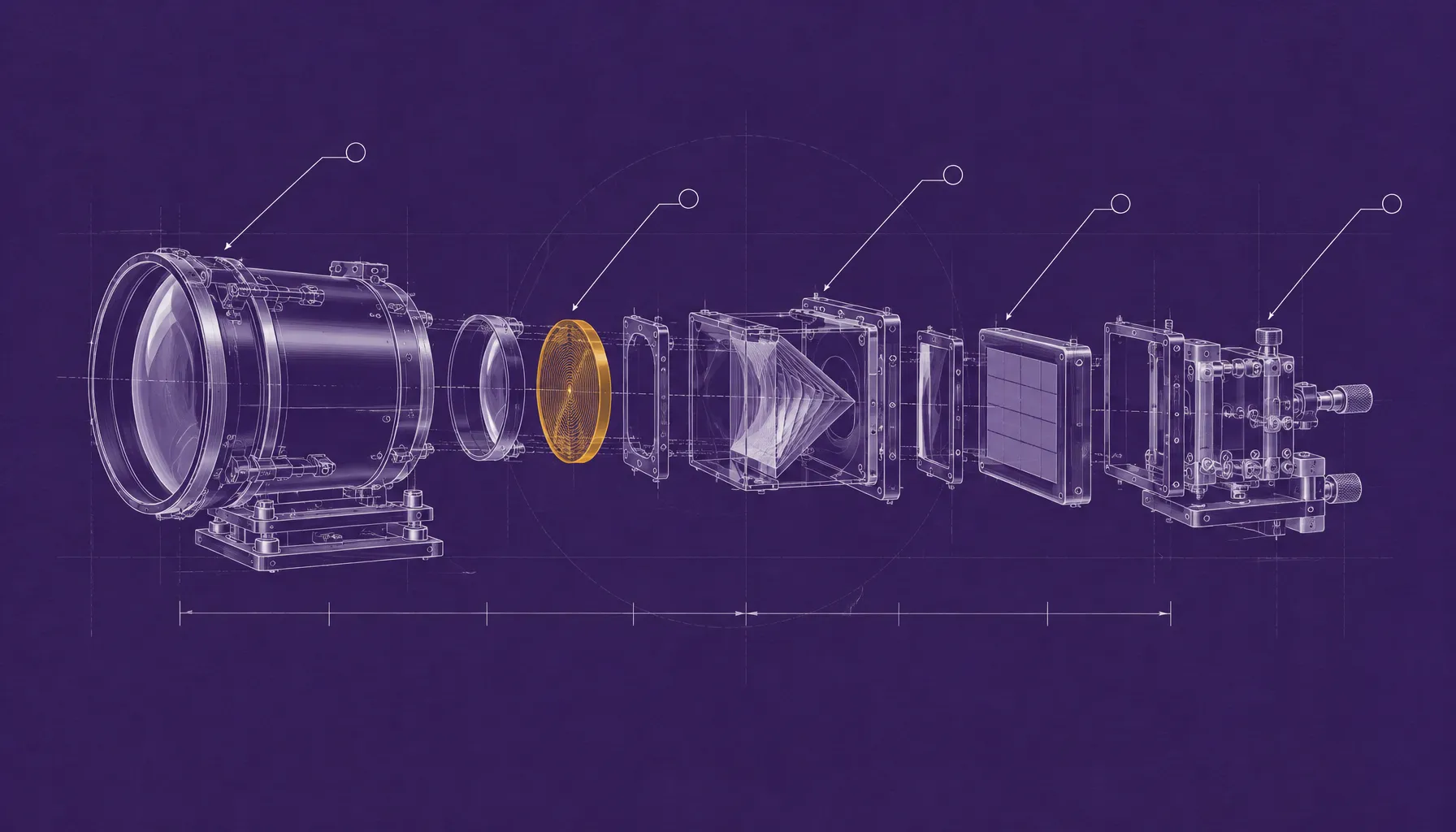
An adaptive, closed-loop imaging framework (AIM). A three-stage cycle—scene estimation, information-driven SLM pattern design, and new acquisition—replaces passive photon integration, using a dual-SLM reconfigurable interface placed after the imaging lens.
-
Direct Fisher-information optimization without explicit mode decomposition. Rather than projecting onto a pre-designed modal basis (as SPADE/MPLC approaches do), AIM selects the next measurement by D-optimality, minimizing the determinant of the inverse Fisher information matrix evaluated at the current estimate.
-
Demonstration of fully blind multi-parameter performance. Joint estimation of positions and brightnesses without prior knowledge, extension to unknown source number detection, and single-parameter targeted design (marginalized CRLB for source separation with nuisance parameters).
-
Turbulence-resilient imaging as an augmented estimation problem. Turbulence is folded into the forward model as an unknown parameter with a total variation (TV) prior; the scene-information objective spontaneously produces an adaptive-optics-like pupil-plane correction.
Main Findings
-
Approaching the quantum floor in simulation: Across five sequential AIM measurements with three sources of brightness ratio [1:5:20] and a total photon budget of 14,000 (50 Monte Carlo trials per condition), AIM RMSE stays below the classical DI CRLB and tracks the QCRLB down to separations of 0.3R, while DI degrades sharply.
-
Error-reduction ratio of roughly 2–3×: The paper's defined metric (√CRLB_DI − √QCRLB)/(√CRLB_AIM − √QCRLB) gives roughly 2–3× closer to the quantum limit for joint position and brightness estimation; the abstract summarizes the overall range as 2–5×.
-
Targeted single-parameter design reaches about 5×: For a two-source scene with brightness ratio [1:15] and 14,000 photons over five measurements, optimizing only the marginalized CRLB of the separation x_sep brings both the AIM CRLB and empirical RMSE close to the QCRLB across the full separation range—approximately 5× closer than DI—while nuisance parameters remain as well or better conditioned than DI.
-
Overlap suppression is separation-dependent: For a three-source scene with brightness ratios [1:3:6], AIM suppresses inter-source correlation more effectively than DI at 1.0R, but at 0.4R the AIM correlation ratio rises toward DI's. The authors conclude that at deep sub-Rayleigh separations the gain comes from source-dependent structural variations in the measurement, not simple decorrelation.
-
Improved source-number detection: AIM improves source-number detection probability in fully blind scenarios; quantitative details are stated to be in the Supplementary Information rather than in the main text.
-
Turbulence case: With three sources at 0.66R separation, brightness ratio [1:5:15], D/r₀ = 8, a total photon budget of 1×10⁶ over 12 AIM measurements, and 50 independent turbulence realizations, the turbulence phase estimate converges with RMSE saturating near 0.2 rad (about 0.03λ wavefront error). Scene errors fall below the diffraction-limited DI benchmark, and SLM1 evolves toward a pupil-plane correction that leaves mainly low-order residuals (tip/tilt and weak defocus).
-
Divergence caveat: For unequal brightness in multi-parameter settings, both the DI CRLB and the QCRLB diverge as separation vanishes (unlike the equal-brightness case), but the substantial gap between them leaves recoverable information.
Methodology in Plain English
The scene is described by a small set of numbers: the x–y position and brightness of each point source (3N parameters for N sources). Each round of the experiment produces photon counts following Poisson statistics, and the estimate is the set of numbers that best fits all data accumulated so far (minimizing cumulative negative log-likelihood).
What makes the scheme adaptive is the choice of the next measurement. The system computes how sensitive the predicted detector image is to each unknown parameter at the current best guess, assembles this into a Fisher information matrix, and then searches for the SLM phase patterns that would make the uncertainty ellipsoid for all parameters as small as possible. Optimization uses Adam: 1,000 updates for the estimation step and 200 for the measurement-design step per AIM iteration. Starting from flat SLM masks (equivalent to ordinary DI), the masks become progressively structured as the estimate improves, and each new measurement is appended to the dataset. Early estimation errors are tolerable because each measurement is only used as a guide for the next design.
To compute the ultimate quantum benchmark, the authors build a multiparameter quantum Fisher information matrix under a weak-source approximation (vacuum plus one-photon states), compress the high-dimensional pixel space onto a 3N-dimensional operational subspace via an eigen-decomposition of a Gram matrix, solve the symmetric logarithmic derivative equation, and invoke a weak-commutativity condition so the SLD-QCRLB is treated as the attainable multi-parameter bound. They drop the vacuum mode in the practical evaluation because the resulting brightness entry 1/[b(1 − b/M)] converges to 1/b for a sufficiently large observation window.
For turbulence, the parameter set is augmented with the turbulent wavefront, regularized by a TV prior; the reported AIM CRLBs bound the scene parameters only, excluding the wavefront.
Why This Matters
AIM reframes super-resolution as an information-engineering problem in the receiver rather than a hardware-scaling problem in the aperture, and it does so without requiring prior scene knowledge—a prerequisite for real astronomy, where source positions and brightnesses are exactly what is unknown. It also sidesteps practical weaknesses of mode-sorter implementations, such as mode-dependent loss and residual crosstalk, by embedding optimization directly in the measurement.
Real-world applications:
- Exoplanet detection and deep-space astrometry, where faint companions sit far below the diffraction limit of the aperture.
- Ground-based astronomical imaging through atmospheric turbulence, where AIM's emergent pupil-plane correction offers an information-driven alternative to explicit wavefront sensing plus adaptive optics hardware.
- Remote sensing from aperture-constrained platforms.
- High-resolution optical microscopy, extending the receiver-side strategy to non-astronomical scenes.
Industry relevance: The scheme is a hardware–software co-design proposal that depends on reconfigurable optics (kHz-class SLMs) and fast quantum detectors, pointing toward commercial opportunities in adaptive optical hardware, wavefront-control modules, and computational imaging pipelines for telescope and imaging-system makers.
Future Directions
-
Real-time operation. Translating the sequential loop to live ground-based use requires SLMs at kHz-class rates paired with faster detectors to keep up with dynamic atmospheric fluctuations; the frozen-turbulence assumption used here must be relaxed and tested.
-
Hardware scaling. The paper notes that performance improves with additional SLMs, with the analysis deferred to the Supplementary Information; experimentally validating multi-SLM configurations and calibration/drift behavior remains open.
-
Non-static and more complex scenes. Extending beyond a fixed number of incoherent point sources—to evolving turbulence, extended objects, or correlated sources—is a natural next step, since the framework's assumptions (weak source, frozen turbulence, Poisson noise) constrain the current demonstrations.
-
Closing the residual gap to the bound. In the turbulence study, the reported scene CRLBs exclude the wavefront parameter, so part of the observed RMSE–CRLB gap (especially in position) reflects joint recovery of an unaccounted nuisance parameter; a tighter joint bound would sharpen the claim of quantum-limited performance.
Target Audience
Quantum metrology and quantum imaging researchers; astronomical instrumentation and adaptive-optics engineers; computational-imaging scientists interested in Fisher-information-driven measurement design; and graduate students with a background in estimation theory and Fourier optics who want a concrete blueprint for prior-free, quantum-limited super-resolution.
Authors’ abstract
The "Rayleigh limit" is not an intrinsic property of light, but a consequence of sub-optimal measurement of collected photons by the imaging instrument. To overcome this limitation, we present Adaptive Information Mining, a framework that achieves super-resolution by using sequentially refined measurements for incoming photons. Our approach employs a reconfigurable imaging system that dynamically reshapes the instrument measurement responses to maximize the Fisher information and guide scene estimation toward the fundamental quantum limit, even in deep sub-Rayleigh regimes. We demonstrate that this approach achieves an estimation error 2-5 times closer to the fundamental quantum limit than traditional direct imaging when imaging point sources, without requiring any prior knowledge of their positions and brightnesses. Importantly, we demonstrate that AIM can be extended to fully blind multi-parameter estimation in scenarios involving an unknown number of sources or turbulence-induced wavefront distortions. Our approach addresses the limitations of conventional fixed imaging, offering a practical path toward quantum-limited super-resolution imaging.