Research
Adaptive Entanglement Witnessing for Two-Qubit Systems
Overview Research area: Quantum information science — entanglement detection and characterization for two-qubit (bipartite qubit) systems, combining theory, numerical benchmarking, and a photonics exp
- arXiv
- 2610.16018
- Published
- 2026-10-12
- Authors
- Lev Gruber, Ria Haapala, Elio Thadhani, Paco Navarro, Eritas Yang, Benjamin Hartley, Rebecca Verghese, Oscar Scholin, Isabel Godoy, Stuart Kerr, Brayden Mendoza, Alec Roberson, Theresa W. Lynn
AI summary
Overview
Research area: Quantum information science — entanglement detection and characterization for two-qubit (bipartite qubit) systems, combining theory, numerical benchmarking, and a photonics experiment.
Technical level: Intermediate. The paper uses the language of density operators, partial transposition, and Stokes parameters, but the core logic (measure in a few bases, check whether a number goes negative) is explained concretely enough for readers with undergraduate quantum mechanics.
Scope (one sentence): The paper introduces an extended family of two-qubit entanglement witnesses that require five measurement bases instead of the nine needed for full tomography, plus an adaptive two-step protocol that uses the first three bases' data to pick which additional bases to measure, and it benchmarks this protocol on 16.8 million simulated states and demonstrates it with polarization-entangled photons.
What This Paper Is About
Determining whether an unknown two-qubit state is entangled normally requires full quantum tomography — correlated local measurements in nine bases — which is slow and measurement-hungry. Entanglement witnesses can certify entanglement with fewer measurements, but any single witness only catches a subset of entangled states, so a small witness set will miss many states. The paper's goal is to squeeze more detection power out of a small number of measurement bases by building new witnesses on top of an existing three-basis set and adaptively choosing which extra bases to measure.
Key Contributions
-
An extended witness family, {W⁵}. The authors construct nine new extremal decomposable witnesses (partial transposes of rank-1 projectors) by rotating the six known {W³} witnesses of Riccardi et al. (2020) about the Bloch-sphere principal axes. These are grouped into three "triplets" — {W⁵}_z, {W⁵}_x, {W⁵}_y — each requiring only one additional cross-basis measurement pair (S_xy/S_yx, S_yz/S_zy, or S_xz/S_zx), for five bases total.
-
Analytic minimization of the witnesses. All six {W³} witnesses are minimized analytically with respect to θ, yielding closed-form expressions in Stokes parameters (e.g., Eq. 4). Six of the nine {W⁵} witnesses are likewise minimized analytically; the third witness in each triplet (rotations on both particles) is reduced to a two-free-parameter form and requires SciPy numerical minimization.
-
Two adaptive choice methods. A "population method" that picks the triplet {W⁵}_n whose diagonal Stokes parameter |S_nn| is largest, and NN5, a five-hidden-layer neural network (Keras, ReLU activations, sigmoid output, Adam optimizer, binary cross-entropy loss) that maps the xx/yy/zz measurement results to a predicted triplet.
-
Computational benchmark and experimental demonstration. The protocol is tested on 16.8 million simulated entangled states and verified on polarization-entangled photon pairs from type-I spontaneous parametric down conversion in BBO crystals.
Main Findings
-
{W³} alone detects 33% of the 16.8 million randomly generated entangled states (generated following Roik et al. 2021), using three measurement bases.
-
{W⁵} oracle reaches 79%. Evaluating all three {W⁵} triplets detects 79% of entangled states — but this requires all three extra cross-basis pairs, i.e., full tomography, so the authors explicitly label 79% an oracle benchmark representing the best the {W⁵} witnesses could do with perfect triplet selection.
-
The adaptive protocol retains most of that gain. Using only one adaptively chosen triplet (five bases total), the population method detects 70% of entangled states and NN5 detects 72%. Both fall below the 79% oracle, as expected, because states with identical {S_ii, S_0i, S_i0} can be witnessed by different triplets.
-
Analytic minimization links witnesses to the PPT criterion. The closed-form witness expressions show that ⟨W³⟩ < 0 signals violation of a specific 2×2 minor determinant of ρ^Γ, connecting the witness values directly to the Peres-Horodecki separability condition.
-
Performance improves with entanglement strength. On states filtered above increasing minimum concurrence thresholds (Fig. 2), both choice methods detect a larger fraction of states.
-
NN5 training details. The network was trained on 4 million generated density matrices, restricted to the 1.208 million witnessed by {W⁵} but not {W³}; 966,000 states were used for training and 242,000 for validation, with hyperparameters (1–1800 neurons per layer, learning rate 10⁻⁵ to 0.5, batch size 256 to 4480 in steps of 32) tuned by grid search using Weights & Biases.
-
Experimental validation succeeded. For the three mixed states (0.65/0.35 ensembles, Eqs. 15–17) and three pure states (Eqs. 18–20), positive ⟨W³⟩ and negative ⟨W⁵⟩ were observed — each state witnessed by a distinct triplet and by no {W³} witness.
-
Experimental limitations were identified. Residual decoherence between |HH⟩ and |VV⟩ limited the experimentally produced maximally entangled states to approximately 94.5% purity, modeled with a "decohered theory" state. Waveplate calibration offsets — θ = 42° instead of 45° for Eq. 19, and θ = 44° instead of 45° for Eq. 20 — explain deviations of ⟨W³⟩ from both theory curves.
Methodology in Plain English
The researchers start from a known trick: for two qubits, you can define a "witness" operator whose average value is guaranteed to be non-negative for every unentangled state. If you measure a negative average, the state must be entangled. Each witness has a free parameter (θ, and for the new ones also rotation angles α and β), so after collecting data you tune the parameter to make the value as negative as possible — that is the "minimization" step.
The first witness set needs measurements in three bases (xx, yy, zz). To detect states that set misses, the authors mathematically rotate those same witnesses about the z, x, or y axis, which means the rotated versions need just one extra pair of cross-basis measurements (for example, the z-rotation needs xy and yx). That gives three candidate "triplets," and measuring all of them would cost the full nine bases — defeating the purpose. So they use the data already in hand from the first three bases to guess which single triplet is most likely to succeed: either by comparing which diagonal Stokes parameter is largest (the population method), or by training a small neural network on millions of simulated states to make the prediction. The network was trained only on states that the first set misses, which is exactly the hard case the second step exists to solve.
Experimentally, they generate entangled photon pairs by pumping BBO crystals with a 403-nm diode laser, use wave plates plus polarizing beam splitters and single-photon counting modules to project each photon onto chosen polarization bases, and record coincidences in a 7-ns window with an FPGA counter. Mixed states are produced by separately preparing the pure states in the ensemble decomposition and statistically combining the counts.
Why This Matters
Impact on research: Entanglement detection is a bottleneck in entanglement distribution and quantum network experiments, where measurement time is expensive and bit rates are low. The paper shows a concrete, quantified tradeoff — three bases gives 33%, five adaptively chosen bases gives 70–72%, nine bases gives full information — that practitioners can use to budget measurements. It also makes explicit the distinction between achievable performance and oracle ceilings in witness design.
Real-world applications (bullets):
- Quantum key distribution, where verifying that a shared resource is entangled underpins security claims.
- Long-distance entanglement distribution and quantum repeater links, where per-measurement cost is high and prior knowledge of the state may be absent.
- Device characterization and benchmarking in photonic quantum hardware, as a cheaper alternative to full tomography during calibration.
- Adaptive measurement selection in quantum experiments generally, where a learned or analytic policy decides which bases to measure next.
Industry relevance: Any quantum hardware group that routinely certifies entanglement — photonics, superconducting qubits, trapped ions — could use a five-basis protocol in place of nine-basis tomography for screening, with a neural-network policy making the choice automatically from the first round of data.
Future Directions
-
Extending to a third step. The authors state they are currently working on extending the adaptive measurement procedure to a third step, continuing to analyze the fraction of entangled states witnessed against the fraction of full tomography performed.
-
Modeling measurement uncertainty. They note it would be interesting to explicitly model uncertainty in measurement statistics — an important gap, since the current analysis is based on noiseless expectation values from simulated states and near-ideal experimental counts.
-
Tradeoff analysis for witnessing efficiency. The paper's final sentence is truncated mid-thought, but it flags exploring tradeoffs in entanglement witnessing efficiency as an open direction.
-
Where the adaptive policy fails. Both choice methods fall short of the 79% oracle because states with identical {S_ii, S_0i, S_i0} can be witnessed by different triplets; better choice policies, richer input features, or partial extra measurements are natural ways to close that gap.
Target Audience
Quantum information researchers and graduate students working on entanglement characterization, experimentalists running photonic Bell-state and entanglement-distribution setups, and quantum engineers who need practical measurement-budget guidance. The paper's combination of closed-form witness expressions, a neural-network policy, and an optical demonstration also makes it useful for machine-learning researchers interested in adaptive experiment design for quantum systems. Readers need comfort with density matrices and the partial transpose; the experimental details are accessible without a photonics background.
Authors’ abstract
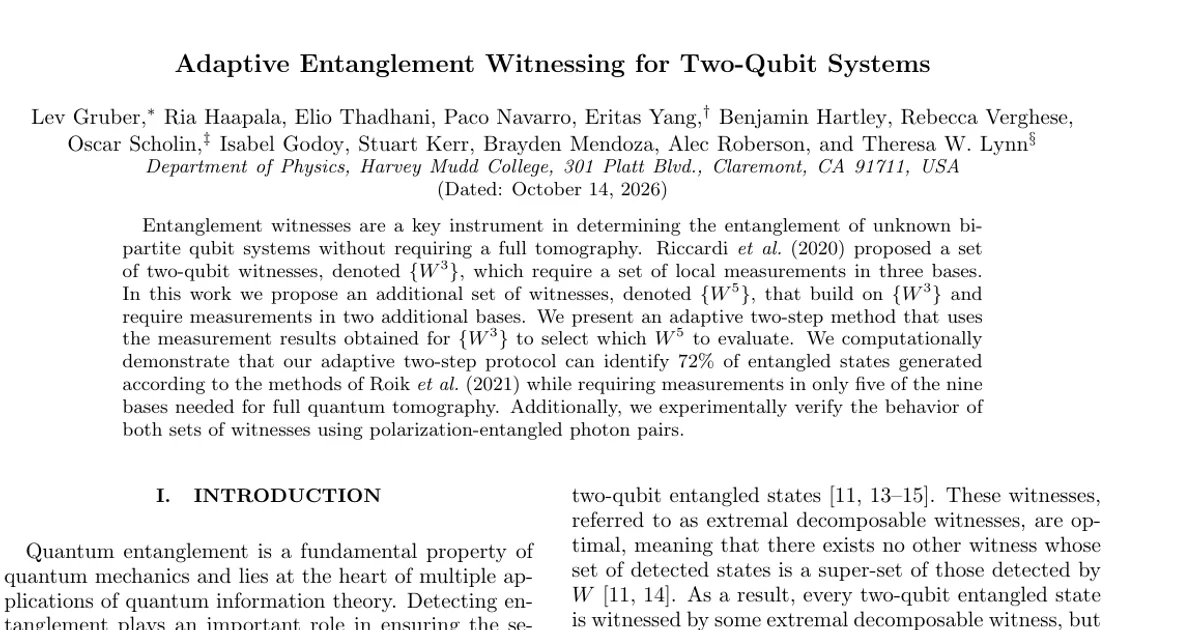
Entanglement witnesses are a key instrument in determining the entanglement of unknown bipartite qubit systems without requiring a full tomography. Riccardi et al. (2020) proposed a set of two-qubit witnesses, denoted $\{W^3\}$, which require a set of local measurements in three bases. In this work we propose an additional set of witnesses, denoted $\{W^5\}$, that build on $\{W^3\}$ and require measurements in two additional bases. We present an adaptive two-step method that uses the measurement results obtained for $\{W^3\}$ to select which $W^5$ to evaluate. We computationally demonstrate that our adaptive two-step protocol can identify 72% of entangled states generated according to the methods of Roik et al. (2021) while requiring measurements in only five of the nine bases needed for full quantum tomography. Additionally, we experimentally verify the behavior of both sets of witnesses using polarization-entangled photon pairs.