Research
A quantum double-bracket algorithm for imaginary-time evolution with exponentially shorter depth
Overview Research area: Quantum algorithms — specifically ground-state preparation via imaginary-time evolution (ITE), probabilistic/measurement-based circuit constructions, and benchmarking against v
- arXiv
- 2609.37095
- Published
- 2026-09-29
- Authors
- Ioannis Kolotouros, Raul Garcia-Patron
AI summary
Overview
Research area: Quantum algorithms — specifically ground-state preparation via imaginary-time evolution (ITE), probabilistic/measurement-based circuit constructions, and benchmarking against variational algorithms such as PITE and QAOA.
Technical level: Advanced. The paper assumes familiarity with Hamiltonian simulation, ancilla-based circuit constructions, mid-circuit measurement, and variational ansätze like QAOA.
Scope: The paper proposes a probabilistic version of Double-Bracket quantum imaginary-time evolution that trades an exponential reduction in circuit depth for a success probability that decays with the number of iterations, and benchmarks it against PITE and QAOA.
What This Paper Is About
Imaginary-time evolution is a standard way to push a quantum system toward its lowest-energy state, which makes it central to quantum simulation and optimization. The obstacle is that implementing it on a quantum computer generally requires very deep circuits, which are impractical on current and near-term hardware. The paper asks whether that depth can be reduced dramatically by making the procedure probabilistic, and whether the resulting success probability is high enough in practice to be useful.
Key Contributions
- A probabilistic double-bracket ITE algorithm (PDBQITE). Building on the existing Double-Bracket quantum ITE framework, the authors introduce a randomized variant that achieves an exponential reduction in circuit depth.
- A minimal per-iteration circuit. Each iteration uses only one ancilla qubit, one controlled real-time evolution, and one mid-circuit measurement — a very lightweight repeated block.
- An analytical success-probability bound. The authors derive a lower bound on the total success probability and show that this bound is independent of system size, while quantifying the exponential decay of total success probability with the number of iterations.
- Empirical comparisons against two established baselines. Numerical simulations indicate that PDBQITE outperforms the near-term probabilistic algorithm PITE for ground-state preparation of molecular Hamiltonians, and that a hybrid QAOA–PDBQITE scheme reaches higher approximation ratios than QAOA at equal circuit depth on MaxCut instances over random regular graphs.
Main Findings
- Exponentially shallower circuits: PDBQITE reduces circuit depth exponentially relative to the deterministic double-bracket construction it builds on.
- Favorable per-step success probability: Numerical simulations show the success probability of an individual iteration stays close to unity, which the authors argue makes many iterations practically executable. The abstract does not report the specific numerical values.
- System-size-independent lower bound: The analytic lower bound on total success probability does not scale with system size, so the depth advantage is not bought with a size-dependent penalty in the bound itself.
- The trade-off is explicit: Total success probability decays exponentially with iteration count — the depth savings are paid for probabilistically rather than deterministically.
- Better than PITE on molecular ground states: For molecular Hamiltonians, PDBQITE outperforms the near-term probabilistic algorithm PITE. The abstract does not state the specific metrics or magnitudes.
- Better than QAOA at matched depth: A hybrid QAOA–PDBQITE scheme achieves higher approximation ratios than plain QAOA at the same circuit depth on MaxCut for random regular graphs.
Methodology in Plain English
The starting point is double-bracket ITE, a recently proposed way of organizing imaginary-time evolution as a sequence of nested-commutator steps that can be compiled into quantum circuits. The authors convert each of these steps into a probabilistic operation: an ancilla qubit is coupled in, a controlled real-time evolution is applied, and a mid-circuit measurement is performed, with the step succeeding or failing depending on the outcome. Because each step is much simpler than its deterministic counterpart, the circuit is exponentially shallower, but the algorithm only produces the desired state when the sequence of measurement outcomes cooperates. The authors analyze the probability of that happening and derive a lower bound that does not grow with system size, then test the scheme numerically — first on molecular Hamiltonians against PITE, and second in a hybrid arrangement with QAOA on MaxCut instances over random regular graphs.
Why This Matters
Circuit depth is the binding constraint on near-term quantum hardware, so any method that prepares ground states with dramatically shallower circuits changes what is feasible without fault tolerance. Framing the cost as a success probability rather than circuit depth is a meaningful shift, because probabilistic repetition is often cheaper than deeper coherent circuits on realistic devices.
- Electronic structure for chemistry and materials: ground-state preparation of molecular Hamiltonians underpins quantum chemistry calculations relevant to catalysis, drug discovery, and materials design.
- Combinatorial optimization: the MaxCut results point to use in optimization problems mapped onto quantum hardware, where approximation ratio at fixed depth is the practical figure of merit.
- Algorithm design for near-term devices: the hybrid QAOA–PDBQITE construction offers a template for combining probabilistic ground-state routines with variational outer loops.
- Benchmarking and resource estimation: an analytic, system-size-independent success bound is useful for deciding when probabilistic algorithms are worth running.
Industry relevance: quantum hardware and software vendors, computational chemistry and pharmaceutical groups evaluating quantum simulation, and optimization teams tracking whether quantum heuristics beat classical or purely variational approaches at realistic circuit depths.
Future Directions
- Controlling the success-probability decay: the total success probability falls exponentially with iteration count, so strategies for mitigating, restarting, or partially correcting failed runs are a natural next step.
- Hardware demonstration: the scheme depends on mid-circuit measurement and a single ancilla, so testing it on noisy devices — and quantifying how measurement and ancilla errors affect the per-step success probability — remains open.
- Scaling the numerical evidence: the simulations reported show near-unity per-step success, but the abstract gives no indication of how far this was verified in system size or problem class; extending to larger and more diverse instances is needed.
- Broadening the application set: beyond molecular ground states and MaxCut, the framework could be applied to other Hamiltonians and other hybrid arrangements with variational algorithms.
Target Audience
Quantum algorithms researchers and graduate students working on ground-state preparation, imaginary-time evolution, and near-term algorithm design; practitioners building hybrid variational/probabilistic schemes for chemistry and optimization; and computational scientists tracking which quantum approaches are practical at currently achievable circuit depths.
Authors’ abstract
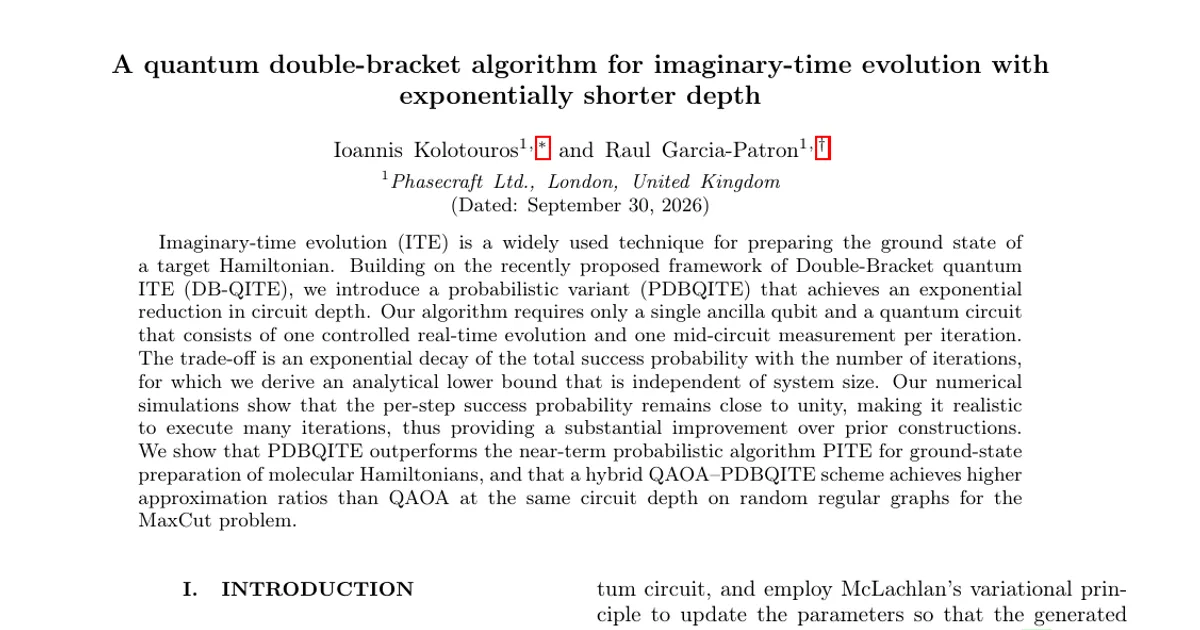
Imaginary-time evolution (ITE) is a widely used technique for preparing the ground state of a target Hamiltonian. Building on the recently proposed framework of Double-Bracket quantum ITE (DB-QITE), we introduce a probabilistic variant (PDBQITE) that achieves an exponential reduction in circuit depth. Our algorithm requires only a single ancilla qubit and a quantum circuit that consists of one controlled real-time evolution and one mid-circuit measurement per iteration. The trade-off is an exponential decay of the total success probability with the number of iterations, for which we derive an analytical lower bound that is independent of system size. Our numerical simulations show that the per-step success probability remains close to unity, making it realistic to execute many iterations, thus providing a substantial improvement over prior constructions. We show that PDBQITE outperforms the near-term probabilistic algorithm PITE for ground-state preparation of molecular Hamiltonians, and that a hybrid QAOA-PDBQITE scheme achieves higher approximation ratios than QAOA at the same circuit depth on random regular graphs for the MaxCut problem.