The Signal
UCLA Team Uses Arginine to Stabilize TaS₂’s Quantum Order at 330 K
A UCLA-led study reports that arginine raises the temperature at which tantalum disulfide maintains a commensurate charge density wave to 330 kelvin. The researchers say the result suggests a molecular route to tuning quantum materials, but
Quantum.world Team · Written with AI · fact-checked ·
In ordinary tantalum disulfide, a quantum-ordered electronic phase gives way as the material warms. A UCLA-led team reports that inserting the amino acid arginine stabilizes that phase to 330 kelvin, above room temperature; other amino acids tested did not produce the same effect. The study, published in Nature Chemistry on September 29, points to a way of changing a crystal’s behavior through molecular chemistry, though it stops well short of demonstrating a device.
Arginine lifts TaS₂’s temperature ceiling
The material is 1T-TaS₂, a layered form of tantalum disulfide. At low temperatures it can form a commensurate charge density wave, or CCDW: an ordered state in which the electronic charge and the crystal lattice form a repeating pattern. The phase has drawn interest for its connection to correlated quantum phenomena, but its stability in the unmodified material is limited to cryogenic temperatures.
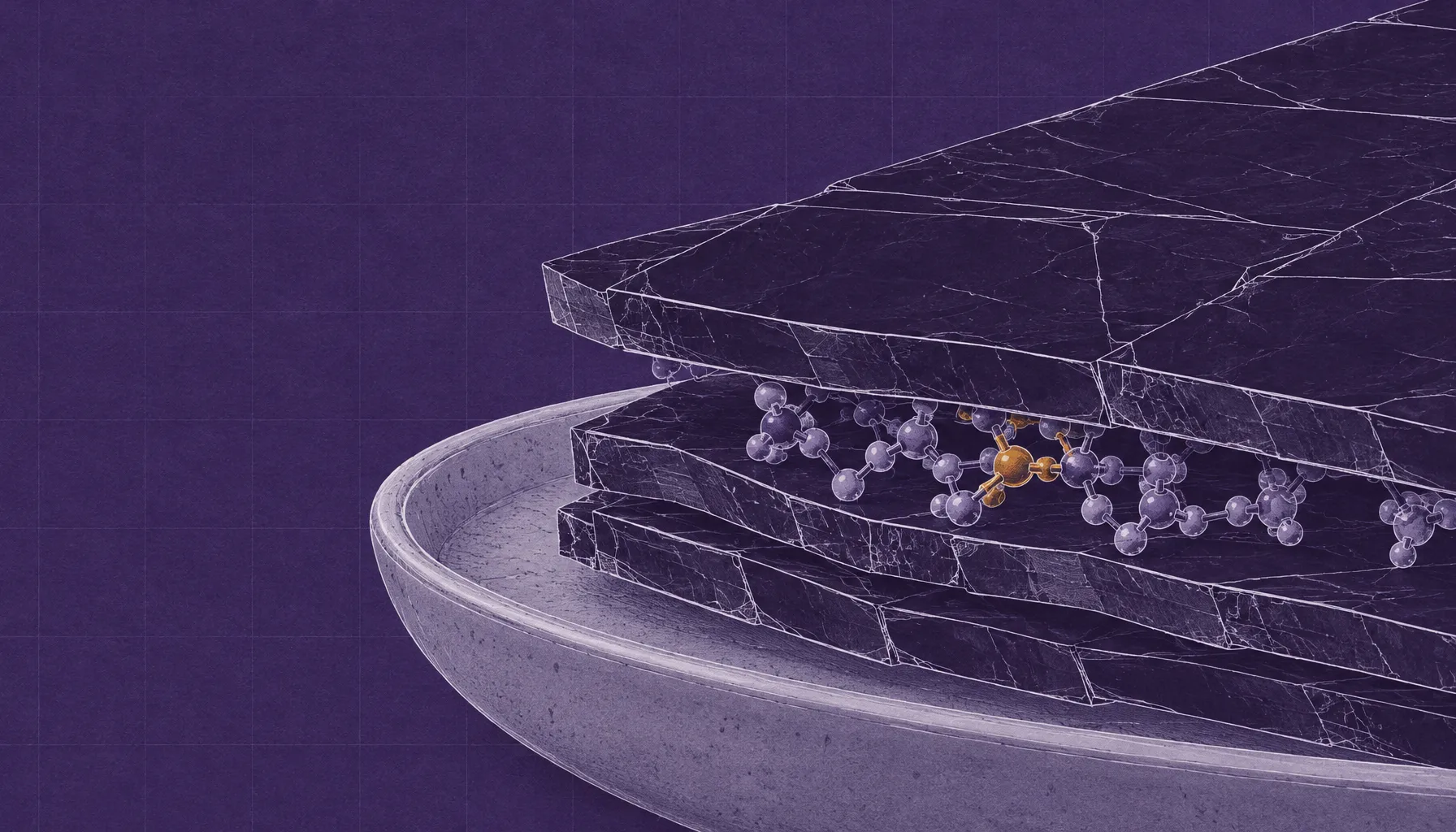
The researchers inserted arginine molecules between the TaS₂ layers, creating a hybrid superlattice. The UCLA account describes the structure as repeated stacks with two arginine layers between individual tantalum disulfide layers. The paper reports that arginine raises the CCDW stabilization temperature to 330 K, roughly 57 degrees Celsius.
“We show that the intercalated arginine molecules exhibit strong non-covalent interactions with the 1T-TaS2 atomic layers, effectively modulating the correlated electronic phase and increasing the CCDW stabilization temperature to 330 K.”
Jingyuan Zhou, Boxuan Zhou et al., Nature Chemistry
Why arginine worked where other amino acids did not
The team compared the arginine hybrid with tantalum disulfide on its own, using measurements of vibrations, electrical transport, temperature changes and atomic structure, alongside computer simulations. The study attributes the effect to arginine’s interactions with the TaS₂ layers, which alter the material’s correlated electronic phase. The authors’ modelling indicates that arginine changes the energy balance of the charge-density-wave states and helps the ordered phase withstand thermal fluctuations.
That chemical selectivity matters: UCLA says two other amino acids combined with tantalum disulfide did not show CCDW behavior at room temperature. The paper likewise reports a less pronounced change in the phase transitions for other, more weakly interacting amino acids. The contrast suggests that molecular size and electronic structure may help determine how an inserted molecule affects the host crystal, rather than amino acids acting as interchangeable additives.
A materials result, not a memory demonstration
The work began with an earlier screening effort that paired tantalum disulfide with more than 50 carbon-based molecules. UCLA says the broader temperature range for the CCDW emerged in later analysis of the arginine material, prompting the team to investigate the effect more closely. The study draws on an international collaboration involving researchers at UCLA, USC, UC Irvine, Tamkang University in Taiwan and the University of Chemistry and Technology in Prague.
UCLA identifies energy-efficient computer memory as one possible future application, but the study reports no memory device, operating speed, endurance test or energy-consumption result. Its immediate contribution is narrower: a demonstration that arginine can stabilize a particular ordered phase in 1T-TaS₂ to 330 K, and evidence that molecular interactions can be used to tune that transition. The authors’ next work, UCLA says, will examine both the material and the method further.