The Signal
A Tryptophan Twist Could Sharpen Cryptochrome’s Magnetic Compass
A Kobe University-led team links motion in cryptochrome to spin selectivity in light-triggered reactions. Its model predicts a rise in directional signal from 0.3% to 1.6%, but the work does not show magnetic navigation in living animals.
Quantum.world Team · Written with AI · fact-checked ·
A 6% spin effect, a fivefold larger modeled signal
A modeled directional signal in cryptochrome rises from 0.3% to 1.6% when researchers include a modest contribution from chirality-induced spin selectivity, or CISS. The calculation uses a 6% CISS contribution and a magnetic field of 332.5 millitesla. The result points to a possible way that small movements inside a protein could amplify its response to magnetic-field direction.
The figures are predictions, not measurements of a bird’s navigation system. A team led by Yasuhiro Kobori at Kobe University reported the work on October 30 in The Journal of Physical Chemistry Letters. Researchers from Toho University, Saitama University, Nagoya Institute of Technology and the University of Freiburg also took part.
Watching a light-triggered radical pair
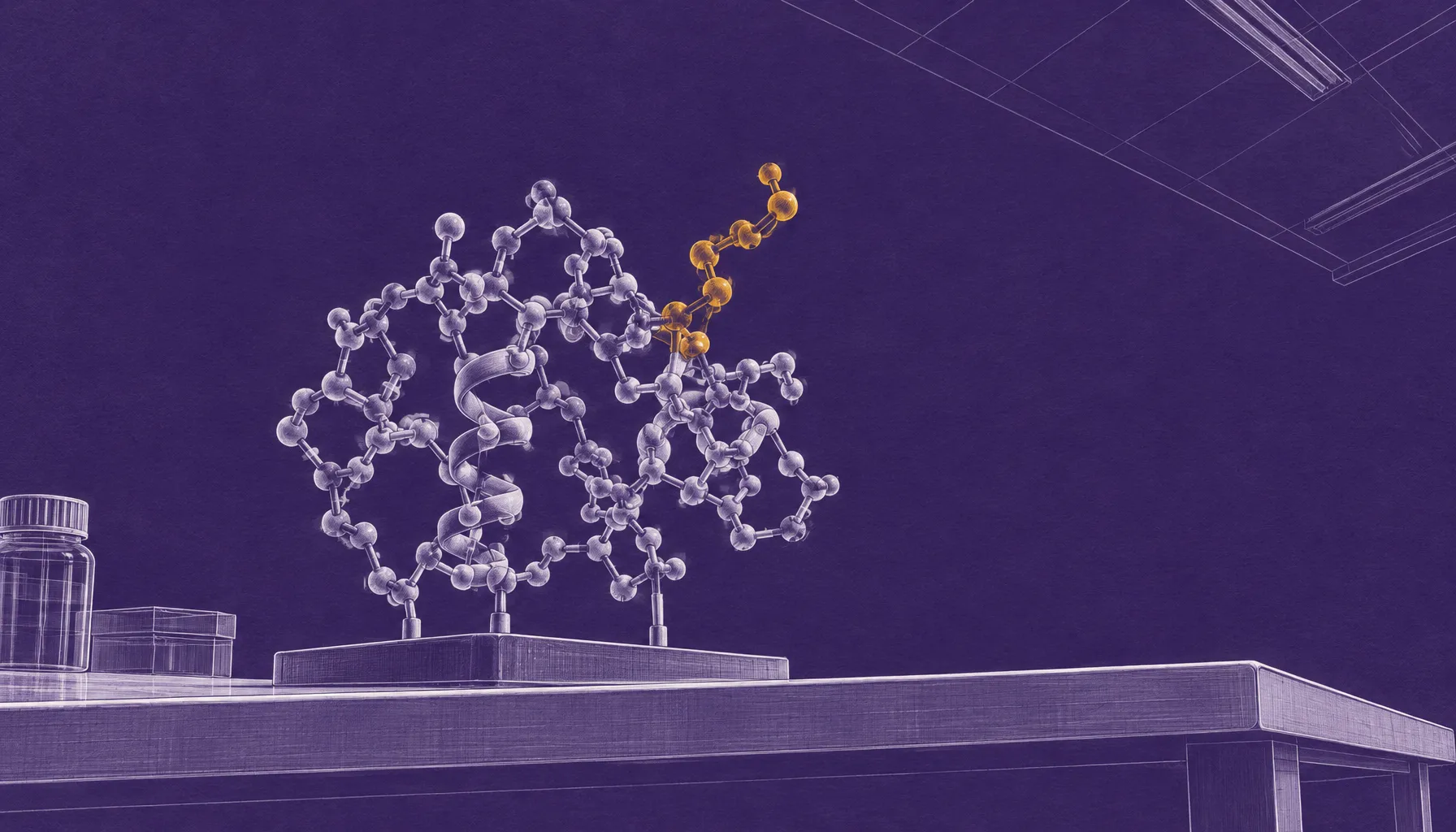
The team studied cryptochrome-DASH from Xenopus laevis, the African clawed frog. The blue-light-sensitive protein contains the pigment FAD; after light excites it, electrons move through nearby tryptophan residues. That process forms radical pairs—molecules with unpaired electrons whose spin states can change as the pair evolves.
To track those states, the researchers used pulsed-laser excitation and time-resolved electron paramagnetic resonance, a technique that detects magnetic properties through microwave signals. They measured the frog protein at temperatures from −153°C to −33°C. Analysis of the signals indicated a structural rearrangement involving a chiral rotation of the oxidized tryptophan residue WB in the second charge-separated state.
The team’s model assigns that state an 8% CISS contribution. In the later, longer-range state involving WC, the inferred contribution is 6% or less. The authors’ account links the smaller later effect to spin coherence established during the earlier separation and carried into the subsequent radical pair.
Why the modeled response grows
CISS describes a connection between a molecule’s handed, or chiral, structure and the spin of electrons or holes moving through it. In the proposed mechanism, rotation of WB biases the spin polarization of the radical pair. The magnetic field then affects how the pair’s singlet and triplet states mix, changing the modeled yield of a downstream signaling state according to field direction.
Without CISS, the team’s calculation gives a normalized directional variation of about 0.3%. Adding a 6% contribution raises it to 1.6% at 332.5 millitesla. For the structural axes in that calculation, the signal also differs between certain opposite field directions—a feature the researchers attribute to the broken field-inversion symmetry introduced by CISS.
The model uses the structure of pigeon cryptochrome CRY4 to set its reference molecular axes. That is distinct from the spectroscopy experiment, which used frog cryptochrome-DASH. The separation matters: the team measured spin signals in a protein sample, then used a quantum-mechanical model to estimate how those effects could shape a signaling reaction.
A molecular mechanism, not evidence of bird navigation
Cryptochrome radical pairs have long been studied as a possible basis for light-dependent magnetic sensing in migratory animals. The new results add a proposed ingredient: protein motion may affect spin selectivity, which could strengthen the directional contrast in a chemical signal. They do not establish that this mechanism operates in a living bird, or show that an animal can use it to navigate.
The experiments also take place at very low temperatures, and the modeled field condition is 332.5 millitesla. The work therefore does not directly reproduce a natural magnetoreception setting. The researchers identify follow-up tests around the molecular rotation, reversal of the predicted spin-polarization signal and changes in signaling-product yield. For now, the concrete result is a spectroscopic signature tied to a modeled rise from 0.3% to 1.6%.